MAPS OF HISTORY · IB HISTORY · PAPER 3 · ASIA AND OCEANIA
IB HISTORY · PAPER 3 · HIGHER LEVEL
Paper 3: Asia and Oceania
Paper 3 is the Higher Level paper on one region of the world, studied in depth. This page gathers what our atlases hold for Asia and Oceania: the sections our IB notes are tagged for, the chapters behind each, evidence to use and model essay plans, followed by the other atlases set in the region. In all, ten atlases cover the region.
Which sections does your class study? Your teacher can tell you. The numbers here follow the provisional outline of the new course, which identifies sections by number until the final guide is published. We will add their titles then.
WW2 is free in full, and chapter 1 of every atlas is free. A free account opens 3 more chapters a day. Opening a new atlas uses one of them. Membership opens all 21 — Join.
Section 12.6
One chapter in The Industrial Revolution carries IB notes for this section.
- A Global Transformation
A cable from Porthcurno in Cornwall to Bombay began carrying telegraph messages in June 1870. News that had spent weeks in the mail could arrive in minutes, allowing London to manage trade and empire in real time.THE INDUSTRIAL REVOLUTION · CHAPTER 11 · 1850–1914
Section 12.11
Four chapters in Uprooted carry IB notes for this section.
- Communist Victory
As Saigon fell, American helicopters lifted about 7,000 people out on 29 and 30 April 1975. From March through June, about 131,000 Vietnamese and Cambodians entered the American refugee system, 111,919 of them through Guam.UPROOTED · CHAPTER 7 · 1975 - Re-education and Flight
After 1975, between about 750,000 and more than a million southerners were moved to New Economic Zones. Many lacked adequate tools or farming experience, and many later regarded the boats as their only alternative.UPROOTED · CHAPTER 8 · 1975–1978 - The Boat People
By mid-1979, first-asylum camps held about 350,000 people, but Western states were resettling only about 9,000 a month. The difference meant that camps grew fuller: Pulau Bidong alone held about 40,000.UPROOTED · CHAPTER 9 · 1978–1979 - Camps, Screening and the CPA
Hong Kong began screening arrivals after 16 June 1988. It recognized 18.8 percent of the 60,275 people interviewed as refugees; families screened out could spend years waiting in camps such as Whitehead.UPROOTED · CHAPTER 11 · 1980–1990
Section 12.12
Twelve chapters in The People’s Republic under Mao carry IB notes for this section.
- Consolidating VictoryTHE PEOPLE’S REPUBLIC UNDER MAO · CHAPTER 1 · 1949–1950
- Korea and the CampaignsTHE PEOPLE’S REPUBLIC UNDER MAO · CHAPTER 2 · 1950–1953
- Tibet and the FrontiersTHE PEOPLE’S REPUBLIC UNDER MAO · CHAPTER 3 · 1950–1959
- The Soviet ModelTHE PEOPLE’S REPUBLIC UNDER MAO · CHAPTER 4 · 1953–1957
- A Hundred FlowersTHE PEOPLE’S REPUBLIC UNDER MAO · CHAPTER 5 · 1956–1957
- The Great Leap ForwardTHE PEOPLE’S REPUBLIC UNDER MAO · CHAPTER 6 · 1958–1960
- The Great FamineTHE PEOPLE’S REPUBLIC UNDER MAO · CHAPTER 7 · 1959–1961
- Retreat and RecoveryTHE PEOPLE’S REPUBLIC UNDER MAO · CHAPTER 8 · 1961–1965
- The Cultural RevolutionTHE PEOPLE’S REPUBLIC UNDER MAO · CHAPTER 9 · 1966–1968
- Down to the CountrysideTHE PEOPLE’S REPUBLIC UNDER MAO · CHAPTER 10 · 1968–1971
- From Soviet Ally to NixonTHE PEOPLE’S REPUBLIC UNDER MAO · CHAPTER 11 · 1960–1972
- Mao’s Death and LegacyTHE PEOPLE’S REPUBLIC UNDER MAO · EPILOGUE · 1976
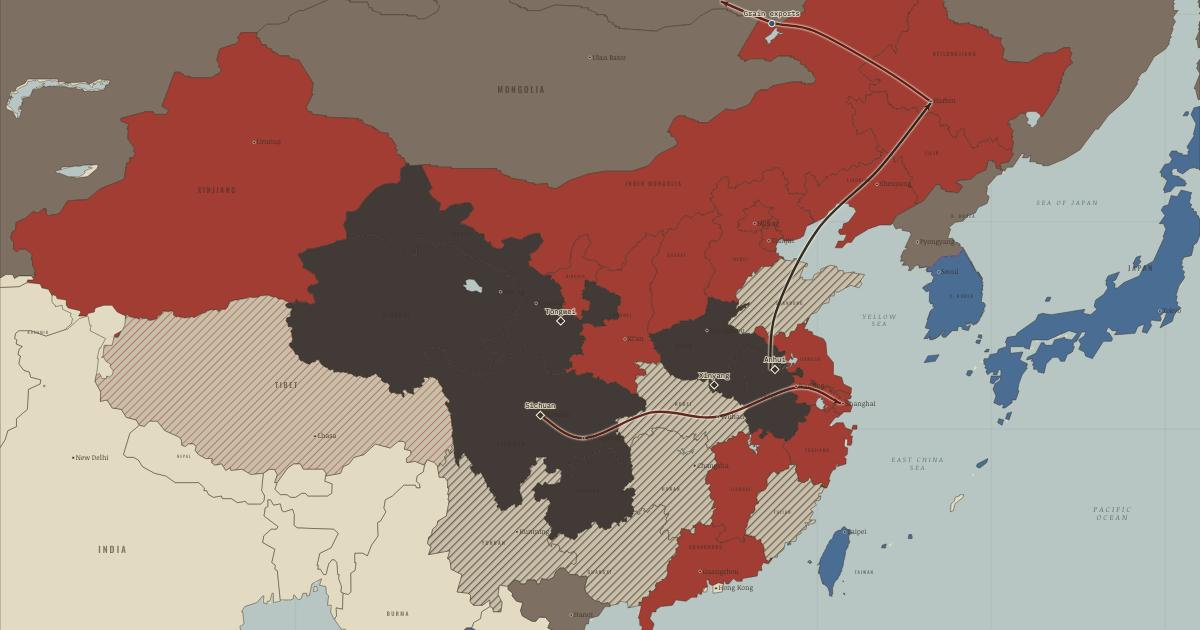
When Mao proclaimed the People’s Republic on 1 October 1949, the Communist Party had about 4.5 million members among some 540 million people. To govern that population, it initially relied on the army and six regional bureaux, largely run by generals.— The People’s Republic under Mao, chapter 1: Consolidating Victory
Practice questions and essay plans
Paper 3 asks for depth, so these questions come from chapters tagged for the sections above. Each comes with the outline of a model plan; the full plans are in the chapters’ IB notes in the atlas.
PAPER 3 · UPROOTED · CHAPTER 11
Examine why policy in Southeast Asia shifted from resettlement toward screening and return during the 1980s.
The 1979 response rested on a willingness to resettle arrivals that later weakened. As places became harder to secure, host states and Western governments increasingly viewed later departures as economic migration. The CPA offered a negotiated way to screen arrivals and encourage return, changing the incentive to leave as the Cold War sympathy behind the earlier response faded.
Resettlement places no longer kept pace with departures.
Governments treated later departures differently and sought individual screening.
Return was intended to discourage further departures.
The evidence for each point, the counter-argument and the judgement are in the IB notes of chapter 11 in the atlas. Read the chapter first: Camps, Screening and the CPA.
PAPER 2 · THE INDUSTRIAL REVOLUTION · CHAPTER 11
How far did industrialisation in Britain cause India’s economic decline in the nineteenth century? Discuss.
British industrialisation caused the decline of India’s export textile industry, but the wider economic decline also reflected colonial policy, earlier Mughal fragmentation and climate shocks. British industry presented India with a competitive challenge. Imperial rule removed the tariffs and the investing state with which India might have answered it. The explanation must also account for why India, unlike Japan, could not respond.
Machine-made cloth destroyed the export market for Indian textiles.
Colonial policy determined much of the damage.
Earlier causes and Indian enterprise make the picture more complicated.
The evidence for each point, the counter-argument and the judgement are in the IB notes of chapter 11 in the atlas. Read the chapter first: A Global Transformation.
PAPER 2 · UPROOTED · CHAPTER 7
Compare and contrast the causes and forms of displacement in Vietnam, Cambodia and Laos in 1975.
Communist victories followed prolonged wars in all three countries, and the treatment of defeated groups as enemies drove people from their homes. Yet the movements took different forms: Vietnam saw an organized evacuation of an elite, Cambodia a forced internal emptying of cities, and Laos the flight of an allied minority.
In Vietnam, many of those evacuated were connected to the defeated government or the United States.
In Cambodia, the Khmer Rouge forced urban civilians to move within the country.
In Laos, the flight of many Hmong followed both their ethnicity and their wartime alliance.
The evidence for each point, the counter-argument and the judgement are in the IB notes of chapter 7 in the atlas. Read the chapter first: Communist Victory.
PAPER 2 · THE PEOPLE’S REPUBLIC UNDER MAO · CHAPTER 1
Examine the reasons for the Chinese Communist Party’s success in consolidating its rule over China between 1949 and 1953.
The Party had a victorious army, but force was joined to policies that gave social groups a stake in the new state. Land reform bound the peasant majority through gain and complicity; the New Democracy coalition and stable prices won the cities. The war in Korea also licensed a terror that removed remaining opponents.
Military victory gave the Party a monopoly of force that no Chinese government had possessed since 1911.
Land reform tied the peasant majority to the new order through dependence and complicity.
In the cities, New Democracy and economic stabilisation encouraged acceptance of the regime.
The evidence for each point, the counter-argument and the judgement are in the IB notes of chapter 1 in the atlas. Read the chapter first: Consolidating Victory.
Paper 1 case studies set in this region
These chapters were written for a Paper 1 Focused Study, so their notes are tagged for Paper 1 and Paper 2. They are set in the region, and their evidence serves a regional essay just as well.
Meiji Japan · Paper 1 · Political and Economic Transitions
- The Closed CountryREMAKING THE STATE · CHAPTER 1 · 1600–1853
- The Black ShipsREMAKING THE STATE · CHAPTER 2 · 1853–1858
- The Fall of the ShogunateREMAKING THE STATE · CHAPTER 3 · 1858–1869
- Dismantling the Old OrderREMAKING THE STATE · CHAPTER 4 · 1868–1877
- Building the Meiji StateREMAKING THE STATE · CHAPTER 5 · 1877–1894
- A Great PowerREMAKING THE STATE · CHAPTER 6 · 1894–1912
Why did the lords accept the loss of their domains? The government assumed the domains’ debts and gave them generous incomes. At the same time, an imperial guard of about 10,000 men from Satsuma, Chōshū and Tosa stood ready in Tokyo. Compensation backed by force prevented organized resistance.— Remaking the State, chapter 4: Dismantling the Old Order
Indochina 1975–1990 · Paper 1 · Conflict and Displacement
- Communist VictoryUPROOTED · CHAPTER 7 · 1975
- Re-education and FlightUPROOTED · CHAPTER 8 · 1975–1978
- The Boat PeopleUPROOTED · CHAPTER 9 · 1978–1979
- Geneva and the US ResponseUPROOTED · CHAPTER 10 · 1979–1982
- Camps, Screening and the CPAUPROOTED · CHAPTER 11 · 1980–1990
In June 1979 Malaysia said it would expel more than 70,000 boat people and towed boats back to sea. ASEAN foreign ministers declared on 30 June that they had “reached the limit of their endurance”.— Uprooted, chapter 9: The Boat People
More atlases set in this region
These atlases are filed under Asia and Oceania for Higher Level. Their IB notes are in preparation; meanwhile every chapter carries the study layer (why it happened, the turning point, what it changed and a discussion question), and each atlas has its own IB History page.
The Mongol Empire 1206 – 1294
The Mongol Empire reached from Korea to Hungary in three generations. How was the steppe united, and why did its cities fall? Along the roads of the Mongol peace traveled silk, silver, ideas and plague.
A QUESTION TO ARGUE · CHAPTER 7
A million rulers, a hundred million ruled: how could such a small Mongol ruling group govern so many people?
Mongol rulers did not administer every household themselves. Local officials and rulers collected revenue and managed daily life; imperial authorities controlled routes, censuses, appointments and military punishment. Trade protection and religious exemptions gave some groups reasons to cooperate, while fear made defiance dangerous. The small ruling group governed through many intermediaries.
The chapter behind it: The Machinery of Empire.
The 12 chapters
- The World of the SteppeCHAPTER 1 · THE STEPPE BEFORE 1206
- Temüjin Becomes Genghis KhanCHAPTER 2 · 1162–1206
- The Fall of North ChinaCHAPTER 3 · 1209–1234
- The Khwarazm CatastropheCHAPTER 4 · 1218–1223
- The Great RaidCHAPTER 5 · 1221–1224
- The Storm on the WestCHAPTER 6 · 1236–1242
- The Machinery of EmpireCHAPTER 7 · 1229–1259
- The Hammer on IslamCHAPTER 8 · 1253–1260
- The Family WarCHAPTER 9 · 1259–1266
- Khubilai and the SongCHAPTER 10 · 1234–1279
- The Limits of the WorldCHAPTER 11 · 1274–1293
- The Long ShadowEPILOGUE · 1294 AND AFTER
Indian Independence & Partition 1857 – 1964 · HL (1857–1964)
The largest colony in history freed itself, but what did freedom deliver? The story runs from the rising of 1857 through ninety years of the Raj and Gandhi’s mass movement, to a border drawn in five weeks and a republic that redrew its states by language.
A QUESTION TO ARGUE · CHAPTER 8
Civil disobedience never militarily threatened the Raj, and the Round Table Conference failed. In what sense did the salt campaign succeed?
The campaign did not defeat the garrison, and the Round Table Conference did not secure independence. Its achievement lay in changing the political relationship. The Raj had governed while Indians petitioned; after Dandi, London responded to a sequence of Indian initiatives with a pact, a conference and an Act. Negotiation with Gandhi acknowledged the standing of the movement he led. The campaign also changed what people could see themselves doing. Peasants saw the state disobeyed, women entered politics, and an international audience saw empire enforced by the lathi. The Treasury faced the cost of governing without the consent it had relied on. The 1935 Act aimed to contain Congress, yet its provinces became a school of government for it. Satyagraha had challenged British confidence in the Raj’s civilizing legality and the Indian belief that obedience was fate. In this account, salt dissolved both: the later negotiations concerned the terms of a connection whose verdict had been delivered on a Gujarat beach.
The chapter behind it: Salt.
The 15 chapters
- The Rebellion and the CrownCHAPTER 1 · 1857–1858
- Congress and the RajCHAPTER 2 · 1858–1905
- The Raj at High NoonCHAPTER 3 · 1905
- Bengal Cut in TwoCHAPTER 4 · 1905–1911
- The Great War’s PriceCHAPTER 5 · 1914–1918
- Amritsar — The End of ConsentCHAPTER 6 · 1919
- Non-Cooperation — The Method ArguedCHAPTER 7 · 1920–1922
- SaltCHAPTER 8 · 1930–1935
- The Elected MapCHAPTER 9 · 1935–1939
- The War Claims IndiaCHAPTER 10 · 1939–1941
- Quit India — and the FamineCHAPTER 11 · 1942–1944
- The Year of the KnifeCHAPTER 12 · 1945–1946
- Freedom at MidnightCHAPTER 13 · 1947
- The Price and the LegacyCHAPTER 14 · 1947–1949
- Building the RepublicCHAPTER 15 · 1950–1964
China in Revolution 1911 – 1949 · HL (1910–1949)
Warlords, the long Japanese war, and the final contest between Chiang and Mao: four decades in which the world’s oldest state was broken and remade.
A QUESTION TO ARGUE · CHAPTER 7
How did the Long March’s founding story contribute to its historical importance, and how should we assess it?
The march was a military catastrophe: roughly nine-tenths of the original force was lost. Its familiar account also enlarged some claims. The traditional 25,000 li (12,500 km) is roughly twice the distance measured by two British writers who walked the route in 2002–03; survivors’ accounts of the twenty-two heroes at Luding differ over the fire and the defenders. Yet the story itself had consequences. The claim that “the Red Army cannot be destroyed” attracted students in 1936–37, impressed war correspondents and shaped party memory. Mao called the march a manifesto and a seeding-machine, expressing what its survivors might still bring into being. They retained cadres and methods as well as a story, and all three helped the movement rebuild. Checking the story’s arithmetic tells us about its construction; its political uses explain why that construction mattered.
The chapter behind it: The Long March.
The 12 chapters
- The Fall of the QingCHAPTER 1 · 1911–1912
- Yuan Shikai’s RepublicCHAPTER 2 · 1912–1916
- Warlords and May FourthCHAPTER 3 · 1916–1925
- The United Front Marches NorthCHAPTER 4 · 1923–1927
- The Purge and the Nanjing DecadeCHAPTER 5 · 1927–1931
- The Soviet Republic and the EncirclementsCHAPTER 6 · 1931–1934
- The Long MarchCHAPTER 7 · 1934–1936
- The Japanese War BeginsCHAPTER 8 · 1937–1938
- Stalemate — Two Chinas at WarCHAPTER 9 · 1938–1944
- The Failed Peace and ManchuriaCHAPTER 10 · 1945–1947
- The Three CampaignsCHAPTER 11 · 1948–1949
- The People’s RepublicCHAPTER 12 · 1949
The Road to War 1931 – 1941
Manchuria, Abyssinia, the Rhineland, Munich: a decade of tests that went unanswered, traced step by step as the world order gives way.
A QUESTION TO ARGUE · CHAPTER 7
Was Munich a betrayal, a blunder, or the best of the bad options available to Chamberlain in September 1938?
The three verdicts bring different parts of the decision into focus. Betrayal describes what happened to Czechoslovakia: its friends decided to dismember a functioning democracy without consulting it. Blunder asks what the bargain did to the military balance. Britain gained time for radar and fighters, while Germany gained Czech arms and a stronger position and a fortified ally was weakened. The officers considering a German coup were never tested. Best-of-bad-options takes Chamberlain’s uncertainty seriously. Allies were unready, the Dominions reluctant, and the public wanted peace; he believed Hitler’s demands might be limited. That belief explains the decision, but it also exposes its cost. Czechoslovakia paid before Hitler’s intentions were established, and the coalition later faced a stronger Germany.
The chapter behind it: Anschluss and Munich: Appeasement at Full Stretch.
The 12 chapters
- The World the Slump MadeCHAPTER 1 · 1931
- Mukden: The First Unpunished GambleCHAPTER 2 · 1931–1933
- Germany Turns CharcoalCHAPTER 3 · 1933–1935
- Abyssinia: The League Dies in AfricaCHAPTER 4 · 1934–1936
- The Rhineland Bluff and the Spanish RehearsalCHAPTER 5 · 1936–1937
- China: The War Nobody DeclaredCHAPTER 6 · 1937–1938
- Anschluss and Munich: Appeasement at Full StretchCHAPTER 7 · 1938
- Prague, the Pact, PolandCHAPTER 8 · 1939
- The Fall of the WestCHAPTER 9 · 1939–1940
- The Turn SouthCHAPTER 10 · 1939–1941
- Barbarossa: The Gamble That Ends the GamblesCHAPTER 11 · 1940–1941
- Pearl Harbor: The Roads MeetCHAPTER 12 · DECEMBER 1941
The Second World War 1936 – 1945
Ten years of war on one living map: fifteen guided chapters across two theaters, twenty-two territorial states, sixty-five battles and memory sites, and a map quiz at the end of it.
A QUESTION TO ARGUE · CHAPTER 8
Was the American victory at Midway a matter of luck or calculated risk?
Both. Codebreaking and Nimitz’s deployment put American carriers in position; navigation, timing and disruption of Japanese defenses helped open the way for the dive-bombers. Preparation made that opportunity usable, without determining every event. Without intelligence there was no ambush, and different timing might have produced a different result.
The chapter behind it: Midway: Intelligence, Risk, and a Turning Point.
The 15 chapters
- The Gathering StormCHAPTER 1 · 1936–1938
- The Pact and the Partition of PolandCHAPTER 2 · AUG–OCT 1939
- Blitzkrieg in the WestCHAPTER 3 · APR–JUN 1940
- The Battle of BritainCHAPTER 4 · JUL–OCT 1940
- Mussolini’s Parallel WarCHAPTER 5 · OCT 1940–JUN 1941
- Barbarossa: The War of AnnihilationCHAPTER 6 · JUN–DEC 1941
- Rising Sun: From China to Pearl HarborCHAPTER 7 · 1937–MAY 1942
- Midway: Intelligence, Risk, and a Turning PointCHAPTER 8 · APR–JUN 1942
- The Hinge: Stalingrad and El AlameinCHAPTER 9 · JUL 1942–FEB 1943
- Kursk, and the Fall of Fascist ItalyCHAPTER 10 · JUL–DEC 1943
- The Island RoadCHAPTER 11 · AUG 1942–OCT 1944
- Overlord and Bagration: Germany pressed from both sidesCHAPTER 12 · JUN–AUG 1944
- Closing the RingCHAPTER 13 · DEC 1944–MAY 1945
- The Downfall of Imperial JapanCHAPTER 14 · FEB–SEP 1945
- The World the War MadeEPILOGUE · 1945 AND AFTER
The Cold War 1945 – 1991
Blocs, walls and proxy wars: how forty-six years of armed peace nearly ended everything, several times — and then ended quietly, in a single autumn.
A QUESTION TO ARGUE · CHAPTER 7
Could the United States have won in Vietnam — and what would “winning” have had to mean?
The answer depends on the outcome called victory. Mining Haiphong in 1965 or less restricted bombing might have imposed higher costs on Hanoi. Escalation also risked Chinese intervention, a danger American leaders had reason to fear after Korea: by 1967 Beijing had 170,000 support troops in North Vietnam. Washington’s political goal was a durable, independent non-communist South. More bombing could not itself give that state legitimacy or persuade its citizens to defend it. Most historians consequently judge the war unwinnable at an acceptable cost as defined. The definition deserves scrutiny too, because the military result Washington sought mattered as victory only if it secured that chosen political settlement.
The chapter behind it: Vietnam.
The 12 chapters
- The World the War LeftCHAPTER 1 · 1945–1946
- ContainmentCHAPTER 2 · 1947–1949
- Two Shocks of 1949CHAPTER 3 · 1949
- Korea: The Cold War Turns HotCHAPTER 4 · 1950–1953
- Coexistence and Its CrisesCHAPTER 5 · 1953–1961
- Cuba: To the BrinkCHAPTER 6 · 1962
- VietnamCHAPTER 7 · 1955–1975
- The Third World FrontCHAPTER 8 · 1947–1979
- Détente: The TriangleCHAPTER 9 · 1969–1979
- The Second Cold WarCHAPTER 10 · 1979–1985
- Gorbachev and the UnravelingCHAPTER 11 · 1985–1989
- The End — and the ArgumentsEPILOGUE · 1990–1991
Revision tools
Test yourself on every atlas set in the region. Each atlas ends with a map quiz that asks you to find places and moments on the map itself; the quick quiz and the printable study guide are free pages on this site.
- The Industrial Revolution
MAP QUIZ · QUICK QUIZ · PRINTABLE STUDY GUIDE - Remaking the State: Meiji Japan and Post-Soviet Russia
MAP QUIZ · QUICK QUIZ · PRINTABLE STUDY GUIDE - Uprooted: Refugees in Europe and Indochina
MAP QUIZ · QUICK QUIZ · PRINTABLE STUDY GUIDE - The People’s Republic under Mao
MAP QUIZ · QUICK QUIZ · PRINTABLE STUDY GUIDE - The Mongol Empire
MAP QUIZ · QUICK QUIZ · PRINTABLE STUDY GUIDE - Indian Independence & Partition
MAP QUIZ · QUICK QUIZ · PRINTABLE STUDY GUIDE - China in Revolution
MAP QUIZ · QUICK QUIZ · PRINTABLE STUDY GUIDE - The Road to War
MAP QUIZ · QUICK QUIZ · PRINTABLE STUDY GUIDE - The Second World War
MAP QUIZ · QUICK QUIZ · PRINTABLE STUDY GUIDE - The Cold War
MAP QUIZ · QUICK QUIZ · PRINTABLE STUDY GUIDE
Maps of History is independent and is not affiliated with or endorsed by the International Baccalaureate Organization. IB course names describe alignment only; paper, theme and section names follow the new course outline and may change when the final guide is published.
THE DISPATCH
Get the printable study guide for The People’s Republic under Mao free. I’ll send you a few short letters, then one when a new atlas opens. That’s all. — Paul
NO TRACKING · YOUR ADDRESS IS USED FOR THE DISPATCH AND NOTHING ELSE · UNSUBSCRIBE ANYTIME