Meiji Japan and post-Soviet Russia · CHAPTER 3 ·
Meiji Restoration and Boshin War
Chapter 3 of Remaking the State: Meiji Japan 1600–1912 and Post-Soviet Russia 1964–2000: “The Fall of the Shogunate”
Within ten years of the 1858 treaties the shogunate fell, as opponents rallied under “revere the emperor, expel the barbarians”. After Western fleets bombarded Kagoshima and Shimonoseki in 1863–64, Satsuma and Chōshū turned to modern arms, and the decisive battle came at Toba–Fushimi in January 1868.
Chapter 3 is included with every paid plan. WW2 is free in full, and chapter 1 of every atlas is free. A free account opens 3 more chapters a day. Starter, at $9 a month, opens all 21 with no daily limit — see the plans.
Free printable Meiji Japan and post-Soviet Russia study guide, sent by email ↓
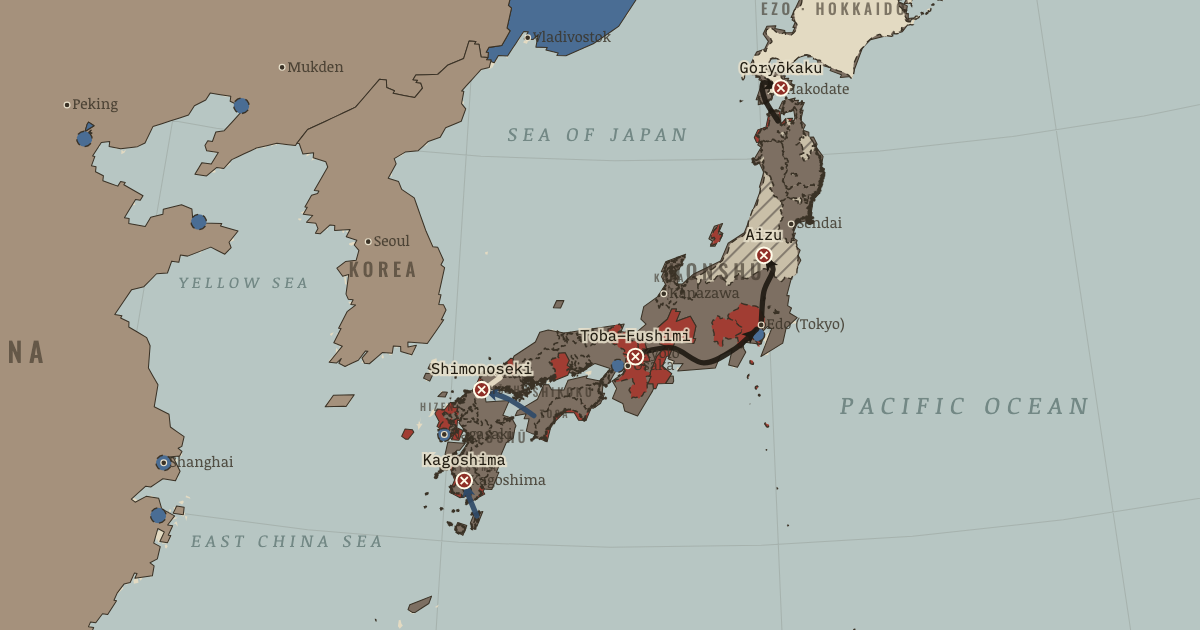
The map above is the world of Japan, June 1868 — The Boshin War: the north in arms.
Every state on the map that year: The world in 1871 · Europe in 1871.
Part of IB History: Meiji Japan and post-Soviet Russia →
SHORT EXPLANATION
The shogunate had governed Japan behind a figurehead emperor since 1603. After it accepted the unequal treaties of 1858, which opened ports to Western trade on Western terms, opponents found a way to challenge its authority: they claimed a higher loyalty to the emperor. Their cry was ‘revere the emperor, expel the barbarians’ (sonnō jōi). Young samurai, members of the hereditary warrior class that staffed government offices, attacked officials and foreigners. Western fleets answered in 1863–64: Britain shelled Satsuma’s capital, Kagoshima, and seventeen allied warships destroyed Chōshū’s forts at Shimonoseki. Satsuma and Chōshū were domains, territories of great lords resembling states in a loose federation. Their leaders learned that they could not drive out the West by force. They kept the emperor as the focus of loyalty, bought rifles and steamships, and made a secret alliance in 1866. When Chōshū’s army of samurai and commoners defeated a shogunal invasion, the government had failed to discipline even one domain.
The change at the top came before a change in most of the country. Satsuma and Chōshū troops seized the Kyoto palace gates on 3 January 1868 and proclaimed the restoration of imperial rule; later that month they defeated the shogun’s army at Toba–Fushimi. On the June 1868 map, red shows the former shogunal lands the new government controlled directly: the Edo plain, Kyoto, Osaka, Kai, Nagasaki and Sado. Grey-tan shows domains still governed by their lords, including the victors’ own territories. In the hatched north, an alliance of more than thirty domains resisted until Aizu fell in November. The Meiji Restoration, named for the new emperor’s reign title, replaced the authority at the head of the state; the deeper revolution in government remained to be made.
The full story
The struggle over Japan’s future centered on a court that had little power of its own. After 1860, young activists called shishi, ‘men of high purpose’, invoked the emperor against the shogunate. Most were samurai from Chōshū, Tosa and Satsuma, outer domains whose lords governed almost independently. Like student radicals in later revolutions, they assassinated officials they considered traitors and attacked foreigners they called barbarians. Whoever could direct the court in Kyoto could issue commands in the emperor’s name. Chōshū’s leaders gained influence there and pressed him to order foreigners expelled by 25 June 1863.
Chōshū put that order into practice by firing on ships in the strait at Shimonoseki. Satsuma faced a separate confrontation with Britain after a British merchant was killed at Namamugi. Britain burned much of Kagoshima in August 1863; in September 1864 an allied Western fleet silenced Chōshū’s batteries in two days. The advocates of expulsion had tried their policy against powerful steam navies. Their defeats forced them to reconsider how Japan could defend itself.
Chōshū already had an institution suited to a different approach. Its Kiheitai trained samurai, farmers and townsmen together with modern rifles, recruiting across lines of birth. Conservatives briefly seized control after the defeats, but Takasugi Shinsaku used mixed-class units to retake the domain in early 1865. Satsuma’s leaders, Saigō Takamori and Ōkubo Toshimichi, bought British ships and weapons through Nagasaki. In March 1866 Sakamoto Ryōma, an activist from Tosa, brokered a secret alliance between the former enemies.
That summer the shogunate sent a large but divided army against Chōshū. It lost on every front; the arrow across the strait shows Chōshū taking the fighting into Kokura, the domain of a lord loyal to the shogun. The result mattered beyond the battlefield. If the shogun could not compel one domain to submit, his claim to protect and govern the country had become difficult to sustain.
Tokugawa Yoshinobu, shogun from early 1867, sought another arrangement. He had reformed his army with French advisers, and in November he returned his governing powers to the young emperor Mutsuhito, hoping to lead a council of lords. Satsuma and Chōshū acted to prevent that outcome. Their palace coup on 3 January 1868 removed Yoshinobu’s land and office. At Toba–Fushimi, about 5,000 of their soldiers fought under the imperial banner and defeated a shogunal force roughly three times as large.
Saigō and the shogunal negotiator Katsu Kaishū arranged the peaceful surrender of Edo in May. Resistance continued in the north, where an alliance of more than thirty domains fought until Aizu fell in November. The final holdouts surrendered at Goryōkaku in Hakodate in June 1869. About 4,000–8,000 people died in the Boshin War, named for the year it began. The toll was comparatively low for a revolution: once the emperor’s banner appeared against the shogun, many domains chose the winning side.
FULL EXPLANATION
Restoration, revolution or coup?
The leaders who took power in 1868 called their action a restoration of ancient imperial rule. That name made a radical change in government appear as a return to tradition. But was the restoration itself a revolution, or did revolution follow it? Japanese Marxist historians in the 1930s disagreed over whether it produced an absolutist monarchy preserving feudal landlords or a bourgeois revolution that opened the way to capitalism. Their dispute shaped scholarship for decades. W. G. Beasley described lower-ranking samurai using the court to seize the state; Thomas Huber emphasized Chōshū’s educated ‘service intellectuals’. Mark Ravina has argued that the movement was nationalist and cosmopolitan together: its leaders invoked Japan’s past while seeking equal standing in a world of nation-states. These accounts share a starting point—a small group from a few domains took power in the emperor’s name—but differ over how much of the sweeping change that followed its members intended.
Rifles, militias and the end of the samurai monopoly
Western weapons reached both camps. The shogunate possessed Japan’s largest modern fleet and hired a French military mission in 1867. Satsuma and Chōshū bought Enfield and Minié rifles through Nagasaki merchants, including the Scot Thomas Glover. The difference was also in the people trained to use them. Chōshū’s Kiheitai and similar units recruited beyond the samurai class, making infantry service, pay and promotion available without dependence on hereditary rank. Foreign powers watched without entering the war: British diplomats, including the young interpreter Ernest Satow, leaned toward Satsuma and Chōshū, while France backed the shogunate, but all declared neutrality in 1868. The victors drew a far-reaching lesson from their military experience: a modern army required ending the samurai monopoly on fighting. That conclusion would soon threaten the samurai way of life.
The Boshin War and the losers’ history
From the northeast, the Boshin War looks different from the victors’ account. Historians there have emphasized the alliance formed in May 1868 under Sendai’s leadership. It brought together more than thirty domains, many seeking to protect Aizu. Its lord had served the shogunate as military governor of Kyoto and was singled out for punishment. Aizu endured a month-long siege remembered for the deaths of teenage soldiers of the White Tiger unit and for women such as Nakano Takeko who fought as samurai. Afterward the Aizu house was moved to a cold, infertile domain at the northern tip of Honshū, where many of its people suffered greatly. Estimates of the war’s dead range from about 4,000 to more than 8,000, reflecting different counts of the wounded and missing. The north’s defeat had political consequences too: men from the southwest dominated the government, and northern domains remained under-represented for a generation.
Key places on the map
On this day
Why it happened
The emperor gave the opposition a higher loyalty. The court’s refusal of the 1858 treaty gave opponents grounds to accuse the shogun of defying the emperor. Ideas from the Mito school had urged national unity around the throne to strengthen the shogunate; activists now used them to challenge it. The emperor had no army, however, so control of the court at Kyoto allowed others to speak with his authority. That made the court a prize.
Defeat turned the expellers into modernisers. Satsuma and Chōshū had demanded the expulsion of foreigners. At Kagoshima and Shimonoseki in 1863–64 they found that coastal guns and samurai swords could not stop Western steam warships. They still sought a strong, independent Japan, but changed their means: they bought rifles and ships and secretly sent students to Britain. Defeat made their leaders more realistic about what independence required.
Chōshū recruited beyond the samurai. Founded in 1863, the Kiheitai and similar units trained farmers, merchants and townsmen alongside samurai in Western drill. By recruiting beyond birth, Chōshū gained a larger, more motivated force than its samurai alone could supply. Those troops helped reformers win the domain’s civil war in 1865 and beat a far larger shogunal army in 1866. The government had kept the rule of birth that Chōshū had broken.
The shogunate’s late reforms alarmed its rivals. Yoshinobu was trying to strengthen the shogunate: French officers trained its troops, and a stronger central administration was planned. To Satsuma and Chōshū, delay could mean facing an opponent too strong to overthrow. His return of power in November 1867 offered him another route to leadership, as head of a council of lords. Their coup in January 1868 was intended to close it.
THE TURNING POINT
Toba–Fushimi, 27–30 January 1868. The palace coup of 3 January had settled control of the court, but its opponents could still reverse it. At Toba–Fushimi, south of Kyoto, the court gave Satsuma and Chōshū the imperial brocade banner. Fighting them now meant appearing to rebel against the throne, and several domains changed sides during the battle. Yoshinobu fled by sea to Edo and refused to continue fighting. Most lords declared for the court within weeks, helping explain the spread of red and grey-tan on the map and the concentration of hatched resistance in the north.
What it changed
Edo surrendered and was renamed Tokyo. Saigō and Katsu Kaishū’s negotiated handover of Edo Castle in May 1868 spared a city of about a million from siege. It became Tokyo, ‘eastern capital’, in September, and the young emperor moved there the next year. The new rulers acquired the old capital with its administrators and archives intact, making it easier to govern from that center.
The victors ruled through domain cliques. The new leadership came chiefly from Satsuma and Chōshū, with Tosa and Hizen as junior partners. Ōkubo, Kido, Saigō, Itō and Yamagata would dominate politics for decades. This experienced group could act together, but its predominance also caused resentment among outsiders, who called the system ‘clique government’.
The domains survived the war that ended the shogunate. Removing the shogun left more than 260 domains intact, including those of Satsuma and Chōshū. The government directly controlled only the confiscated shogunal lands shown in red; for soldiers and revenue elsewhere it had to bargain with lords. Its leaders came to see the domains as an obstacle to a strong state, setting up the more radical change of 1871.
DISCUSSION QUESTION — Was the Meiji Restoration made by ideas, by guns, or by the shogunate’s own mistakes?
Each explanation addresses a different part of the outcome. Imperial loyalty gave a small group of domains a claim to authority and made other lords reluctant to fight the banner. The shogunate’s errors, from Ii’s treaty without imperial approval to the failed 1866 expedition, gave the challenge an opening. Chōshū’s mixed-class infantry and Satsuma’s modern equipment helped turn that opening into victory over larger forces in 1866 and 1868. Historians give these elements different weight: Marxists stress social forces, Beasley lower samurai ambitions, and Totman the shogunate’s reforms and mistakes. A strong answer connects legitimacy, opportunity and organized force; without any one of them the outcome would have been different. The broader lesson is that a rival to an old regime needs both a claim to higher legitimacy and a force willing to act on it.
An interesting fact
The last shogunal holdouts established what they called the Republic of Ezo at Hakodate. In January 1869 its officers chose their leaders by vote, electing naval commander Enomoto Takeaki president; this is often described as Japan’s first election. Among his advisers was Jules Brunet, a French artillery officer who resigned from the French mission to remain with his Japanese students. Enomoto was imprisoned after surrender, pardoned in 1872, and later served the Meiji government as envoy to Russia and as a cabinet minister.
Related
THE FREE PRINTABLE STUDY GUIDE
Get the printable study guide for Remaking the State free. I’ll send you a few short letters, then one when a new atlas opens. That’s all. — Paul
NO TRACKING · YOUR ADDRESS IS USED FOR THE DISPATCH AND NOTHING ELSE · UNSUBSCRIBE ANYTIME