Cold War · CHAPTER 9 ·
Détente and Nixon in China
Chapter 9 of The Cold War, 1945–1991: “Détente: The Triangle”
Détente was managed rivalry resting on a three-sided balance: the Sino-Soviet split let Nixon open relations with China in 1972 and press Moscow to negotiate. SALT I, the ABM Treaty and the Helsinki Accords of 1975 reduced several dangers, but rival interventions wore détente down before the invasion of Afghanistan ended it.
Chapter 9 is included with every paid plan. WW2 is free in full, and chapter 1 of every atlas is free. A free account opens 3 more chapters a day. Starter, at $9 a month, opens all 21 with no daily limit — see the plans.
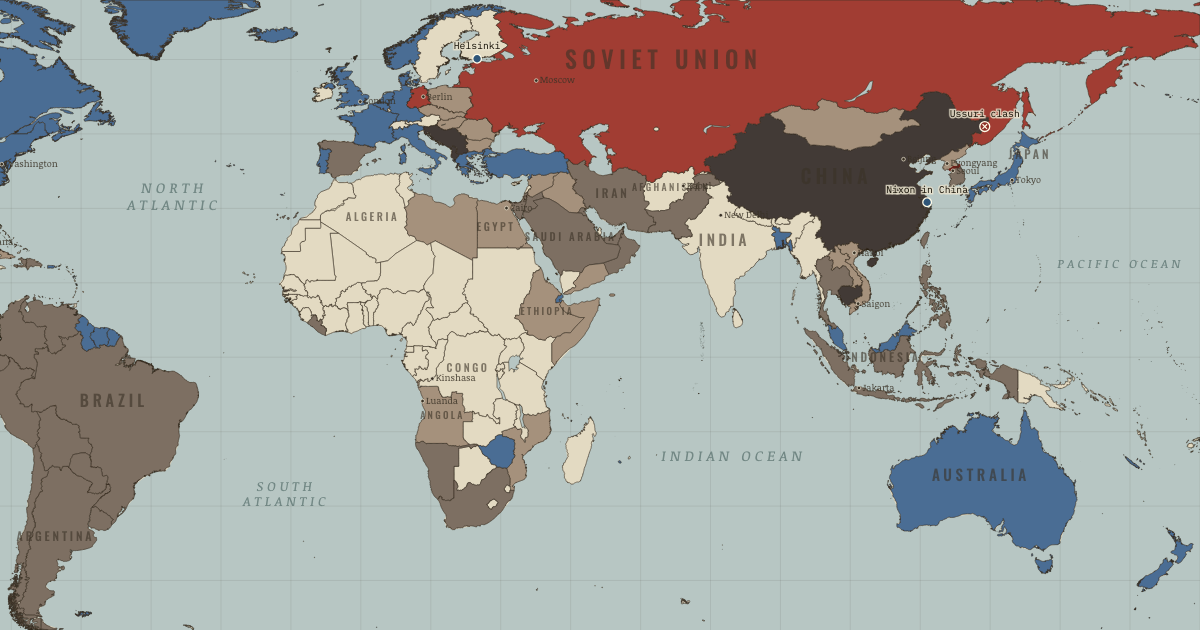
The map above is the world of The world, November 1975 — The high-water mark.
Every state on the map that year: The world in 1980 · Europe in 1980.
Part of IB History: The Cold War →
SHORT EXPLANATION
By 1969, the Cold War no longer divided the world neatly between two camps. The Soviet Union faced a hostile China as well as NATO; China feared a Soviet attack, and the United States was burdened by Vietnam. Nixon’s opening to Beijing in 1972 gave Washington leverage with Moscow. Meanwhile, the Soviet buildup after Cuba had produced strategic parity, making limits on weapons attractive to both superpowers.
Détente was a way to manage rivalry through negotiation. SALT I and the ABM Treaty limited strategic systems, while West Germany’s Ostpolitik and the Helsinki Accords helped regularize Europe’s postwar settlement. The powers had no comparable rules for competition in Africa and Asia. Those contests strained détente, and the Soviet invasion of Afghanistan ended the phase, though some of its institutions survived.
The full story
The communist alliance had already broken apart before Washington tried to use the division. Moscow withdrew nuclear assistance in 1959; Khrushchev’s de-Stalinization indirectly challenged Mao’s cult, and Beijing condemned the Soviet retreat in Cuba as “capitulationism.” Behind these disputes was a question neither government was willing to leave to the other: who should lead world revolution? In 1969 Soviet and Chinese troops fought on the Ussuri. The communist “monolith” that Washington had spent two decades containing had become two hostile powers.
This rupture gave Nixon and Kissinger an opportunity. The United States was paying heavily for the war in Vietnam, while Moscow had to consider China as well as NATO and Beijing feared a Soviet attack more than an American one. If Washington could improve relations with each communist power, each would have reason to compete for American favor. The opening to China helped bring Moscow toward summit diplomacy too. These governments still disagreed over ideology; their immediate interests made negotiation worthwhile.
The arms agreements rested on a particularly unsettling calculation. SALT I limited launchers, and the ABM Treaty restricted missile defenses. Each side would remain exposed to retaliation, so a leader contemplating a first strike would have to expect a devastating answer. The limits were consequential, but they did not cover everything: multiple warheads could still increase the destructive power of the arsenals. Competition continued even as rules and communication reduced some of its dangers.
At Helsinki in 1975, Moscow obtained recognition of Europe’s borders and accepted human-rights commitments in return. Dissidents found a use for those commitments. The Moscow Helsinki Group appeared in 1976, followed by Charter 77 in Prague and KOR in Poland; they could measure their governments’ conduct against promises those governments had signed and make violations internationally visible. Authorities persecuted them, yet Basket III’s provisions supplied a language later used by reformers and opponents of Eastern European regimes. Meanwhile, rivalry in the decolonizing world placed pressures on détente that its European agreements had not resolved.
FULL EXPLANATION
Geometry as a source of leverage
Triangular diplomacy began with a division that Washington had not made. De-Stalinization, withdrawn nuclear assistance, contested borders and the struggle to lead world revolution had damaged the Sino-Soviet alliance. The 1969 fighting on the Ussuri showed the danger of a rupture between two armed communist powers. Washington’s aim was to develop better relations with each than either had with the other. Moscow would then have to consider its hostile eastern frontier alongside NATO, while Beijing could use the American opening to reduce its isolation. Nixon’s anti-communist reputation lowered the domestic political cost of meeting Mao, a possibility later captured in “Nixon goes to China.” The opening did not settle Taiwan or make China an American ally. It changed the choices and expectations of all three governments, shifting the balance through alignment and signaling rather than territorial conquest.
How to judge a policy that later ended
A policy that ends may still leave something behind. By 1980 arms talks had stalled and confrontation had returned, so détente failed if its purpose is taken to be permanent cooperation. Yet its more immediate purpose was to manage an enduring rivalry. SALT and the ABM Treaty constrained strategic systems; the 1971 Berlin agreement eased a recurrent flashpoint; and Helsinki supplied dissidents with commitments and procedures they could use after relations soured. Those gains had limits of their own. The arms agreements did not cap individual warheads, and there was no shared code for conflicts such as Angola and Ethiopia. Each power treated its own involvement as legitimate and the other’s as expansion, while domestic critics argued that negotiation licensed weakness. Détente reduced particular risks without resolving the rivalry. Its breakdown did not erase the agreements or their later uses.
Key places on the map
On this day
Why it happened
The split that made the triangle possible. The alliance’s collapse had several causes. Khrushchev’s de-Stalinization undermined Mao’s cult indirectly, the Soviet withdrawal of nuclear assistance in 1959 damaged cooperation, and Beijing called Moscow’s retreat in Cuba “capitulationism.” The deeper contest concerned leadership of world revolution. Fighting on the Ussuri in 1969 showed that the dispute had become a military danger. Kissinger’s pricing of the division meant making relations with Washington valuable to each side: neither would want the other to gain the better American relationship.
Parity made arms control rational. After the Soviet buildup produced strategic parity, neither superpower could safely assume it could strike without suffering retaliation. SALT I limited launcher numbers, and the ABM Treaty restricted defenses, preserving that vulnerability. Defenders regarded it as a stable equilibrium; critics saw a system built on the threat of mutual destruction as madness. The agreements did not cover every weapon. MIRVs allowed more warheads on missiles, and theater weapons remained outside these limits; the Euromissile crisis of Chapter 10 would grow from that competition. Arms control could manage part of the race without ending it.
Economics pressed both ways. Diplomacy also answered economic needs. Soviet harvest failures beginning in 1972 increased the USSR’s need for Western grain and technology. The United States faced heavy defense costs and a strained monetary system; in 1971 Nixon closed the gold window, ending the dollar’s convertibility under Bretton Woods. West Germany had reasons of its own to seek accommodation: Eastern markets and the reunion of divided families. These different pressures helped make practical agreements attractive.
THE TURNING POINT
Beijing and Shanghai, 21–28 February 1972. Nixon’s visit to Beijing and Shanghai on 21–28 February 1972 became known as “The week that changed the world.” Its effect lay in the choices it forced upon the three governments. Moscow now faced a Chinese adversary improving relations with Washington as well as a NATO front; an estimate places a quarter of the Red Army opposite China, unavailable to watch NATO. Beijing gained a way out of diplomatic isolation, and Washington gained leverage with Moscow. Taiwan remained disputed, but the balance had shifted without a battle.
What it changed
Helsinki’s slow fuse. Helsinki’s rights provisions gave dissidents a standard their governments had publicly accepted. The Moscow Helsinki Group formed in 1976, with Charter 77 in Prague and Poland’s KOR following. Their compliance monitoring brought violations to international attention even as authorities persecuted them. Basket III thus supplied a language for later reformers and for challenges to the legitimacy of Eastern European governments. The effects of an apparently “symbolic” agreement emerged over time.
Détente’s decay: the periphery eats the center. The powers had no agreed code for the Third World. Soviet and Cuban support in Angola in 1975 and the Horn of Africa in 1977–78 persuaded American critics that Moscow was using détente to advance. Moscow could respond that those contests lay outside the agreement and point to Egypt’s movement toward Washington as Western competition. Each side regarded its own involvement as legitimate and the other’s as threatening. The resulting distrust weakened the relationship, and the Soviet invasion of Afghanistan in December 1979 finished the détente phase.
The dissenters institutionalize. While negotiations continued, critics prepared the case for renewed confrontation. Team B and the Committee on the Present Danger argued that détente had ratified Soviet gains and concealed a buildup; Reagan would later campaign on such criticisms. In Moscow, the military-industrial complex continued building, and SS-20 deployment began in 1977. The people, weapons and arguments of the Second Cold War were taking shape during détente itself.
DISCUSSION QUESTION — Détente collapsed within a decade. Was it therefore a failure?
That depends on what we ask détente to accomplish. If the test is permanent stable coexistence, it failed: by 1980 the powers were rearming and boycotting each other’s Olympics. But agreements can reduce dangers even when rivalry returns. SALT and the ABM Treaty limited strategic systems, and the 1971 Quadripartite Agreement regularized Berlin; no Berlin crisis recurred. After Soviet leaders had seriously considered a strike on China in 1969, the triangular opening changed their calculations. Helsinki gave dissidents commitments they could use long after the diplomatic mood changed. These gains were limited: warheads remained uncapped, and no rules settled competition outside Europe. Détente was a partial system for managing rivalry, whose agreements retained value after the phase ended.
An interesting fact
A missed shuttle helped set the opening to China in motion. At the world table-tennis championships in Nagoya in April 1971, American Glenn Cowan mistakenly boarded the Chinese team’s bus. Three-time world champion Zhuang Zedong broke standing orders against contact with Americans and gave him a silk-screen print of the Huangshan mountains. Mao read of the exchange, overruled his foreign ministry and invited the US team to Beijing within days. Three months later Kissinger used a reported stomachache in Islamabad as cover for a secret flight to China to prepare Nixon’s visit.
Related
THE FREE PRINTABLE STUDY GUIDE
Get the printable study guide for The Cold War free. I’ll send you a few short letters, then one when a new atlas opens. That’s all. — Paul
NO TRACKING · YOUR ADDRESS IS USED FOR THE DISPATCH AND NOTHING ELSE · UNSUBSCRIBE ANYTIME