MAPS OF HISTORY · IB HISTORY · THE INDUSTRIAL REVOLUTION
IB HISTORY · 1750 – 1914 · 12 CHAPTERS
IB History: The Industrial Revolution — notes, maps and essay plans
Why did coal-driven machines first change work in Britain? Follow their spread to Europe, the United States and Japan, the resistance they met, and who paid for them — from Lancashire’s mill children to the enslaved growers of its cotton.
This page gathers the atlas’s IB notes: where each of its 12 chapters fits the syllabus, the concepts and evidence it supports, practice questions with model essay plans, primary sources, and starting points for the Internal Assessment.
WW2 is free in full, and chapter 1 of every atlas is free. A free account opens 3 more chapters a day. Opening a new atlas uses one of them. Membership opens all 21 — Join.
Where it fits the course
Every chapter’s IB notes name the parts of the course it serves. Across the atlas they add up to this:
- Paper 1 · Political and Economic Transitions · 1 CHAPTER
- Paper 2 · Innovation and Transformation · 12 CHAPTERS
- Paper 3 · The Americas, section 11.4 · 1 CHAPTER
- Paper 3 · Asia and Oceania, section 12.6 · 1 CHAPTER
- Paper 3 · Europe, section 13.5 · 1 CHAPTER
- Paper 3 · Europe, section 13.7 · 1 CHAPTER
- Old course · World history topic 7: Origins, development and impact of industrialization (1750–2005) · 12 CHAPTERS
Chapter by chapter
Across its 12 chapters, the atlas holds 70 points of evidence and 30 primary sources. Here you can read all the evidence for chapters 1 and 2. For each later chapter there is one point and the practice question; the rest is in the atlas. Select a chapter title to open its free page and read the full explanation.
1. Why Britain?
CHAPTER 1 · c. 1750 · CONCEPTS: CAUSATION, PERSPECTIVES, SIGNIFICANCE
EVIDENCE TO USE · ALL 6 POINTS (A FREE CHAPTER)
- In 1750, according to Paul Bairoch’s estimates, China produced about 33 per cent of the world’s manufactured goods and India about 25 per cent. Britain produced under 2 per cent. Its later lead, then, did not grow out of an early advantage in manufacturing.
- Why did the spinning jenny spread first in Lancashire? Robert Allen calculates that it earned a return of about 38 per cent a year in England, against only 2.5 per cent in France. High English wages made a machine that saved labor especially profitable.
- London was already receiving more than 460,000 tons of coal a year by sea from the Tyne by 1700. Long before the steam engine, Britain had both a cheap mineral fuel and a means of transporting it.
- Kenneth Pomeranz estimates that by about 1830 Britain’s imports of cotton, sugar and timber replaced what 25 to 30 million acres could have produced—more than the area of all its farmland. Colonies helped relieve a shortage of land in Britain itself.
- About 12.5 million Africans were embarked on ships for the Atlantic slave trade. In the late eighteenth century, British ships carried more of them than those of any other nation; Liverpool was the chief British port involved.
- David Eltis and Stanley Engerman found that West Indian sugar added about £5.4 million to the British economy in 1805, while cotton textiles added £10.5 million. The comparison suggests that slavery’s direct profits were smaller than its indirect effects.
2. Cotton and the Factory
CHAPTER 2 · 1760–1830 · CONCEPTS: CHANGE, CONSEQUENCE, PERSPECTIVES
EVIDENCE TO USE · ALL 6 POINTS (A FREE CHAPTER)
- When Richard Arkwright opened his mill at Cromford in 1771, he brought water-powered spinning frames together with shift work and company housing. Within twenty years, factories across Derbyshire, Lancashire and Scotland had copied the model.
- How much time could machinery save? According to figures used by Robert Allen, an Indian hand spinner took about 50,000 hours to spin 100 pounds of cotton. Crompton’s mule took about 2,000 hours, and the self-acting mule of the 1820s about 135.
- Britain’s appetite for raw cotton grew from imports of about 2.5 million pounds in 1760 to about 264 million pounds in 1830. By the late 1820s, more than 70 per cent of those imports came from slave plantations in the United States.
- The factory returns of 1835 show how much early cotton mills depended on young workers: people under eighteen accounted for about 43 per cent of the workforce in the mills surveyed.
- Before 1807, Liverpool ships carried between 1.3 and 1.5 million enslaved Africans across the Atlantic. Later, the same port imported the slave-grown cotton on which Manchester’s mills depended.
- Cotton goods made up about half of British domestic exports by 1830. Cotton had become the leading sector of Britain’s first industrial economy and its largest employer of factory labour.
3. Steam, Coal and Iron
CHAPTER 3 · 1769–1830 · CONCEPTS: CAUSATION, CHANGE, SIGNIFICANCE
EVIDENCE TO USE · 1 OF 5
- James Watt conceived the separate condenser in 1765 and patented it in 1769. An engine using it could burn about a quarter as much coal as a Newcomen engine, bringing the cost of steam power within reach away from the coalfields.
Practice question: Examine the reasons for the development and spread of steam power in Britain between 1769 and 1830.
4 more points of evidence, 3 primary sources and the model plan for this question are in the IB notes of chapter 3 in the atlas.
4. The Railway Age
CHAPTER 4 · 1825–1850 · CONCEPTS: CHANGE, CONSEQUENCE, SIGNIFICANCE
EVIDENCE TO USE · 1 OF 5
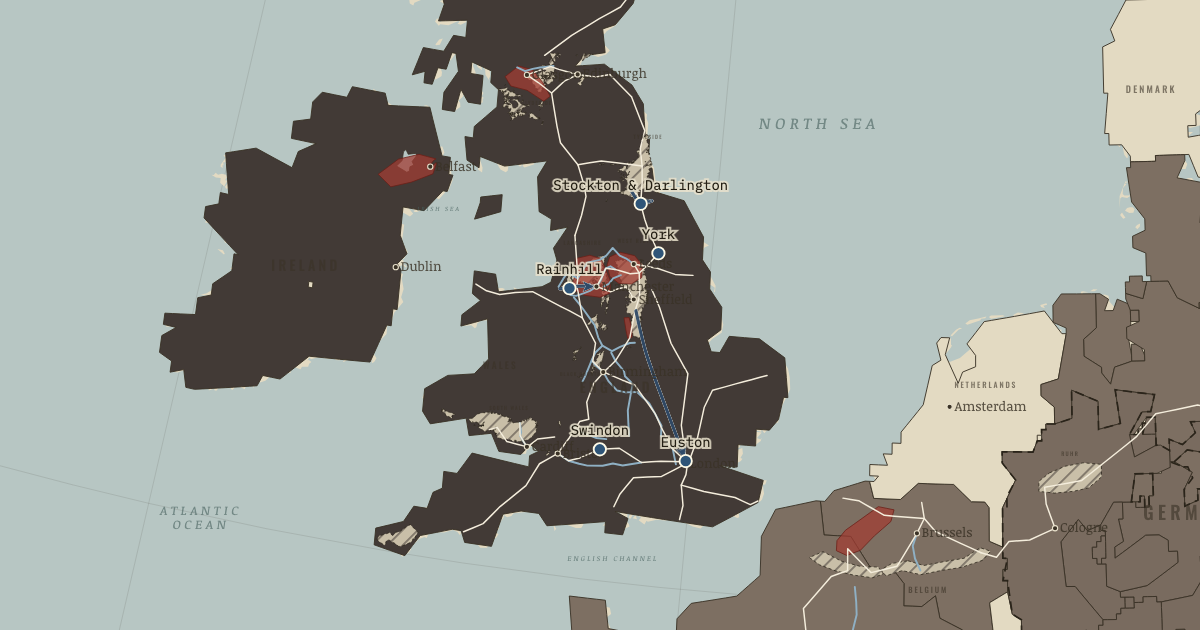
- After the Rainhill trials of 1829, the Liverpool and Manchester Railway opened on 15 September 1830. It was the first inter-city line to run to a timetable using steam locomotives throughout.
Practice question: To what extent did railways transform British society between 1830 and 1850?
4 more points of evidence, 2 primary sources and the model plan for this question are in the IB notes of chapter 4 in the atlas.
5. Industrial Society
CHAPTER 5 · 1800–1850 · CONCEPTS: CONSEQUENCE, PERSPECTIVES, CHANGE
EVIDENCE TO USE · 1 OF 6
- By the 1851 census, about 9.2 million of the 17.9 million people in England and Wales lived in towns. That was just over half the population, making Britain the first predominantly urban society.
Practice question: Discuss how industrialization affected living and working conditions in Britain between 1800 and 1850.
5 more points of evidence, 3 primary sources and the model plan for this question are in the IB notes of chapter 5 in the atlas.
6. Resistance
CHAPTER 6 · 1811–1848 · CONCEPTS: CAUSATION, PERSPECTIVES, CONSEQUENCE
EVIDENCE TO USE · 1 OF 6
- On 11 March 1811, framework knitters at Arnold near Nottingham began the Luddite rising by breaking about sixty stocking frames. They chose the frames of employers who paid low rates and spared those of others.
Practice question: Evaluate why industrial innovations encountered resistance in Britain between 1811 and 1848.
5 more points of evidence, 3 primary sources and the model plan for this question are in the IB notes of chapter 6 in the atlas.
7. The Continent Follows
CHAPTER 7 · 1815–1870 · CONCEPTS: CHANGE, CAUSATION, CONTINUITY
EVIDENCE TO USE · 1 OF 6
- In 1817 John Cockerill, the son of a Lancashire mechanic, founded a machine works and ironworks at Seraing near Liège. The works grew into one of the largest industrial plants in the world, and continental engineers learned their trade there.
Practice question: How did the role of the state in industrialisation before 1870 compare in Belgium and the German states?
5 more points of evidence, 2 primary sources and the model plan for this question are in the IB notes of chapter 7 in the atlas.
8. The Second Industrial Revolution
CHAPTER 8 · 1870–1914 · CONCEPTS: CAUSATION, CHANGE, SIGNIFICANCE
EVIDENCE TO USE · 1 OF 6
- Lorraine’s minette ores became Europe’s largest iron-ore field after a new process made phosphoric ore usable for steel. Cousins Sidney Gilchrist Thomas and Percy Gilchrist tested the process at Blaenavon in 1878–79 and proved it at Middlesbrough.
Practice question: To what extent did science-based innovation explain Germany’s industrial rise after 1870?
5 more points of evidence, 2 primary sources and the model plan for this question are in the IB notes of chapter 8 in the atlas.
9. America Industrialises
CHAPTER 9 · 1865–1914 · CONCEPTS: CHANGE, CONSEQUENCE, PERSPECTIVES
EVIDENCE TO USE · 1 OF 6
- On 10 May 1869, the first transcontinental railroad was completed at Promontory Summit, Utah. Chinese workers had supplied much of the labor: in 1867 they made up about 90 per cent of the Central Pacific’s workforce.
Practice question: How far did industrialization change the lives of workers in the United States between 1865 and 1914? Evaluate its impact.
5 more points of evidence, 3 primary sources and the model plan for this question are in the IB notes of chapter 9 in the atlas.
10. Japan: Industrialisation from Above
CHAPTER 10 · 1868–1914 · CONCEPTS: CHANGE, CAUSATION, PERSPECTIVES
EVIDENCE TO USE · 1 OF 6
- Under the Harris Treaty of 1858, Japan opened ports including Yokohama. The treaty also fixed low import tariffs—about 5 per cent from 1866—and placed foreigners under their own courts until 1899.
Practice question: Compare and contrast how the state contributed to industrialisation in Japan and Britain before 1914.
5 more points of evidence, 3 primary sources and the model plan for this question are in the IB notes of chapter 10 in the atlas.
11. A Global Transformation
CHAPTER 11 · 1850–1914 · CONCEPTS: CONSEQUENCE, PERSPECTIVES, SIGNIFICANCE
EVIDENCE TO USE · 1 OF 6
- When the Suez Canal opened on 17 November 1869, ships gained a shorter route from London to Bombay: about 6,300 nautical miles instead of 10,700, a saving of about 41 per cent.
Practice question: How far did industrialisation in Britain cause India’s economic decline in the nineteenth century? Discuss.
5 more points of evidence, 3 primary sources and the model plan for this question are in the IB notes of chapter 11 in the atlas.
12. Who Won and Who Lost
EPILOGUE · 1750–1914 · CONCEPTS: CONSEQUENCE, PERSPECTIVES, SIGNIFICANCE
EVIDENCE TO USE · 1 OF 6
- Industrial production shifted dramatically toward Europe and the United States. Paul Bairoch estimated that their share of the world’s manufactured goods rose from about 23 per cent in 1750 to about 85 per cent in 1900, while China’s fell from about 33 to about 6 per cent.
Practice question: Using two countries from different regions, evaluate who benefited most from industrialisation before 1914.
5 more points of evidence, 2 primary sources and the model plan for this question are in the IB notes of chapter 12 in the atlas.
Practice questions and essay plans
Each chapter closes with a practice question and a model plan. The plan gives a thesis, three points with evidence and a link back to the question, a counter-argument and a judgement. Chapter 1’s plan appears here in full. The other plans are outlined here and given in full in the atlas.
PAPER 2 · THE INDUSTRIAL REVOLUTION · CHAPTER 1
How far were economic factors the main reason industrialisation began in Britain?
Economic factors offer the strongest starting point. High wages and cheap coal made labor-saving machines profitable in Britain before anywhere else, giving people a reason to invent and use them. But those incentives operated alongside an Atlantic economy built on enslaved labor and a culture of practical science. Empire and knowledge help explain the scale and speed of the response.
Relative prices made invention profitable in Britain.
EVIDENCEAllen shows that wages in London were roughly twice those in Vienna or Beijing, while coal near Newcastle was the cheapest energy anywhere. A spinning jenny returned about 38 per cent a year in England, compared with 2.5 per cent in France.
LINKThe difference in returns helps explain why innovations appeared first in Britain: inventors had the greatest financial reason to pursue them there.
Coal lifted the land limit on the organic economy.
EVIDENCEBritish coal output rose from about 5 million tons in 1750 to 15 million in 1800. Wrigley shows that the energy from this coal equaled the yearly growth of millions of acres of woodland.
LINKHigh wages alone, on this argument, would have produced a rich trading economy like the Dutch Republic’s. Coal allowed Britain to turn the incentive into lasting growth; geology mattered as well as prices.
Knowledge and institutions influenced how Britain responded.
EVIDENCEMokyr’s Industrial Enlightenment and the Lunar Society’s combination of science and business show the part played by knowledge. Laws mattered too: the Calico Acts of 1700 and 1721 protected a home market for imitations of Indian cloth.
LINKAn incentive does not act on its own. Ideas and laws shaped whether people acted on it, qualifying an explanation based on economics alone.
Historians who emphasize empire give the Atlantic slave economy a role as important as prices. Williams and Inikori place slave-grown sugar and cotton, Atlantic markets and Liverpool’s capital at the center of their accounts. Pomeranz regards colonies as one of the two windfalls that separated England from the Yangzi delta.
Economic factors were the main reason insofar as prices gave people an incentive to invent. The strongest explanation nevertheless combines causes: coal, wages, empire and knowledge reinforced one another. Removing any one of them would have slowed Britain’s lead considerably.
Read the chapter behind this plan: Why Britain?.
PAPER 2 · THE INDUSTRIAL REVOLUTION · CHAPTER 3
Examine the reasons for the development and spread of steam power in Britain between 1769 and 1830.
Steam engines first answered an existing need: coal mines had to be pumped as they grew deeper. Watt’s condenser then reduced fuel costs enough to make engines useful where coal was expensive. Yet invention alone did not determine their spread. Water remained cheaper for many mills until about 1830, while mining and urban industry supplied reasons to adopt steam.
The first demand came from coal mining.
Watt’s improvement and Boulton’s business opened uses beyond the coalfields.
Urban industry encouraged steam’s later spread.
The evidence for each point, the counter-argument and the judgement are in the IB notes of chapter 3 in the atlas. Read the chapter first: Steam, Coal and Iron.
PAPER 2 · THE INDUSTRIAL REVOLUTION · CHAPTER 12
Using two countries from different regions, evaluate who benefited most from industrialisation before 1914.
Capital owners and the state gained most from industrialisation in both Britain and Japan, though the timing and distribution of other gains differed. British workers shared in rising real wages after 1850; before 1914, Japan’s mill girls and colonised Koreans bore heavy costs. Political power helped determine who could claim a share.
In both countries, owners of capital were the greatest beneficiaries.
After 1850, British workers began to share in the gains.
The costs fell heavily on Japanese workers and colonised peoples.
The evidence for each point, the counter-argument and the judgement are in the IB notes of chapter 12 in the atlas. Read the chapter first: Who Won and Who Lost.
PAPER 2 · THE INDUSTRIAL REVOLUTION · CHAPTER 4
To what extent did railways transform British society between 1830 and 1850?
By 1850 railways had transformed British society to a great extent. They created a national market and a common time, helped produce new towns, and brought a mass public into travel and investment. Measured by cheaper freight alone, their economic effect was more modest. The transformation was therefore social and cultural as well as economic.
Railways brought Britain into a national market.
Railways changed how people kept time and travelled.
Railways brought the middle classes into a capital market.
The evidence for each point, the counter-argument and the judgement are in the IB notes of chapter 4 in the atlas. Read the chapter first: The Railway Age.
Primary sources
Before reading a primary source, it helps to know where it came from and its context. Each chapter’s IB notes provide both. Here are the sources from chapter 1 in full.
TEXT · CHAPTER 1
The Wealth of Nations, Book I, chapter 1, “Of the Division of Labour”
- CREATOR
- Adam Smith
- DATE
- 9 March 1776
- ORIGIN
- An Inquiry into the Nature and Causes of the Wealth of Nations (London: W. Strahan and T. Cadell, 1776)
Context. Adam Smith, a Scottish moral philosopher, argued that output rose when work was divided into simple, repeated tasks. In this passage he makes a further claim: the division of labor also gave workers opportunities to devise many of the machines that mechanized industry. It is an early account of invention driven by workers’ tinkering.
Public domain (author d. 1790). Text: Project Gutenberg eBook #3300 · original ↗
TEXT · CHAPTER 1
The Interesting Narrative of the Life of Olaudah Equiano, volume I, chapter 2
- CREATOR
- Olaudah Equiano
- DATE
- 1789
- ORIGIN
- London: printed for and sold by the author, 1789
Context. Kidnapped as a child in West Africa and later freed, Equiano describes the hold of a slave ship during the Middle Passage, the Atlantic crossing. His book became a key text in the British campaign against the slave trade. It also shows the human cost of an Atlantic economy that supplied Britain with raw materials and markets.
Public domain (author d. 1797). Text: Project Gutenberg eBook #15399 · original ↗
Every other source in the atlas (28)
- Chapter 2: Cotton and the Factory
- The Philosophy of Manufactures, Book I, chapter 1 Andrew Ure · 1835
- History of the Cotton Manufacture in Great Britain, Preface Edward Baines (junior) · 1835
- Chapter 3: Steam, Coal and Iron
- Specification of James Watt’s patent No. 913, “A new invented method of lessening the consumption of steam and fuel in fire engines” James Watt · Patent granted 5 January 1769; specification enrolled 29 April 1769
- Letter from Matthew Boulton to James Watt Matthew Boulton · 7 February 1769
- “Tour to Shropshire”, Annals of Agriculture, vol. IV Arthur Young · Published 1785; the visit is usually dated 1776
- Chapter 4: The Railway Age
- Letter from Liverpool, 26 August 1830, in Record of a Girlhood, vol. II Frances Anne (Fanny) Kemble · Letter 26 August 1830; published 1878
- Dombey and Son, chapter 6 Charles Dickens · Monthly part, November 1846; book edition 1848
- Chapter 5: Industrial Society
- Speech in the House of Commons on the employment of women and children in mines and collieries Lord Ashley (later the 7th Earl of Shaftesbury) · 7 June 1842
- The Condition of the Working Class in England in 1844, “The Great Towns” Friedrich Engels · German original 1845; English translation 1887
- Report on the Sanitary Condition of the Labouring Population of Great Britain, “Recapitulation of the conclusions” Edwin Chadwick, for the Poor Law Commissioners · July 1842
- Chapter 6: Resistance
- “Ned Lud’s Proclamation” Anonymous Luddites in Nottingham, writing as “Ned Lud” · 23 December 1811
- Passages in the Life of a Radical, on 16 August 1819 Samuel Bamford · First published 1844
- The People’s Charter London Working Men’s Association (drafted chiefly by William Lovett) · 8 May 1838
- Chapter 7: The Continent Follows
- The National System of Political Economy, Book IV, chapter 33 Friedrich List · German original 1841; English translation 1885
- “The Silesian Weavers” Heinrich Heine · German original 10 July 1844; English translation 1884
- Chapter 8: The Second Industrial Revolution
- “Made in Germany”, chapter 1 Ernest Edwin Williams · 1896
- “Wealth” Andrew Carnegie · June 1889
- Chapter 9: America Industrialises
- Speech in the US Senate on the Lecompton Constitution (“Cotton is King”) James Henry Hammond, Senator for South Carolina · 4 March 1858
- Proclamation of the Lowell mill women, “Union is Power” The striking women workers of the Lowell mills · 15 February 1834
- An Act to execute certain treaty stipulations relating to Chinese (the Chinese Exclusion Act) 47th United States Congress · 6 May 1882
- Chapter 10: Japan: Industrialisation from Above
- Letter of the President of the United States to the Emperor of Japan Millard Fillmore · Dated 13 November 1852; delivered by Commodore Perry on 14 July 1853
- The Charter Oath (Oath of Five Articles) Emperor Meiji · 6 April 1868
- A Handbook for Travellers in Japan (7th edition), on the Ashio copper mines Basil Hall Chamberlain and W. B. Mason · 1903
- Chapter 11: A Global Transformation
- The History of British India from 1805 to 1835, Book I, chapter 8, footnote on the cotton trade of 1813 Horace Hayman Wilson · Edition of 1858 (the continuation first appeared in 1845–48)
- Poverty and Un-British Rule in India Dadabhai Naoroji · 1901, collecting papers from 1876 onward
- Report of the British Consul at Boma on the administration of the Congo Free State Roger Casement · Dated 11 December 1903; presented to Parliament in February 1904
- Chapter 12: Who Won and Who Lost
- Labour and Life of the People, vol. II, “Statistics of Poverty” Charles Booth · 1891
- “On the Influence of Carbonic Acid in the Air upon the Temperature of the Ground” Svante Arrhenius · April 1896
Internal Assessment starting points
Each starting point is an idea for an investigation: a question, the concept it tests, the kinds of sources you could use and where they are held, and one caution. The investigation must be your own work, and your teacher approves the question.
To what extent did the Factory Act of 1833 alter the hours children worked in a particular mill or district?
CONCEPTChange
SOURCESFactory inspectors’ reports, mill wage books and apprentice registers, the 1841 and 1851 census enumerators’ books, local newspapers.
CAUTIONAn inspector’s report tells us what the inspector recorded, but mills could evade the Act. Set those claims beside the mill’s own records to investigate what happened to children’s hours.
Why were particular West Riding mills chosen as targets by the Luddites in 1812?
CONCEPTCausation
SOURCESHome Office disturbance papers, the Leeds Mercury and other newspapers, York trial records of 1813, Luddite letters.
CAUTIONMuch of the evidence comes from magistrates and paid informers, whose reports exaggerated conspiracy. Their accounts need to be considered carefully when investigating the choice of targets.
How far did a named British town’s economy change with the arrival of the railway between 1840 and 1870?
CONCEPTConsequence
SOURCESTrade directories, census returns, railway company minutes and timetables, local newspapers, Ordnance Survey maps.
CAUTIONThe railway arrived while many other changes were taking place. A change that followed its arrival was not necessarily caused by it; comparison across the period can help distinguish its contribution.
What did Lancashire cotton workers experience during the cotton famine of 1861–65, and how did they respond?
CONCEPTPerspectives
SOURCESRelief committee records, Hansard debates, local newspapers, John Watts’s Facts of the Cotton Famine (1866), workers’ letters and meetings.
CAUTIONThe familiar account of Lancashire workers united behind the Union is disputed. Evidence on both sides can help you examine the range of workers’ experiences and responses.
What was working life like for young women in Japan’s silk mills before 1914?
CONCEPTPerspectives
SOURCESThe government survey Shokkō jijō (1903) in translated excerpts, Tomioka mill records, the workers’ songs collected by historians, contemporary reports.
CAUTIONWorkers’ own voices are scarce: officials or later historians wrote most of the sources, and translation can shape their meaning. Read carefully for what the evidence allows the workers themselves to tell us.
How significant was the Suez Canal in changing British trade with India between 1860 and 1890?
CONCEPTSignificance
SOURCESBoard of Trade statistics, Suez Canal Company annual reports, shipping registers, P&O company records.
CAUTIONThe canal was one of several changes affecting trade: steamships, the telegraph and the cotton famine also mattered during this period. Careful comparison is needed to distinguish the canal’s effect from theirs.
How did people at the time explain the cholera epidemic of 1832 or 1849 in a named town?
CONCEPTPerspectives
SOURCESLocal board of health reports, sermons, newspapers, medical pamphlets, burial registers.
CAUTIONModern germ theory gives us a different explanation, but it cannot by itself tell us why earlier accounts persuaded people. Ask what made each explanation intelligible to those who held it.
Revision tools
The atlas ends with a map quiz that asks you to find places and moments on the map itself (part of every plan from Starter up). The quick quiz and the discussion questions with our answers are free pages on this site, and the printable study guide gathers every chapter’s notes into one document for revision.
Read next
- Meiji Japan’s remaking of the state · REMAKING THE STATE
- The political revolutions of the same age · THE AGE OF REVOLUTIONS
Maps of History is independent and is not affiliated with or endorsed by the International Baccalaureate Organization. IB course names describe alignment only; paper, theme and section names follow the new course outline and may change when the final guide is published.
THE DISPATCH
Get the printable study guide for The Industrial Revolution free. I’ll send you a few short letters, then one when a new atlas opens. That’s all. — Paul
NO TRACKING · YOUR ADDRESS IS USED FOR THE DISPATCH AND NOTHING ELSE · UNSUBSCRIBE ANYTIME