Cold War · CHAPTER 8 ·
Cold War in the Third World
Chapter 8 of The Cold War, 1945–1991: “The Third World Front”
Decolonisation created dozens of new states between 1947 and 1975, and many used superpower rivalry as leverage, taking aid from both sides or joining the Non-Aligned Movement. Intervention still carried grave costs: Lumumba was removed and murdered in the Congo, and a US-backed coup toppled Chile’s elected government in 1973.
Chapter 8 is included with every paid plan. WW2 is free in full, and chapter 1 of every atlas is free. A free account opens 3 more chapters a day. Starter, at $9 a month, opens all 21 with no daily limit — see the plans.
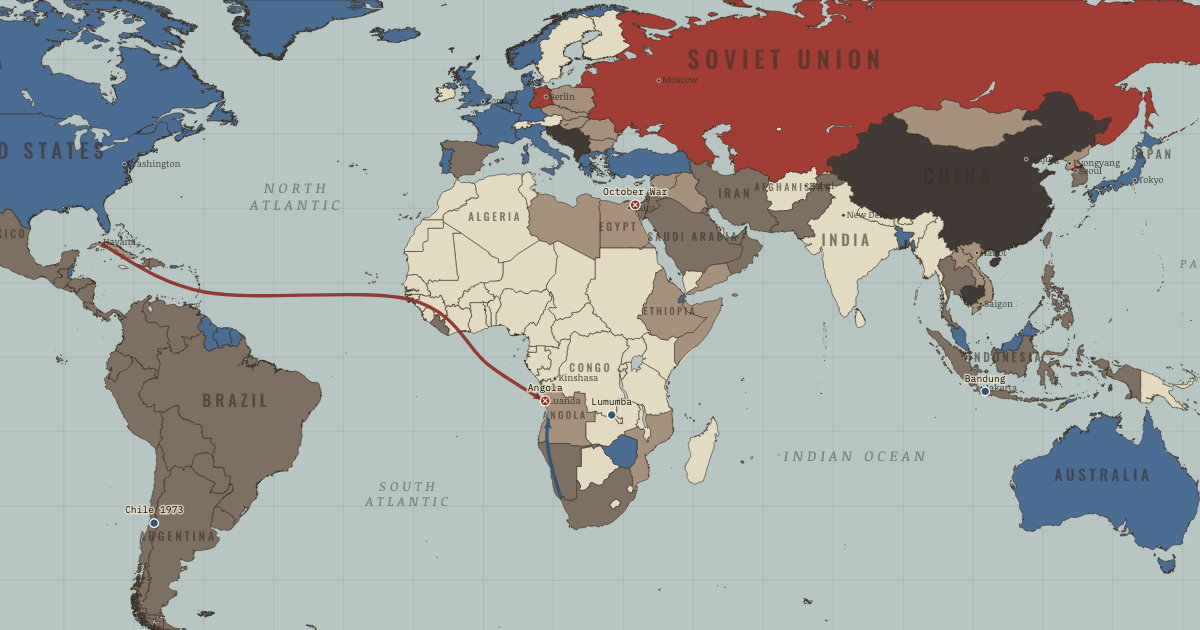
The map above is the world of The world, November 1975 — The high-water mark.
Every state on the map that year: The world in 1980 · Europe in 1980.
Part of IB History: The Cold War →
SHORT EXPLANATION
As European empires collapsed between 1947 and 1975, dozens of new states entered a world divided by superpower rivalry. Leaders at Bandung in 1955 and later in the Non-Aligned Movement sought space to pursue their own interests. Competition between Washington and Moscow could bring them aid and bargaining power, although interference from abroad could also restrict their choices.
The results were different in each region. Patrice Lumumba was removed and murdered in the Congo; in Chile a US-backed coup overthrew an elected Marxist government. Egypt used war and diplomacy to change its alignment, and Cuba sent troops into Angola’s international civil war. Communist-aligned governments gained ground in the 1970s, but Moscow’s new relationships also brought expensive obligations.
The full story
Between 1947 and 1975 roughly ninety new states emerged as European empires collapsed. Their leaders had to find resources and security in a world where Washington and Moscow competed for influence. At Bandung in 1955, many rejected the demand to join either camp. The Non-Aligned Movement grew from the ambition to retain room for independent decisions. India, Egypt, Yugoslavia and others could seek aid and arms from rival powers; each side’s desire for influence gave poorer states something with which to bargain.
The end of empire had causes of its own. War exhausted European powers, nationalist movements challenged colonial rule, and defeats such as Japan’s capture of Singapore damaged the claim of European invincibility. Yet the Cold War changed how struggles for independence developed. Movements sought foreign patrons, and the patrons saw local contests as part of a global rivalry. Washington supported anti-communists including Mobutu, Pinochet and apartheid Pretoria. Soviet “scientific socialism” brought severe economic trouble to countries it advised. Foreign arms and money helped prolong wars whose local causes preceded that support.
The Congo showed the danger to a vulnerable leader: Patrice Lumumba was removed and murdered amid a crisis drawn into the Cold War. In Chile, a US-backed military coup destroyed Salvador Allende’s elected Marxist government in 1973. Other leaders were able to press their own purposes on the powers. Egypt fought Israel in 1973 and used the ensuing diplomacy to pursue the return of Sinai and closer relations with Washington. Angola’s civil war became international as rival movements, South African forces and Cuban troops sent on Havana’s initiative converged. Local decisions mattered, though civilians and weaker governments often bore costs they could not control.
Moscow saw opportunities in the changes of 1975–79. Indochina, Angola, Mozambique, Ethiopia, Afghanistan and Nicaragua entered or moved toward the communist camp, suggesting a favorable shift in the “correlation of forces”. But allies could also require subsidies and become entangled in guerrilla wars. In 1976 the US Congress, reacting after Vietnam, barred covert military aid in Angola. Moscow read American restraint as retreat and overcommitted. The apparent high-water mark was also a point of overextension: within fifteen years every tan state on this map except Cuba had left the column.
FULL EXPLANATION
Non-alignment as bargaining strategy
Leaders associated with Bandung and the Non-Aligned Movement did not share one ideology or one set of interests. They did share support for decolonization and resistance to formal subordination. Their aim was to make decisions in a world where much stronger powers wanted their allegiance. The rivalry itself created an opportunity. A superpower that feared losing influence to its competitor might supply arms or other resources. A government could take Soviet arms, American grain or Western credit without treating every transaction as a permanent alliance. Aid could help build dams, universities and armies; the possibility of going to another supplier gave the recipient a bargaining position. That position had limits. Patrons attached conditions and sometimes backed coups against governments that crossed a perceived red line. Lumumba’s fate shows that non-alignment could not guarantee safety. Leaders with alternative suppliers, internal legitimacy and valuable strategic resources were better placed to bargain than those facing deep divisions or weak institutions. Non-alignment was an active strategy within an unequal system.
Why “chessboard” is an incomplete model
The chessboard image begins with a true observation: great powers supplied money and weapons, withdrew support and imposed costs that weaker states could not match. Former colonial powers also retained influence. Lumumba and Allende died in crises that exposed the deadly limits of independence. But pieces on a chessboard have no purposes of their own. Sadat launched the 1973 war partly to force diplomatic movement, then brought Egypt closer to Washington. Castro committed Cuban forces to Angola with an initiative that the picture of an obedient Soviet proxy cannot explain. Israel, Syria and other clients likewise created situations their patrons had to manage. These actors pursued local struggles over territory, security and state power. Outside assistance changed those struggles: money and weapons could make them longer and more destructive. To understand an outcome we must therefore follow the choices of local actors and the unequal power of their patrons together. Neither account makes the other unnecessary.
Key places on the map
On this day
Why it happened
Decolonization and bipolarity, mutually radicalizing. The imperial powers had exhausted resources, faced nationalist movements and suffered wartime defeats that weakened their prestige. Singapore was one such defeat. These pressures were already breaking empires apart when the superpowers brought their rivalry to the resulting struggles. Liberation movements could seek a foreign patron; Washington and Moscow could treat local rivals as assets or threats in a worldwide contest. Washington backed anti-communist rulers including Mobutu, Pinochet and apartheid Pretoria, however harsh their rule. Soviet “scientific socialism” wrecked half the economies it advised. The wars had local causes, but outside money and weapons altered their course and prolonged the violence.
Non-alignment was a strategy, not a sentiment. India accepted Soviet steel mills and American wheat while criticizing both sides. Nasser took Soviet arms and hanged Egyptian communists. Tito obtained Western loans against Soviet pressure. Their dealings illustrate what non-alignment could achieve: competing suppliers offered a chance to acquire dams, universities and armies without formally joining either camp. The terms still reflected unequal power, and aid could carry conditions. Nor could bargaining guarantee a leader’s safety. Lumumba’s removal and murder showed how little protection non-alignment sometimes provided.
Clients pulled patrons, not only the reverse. The direction of influence did not always run from patron to client. Sadat expelled 15,000 Soviet advisers in 1972 and attacked Israel in 1973 partly to make both superpowers take Egypt seriously. He then moved toward Washington in pursuit of a Sinai settlement; Egypt’s alignment changes on the map in 1979. Castro sent troops to Angola before consulting Moscow. Israel, Syria, both Koreas and both Vietnams also presented their patrons with decisions already made. The powers had to manage crises that their partners had helped create.
The oil weapon rewrites the ledger. Oil gave producing states a source of influence and imposed heavy costs on importers. After the 1973 embargo and price shock, the price rose from about $3 to $12 a barrel. OPEC states gained power; oil-importing Third World countries faced especially severe pressures. The shock helped end the postwar boom and contributed to borrowing that fed the debt spiral of the 1980s. Higher prices also sustained the Soviet Union, an oil exporter, for a decade. When prices collapsed in 1986, some of that support disappeared. The price of oil shaped the resources available to states across the Cold War divide.
THE TURNING POINT
October 1973 — the war that moved the pivot. Egyptian troops crossed the Suez Canal in October 1973, challenging Israel’s reputation for invincibility. Israel counter-crossed and nearly destroyed Egypt’s Third Army. The danger extended beyond the battlefield: a hint of Soviet intervention brought a US DEFCON III nuclear alert. Henry Kissinger then pursued disengagement in stages. By the end of the decade Egypt, the Arab world’s center of gravity and Moscow’s greatest Third World investment, had moved toward Washington, signed peace with Israel and pursued the return of Sinai and American aid. A crisis that nearly drew the superpowers into confrontation opened the way to a major diplomatic realignment.
What it changed
Communism’s maximum map — and its hollowness. From 1975 to 1979, Indochina, Angola, Mozambique, Ethiopia, Afghanistan and Nicaragua moved into the communist column. For Moscow, the expanding map suggested that the “correlation of forces” was turning in its favor. Yet the new relationships also demanded subsidies and became entangled in guerrilla wars. The US Congress barred covert military aid in Angola in 1976; Moscow interpreted this post-Vietnam restraint as retreat and overcommitted. Within fifteen years every tan state on the map except Cuba had left the column. The moment of apparent expansion had brought liabilities as well as gains.
The wounds that outlive the era. Consider what remained after outside patrons had armed and financed their allies: Mobutu’s Zaire, wars in the Horn of Africa, Angola’s 27-year civil war, Middle Eastern garrison states and Latin America’s torture archives. Each has its own history, but Cold War support helped equip armies, sustain governments and suppress opponents. Some subsidies ended after 1991. The institutions and conflicts built with their help did not simply disappear when the rivalry ended.
Human rights enter the arsenal. Reports of the Chilean military government’s brutality helped bring human rights into international debate. The 1975 Helsinki Accords contained rights provisions, and the US Congress began conditioning some aid on human-rights practices. In 1977 Carter made rights a declared policy. Enforcement was selective: allies’ abuses often received gentler treatment. Even so, dissidents from Santiago to Moscow could invoke the language and commitments against their own governments. A vocabulary used to challenge Western clients also became a resource against Soviet-bloc rule in the 1980s.
DISCUSSION QUESTION — “The Third World was the Cold War’s chessboard.” Attack that sentence with evidence from this map.
The chessboard captures something real: the great powers could intervene in countries with far fewer resources. But it leaves out the decisions made by the people supposedly serving as pieces. Bandung, the Non-Aligned Movement and OPEC were initiatives through which states organized and bargained for themselves. In crises, Sadat launched the 1973 war against Soviet advice, and Castro sent troops to Angola ahead of Moscow. Patrons then had to respond. Outcomes also reflected choices the powers could not simply dictate. Egypt moved toward Washington, the Sino-Soviet relationship split, and Iran’s revolution rejected both blocs. Still, the ability to choose was unequally distributed. Lumumba and Allende lost their lives in crises where great powers could intervene at far less cost to themselves. The useful question is how local choices and outside power interacted in each case.
An interesting fact
Cuba named its Angola intervention Operation Carlota for an enslaved Yoruba woman who led an 1843 rebellion at the Triunvirato sugar mill in Matanzas. The name connected the expedition with descendants of the slave trade crossing the Atlantic again. Its first special-forces companies traveled by aging Bristol Britannia turboprops, stopping via Barbados and Guinea-Bissau; thousands more came by sea on passenger ships. Gabriel García Márquez served as the campaign’s semi-official chronicler. His 1977 essay “Operation Carlota” remains a classic inside account.
Related
THE FREE PRINTABLE STUDY GUIDE
Get the printable study guide for The Cold War free. I’ll send you a few short letters, then one when a new atlas opens. That’s all. — Paul
NO TRACKING · YOUR ADDRESS IS USED FOR THE DISPATCH AND NOTHING ELSE · UNSUBSCRIBE ANYTIME