Indian independence · CHAPTER 9 ·
1937 Indian provincial elections
Chapter 9 of Indian Independence & Partition, 1857–1964: “The Elected Map”
The Government of India Act of 1935 created elected provincial governments, and in the 1937 elections Congress won office across most provinces while the Muslim League won under five per cent of the Muslim vote. Congress then refused a coalition in the United Provinces, and Jinnah rebuilt the League around Muslim fears.
Chapter 9 is included with every paid plan. WW2 is free in full, and chapter 1 of every atlas is free. A free account opens 3 more chapters a day. Starter, at $9 a month, opens all 21 with no daily limit — see the plans.
Free printable Indian independence study guide, sent by email ↓
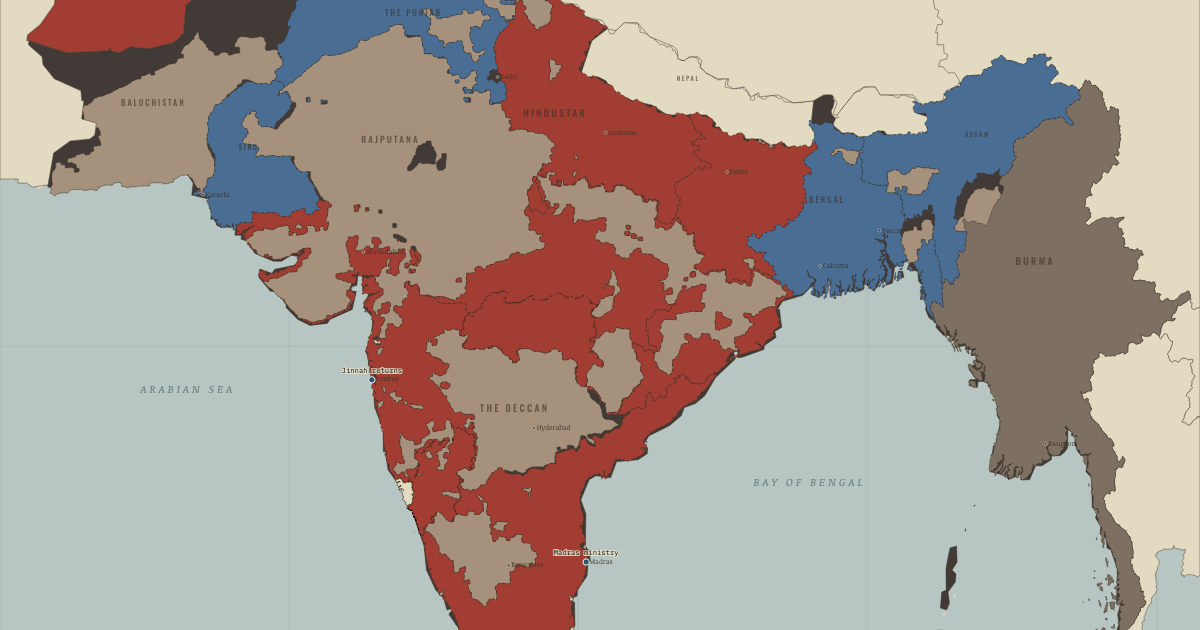
The map above is the world of India, July 1937 — The elected map.
Every state on the map that year: The world in 1938 · Europe in 1938.
Part of IB History: Indian Independence and Partition →
SHORT EXPLANATION
The 1937 elections put provincial self-government into practice under the Government of India Act of 1935. British governors kept major powers, and the princely states remained outside the proposed federation. Congress gained office in most provinces, along with experience of administration and a broad popular reach. For politically organized Muslims, however, a government led by a Hindu-majority party raised a different question: what protection would they have if that party could continue to rule without them?
Congress ministries governed honestly and introduced reforms, but their national symbols and their refusal to share office in the United Provinces gave the Muslim League material for an answer. Jinnah built the League around the fear that majority rule would leave Muslims permanently subordinate. Its claim that Muslims formed a separate political nation gained strength from provincial experience, as well as from forces beyond British manipulation. In 1946, political belonging would dominate the next election.
The full story
The Government of India Act 1935 created a new arena for Indian politics: elected provincial governments with genuine powers of self-government. In the winter of 1936–37, 35 million enfranchised Indians could vote under the longest statute the British Parliament had passed. The resulting map showed several kinds of politics at once. Congress won Madras, Bombay, the United Provinces, Bihar, the Central Provinces and Orissa. It also won the overwhelmingly Muslim North-West Frontier Province, where Abdul Ghaffar Khan’s Khudai Khidmatgars, the “Servants of God,” had organized a non-violent Pathan movement alongside it.
Elsewhere, provincial alliances prevailed. Fazlul Huq’s peasant alliance governed Bengal, and Sikandar Hayat Khan’s Unionists governed the Punjab. These Muslim-led landlord parties crossed communal lines in their own fashion and depended on neither Congress nor the Muslim League. The League had entered its first real election claiming to speak for Muslim India. Jinnah had returned from self-imposed exile in London to rebuild it, but it won under five per cent of the Muslim vote. For two years the map would show elected politics in an undivided India; its colors did not yet divide neatly along religious lines.
The United Provinces brought the difficulty of sharing power into focus. Congress and the League had cooperated against the landlord party, but Congress won so decisively that it could govern alone. It offered League politicians ministries only if their party dissolved itself into Congress. Jinnah refused. A party that had claimed to represent Muslim interests now faced the prospect of accepting office at the cost of its separate identity.
Congress ministries released prisoners and promoted schools and prohibition, governing cheaply and well. Yet many Muslims saw Hindu symbols in the flag and anthem associated with their rule. The League’s allegations of atrocities were thin, but the anxiety to which they appealed was real. Jinnah used opposition to build a mass party around the claim that Congress was Hindu, that majority rule meant Hindu rule, and that Muslims were a nation rather than a minority. The two-nation theory was older than Jinnah; after 1937 it acquired a constituency. The red-and-blue map was the last portrait of an India organized by interest rather than faith. In 1946 the next election would become a referendum on Pakistan.
FULL EXPLANATION
Where Pakistan was actually made
Gandhi, Nehru, Jinnah and Mountbatten can dominate an account of Partition, but the 1937 map asks us to look beyond the center. Provincial forces had their own power, and leaders in Delhi and London could not simply command them. Ayesha Jalal’s all-India work and, especially, regional historians’ studies helped bring those forces into view. Ian Talbot showed why the Punjab mattered: its cross-communal Unionist landlord order had kept the League out for a generation, and that order had to collapse before Pakistan could claim its heartland. Joya Chatterji found a different pressure in Bengal. In 1947 western Bengal’s Hindu bhadralok demanded partition as much as Muslims did, preferring a smaller Hindu-majority province in India to rule from a Muslim-majority Calcutta. Provincial colors were therefore not just the results of decisions at the center. The nation-state was assembled and divided from the provinces upward as well as from the leaders down.
The Frontier Gandhi and the movement that refutes the theory
A province more than ninety per cent Muslim voted solidly for Congress in 1937. The North-West Frontier Province’s result is difficult to fit into the claim that India’s Muslims formed one political nation with one interest. There Abdul Ghaffar Khan had built the Khudai Khidmatgars, or Servants of God, among the Pashtuns. A devout Muslim known as the Frontier Gandhi, he taught non-violence as an Islamic duty and trained a hundred thousand red-shirted volunteers. On the subcontinent’s most martial frontier, a Muslim mass movement chose non-violence and a united India. At Partition the Frontier went to Pakistan after a referendum Congress boycotted. Ghaffar Khan told his Congress allies, “you have thrown us to the wolves,” and Pakistan jailed him for much of the rest of his life. The movement fits neither national story easily; its history belongs in both.
Key places on the map
Why it happened
The 1935 Act: self-rule as containment. The 1935 Act offered provincial self-rule while keeping the commanding powers under British control. London could bring Congress into government in the provinces; at the proposed federal center, princely nominees and the viceroy’s reserve powers would protect British authority. The princes would not join, and the federation never came into force. The Act instead left eleven provincial democracies and a constitutional grammar that became the skeleton of India’s and Pakistan’s constitutions. Machinery designed to contain nationalism helped its successor states govern.
Why Congress swept and the League failed, 1937. A vote required an organization capable of reaching voters. For fifteen years Congress had built village units, a peasant program and cadres tested in prison; on the frontier it could also draw on the Khudai Khidmatgars. The League remained a club of Lucknow notables, with little organization or economic program. A Muslim tenant had little reason to choose a party of Muslim landlords simply because they shared his religion. Jinnah’s response over the next nine years was to build the mass organization the League lacked around religious identity.
The UP coalition refusal. Congress had a majority in the United Provinces and no constitutional duty to give the League office. The political question was whether a partner that had helped oppose the landlord party could retain a separate voice in government. Congress’s terms effectively required the League to dissolve. Maulana Azad later called the refusal the error that made Pakistan possible. Nehru said “there are only two parties”; Jinnah replied, “there is a third: Muslim India.” Historians disagree about whether a coalition would have changed events, but the refusal gave the League an argument for Muslim constituencies: Congress could discard its cooperation once it had a majority.
Office reveals the stakes of majority rule. Provincial office let Indians see how a Congress government acted. Its ministries were competent and honest, but some politically organized Muslims found their symbols troubling: Bande Mataram in the assembly, Hindi in the schools debate, and the tricolour on buildings suggested a national culture they did not share. The League’s 1938–39 grievance reports exaggerated freely. They nevertheless exploited a concern about the structure of a unitary majoritarian India: Muslims could lose an election, but they could not vote the majority out of existence.
THE TURNING POINT
Jinnah refused, 1937. Imagine the alternative in the United Provinces: Congress admits two League ministers, and the League enters government as a junior partner in nationalism, consistent with Jinnah’s earlier course. The coalition did not form. In opposition, the League could instead organize around fears aroused by Congress rule. Ayesha Jalal’s celebrated thesis interprets the Pakistan demand that grew from this period as a bargaining counter for power-sharing, rather than a partition blueprint. Critics answer that a counter used for a decade can become a commitment. Either way, 1937 marks a turn from seeking a share of India toward pricing an exit.
What it changed
The League learns mass politics. The defeated League needed a presence beyond its old circle of notables. Between 1937 and 1943 it built branches, student wings and a press, with Pakistan as a one-word program. Membership grew from thousands to hundreds of thousands. Congress had demonstrated how mass organization could work; the League now used it against Congress. The 1946 election would measure the result.
The ministries as proof of capacity. Congress politicians whom the Raj had imprisoned now held office, balanced budgets and freed prisoners. Two years of competent ministries weakened the imperial argument that Indians were unfit to govern; even war cabinet hardliners no longer made it. The dispute shifted to whom India should be handed, conceding the question of capacity.
The princes miss their exit. Under the proposed 1935 federation, princely rulers could have negotiated entry into an Indian union on protected terms. They lobbied, delayed and refused, and the offer lapsed. In 1947 they entered the successor states in ten weeks, on terms shaped by Patel and events. Their earlier chance to negotiate their future had gone.
DISCUSSION QUESTION — Was the Congress refusal of a UP coalition in 1937 the mistake that made Pakistan?
The refusal gave Jinnah an argument that the League’s election defeat alone could not supply. Congress had cooperated with the League, then offered it office only at the cost of its separate identity. Jinnah could present that choice as an example of what majority rule meant; Azad, who was in the room, called it the turning point. The League’s growth followed. But the refusal cannot carry the whole explanation. Separate electorates had hardened communal politics for thirty years, and Hindu symbolism in the ministries would have caused anxiety even with a coalition. Jalal’s work shows, moreover, that the content of the Pakistan demand remained negotiable into 1946. Later opportunities were missed, above all the Cabinet Mission. The refusal ended the last configuration in which Muslim politics was organized around anything except the communal question, but it did not make Partition inevitable. Each later exit remained available at a rising cost.
An interesting fact
The Government of India Act 1935 filled 321 sections and 10 schedules, making it the longest Act the British Parliament had passed. Five years of committees produced it. Churchill fought it clause by clause from the back benches, calling it “a monstrous monument of sham built by the pygmies.” Its franchise included 35 million people and, for the first time in most provinces, women who met property tests. Both successor states kept its administrative framework: India’s 1950 constitution and Pakistan’s first constitutional order borrowed its skeleton nearly whole. The law meant to contain Indian freedom supplied machinery for two free states.
Related
THE FREE PRINTABLE STUDY GUIDE
Get the printable study guide for Indian Independence & Partition free. I’ll send you a few short letters, then one when a new atlas opens. That’s all. — Paul
NO TRACKING · YOUR ADDRESS IS USED FOR THE DISPATCH AND NOTHING ELSE · UNSUBSCRIBE ANYTIME