WW2 · CHAPTER 9 ·
Stalingrad and El Alamein
Chapter 9 of The War Room — WW2, 1936–1945: “The Hinge: Stalingrad and El Alamein”
Axis-held territory peaked in November 1942, and within months the tide turned. Operation Uranus struck the Romanian armies on the flanks and trapped the German Sixth Army at Stalingrad, while British forces broke the Axis line at El Alamein and Anglo-American troops landed in Morocco and Algeria in Operation Torch.
WW2 is free — every chapter. No sign-up.
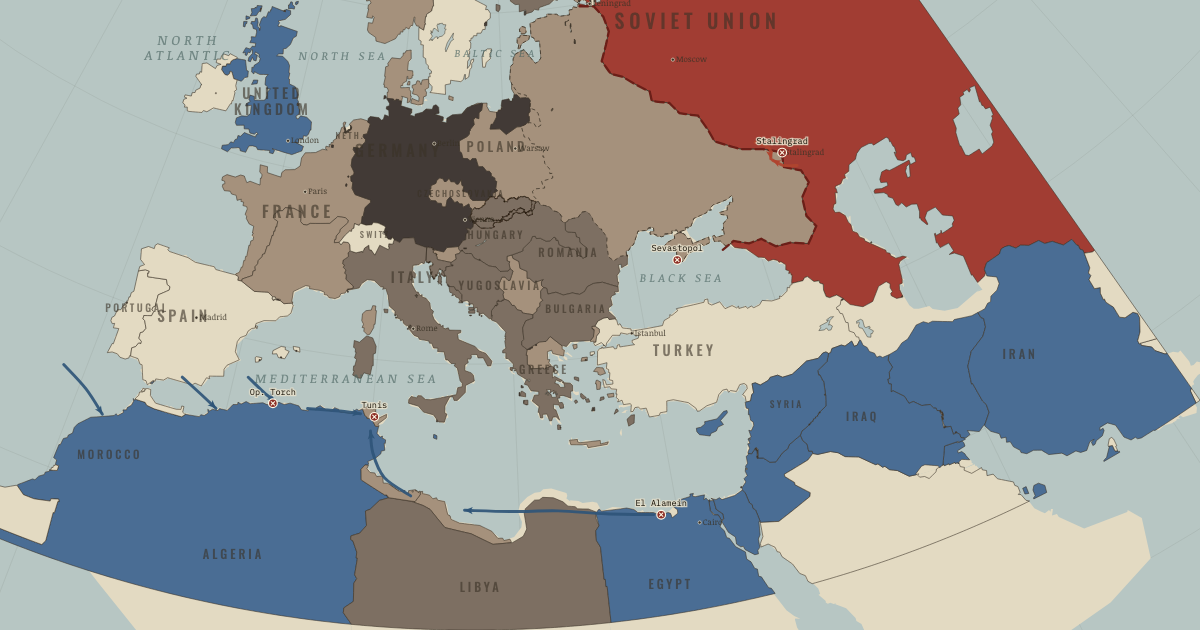
The map above is the world of Europe, November 1942 — The furthest extent.
Every state on the map that year: The world in 1942 · Europe in 1942.
Part of IB History: The Second World War →
SHORT EXPLANATION
In November 1942, the map showed Axis power at its greatest extent. Its armies had reached the Volga and advanced into Egypt, but holding such distant positions exposed weaknesses that their opponents could attack. At Stalingrad, Soviet forces broke through the Romanian armies on the German flanks and surrounded the Sixth Army. Hitler refused to permit a breakout, while the promised airlift brought only a fraction of the supplies the trapped army required.
North Africa changed direction in the same weeks. British forces broke the Axis line at El Alamein and drove west; Anglo-American troops landed in Morocco and Algeria in Operation Torch, bringing pressure from the opposite direction. Fighting continued in Tunisia and on the Eastern Front, but Germany and Italy were losing the initiative. Increasingly, they had to respond to Allied attacks instead of deciding where the decisive battles would be fought.
The full story
The German offensive of 1942, Case Blue, had a practical object: the Caucasus oil fields. Germany lacked secure fuel for a long war, and taking the oil promised to help sustain it. The advance also brought German forces to Stalingrad, on the Volga. The city guarded a transport route and covered the flank of the Caucasus operation; its name made it a prize in a contest of prestige between Hitler and Stalin. Forces committed to the city could not also be concentrated on the oil fields. Germany secured neither objective.
Inside Stalingrad, fighting among the ruins restricted German advantages in movement and air power. Soviet commanders could see another opportunity outside the city. German troops had been drawn into the battle there, while Romanian armies with too few anti-tank weapons held long stretches of the flanks. On 19 November Operation Uranus struck those positions. Soviet pincers met near Kalach and enclosed the Sixth Army: the German force fighting for the city was now cut off by an attack on the armies protecting it.
Encirclement did not have to mean immediate surrender. Hitler could have allowed an attempt to break out, but he ordered the army to hold and trusted Göring’s promise of supply by air. Aircraft delivered only a fraction of what the pocket needed. The Sixth Army surrendered on 2 February 1943.
Meanwhile, British forces had prepared an offensive at El Alamein, where their material superiority helped break the Axis line and drive it west from Egypt. Operation Torch brought Anglo-American troops ashore in Morocco and Algeria, placing another Allied force to the west. Axis reinforcements kept fighting in Tunisia until May 1943, and the war on the Eastern Front continued. These campaigns did not produce an instant victory. They showed, however, that Allied production, shipping and coalition resources could sustain attacks across distant theaters at once. Germany and Italy still controlled vast territory, but they had less choice over where to meet the next pressure.
FULL EXPLANATION
Objectives, flanks, and overextension
Why was the force at Stalingrad so vulnerable to an attack outside the city? Case Blue sought Caucasus oil because Germany lacked secure fuel, while Stalingrad mattered both as a point on the Volga route and as protection for the offensive’s flank. Its name added prestige to the contest between Hitler and Stalin. Hitler divided his forces between the city and the Caucasus, weakening the concentration available at each objective. The force drawn into Stalingrad depended on other armies to guard its long flanks. Romanian formations held much of that ground with too few anti-tank weapons. Soviet planners chose those positions for Operation Uranus; by breaking the supporting line, they could surround a strong German army without first defeating it in the city. Hitler’s response made the danger worse. Earlier stand-fast orders had sometimes prevented panic and held a front together, giving him a reason to trust the same method again. But an encircled army needed a way out or a dependable supply route. Hitler forbade withdrawal, and Göring’s airlift promised far more than it could deliver. A command that had worked under earlier conditions became disastrous under these ones.
What makes a turning point?
A victory can be dramatic without changing the direction of a war. To call late 1942 a turning point, we need to ask what changed for the armies that continued fighting. Stalingrad destroyed a German field army and damaged German prestige. El Alamein protected Egypt and drove the Axis west; Torch introduced large American ground forces into the European theater and put pressure on North Africa from the other side. Axis troops were eventually trapped in Tunisia. None of these events made defeat immediate or certain. Together they forced Germany to answer pressure on several fronts and demonstrated that the Allied coalition could coordinate resources over great distances. Production, logistics and the depth of the alliance had already tilted toward the Allies; the campaigns made that balance visible on the map. Kursk in 1943 later confirmed the eastern shift. The strongest case for a hinge therefore rests on the combined change, rather than on choosing one battle as the sole decisive event.
Key places on the map
On this day
Why it happened
Oil and the Volga. Germany needed secure fuel, and Case Blue aimed at the oil of the Caucasus. Stalingrad also mattered: it stood on the Volga and covered the advance’s flank. Hitler divided forces between the two objectives, straining the offensive without gaining the oil or lasting control of the city.
The city and its name. Stalingrad’s name gave the battle a political charge beyond its military position. Hitler publicly vowed to hold it, and Stalin issued Order 227, “Not a step back.” Soviet planners, including Zhukov, meanwhile looked past the struggle in the city to the vulnerable armies on its flanks.
Supplies across the sea. Allied armies could fight in North Africa because ships brought them there and kept them supplied. Convoys carried American Sherman tanks to British forces in Egypt despite the U-boat threat; other shipping carried the Torch invasion force. The struggle in the Atlantic supported both campaigns.
THE TURNING POINT
Operation Uranus, 19–23 November. Between 19 and 23 November, Soviet pincers broke through the overstretched Romanian-held flanks and met near Kalach. The Sixth Army was surrounded. Göring promised to supply it by air, but deliveries fell far short, and Hitler forbade a breakout. By 2 February 1943 Field Marshal Paulus and the remaining forces had surrendered; about 91,000 prisoners were taken.
What it changed
A German army lost. The loss of a complete German field army carried a political shock as well as a military cost. Germany declared three days of mourning; occupied Europe and neutral Turkey, Spain and Sweden took notice. Germany still mounted major offensives in 1943, including Kursk, before the Soviet advance carried the war toward Berlin.
The Tunisian campaign. Montgomery’s forces came from the east, while Torch forces approached from the west. Germany and Italy sent reinforcements to Tunisia, but their armies there surrendered in May 1943. Around 250,000 prisoners were taken in what became known as a “second Stalingrad.” Allied Mediterranean routes could reopen, and Italy lay next.
“The end of the beginning”. Churchill called the victory at El Alamein “the end of the beginning.” The balance had changed, but the phrase left the great questions ahead: how long and bloody the war would be, and who would reach Central Europe first.
DISCUSSION QUESTION — Why did Hitler refuse to let the Sixth Army attempt a breakout?
Earlier stand-fast orders had sometimes held a front together, and Hitler saw retreat as a military and prestige loss. He also trusted Göring’s promise of air supply. A command system reluctant to convey bad news reinforced these judgments, even as the airlift delivered only a fraction of the roughly 600 tons requested each day.
An interesting fact
At Christmas 1942, Kurt Reuber drew a mother and child in charcoal on the back of a captured Soviet map. A German army doctor and Protestant pastor, he hung the drawing in his bunker and inscribed it “Light, Life, Love.” It left the pocket on one of the last aircraft; Reuber remained and died in a Soviet prison camp in 1944. The Stalingrad Madonna now hangs in Berlin’s Kaiser Wilhelm Memorial Church, with copies in the cathedrals of Coventry and Volgograd, three cities burned by the war.
Related
THE FREE PRINTABLE STUDY GUIDE
Get the printable study guide for WW2 free. I’ll send you a few short letters, then one when a new atlas opens. That’s all. — Paul
NO TRACKING · YOUR ADDRESS IS USED FOR THE DISPATCH AND NOTHING ELSE · UNSUBSCRIBE ANYTIME