Indian independence · CHAPTER 12 ·
Cabinet Mission and Direct Action Day
Chapter 12 of Indian Independence & Partition, 1857–1964: “The Year of the Knife”
In the 1945–46 elections Congress swept the general seats and the Muslim League took 87 per cent of the Muslim seats, and in February 1946 the Royal Indian Navy mutinied in Bombay. The Cabinet Mission’s plan for a united India was accepted by both parties in June, then collapsed before the Calcutta violence of 16–19 August 1946.
Chapter 12 is included with every paid plan. WW2 is free in full, and chapter 1 of every atlas is free. A free account opens 3 more chapters a day. Starter, at $9 a month, opens all 21 with no daily limit — see the plans.
Free printable Indian independence study guide, sent by email ↓
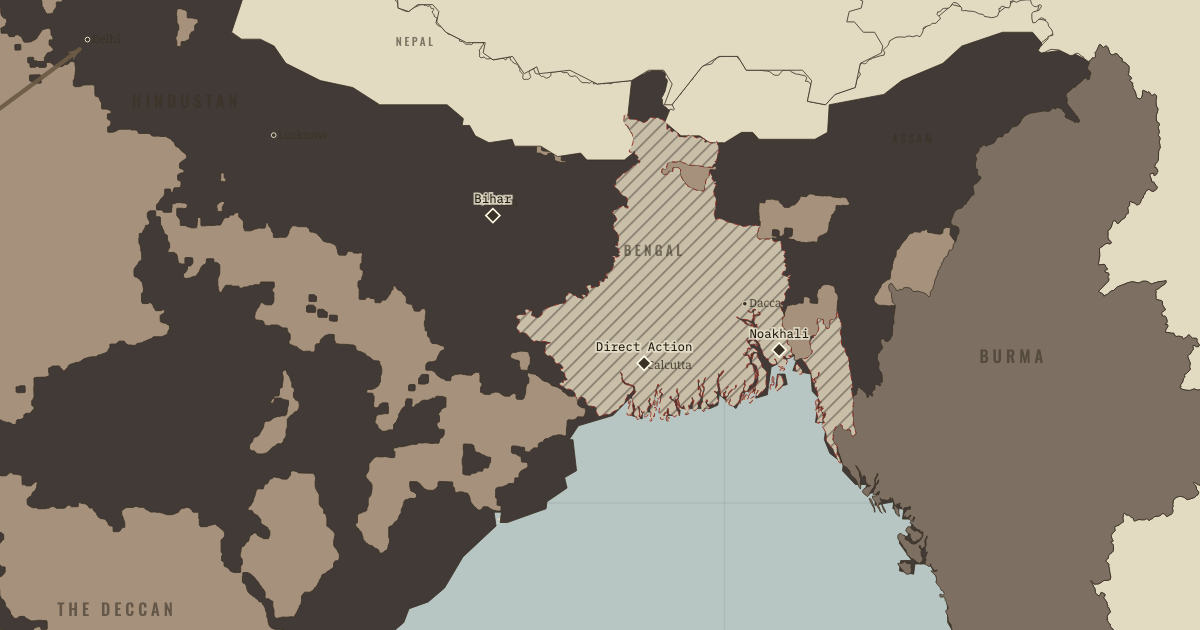
The map above is the world of India, August 1946 — Direct Action.
Every state on the map that year: The world in 1945 · Europe in 1945.
Part of IB History: Indian Independence and Partition →
SHORT EXPLANATION
Britain emerged from the war bankrupt and weaker in the world, and Attlee’s government intended to leave India. Its capacity to hold India by force was also in doubt. Public sympathy for Indian National Army officers tried at the Red Fort and the Royal Indian Navy mutiny in Bombay in early 1946 revealed unrest around the institutions on which the Raj depended. The transfer of power now raised a difficult question: who would receive it?
The election gave Congress most general seats and the League almost every Muslim seat, making Pakistan an electoral mandate as well as a resolution. A Cabinet Mission compromise briefly offered a united India, but disputes over provincial grouping and central power undermined it. The League called for direct action; killing in Calcutta began a cycle of communal violence that spread from Bengal to Bihar. Negotiations continued amid fear and armed mobilization.
The full story
Attlee’s Labour government intended to leave India. Britain had emerged from the war bankrupt, and the old settlement could no longer be preserved on the same terms. The election of winter 1945–46 showed how difficult it would be to decide who should inherit power. Congress swept the general seats. The League, which had won under five per cent of the Muslim vote in 1937, now won 87 per cent of Muslim seats and every Muslim seat in the central assembly. Pakistan had acquired a mandate.
The Raj also had reason to doubt the institutions that enforced its rule. Public fury over the Indian National Army trials at the Red Fort brought remission of the sentences. In February 1946 the Royal Indian Navy mutinied in Bombay; 78 ships flew the tricolour and the crescent together, and Patel’s persuasion put the mutiny down. London could no longer rely on its sword arm with the same confidence.
The Cabinet Mission arrived in March with a plan to keep India united. Its three-tier union would group provinces into Hindu-majority and Muslim-majority sections, leaving the center only defense, foreign affairs and communications. Congress would have a union; the League would have powerful groups within it. For one week in June both parties accepted the plan. A single Indian state came no closer to agreement.
The agreement depended on compulsory grouping surviving the departure of the British. Jinnah saw grouping as the substance of Pakistan within the union and feared that a Hindu majority would undo it. On 10 July Nehru said Congress entered the constituent assembly “uncommitted” to the scheme. For Jinnah, the remark appeared to confirm the danger. The League withdrew its acceptance and called for direct action.
Calcutta became a battlefield on 16 August 1946. Over four days, four to ten thousand people died as members of both communities killed and were killed. A League ministry governed the province, while the police lost control. In October Hindus were attacked in Noakhali; the seventy-seven-year-old Gandhi walked barefoot from village to village there for four months. In Bihar, Hindu crowds destroyed Muslim villages and killed thousands. By spring the violence had reached Punjab.
Meanwhile Congress and League ministers undermined their own interim government in Delhi. Ismay described the choice as partition or civil war, but events on the streets were already making the distinction harder to sustain.
FULL EXPLANATION
The “riot” was not a frenzy — it was organized
A “riot” can sound like an outbreak of impersonal crowd madness. That picture makes it easy to miss the preparation behind much of the killing of 1946–47. Before the Great Calcutta Killing, the League ministry declared a holiday and inflammatory mobilization took place. The Muslim League National Guard, the RSS and Sikh jathas of demobilized soldiers supplied planning, weapons and trained men on different sides. Targets were chosen in ways that helped clear territory. Gyanendra Pandey has shown how the language of “communal frenzy” could relieve leaders, states and neighbors of responsibility by attributing violence to collective madness. Paul Brass described enduring “institutionalized riot systems” with identifiable organizers and beneficiaries. To remember the dead of Calcutta, Noakhali and Bihar is therefore to reckon with decisions made by people for calculable ends, rather than to describe a natural disaster for which no one answered.
Why Britain left: an empire that ran out of money
Britain was a party to the crisis as well as a power presiding over negotiations. The war had bankrupted it. Britain owed India more in sterling balances than India owed it, depended on a punishing American loan and could not afford the garrisons its empire required. Attlee’s Labour government had been elected to reconstruct Britain at home. Holding India by force demanded money and will it lacked, especially when the response at the Red Fort and in Bombay harbor had made reliable service uncertain. India was the first and largest departure in a wider imperial retreat. In the same 1947 crisis, Palestine was handed to the United Nations and responsibility in Greece and Turkey to the Americans. Historians differ over the weight of British statesmanship, Indian pressure and imperial insolvency. The greatest weight belongs to insolvency: Britain could no longer afford the alternative to withdrawal. Its own needs help explain why departure followed Britain’s convenience and timetable rather than India’s readiness.
Key places on the map
On this day
Why it happened
1946: the mandate for Pakistan. Pakistan became a demand with a large electoral constituency. In nine years the League went from under 5% to 87% of the Muslim vote. The change grew out of the grievance of its 1937 wilderness years, official favor while Congress leaders were jailed during the war, and the promise of deliverance from majority rule. Faith was part of the campaign: pirs issued fatwas, and the ballot became a profession of belief. Whatever Jinnah’s original intentions, twenty million voters had been promised a country. After 1946 the demand could not be dismissed as a lawyer’s bluff.
The armed forces stop being reliable. A government considering the use of force must be able to trust the people expected to use it. The INA trials and the RIN mutiny made that assumption doubtful for London, turning the army and navy into a political problem at the heart of imperial rule. Wavell’s “breakdown plan” that winter amounted to an evacuation scheme. With the instrument of last resort in doubt, British planners worked against a clock. Haste became policy; the next chapter follows its execution.
The Cabinet Mission: the road not taken. The Cabinet Mission’s bargain had two faces. Congress would keep a union, though with a greatly reduced center; compulsory grouping and a communal veto would give the League much of Pakistan’s substance within it. Both accepted, yet each suspected the other would undo the bargain. Nehru’s July remark, careless or candid, confirmed the fear. Historians differ about intentions: Jalal argues that Congress preferred partition with a strong center to a weak-centered union, while others see Jinnah’s acceptance as tactical. June shows that common terms could be found. It also shows how much their survival depended on trust the parties lacked.
Violence becomes an argument. Direct Action Day made mass killing part of the political reckoning. In Calcutta violence created facts that conferences could not disregard, and refugee columns gave visible form to each community’s fear of rule by the other. Moderate positions lost support as those fears spread. The violence was not merely a background to the endgame: it changed the choices confronting the negotiators and helped steer the settlement.
THE TURNING POINT
Calcutta, 16–19 August 1946. Four days of killing in Calcutta changed the terms of negotiation. Partition had been one formula among several; now every party had to reckon with mass killing between communities and the possibility that it would recur. Wavell brought the League into the interim government hoping to stop the violence, but the killings had already altered political calculations. The map marks Calcutta first as a memorial to the dead of both communities, killed with equal savagery, and second as a turning point. The political consequences began with human lives.
What it changed
The spiral acquires its own government. The sequence widened: Noakhali followed Calcutta, Bihar followed Noakhali, and Garhmukteshwar followed Bihar. By March 1947 Punjab was arming. The League had brought down the Unionist coalition, and no ministry could hold the ring. As the state dissolved, veterans from the two million wartime soldiers organized on all sides. The Punjab catastrophe of chapter 13 was being prepared in these months.
Attlee sets a deadline. Attlee made British departure certain on 20 February 1947, announcing a transfer of power “by a date not later than June 1948,” and replacing Wavell with Mountbatten. The deadline was meant to force agreement among Indian parties. It also gave each an incentive to secure its position before time ran out. A prolonged crisis had become a countdown.
Gandhi is left behind by his own movement. Gandhi went to the places where people faced the violence: barefoot through the villages of Noakhali, then to Bihar and Calcutta’s slums. His presence calmed places where he stood. Calcutta stayed calm in August 1947 while Punjab burned, and Mountbatten called him a “one-man boundary force”. Elsewhere the killing continued. The movement Gandhi had built now followed leaders making different calculations: Patel counted states, Nehru days and Jinnah provinces. Gandhi directed his last fasts at his own side.
DISCUSSION QUESTION — For one week in June 1946, Congress and the League had both accepted a plan that kept India united. Was the Cabinet Mission plan a real chance, or an agreement neither side meant?
The acceptances were real, but the parties understood the bargain differently. On 6 June Jinnah accepted alongside a League resolution calling grouping the “foundation” of Pakistan: it was an installment toward the League’s goal. Congress accepted on 24 June with qualifications of its own. Nehru’s 10 July press conference gave those qualifications a practical meaning: the permanent majority in the constituent assembly would not consider itself bound. The plan left sovereignty ambiguous between the union and the groups. Reading Ayesha Jalal’s argument in reverse, that ambiguity made agreement possible while leaving its most important question to be contested later. Each party had spent a decade telling followers that ambiguity meant betrayal, so neither could easily let the other decide the answer. A durable chance would have required enforcement, such as a decade-long British guarantee of grouping. Bankrupt Britain, preparing to leave, could not credibly offer it. The June agreement shows that terms for unity could be found. Trust and time to sustain them were missing; Nehru’s press conference hastened a failure whose deeper problem was the absence of a trusted third party able to stay.
An interesting fact
Nationalist leaders helped end the Royal Indian Navy mutiny in February 1946. Vallabhbhai Patel persuaded the ratings to surrender, promising protection from the national parties: “the discipline of the movement required it,” he said. Jinnah appealed in parallel to Muslim ratings. Aruna Asaf Ali, a heroine of 1942, took a different view: she would “rather unite Hindus and Muslims at the barricade than on the constitution-making front.” Neither independent India nor Pakistan reinstated the dismissed sailors; symbolic gestures came decades later. The mutiny was too radical for the parties in 1946, and historians later restored it to the story of independence.
Related
THE FREE PRINTABLE STUDY GUIDE
Get the printable study guide for Indian Independence & Partition free. I’ll send you a few short letters, then one when a new atlas opens. That’s all. — Paul
NO TRACKING · YOUR ADDRESS IS USED FOR THE DISPATCH AND NOTHING ELSE · UNSUBSCRIBE ANYTIME