WW2 · CHAPTER 3 ·
Fall of France
Chapter 3 of The War Room — WW2, 1936–1945: “Blitzkrieg in the West”
In April 1940 Germany occupied Denmark and invaded Norway, and on 10 May it attacked the Low Countries and France. While the Allies advanced into Belgium, German armour crossed the Ardennes, forced the Meuse at Sedan and reached the Channel. About 338,000 troops escaped from Dunkirk, but France collapsed within six weeks.
WW2 is free — every chapter. No sign-up.
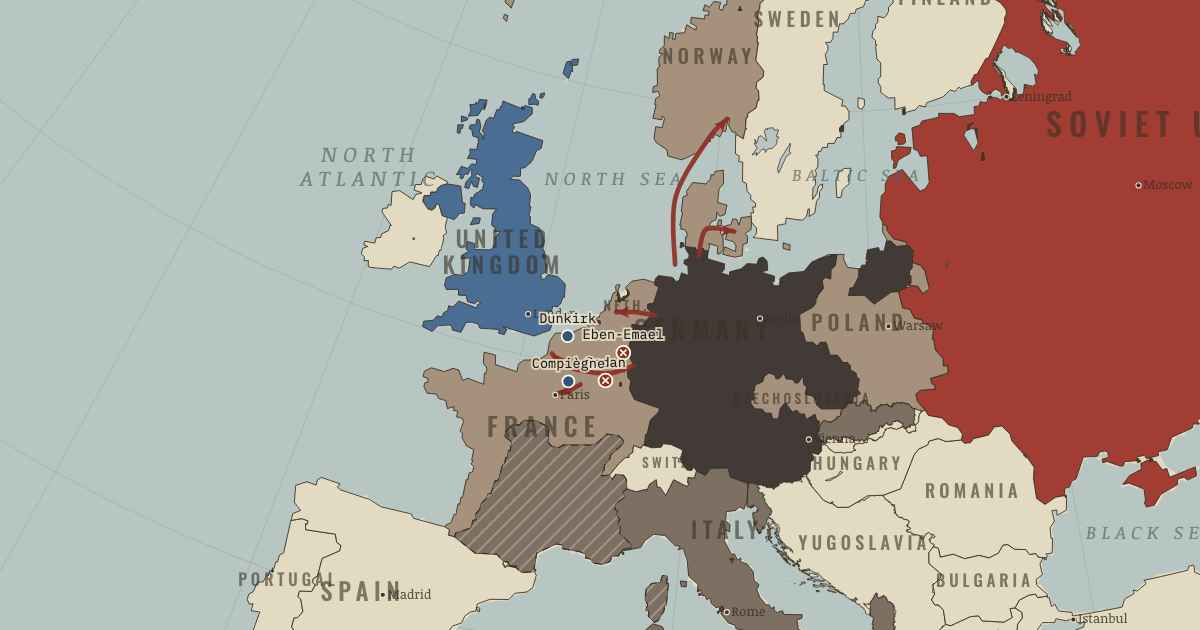
The map above is the world of Europe, June 1940 — France falls.
Every state on the map that year: The world in 1940 · Europe in 1940.
Part of IB History: The Second World War →
SHORT EXPLANATION
Germany first secured its northern flank. In April 1940 it occupied Denmark and invaded Norway, protecting the route for Swedish iron ore. Then, on 10 May, it attacked the Netherlands, Belgium, Luxembourg, and France. Expecting a repeat of the 1914 advance across the northern plains, the Allies sent their strongest armies into Belgium.
The main German blow came farther south. Armored divisions passed through the wooded Ardennes, which the Allies thought unsuitable for tanks, crossed the Meuse at Sedan, and reached the Channel. The armies in Belgium were cut off; about 338,000 troops escaped from Dunkirk, but France signed an armistice after six weeks. The map shows German occupation in the north and west and the collaborationist Vichy government in the south.
The full story
Germany’s invasion of Norway in 1940 had an immediate purpose. Swedish iron ore reached the sea through Narvik in winter, and control of Norway protected that route. Norwegian ports and airfields also gave Germany bases facing the Atlantic. The campaign brought a loss as well as a gain: the German navy lost warships that would have mattered when an invasion of Britain was considered later that year.
The attack on France and the Low Countries began on 10 May. The Allies expected the decisive German advance to come through the northern plains, as it had a generation earlier. They sent their best mobile formations into Belgium to meet it. This decision made sense if the main attack came where they expected. But it also placed those formations far to the north of the route Germany had chosen for its principal thrust.
Seven German panzer divisions moved through the Ardennes, crossed the Meuse at Sedan and drove west to the Channel. Look at what that route accomplished. The armies that had advanced into Belgium were now separated from the rest of France, and their communications were cut. The German success did not depend on equipment that was generally superior to the Allies’. Commanders concentrated their forces at the breach, used radios to communicate, and gave junior officers room to act as the situation changed.
Could the Allies have stopped the advance? The German columns were crowded and exposed on the narrow Ardennes roads, and Allied reconnaissance did glimpse them. Its reports, however, did not overturn the expectation that the main danger lay farther north. French doctrine envisaged a slower, closely controlled battle. German commanders used local initiative to keep moving before French headquarters could restore a continuous front. By the time the Germans reached the coast, the northern armies faced encirclement and the French reserve was badly placed to respond.
At Dunkirk, evacuation saved much of Britain’s trained army, but almost all its heavy weapons were left behind. France fell within six weeks. In the south, the Vichy government, shown hatched on the map, collaborated with Germany while retaining a limited administration of its own.
The victory changed the position of every major power in Europe. Britain lost its principal continental ally, Italy joined Germany as France fell, and the Soviet Union expanded in the Baltic. Germany now held the Atlantic coast. Its gains were enormous, but they had not forced Britain out of the war.
FULL EXPLANATION
How the German advance worked
Many French tanks had thicker armor and heavier guns than their German counterparts. Yet a tank comparison alone cannot explain what happened at Sedan. German panzer divisions brought tanks, infantry, engineers, artillery, and radios together. Concentrated at a narrow point, they could break through and then exploit the opening before senior headquarters restored a continuous line. Dive-bombers provided mobile firepower when artillery fell behind. French commanders expected a carefully controlled “methodical battle.” That preference was understandable after 1914–18, but its decision cycle was too slow to contain a rapid penetration. The German approach carried its own risks: the Ardennes columns were exposed, and spearheads sometimes outran infantry and supplies. The outcome depended on a hazardous method meeting an opponent whose assumptions made the danger difficult to recognize and punish.
Why France fell
Earlier accounts attributed France’s defeat to low morale or national decline. But France mobilized millions of men, fought hard in many sectors, and lost roughly 90,000 military dead in six weeks. Recent military history instead asks how deployment and command allowed the front to come apart. The main mobile reserve went north, the response at Sedan was slow, and command lost control after the northern armies were cut off. Political instability and defensive habits mattered, but these are different claims from an accusation of cowardice. The Maginot Line did not itself fail: German planners had expected to go around its main fortifications, and they did. Sending the mobile reserve north while underrating the Ardennes was the decisive error in this account, which can be tested against the map, the deployment of forces, and the timing of decisions.
Key places on the map
On this day
Why it happened
Concentrating the armor. France had many capable tanks and assigned much of its armor to infantry support. Germany brought tanks and other arms together in formations coordinated by radio, allowing force to be concentrated at a breakthrough.
Risk through the Ardennes. The revised German plan sent its main weight along a route the Allies thought unsuitable for a large, rapid armored advance. That choice offered surprise, but crowded columns on narrow roads were exposed.
Norway’s gain and cost. Norway protected Swedish ore shipments and offered Atlantic bases. The warships Germany lost there were unavailable to cover a later invasion of Britain.
THE TURNING POINT
The crossing at Sedan, 13–15 May. On 13–15 May German forces crossed the Meuse at Sedan under concentrated air attack. French command was too slow to organize a counterattack, and the bridgehead grew. Reserves could not seal the breach before it threatened the wider Allied position.
What it changed
Trained troops survive. A pause in the German advance and the Luftwaffe’s failure helped about 338,000 Allied troops escape from Dunkirk. Britain abandoned much equipment but kept trained personnel for the war ahead.
Britain remains at war. Defeat in France left Britain facing invasion and pressure to seek terms. Churchill’s government chose to fight on, making control of the air the next test.
Other powers move. Italy entered the war as France fell, while the USSR annexed the Baltic states and Bessarabia. Germany’s rapid victory changed what other powers could attempt in Europe.
DISCUSSION QUESTION — France had more tanks and artillery, and comparable manpower. Why did its armies collapse so quickly?
The totals do not tell us where the forces were or how quickly they could be used. France sent its mobile reserve north and prepared for a controlled battle. Germany concentrated combined arms through the Ardennes, crossed at Sedan, and used radio communications to exploit the breach. The drive to the coast severed communications and separated the Allied armies before France could restore its front.
An interesting fact
Some 41,000 vehicles of Panzergruppe Kleist queued for the Ardennes advance, in columns stretching 250 kilometers back beyond the Rhine. For days they were exposed to air attack. Allied reconnaissance pilots reported seeing the columns, including headlights burning on the night of 10–11 May, but headquarters continued to expect that the Ardennes was unsuitable for a major tank advance.
Related
THE FREE PRINTABLE STUDY GUIDE
Get the printable study guide for WW2 free. I’ll send you a few short letters, then one when a new atlas opens. That’s all. — Paul
NO TRACKING · YOUR ADDRESS IS USED FOR THE DISPATCH AND NOTHING ELSE · UNSUBSCRIBE ANYTIME