Road to WW2 · CHAPTER 7 ·
Anschluss and the Munich Agreement
Chapter 7 of The Road to War, 1931–1941: “Anschluss and Munich: Appeasement at Full Stretch”
Germany annexed Austria in March 1938, leaving Czechoslovakia nearly surrounded. Hitler then used the grievances of the Sudeten Germans to manufacture a crisis, and at Munich on 29–30 September Britain and France agreed to hand the Sudetenland to Germany, while Czechoslovakia and the Soviet Union were excluded from the talks.
Chapter 7 is included with every paid plan. WW2 is free in full, and chapter 1 of every atlas is free. A free account opens 3 more chapters a day. Starter, at $9 a month, opens all 21 with no daily limit — see the plans.
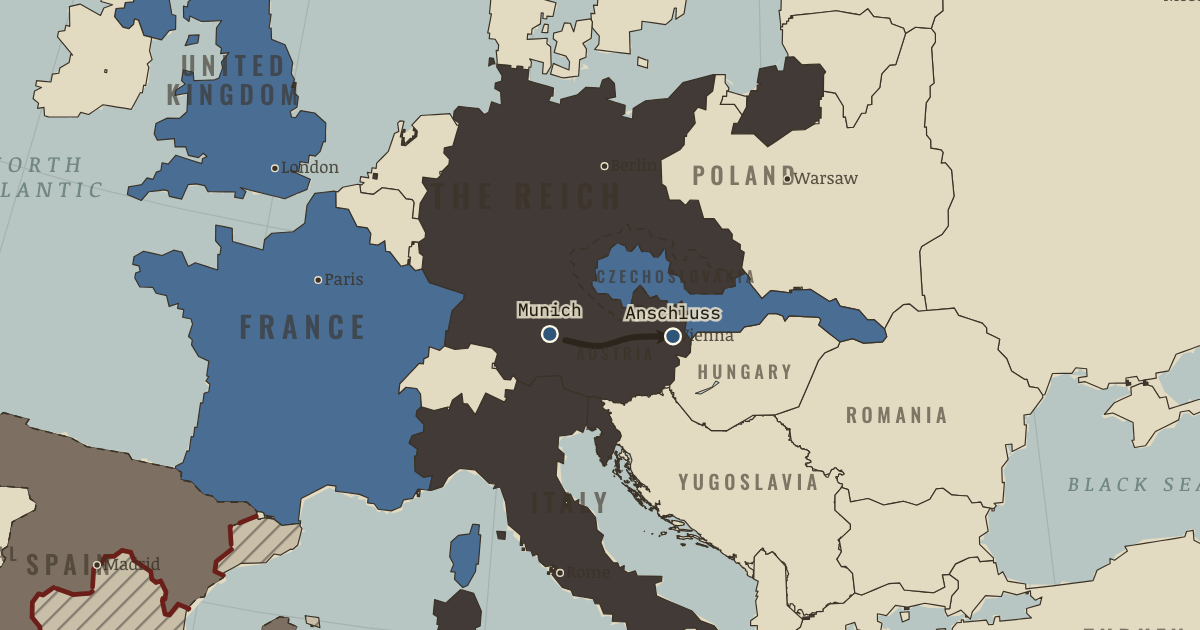
The map above is the world of Europe and Africa, October 1938 — Munich — the Sudetenland signed away.
Every state on the map that year: The world in 1938 · Europe in 1938.
Part of IB History: The Road to War →
SHORT EXPLANATION
The union of Germany and Austria in March 1938 left Czechoslovakia with German territory on three sides. Hitler then turned to its Sudeten borderlands, where about three million ethnic Germans had real grievances. He used those complaints to create a crisis. At Munich, Britain and France joined Germany and Italy in awarding the region to Germany; Czechoslovakia had no seat at the conference.
The British and French hoped a concession would avert war, address a disputed settlement and give them time to rearm. But the territory they surrendered contained Czechoslovakia’s mountain defenses and much of its industrial strength. The Soviet Union’s exclusion deepened distrust. The settlement could preserve peace only if Hitler’s demands had a limit; his occupation of Prague in March 1939 showed that they extended beyond German-speaking lands.
The full story
German troops crossed into Austria on 12 March 1938, and Germany annexed the country. Many Austrians celebrated, while Jews faced immediate persecution. The union changed the position of another state: Czechoslovakia, which France had promised to defend, now had German territory on three sides.
Hitler next made the Sudeten Germans’ grievances the occasion for a crisis. Their border region contained Czechoslovakia’s main fortifications. At Munich on 29–30 September, Britain and France agreed with Germany and Italy that the Sudetenland should pass to Germany. Neither Czechoslovakia nor the Soviet Union was present. Chamberlain hoped the concession would satisfy Hitler and prevent war; Hitler had wanted a war.
The British case for a settlement was serious. Leaders remembered the slaughter of 1914–18 and feared devastating air raids. Britain had a small army, and its leaders doubted that the Dominions would fight over the Sudetenland. Many also thought the postwar settlement had left real injustices. Negotiation could address a grievance and give Britain time to produce fighters and develop radar.
But time had a price. Czechoslovakia’s roughly thirty-five divisions depended on mountain defenses, and its Škoda works produced arms. Surrendering the border weakened an ally and improved Germany’s position. France had a treaty with Prague but judged it could not fight without Britain; the Soviet Union’s exclusion deepened its distrust. Britain gained time to strengthen its defenses, while Germany gained resources and strategic advantages. The occupation of Prague in March 1939 showed that Hitler’s ambitions went beyond German-populated territory.
FULL EXPLANATION
Appeasement as strategy
Negotiation offered British leaders more than an escape from an immediate crisis. The memory of 1914–18, fear of bombing, Britain’s small army and doubts about the Dominions’ willingness to fight all made war a frightening prospect. Many also believed that Versailles had left genuine injustices. A settlement might correct one of them while Britain built fighters and developed radar. The difficulty was deciding whether a concession had settled the dispute. Each one gave Hitler resources and prestige; a further demand could be presented as another correction to the postwar settlement. When Germany occupied Prague in March 1939, the claim to German populations could no longer explain its expansion. By then Czechoslovakia had lost its border defenses and much of its industrial strength.
The 1938 military counterfactual
A different decision at Munich might have led to war in 1938. We cannot establish its outcome by pointing to the Allied victory in 1945. Czechoslovakia had substantial forces, fortifications and an arms industry; France outnumbered German forces in the west, and some German officers discussed a coup if Hitler provoked war. These were considerable assets. There were obstacles as well. Britain could not quickly send a large army, and British and French leaders feared heavy air losses. Poland and Hungary had claims against Czechoslovakia. Soviet help depended on disputed transit routes and political trust. The year after Munich improved British air defenses, but it also gave Germany Czech weapons and a stronger position. Many historians judge that the military balance moved against the anti-German coalition, though a 1938 war remains a counterfactual. Czechoslovakia’s exclusion and dismemberment can be judged without knowing its outcome.
Key places on the map
On this day
Why it happened
The memory of war and fear of bombing. A generation after the trenches, British leaders had reason to dread another European war. Air power added a fear of cities being devastated at once. Baldwin’s warning that “the bomber will always get through” and the bombing of Guernica (Ch. 5) gave that fear force; air-staff forecasts for London predicted casualties about ten times those later experienced. Against such expectations, negotiating a border revision could seem a smaller price. The forecast was mistaken about 1938, but the fear was intelligible.
A real grievance used for conquest. Sudeten Germans had entered Czechoslovakia without choosing that state in 1919. The Depression struck their region hard, and Czech policy had only partly addressed their complaints. Many British officials also believed Versailles had treated Germany unfairly. A concession might therefore seem a way to meet a legitimate grievance and distinguish reasonable demands from conquest. Hitler and Henlein’s party used those same grievances to intensify a crisis whose aims went beyond minority rights.
The disputed military balance. Britain could not send an army to Bohemia, Chamberlain’s advisers said, and needed roughly two years to prepare its air defenses. Time for radar and Spitfires mattered. Yet Czechoslovakia had roughly thirty-five divisions behind mountain fortifications, and France had a hundred divisions facing five German ones in the west. Officers around Beck and Halder discussed a coup if Hitler brought war. Division counts alone do not settle readiness, deployment or political will, and the coup was never tested. Britain improved its defenses in the year gained, but Germany armed faster and acquired Czech weapons. Many historians judge the exchange unfavorable; the leaders deciding in 1938 lacked the German archives later scholars could consult.
France and its British ally. France had promised to support Prague since 1924; Britain had no equivalent treaty. The French decision nevertheless depended heavily on London. French planning was defensive, politics were divided, and Daladier, though doubtful that Hitler’s ambitions were limited, judged that France could not fight without Britain. Returning to Le Bourget, he reportedly expected an angry reception. When crowds cheered instead, he is said to have murmured “the fools”.
THE TURNING POINT
Munich, 29–30 September 1938. Munich was the last opportunity to resist Hitler with Czechoslovakia’s army and border fortifications intact as an ally. The Soviet Union’s exclusion also deepened distrust of the West, with consequences discussed in Chapter 8. The later “Guilty Men” account treated the decision as the betrayal of an easy victory. That judgment leaves out Chamberlain’s rearmament, the Dominions’ reluctance to fight over the Sudetenland and the weakness of French air power. Still, the settlement depended on Hitler’s demands having a limit. Prague supplied the answer in March 1939, after Czechoslovakia’s territory and defenses had been surrendered.
What it changed
Czech arms in German hands. The loss of Czech defenses and industry changed the forces available for a later war. Germany acquired further military resources when it occupied Prague in March 1939. Czech-built 35(t) and 38(t) tanks formed a significant part of its force against France in 1940; the original estimate puts their share at about a third. The territory given up at Munich had helped strengthen the enemy Britain was buying time to face.
Soviet distrust deepens. Munich reinforced Stalin’s fear that Western powers might direct Hitler eastward: the Soviet Union had been excluded from the settlement. In May 1939 Molotov replaced Litvinov, the Jewish foreign minister who had advocated collective security. Berlin received the signal. Munich was one influence on the road to the Nazi–Soviet Pact, discussed in Chapter 8.
Britain issues guarantees. Prague changed Chamberlain’s policy within a weekend. Britain guaranteed Poland, then Romania and Greece, seeking to deter further aggression. The commitments were easier to issue than direct military help would be to deliver. Their effectiveness depended in part on whether Hitler believed Britain would act.
DISCUSSION QUESTION — Was Munich a betrayal, a blunder, or the best of the bad options available to Chamberlain in September 1938?
The three verdicts bring different parts of the decision into focus. Betrayal describes what happened to Czechoslovakia: its friends decided to dismember a functioning democracy without consulting it. Blunder asks what the bargain did to the military balance. Britain gained time for radar and fighters, while Germany gained Czech arms and a stronger position and a fortified ally was weakened. The officers considering a German coup were never tested. Best-of-bad-options takes Chamberlain’s uncertainty seriously. Allies were unready, the Dominions reluctant, and the public wanted peace; he believed Hitler’s demands might be limited. That belief explains the decision, but it also exposes its cost. Czechoslovakia paid before Hitler’s intentions were established, and the coalition later faced a stronger Germany.
An interesting fact
The document Chamberlain waved at Heston was not the Munich Agreement. He had drafted a separate half-page Anglo-German friendship declaration over breakfast and asked Hitler to sign it the next morning; witnesses said Hitler barely read it. The agreement itself was signed in the small hours at the Führerbau on Munich’s Königsplatz. The building is now a music conservatory, and the room where four powers dismembered a fifth is used for student recitals.
Related
THE FREE PRINTABLE STUDY GUIDE
Get the printable study guide for The Road to War free. I’ll send you a few short letters, then one when a new atlas opens. That’s all. — Paul
NO TRACKING · YOUR ADDRESS IS USED FOR THE DISPATCH AND NOTHING ELSE · UNSUBSCRIBE ANYTIME