Refugee crises · CHAPTER 10 ·
1979 Geneva conference on refugees
Chapter 10 of Uprooted: Refugees in Europe 1945–1960 and Indochina 1975–1990: “Geneva and the US Response”
At the UN’s call, 65 governments met in Geneva on 20–21 July 1979 and raised resettlement pledges from about 125,000 to 260,000 places. Southeast Asian states agreed to let boats land, Vietnam promised to curb illegal departures, and the Orderly Departure Program flew about 620,000 approved emigrants out of Vietnam by 1997.
Chapter 10 is included with every paid plan. WW2 is free in full, and chapter 1 of every atlas is free. A free account opens 3 more chapters a day. Starter, at $9 a month, opens all 21 with no daily limit — see the plans.
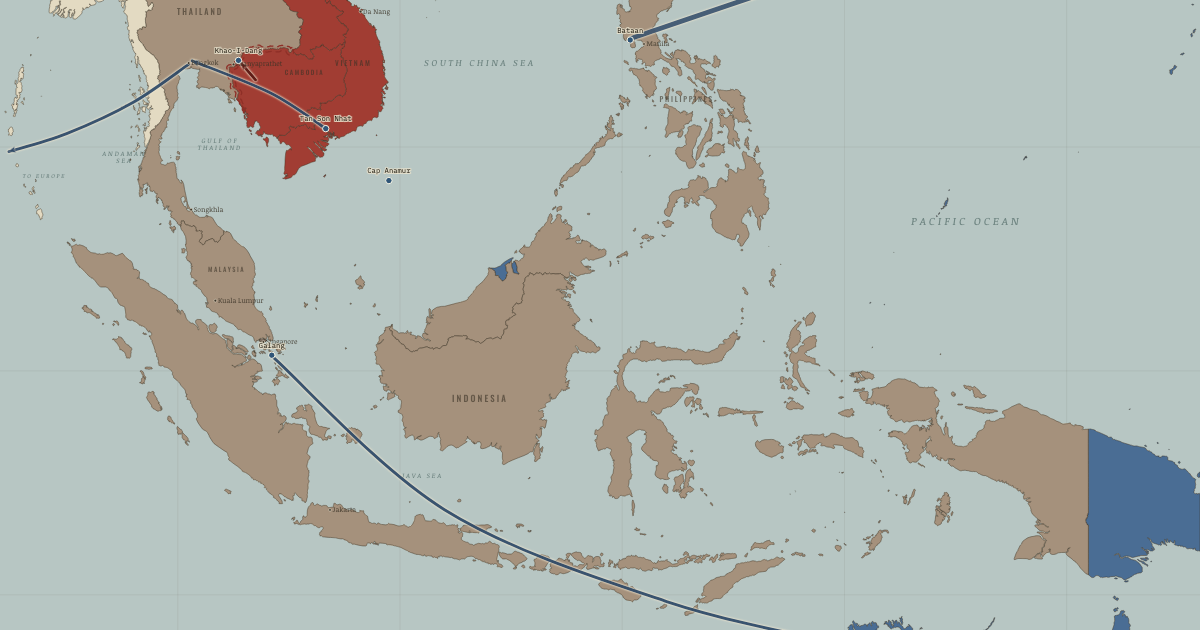
The map above is the world of Refugees in Southeast Asia, October 1979 — Thailand admits Cambodians.
Every state on the map that year: The world in 1980 · Europe in 1980.
Part of IB History: Refugees in Europe and Indochina →
SHORT EXPLANATION
The shores of Southeast Asia had begun to close when 65 governments met at Geneva on 20–21 July 1979, at the UN Secretary-General’s request. Their agreement joined two promises: regional states would let boats land and offer first asylum, a temporary refuge in the first country reached; Western states would provide permanent homes elsewhere. Resettlement pledges rose from about 125,000 places to 260,000, and governments promised about $160 million. Indonesia and the Philippines offered sites for processing centers, where people already accepted elsewhere could prepare for travel. Vietnam agreed to curb illegal departures and expand the Orderly Departure Program, agreed with UNHCR, the UN refugee agency, in May, so approved emigrants could leave by air. Arrivals fell from more than 50,000 a month in May and June to about 9,000 in August, partly because Vietnamese police stopped boats leaving.
The United States became the principal destination. In June 1979 President Carter doubled admissions to 14,000 a month; the Refugee Act of March 1980 adopted the UN definition of a refugee as a person outside their country with a well-founded fear of persecution and established a permanent admission and resettlement system. From 1975 to 1995 the United States accepted about 823,000 Indochinese from first-asylum camps and hundreds of thousands more through orderly departure. Blue arrows on the map lead to North America, Australia and Europe, and coastlines turn tan as landing became possible again. From October 1979 starving Cambodians were admitted to Thai border camps such as Khao-I-Dang. The bargain had been made under threat, and it relied on continuing public support for resettlement.
The full story
At Geneva the immediate problem was how to let people land without leaving their first hosts responsible for them indefinitely. Resettlement countries promised places, and monthly departures to permanent homes rose from about 9,000 before the meeting to about 25,000 afterward. Regional governments could reopen their shores; Western governments no longer faced the spectacle of boats being towed back to sea. Vietnam, for its part, gained relief from condemnation after promising to “make every effort to halt illegal departures”. Arrivals fell sharply as Vietnamese police stopped boats leaving.
A separate route already existed for some who wanted to leave. Under a memorandum signed by Vietnam and UNHCR on 30 May 1979, the Orderly Departure Program allowed approved emigrants, often relatives of earlier refugees, to fly from Tan Son Nhat airport near Saigon. By 1997 about 620,000 had left through the program, most for the United States. A flight avoided the dangers of the sea, and the program gave governments an orderly way to bring families together. Critics nevertheless saw a cost in the wider bargain: stopping the boats also meant that Vietnam prevented some of its citizens from fleeing.
The United States accepted the largest share, partly because it saw many refugees as allies left behind. The crisis also exposed a weakness in American law. Before 1980 the refugee category focused mainly on people fleeing communist countries or the Middle East. Large groups, including Indochinese, needed emergency parole powers to enter outside normal quotas. Each new wave required another exceptional decision. The Refugee Act, signed on 17 March 1980, adopted the 1951 Convention’s definition of a refugee as a person with a well-founded fear of persecution, established a normal ceiling of 50,000 admissions a year and created an Office of Refugee Resettlement to fund the work.
Acceptance was followed by preparation for a new home. At Galang in Indonesia and the Philippine Refugee Processing Center at Bataan, refugees passed through centers before onward travel. Bataan taught English and American work habits to more than 400,000 people. Other countries took substantial numbers too. Canada admitted about 60,000 in 1979–80, including about 34,000 sponsored privately by citizens’ groups. By 1995 Australia had taken about 138,000 and France about 96,000. Resettlement depended on several governments and, in Canada, on private groups as well.
The emergency on Thailand’s Cambodian border could not be settled by the Geneva bargain alone. Vietnam had overthrown Pol Pot’s communist Khmer Rouge regime, and hundreds of thousands of survivors, many starving after failed harvests, moved toward Thailand alongside Khmer Rouge troops and civilians under their control. In June 1979 Thai soldiers forced more than 42,000 Cambodians back across a mined escarpment at Preah Vihear. An international outcry followed. Prime Minister Kriangsak Chomanan announced an open door on 19 October, and UNHCR opened Khao-I-Dang on 21 November. Though Thailand closed it to new arrivals in January 1980, it held about 140,000 to 160,000 people by March.
Hundreds of thousands more remained along the border, shown as a dashed red zone on the map. Rice and seed reached them through a “land bridge” at Nong Chan. Thailand, China and Western governments also allowed the camps to shelter resistance armies fighting the Vietnamese-backed government. Relief saved people from immediate want, but most were not resettled. The border became a holding zone for a decade.
FULL EXPLANATION
The Geneva bargain and its critics
In Terms of Refuge (1998), W. Courtland Robinson describes Geneva as an exchange: first asylum in the region for resettlement elsewhere. The numbers show the speed of change. US intelligence counted 59,412 arrivals in May 1979, 24,315 in July, 8,792 in August and 8,988 in September. It credited Hanoi’s controls on departure as well as the Geneva pledges. This created a difficulty for UNHCR. The agency protected people who fled, yet welcoming Vietnam’s promise to stop “illegal departures” appeared to support restrictions on the right to leave one’s country, a right protected by the Universal Declaration of Human Rights. Supporters answered that orderly departure saved lives by substituting a flight for a dangerous voyage. The agreement also left Cambodians at the Thai border outside its solution and gave no answer to how long resettlement countries would continue accepting arrivals. When departures rose again in the late 1980s, the sense of crisis behind the first bargain had faded. The parties negotiated a harsher agreement, the Comprehensive Plan of Action of 1989.
The Refugee Act of 1980
American refugee policy had long followed foreign-policy priorities. Gil Loescher and John Scanlan’s Calculated Kindness (1986) traces that pattern from 1945 to 1980: the 1965 law reserved its small refugee category for people fleeing communist countries or the Middle East. Larger groups, including Hungarians in 1956, Cubans and Indochinese, entered through the attorney general’s “parole” power, an emergency authority outside ordinary quotas. That power could admit a particular group, but each new wave needed a fresh decision. The Refugee Act of 1980 replaced this dependence on emergencies with the Convention’s neutral definition, a regular annual ceiling and an emergency procedure. A federal office funded resettlement through states and voluntary agencies. Carl Bon Tempo’s Americans at the Gate (2008) regards the Act as genuine reform on paper, while arguing that Cold War preferences persisted in practice; the contrasting treatment of Cubans and Haitians arriving by sea that year illustrated the point. The Act nevertheless furnished the machinery for the Indochinese program, including Orderly Departure and Amerasian programs, throughout the 1980s.
Canada and the sponsors
In Canada, responsibility for a refugee family could be taken on by people outside government. The Immigration Act of 1976, effective from 1978, let groups of at least five citizens, churches and associations sponsor refugees and provide housing, income and settlement assistance for a year. In July 1979 the government promised a state-sponsored place for each privately sponsored refugee. The response was so quick that the 1979–80 target rose to 60,000, including about 34,000 privately sponsored people. UNHCR awarded its Nansen Refugee Award in 1986 to “the people of Canada”, the only occasion on which it honored an entire nation. Later governments copied Canada’s model. Australia relied chiefly on government programs; France, the former colonial power, accepted many Vietnamese, Cambodians and Laotians with French education or family ties. These arrangements placed different amounts of work with the state and civil society. Public involvement could give citizens a stake in sustaining a program, as when Austrians and other Europeans welcomed Hungarians into their homes in 1956.
Key places on the map
On this day
Why it happened
The threat at the shoreline. In June 1979 ASEAN declared that no new arrivals would be accepted, and boats were pushed back. The prospect was plain: people whom Western governments had promised to help could die at sea. First-asylum states used their power to refuse as leverage. Within weeks the UN called the Geneva meeting, with mass death at sea the alternative to action.
Debts of a lost war. Many refugees were former allies or employees of the United States, France or Australia, or their relatives. American leaders spoke of a moral obligation; the Vietnamese community formed after 1975 pressed for relatives to be admitted. Cold War interest reinforced that sense of duty, since flight from a communist state confirmed Western judgments of it.
Public pressure in the West. Crowded boats appeared on television, and reports described piracy at sea. Public sympathy gave Western governments room to increase quotas, as it had for Hungarians in 1956. French intellectuals from left and right joined “A Boat for Vietnam”; a West German citizens’ committee chartered the Cap Anamur to rescue people.
Hanoi’s interest in a deal. Vietnam’s invasion of Cambodia and war with China had left it isolated, while its economy depended on aid. Further condemnation threatened the support it retained. An agreement eased that pressure; orderly departure also allowed Hanoi to control who left and retain remittances from relatives abroad. Curbing departures cost Hanoi little and brought it into the international arrangement.
THE TURNING POINT
Geneva, 20–21 July 1979, and the camp at Galang. Galang shows what the Geneva agreement required on the ground. Before the meeting, refugees landing in Indonesia waited in makeshift camps without guaranteed onward movement. Afterward Indonesia offered an island south of Singapore as a processing center, where resettlement officers registered and interviewed people and prepared them for their new countries. The promise of Western places made temporary regional asylum possible, and shores reopened within weeks. The same arrangement made asylum dependent on continued resettlement, a condition tested when Western generosity ran out.
What it changed
Leaving by aeroplane. Orderly departure gave some families a route through regulated emigration instead of a sea crossing. Numbers grew from a trickle in 1980 to about 86,000 departures at the 1991 peak. Relatives of earlier refugees, former re-education prisoners and Amerasian children traveled under the program, often after years of paperwork, interviews and bribes. The 1989 plan repeated the lesson that some departures could be organized; chapter 11 follows it.
A refugee law for the United States. The Refugee Act of 1980 remains the basis of American refugee admissions. Its Convention definition linked the United States to the international regime it had refused to sign in 1951. Chapter 12 compares the legal legacies: Europe’s crisis produced the Convention, while Indochina’s brought its largest resettlement country under it.
Processing centres become a system. Schools, clinics and language courses turned Galang, Bataan and Phanat Nikhom into lasting institutions. For people accepted elsewhere they were transit centers; for those whose cases were refused, the wait could last years. A place built for passage could become a place of indefinite detention. Chapter 11 follows the screening intended to address the growing problem.
The border camps endure. Hundreds of thousands of Cambodians remained in Thai border camps, partly governed by resistance factions. From 1982 the United Nations Border Relief Operation supplied them. Their return in 1992–93 followed a decade of waiting; their fate depended on a Cambodian peace settlement that took twelve years to arrive. Chapter 11 follows that wait.
DISCUSSION QUESTION — How far did the Geneva meeting of July 1979 solve the boat-people crisis?
Geneva resolved the immediate danger at the closed shores. Resettlement rose to about 25,000 a month, arrivals fell from over 50,000 to under 10,000, and orderly departure began to offer a safer route. Yet much of the fall resulted from Vietnamese police stopping boats: fewer people faced death at sea, while others lost the freedom to flee. The agreement did nothing for Cambodians at the Thai border and depended on resettlement countries continuing to accept arrivals. That promise weakened during the 1980s as later arrivals were increasingly seen as economic migrants. Geneva managed an emergency and bought a decade of order, but made asylum conditional rather than settling the problem. Hungary in 1956 suggests why sharing responsibility can work when the burden seems finite and falter when it appears endless.
An interesting fact
Jean-Paul Sartre and Raymond Aron had been friends at the École normale supérieure in the 1920s, then bitter political opponents for three decades. The boat people brought them together again. On 20 June 1979 they appeared at a Paris press conference for “A Boat for Vietnam”, the campaign that chartered the hospital ship Île de Lumière; photographers captured their handshake. Six days later they went together to the Élysée Palace to ask President Valéry Giscard d’Estaing to admit more refugees. A dispute over the ship within Médecins Sans Frontières led Bernard Kouchner to leave and found Médecins du Monde in 1980.
Related
THE FREE PRINTABLE STUDY GUIDE
Get the printable study guide for Uprooted free. I’ll send you a few short letters, then one when a new atlas opens. That’s all. — Paul
NO TRACKING · YOUR ADDRESS IS USED FOR THE DISPATCH AND NOTHING ELSE · UNSUBSCRIBE ANYTIME