WW2 · CHAPTER 10 ·
Kursk and the fall of Mussolini
Chapter 10 of The War Room — WW2, 1936–1945: “Kursk, and the Fall of Fascist Italy”
In July 1943 Germany attacked the Kursk salient, but Soviet forces, warned months in advance, had built deep defensive belts that halted the attack, and by autumn the Red Army reached the Dnieper. That month the Allies landed in Sicily; Mussolini was voted out and arrested, and Italy signed an armistice in September.
WW2 is free — every chapter. No sign-up.
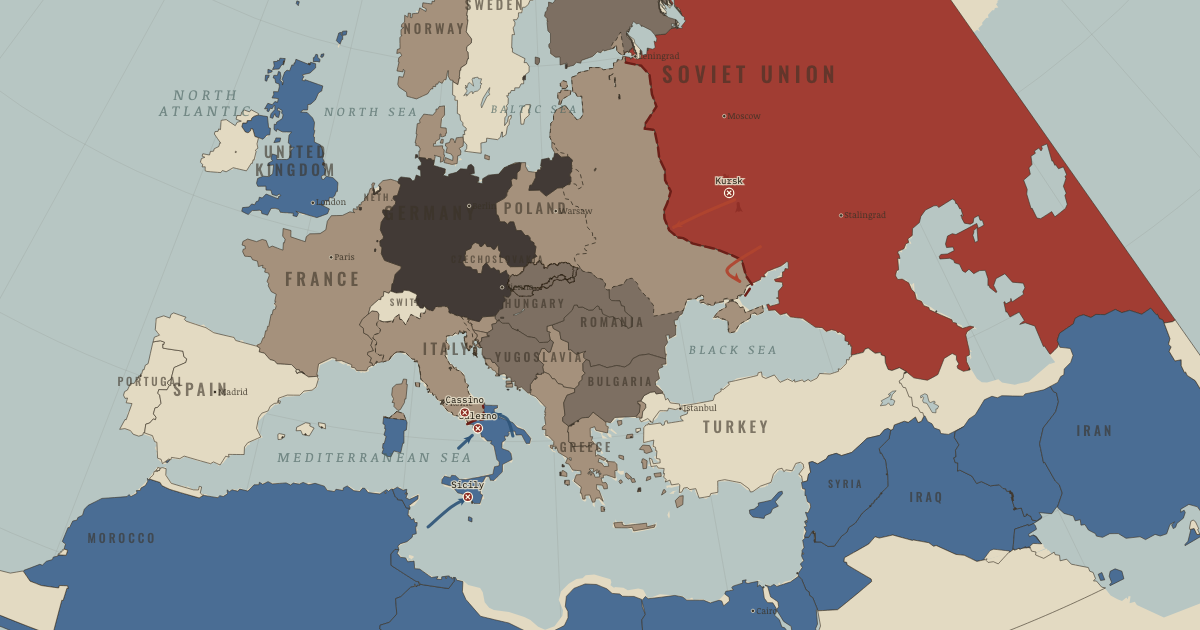
The map above is the world of Europe, October 1943 — Italy changes sides.
Every state on the map that year: The world in 1942 · Europe in 1942.
Part of IB History: The Second World War →
SHORT EXPLANATION
Germany sought to regain the initiative after Stalingrad. In July 1943 it attacked the Kursk salient, a great bulge in the eastern front, hoping to surround the Soviet forces inside it. Soviet intelligence had identified the target, and months of warning allowed commanders to build deep defenses. German attacks stalled among minefields and gun lines; Soviet counteroffensives then carried the fighting west.
That same July, Western Allied forces landed in Sicily. The invasion exposed the weakness of Mussolini’s government: his Fascist colleagues removed him, the king had him arrested, and Italy signed an armistice in September. Germany was ready for that possibility. Its troops occupied much of Italy, disarmed Italian forces and restored Mussolini as head of a dependent state. The peninsula became the scene of an Allied campaign from the south and a civil war among Italians.
The full story
The front at Kursk offered Germany an appealing target. Soviet territory projected into German-held ground in a large salient, and attacks from north and south might meet behind it, trapping the forces inside. After Stalingrad, such a victory in Operation Citadel promised to restore confidence in Germany’s ability to take the initiative. Its very shape, however, made the likely target apparent. Soviet intelligence supplied warning, and German delays while awaiting new tanks gave Soviet commanders more time to prepare.
The Soviets chose to receive the attack. They laid minefields and built successive belts of anti-tank positions, keeping reserves farther back. A German breakthrough at one line would therefore lead to another line, not open country. German forces penetrated parts of the defenses, but could not close the encirclement. The Soviet counteroffensives followed, and by autumn the Red Army had reached the Dnieper. Germany never again mounted a strategic offensive in the east.
The cost of the defense deserves attention. Soviet losses near Prokhorovka were far heavier than older heroic accounts admitted. Yet the two sides needed different results. Germany needed a rapid encirclement; the Soviets needed to stop it and retain enough strength to counterattack. Their reserves and replacements allowed them to continue after heavy losses, while the defensive belts had made the attackers spend time and strength before those reserves went forward.
While Citadel was under way, the Western Allies landed in Sicily in July. Military failure had reached Italian soil, and Mussolini lost the support of his own Fascist Grand Council. The king ordered his arrest, and Italy signed an armistice in September. This did not end the fighting in Italy. German forces had prepared for an Italian departure; they occupied northern and central Italy, disarmed Italian units, rescued Mussolini and installed him over the puppet Salò Republic. Allied forces and Italian co-belligerents advanced from the south, while German troops, Italian fascists and Italian partisans fought across the peninsula.
The Sicily landing added another demand on Hitler’s forces, although Citadel was already failing on its own. In Italy, mountains, narrow fronts and prepared German lines slowed the Allied advance. The campaign removed an Axis partner and tied down German divisions, but it provided no quick road into Germany. Its strategic gains had to be weighed against a long and costly fight.
FULL EXPLANATION
Why wait for the attack?
Waiting for an enemy attack can look like surrendering the initiative. At Kursk, Soviet commanders chose to do it because they could prepare the ground on which that attack would be fought. They accepted that German forces might take some ground and trusted the defenses to hold long enough for reserves to intervene. The defenses were a system of successive belts: mines, anti-tank guns and infantry strongpoints, with reserves behind them. Breaking one position would not end the fight. German armor had to keep moving through the next, spending fuel, vehicles and time. Soviet reserves could then strike forces already worn down by the advance. The losses were not evenly distributed. Archival research has revised the familiar picture of Prokhorovka as an even tank duel: Soviet armored losses on 12 July were much higher than German losses. But the exchange and the strategic result answer different questions. Germany needed to encircle the salient. The Soviets prevented that and had the reserves and replacement capacity to continue their offensive despite the heavy cost.
After Mussolini’s fall
Mussolini’s fall revealed how vulnerable his dictatorship had become among its own elite once military failure reached home soil. But an armistice could not by itself remove German troops from Italy. Germany disarmed many Italian units and seized key routes, leaving the Allies with an Italian partner and naval advantages, yet a peninsula still to fight through. The ground favored its defenders. Mountains, rivers, narrow fronts and poor weather limited the use the Allies could make of their superiority. German divisions were tied down in Italy, but Allied troops and shipping were committed there too, instead of serving elsewhere. Historians consequently assess the campaign as a strategic compromise: it removed an Axis power and opened the Mediterranean, while failing to provide a rapid route into Germany. For Italians, German occupation and partisan fighting made 1943–45 both an international war and a civil war.
Key places on the map
On this day
Why it happened
A victory after defeat. Stalingrad and Tunis had damaged German standing. Berlin wanted its allies, neutral states and its own public to see that Germany could still seize the initiative. Kursk offered a conspicuous opportunity, even though victory there could not itself win the war; standing still risked displaying weakness.
Warning and preparation. Moscow received warning from the Lucy spy ring and British Ultra decrypts. The salient itself suggested where an attack might come, and German delays while awaiting new tanks allowed further preparation. Soviet commanders used the time to build defenses and gather reserves for a counterattack.
The Mediterranean compromise. The Allies had to decide where they could fight next. At Casablanca, Americans wanted an invasion of France in 1943; the British judged Sicily more realistic given the available shipping and experience. The Mediterranean compromise would maintain pressure, seek Italy’s exit and draw German divisions south while the invasion of France waited until 1944.
THE TURNING POINT
Prokhorovka and the halt order, 12–13 July. On 12 July the southern German attack met a Soviet reserve tank army near Prokhorovka. Hitler also received news of the Sicily landings. He halted Citadel and considered the need for forces elsewhere. Germany had failed to encircle the Soviet forces, and Soviet counteroffensives would carry the initiative westward.
What it changed
The retreat west. Soviet counteroffensives carried the Red Army toward the Dnieper in autumn; Kiev fell in November. The war was moving west, and Germany had to defend a long front against continuing Soviet attacks.
Italy’s divided war. Italy’s armistice left a divided country at war. Allied and co-belligerent Italian forces fought from the south; in German-occupied territory, Mussolini’s Salò Republic fought Italian partisans. The Gustav Line divided the opposing forces in the campaign. The civil war within the wider conflict left scars long after 1945.
Experience for another landing. Sicily and Salerno gave the Allies experience in amphibious command and naval gunfire, as well as mistakes to learn from. That experience helped prepare the invasion of Normandy in 1944.
DISCUSSION QUESTION — Why did Soviet commanders choose to receive the German attack at Kursk before counterattacking?
Soviet commanders expected their prepared belts to slow the Germans and inflict losses before the reserves counterattacked. The choice required them to accept lost ground and trust the defenses to hold. They had the depth and replacements to absorb the blow and then attack an enemy that had spent strength trying to break through.
An interesting fact
The story of Prokhorovka changed when Soviet archives became available. For decades the battle had been celebrated as a great tank clash that bled both sides equally. On 12 July the attacking 5th Guards Tank Army lost an estimated 200–300 armored vehicles, dozens in an anti-tank ditch dug by its own engineers; German losses were a small fraction of that. Stalin convened a commission and considered court-martialing the tank army’s commander, although the heroic account survived. The Red Army could absorb that costly day and continue its advance; the German panzer force could less readily afford even its smaller losses.
Related
THE FREE PRINTABLE STUDY GUIDE
Get the printable study guide for WW2 free. I’ll send you a few short letters, then one when a new atlas opens. That’s all. — Paul
NO TRACKING · YOUR ADDRESS IS USED FOR THE DISPATCH AND NOTHING ELSE · UNSUBSCRIBE ANYTIME