MAPS OF HISTORY · IB HISTORY · INDIAN INDEPENDENCE & PARTITION
IB HISTORY · 1857 – 1964 · 15 CHAPTERS
IB History: Indian Independence and Partition — notes, maps and essay questions
The largest colony in history freed itself, but what did freedom deliver? The story runs from the rising of 1857 through ninety years of the Raj and Gandhi’s mass movement, to a border drawn in five weeks and a republic that redrew its states by language.
IB notes for this atlas are in preparation. Meanwhile, this page gathers the study notes every one of its 15 chapters already carries: why each episode happened, the moment it turned on, what it changed, and the question historians still argue about. It also shows where the atlas fits the IB course.
WW2 is free in full, and chapter 1 of every atlas is free. A free account opens 3 more chapters a day. Opening a new atlas uses one of them. Membership opens all 21 — Join.
Where it fits the course
The atlas is filed under Paper 2 (Popular Movements) and Paper 3 for Higher Level (Asia and Oceania, (1857–1964)). Its IB notes, with evidence lists, primary sources and model essay plans, are in preparation. These are the IB History pages for the parts of the course it serves:
- Paper 2 · Popular Movements
- Paper 3 · Asia and Oceania · HL (1857–1964)
Why it began
The opening chapters offer explanations for how this story began. Their arguments about the causes appear here in a few sentences each, ready to test against your own reading.
Chapter 1: The Rebellion and the Crown
Dalhousie’s annexations and the Doctrine of Lapse. Between 1848 and 1856 Dalhousie added more territory to British India than any previous governor. Some came by conquest: Punjab in 1849 and Lower Burma in 1852. The Doctrine of Lapse provided another means. A dependent ruler without a natural son could adopt an heir, but the Company refused to recognize that succession and took Satara, Jhansi and Nagpur. Other rulers could see what might happen to their own states. Among those who lost a throne or pension were the Rani of Jhansi and Nana Sahib, who went on to lead the rising.
Awadh: an annexation that reached the barracks. The Company annexed Awadh in February 1856 on grounds of misgovernment and sent King Wajid Ali Shah into exile in Calcutta. Its new summary revenue settlement deprived the talukdars, the province's great landholders, of thousands of villages. The consequences reached the barracks because many Bengal Army sepoys came from Awadh. Soldiers, landholders and peasants thus had connected reasons to resist the new rule; in Awadh their participation made the rebellion a popular war.
An army that no longer trusted its masters. Pay and standing helped bind the Bengal Army to the Company. Both were under strain in the 1850s. Allowances for service in newly annexed provinces were cut, while the General Service Enlistment Act of July 1856 required new recruits to serve overseas. Many high-caste Hindus believed that crossing the sea would break caste. Missionary preaching and reforms, including the 1856 law permitting Hindu widows to remarry, encouraged fears that the Company intended forced conversion. Soldiers could therefore read a new order in the light of an existing distrust.
The cartridge: a rumour as trigger. The Enfield rifle issued in 1857 required a soldier to bite open a paper cartridge. Reports from Dum Dum and Barrackpore said its grease contained cow and pig fat, polluting to Hindus and Muslims alike. The army ordered ungreased cartridges and changed the drill, but the rumor persisted because it fitted fears already present in the ranks. At Barrackpore Mangal Pandey attacked his officers on 29 March. On 9 May at Meerut, 85 troopers who had refused the cartridges were shackled on parade; their comrades rose the following evening. A shared suspicion had become a shared act of defiance.
Chapter 2: Congress and the Raj
The Crown’s promise and its limits. In her proclamation of 1858 Victoria promised that Indians would be “freely and impartially admitted” to office. The conditions for entering the ICS made that promise difficult to realize. Candidates had to sit the examination in London; in 1876 the Secretary of State, Lord Salisbury, reduced the upper age limit to nineteen, beginning with the 1878 examination. Indian graduates could scarcely compete, and only a handful entered before the century ended. Lawyers and teachers who had taken the promise seriously organized to bring practice closer to it.
The Ilbert Bill and the lesson of agitation. Viceroy Lord Ripon backed a bill in 1883 drafted by his law member, Courtenay Ilbert. It would have allowed senior Indian magistrates to try Europeans in rural courts. British planters, merchants and officials in Calcutta mounted an openly racial campaign against the measure. In the 1884 compromise, a European defendant could demand a jury at least half European. Educated Indians saw both the unequal result and the means by which it had been obtained: organized pressure had moved the government. Two years later they founded a body of their own, the Indian National Congress.
Railways, print and English made an all-India public. A movement claiming to speak across India needed people to meet and ideas to travel. Railways brought delegates from Madras, Lahore and Calcutta to the same city, allowing Congress to meet in a different place each December. Telegraphs and cheap newspapers carried arguments between provinces. English, used in the universities founded in Calcutta, Bombay and Madras in 1857, supplied Bengalis, Marathas and Tamils with a shared political language. Institutions and communications created under the Raj became resources for its critics.
Famine and the economic case against the Raj. Dadabhai Naoroji's income-per-head estimates, begun in the 1870s and collected in Poverty and Un-British Rule in India (1901), offered a way to connect colonial government to poverty. Pensions, army costs and interest sent a “drain” to Britain, he argued, leaving India poorer and less able to withstand drought. Romesh Chunder Dutt's Economic History of India (1902–04) placed direct blame for famine on heavy land revenue. The famines gave their arguments urgency: the question was not only who held office, but whether people could sustain their livelihoods.
Chapter 3: The Raj at High Noon
Conquest completed, confidence at its peak. By 1905 British officials could look back on half a century in which the conquest appeared settled. The Mutiny of 1857 had been crushed, Crown rule had begun in 1858, and the frontier against Russia had been fixed in the Great Game. Curzon called the Raj “the miracle of the world”; no serious challenge had yet been mounted. That confidence encouraged officials to discount Indian opinion just as it was organizing.
The quilt, not the monolith. After 1857 Britain kept the princely states as loyal buffers, inexpensive to govern and a traditional barrier to nationalism. The tan areas on the map accounted for two-fifths of the land and a quarter of the people, outside British India proper. Their rulers had personal treaties with the Crown; there were no elections or Congress branches in the states. In 1947 the same legal separation would present a final crisis: 565 separate sovereignties to gather in ten weeks.
An educated class with nowhere to rise. The universities Britain founded in 1857 produced more graduates than the Raj would employ. By 1905 the upper ranks of the ICS remained almost entirely white, while the “statutory Indian” faced examinations held only in London. English-speaking lawyers and editors from this blocked elite helped found Congress. They had learned the Raj's liberal language and wanted its promises applied to their own government. Refusal of that modest request radicalized a generation.
Land revenue and the drain. Indian land tax funded the Raj, while a further “Home Charge” sent money to Britain for pensions, army costs and guaranteed railway dividends. Nationalist economists called this transfer the Drain. In Poverty and Un-British Rule (1901), Dadabhai Naoroji connected it to the famines of the 1890s, which killed millions. The economic critique came before the political one and outlasted it.
Chapter by chapter
These entries trace the atlas through 15 chapters, identifying the causes and turning point of each. Select a title to open its free chapter page, where the full explanation, a discussion question and the map appear together.
1. The Rebellion and the Crown
CHAPTER 1 · 1857–1858
Why it happened: Dalhousie’s annexations and the Doctrine of Lapse · Awadh: an annexation that reached the barracks · An army that no longer trusted its masters · The cartridge: a rumour as trigger
The turning point: Delhi, 11 May 1857.
2. Congress and the Raj
CHAPTER 2 · 1858–1905
Why it happened: The Crown’s promise and its limits · The Ilbert Bill and the lesson of agitation · Railways, print and English made an all-India public · Famine and the economic case against the Raj
The turning point: Bombay, 28 December 1885.
3. The Raj at High Noon
CHAPTER 3 · 1905
Why it happened: Conquest completed, confidence at its peak · The quilt, not the monolith · An educated class with nowhere to rise · Land revenue and the drain
The turning point: The Delhi durbar, 1 January 1903.
4. Bengal Cut in Two
CHAPTER 4 · 1905–1911
Why it happened: An administrative logic with a political edge · Swadeshi: the economy as battlefield · Muslim anxiety was real, not manufactured · Congress splits over method
The turning point: 16 October 1905 — the day of the partition.
5. The Great War’s Price
CHAPTER 5 · 1914–1918
Why it happened: Loyalty as investment · Lucknow: unity brokered at a price · Champaran: the method finds its country · The war hollows the Raj itself
The turning point: Lucknow, December 1916.
6. Amritsar — The End of Consent
CHAPTER 6 · 1919
Why it happened: Rowlatt: the insult of permanence · The Punjab under pressure · Dyer’s theory of exemplary terror · A promise already discounted
The turning point: Jallianwala Bagh, 13 April 1919.
7. Non-Cooperation — The Method Argued
CHAPTER 7 · 1920–1922
Why it happened: Amritsar plus Khilafat: two griefs, one front · Gandhi’s wager on discipline · The boycott’s real economics · Swaraj undefined — deliberately
The turning point: Chauri Chaura, 4 February 1922.
8. Salt
CHAPTER 8 · 1930–1935
Why it happened: Why salt was the perfect target · The lesson of 1922, applied · A world now watching · Depression squeezes the countryside
The turning point: Dandi, 6 April 1930.
9. The Elected Map
CHAPTER 9 · 1935–1939
Why it happened: The 1935 Act: self-rule as containment · Why Congress swept and the League failed, 1937 · The UP coalition refusal · Office reveals the stakes of majority rule
The turning point: Jinnah refused, 1937.
10. The War Claims India
CHAPTER 10 · 1939–1941
Why it happened: One signature, four hundred million people · Congress’s impossible position · The Raj discovers the League’s uses · From minority to nation: the doctrine assembled
The turning point: Lahore, 23 March 1940.
11. Quit India — and the Famine
CHAPTER 11 · 1942–1944
Why it happened: 1942: the empire’s prestige collapses in Asia · Cripps: too little for Congress, too late for trust · The rising without leaders · Famine: policy inside the catastrophe
The turning point: Gowalia Tank, 8 August 1942.
12. The Year of the Knife
CHAPTER 12 · 1945–1946
Why it happened: 1946: the mandate for Pakistan · The armed forces stop being reliable · The Cabinet Mission: the road not taken · Violence becomes an argument
The turning point: Calcutta, 16–19 August 1946.
13. Freedom at Midnight
CHAPTER 13 · 1947
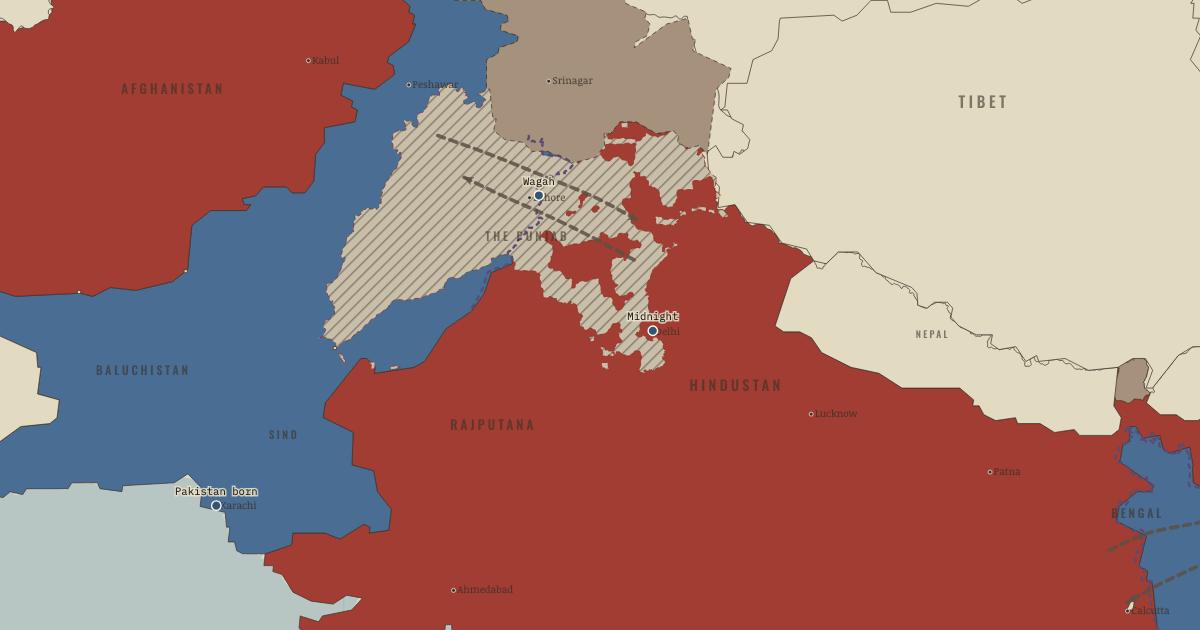
Why it happened: The seventy-three-day timetable · Radcliffe’s five weeks · The princely stampede · Why the Punjab, worst of all
The turning point: The award published, 17 August 1947.
14. The Price and the Legacy
CHAPTER 14 · 1947–1949
Why it happened: Three holdouts, one doctrine · Kashmir: geography against theory · The assassination’s politics · Why Ceylon and Burma exited differently
The turning point: Birla House, 30 January 1948.
15. Building the Republic
CHAPTER 15 · 1950–1964
Why it happened: Partition’s legacy: a state that feared its own divisions · Universal suffrage as a deliberate gamble · The language movements · Cold War choices and the border with China
The turning point: Madras, 15 December 1952.
Essay questions, argued
Historians still debate the question at the end of each chapter. Before reading our brief answer, try making a plan for how you would answer it.
DISCUSSION QUESTION · CHAPTER 1
Was the rising of 1857 a mutiny, a peasants’ war or a war of independence?
Each name identifies something that happened, but none describes the whole rising equally well. It began with soldiers refusing orders, killing officers and marching on Delhi: that was a mutiny. In Awadh and the upper Doab, talukdars and peasants joined a struggle over annexation, revenue and lost land. Stokes and Mukherjee show how intense the rebellion became where those grievances were sharpest. Independence is a question of definition. Rebels at Delhi, Lucknow and Jhansi sought to end Company rule and restore an Indian sovereign. A national movement, however, would require a wider common cause: Punjab, Bengal, the south and most princes stood aside, and educated classes opposed the rising. It was the last great attempt to restore the old political order, and it frightened Britain into changing its government of India. The map lets us test each name against the people and regions it includes.
The chapter behind it: The Rebellion and the Crown. Every chapter’s question is on the discussion questions page.
DISCUSSION QUESTION · CHAPTER 6
The Hunter Commission censured Dyer and he was retired from active command. Why was that punishment worse than none at all?
The official response censured Dyer without treating his action as a crime. He faced no court and kept his pension. The Lords voted in his favour, and the British public presented him with a fortune in a purse and a jewelled sword inscribed “Saviour of the Punjab”. O’Dwyer, who had ratified the massacre, was entirely exonerated. Indians could see formal disapproval beside evidence that the killing was valued as a service. A hanging would have been justice; full exoneration would at least have been candid. The half-measure neither punished terror nor honestly acknowledged its use, undermining the government’s claim to rule by law. From 1920 the argument in India shifted from whether British rule was legitimate to how and when it would end.
The chapter behind it: Amritsar — The End of Consent. Every chapter’s question is on the discussion questions page.
DISCUSSION QUESTION · CHAPTER 11
Amartya Sen showed Bengal in 1943 had enough food. Why, then, did three million people die, and who bears responsibility?
Sen asked us to look at what people could command, not simply at whether food existed. Rice prices tripled under wartime inflation while rural wages stood still. Fishermen first lost boats to denial policy; landless laborers and artisans also lost the means to buy food that remained visible in the market. The chain of responsibility runs through several governments and the market. The League-led provincial government under Huq and then Nazimuddin mishandled procurement and concealed the famine’s scale; New Delhi gave the war priority over relief. Hoarders acted in an unregulated market during shortage. London refused repeated shipping requests while food was stockpiled in the Mediterranean theater, and Churchill’s recorded remarks supply the tone. Bayly and Harper call this “callous neglect”; Mukerjee argues for something nearer policy. Historians differ over the weight of these causes, while almost none accept pure natural disaster as an explanation. Sen also argued that famine of this kind has not occurred in a functioning democracy with a free press. Accountability matters because rulers must answer to the people affected. Bengal’s rulers did not answer to those who starved.
The chapter behind it: Quit India — and the Famine. Every chapter’s question is on the discussion questions page.
DISCUSSION QUESTION · CHAPTER 15
By 1964, had independence delivered what the national movement had promised?
The movement made more than one promise, and by 1964 their fortunes had diverged. Self-government had taken substantial form: India had a constitution, universal suffrage, an independent judiciary and three general elections held on time. Its federation had absorbed the princely states and redrawn its internal boundaries by language without breaking. Foreign rule had also receded from the subcontinent: by 1961 the French and Portuguese enclaves were gone. Other promises were harder to fulfill. Mass poverty persisted, incomes rose slowly and food shortages threatened in the 1960s; literacy reached only 28 per cent by 1961. Social equality had a place in law that it did not yet have in daily life, a gap made visible by Ambedkar’s conversion in 1956. The hope of secure surroundings also went unfulfilled: Kashmir remained disputed and China defeated India in 1962. Historians weigh the record differently. There is a strong case for calling democracy the rarer achievement, since prosperity could still come later while lost freedoms are seldom recovered. Independence gave Indians a state through which to pursue the remaining promises; their fulfillment would demand work over the following decades.
The chapter behind it: Building the Republic. Every chapter’s question is on the discussion questions page.
What it changed
Consequence questions need the end of the story. The final chapter, Building the Republic, sets out what the period left behind:
A democracy that held. Elections had to become a habit before the first one could count as the beginning of a durable democracy. India held its second and third general elections on time in 1957 and 1962, and power passed peacefully to Lal Bahadur Shastri after Nehru’s death. Kerala tested another aspect of the system. In 1957 it elected a Communist government, among the first anywhere to take office through a free election. The centre accepted it until dismissing it in 1959, revealing the reach of Delhi’s constitutional powers. As many other newly decolonized states moved toward one-party or military rule, India’s democratic survival became its most cited achievement.
The unfinished revolution of caste and gender. The republic could change the law more quickly than it changed social relations. The constitution abolished untouchability, while the Hindu Code laws of 1955–56 gave Hindu women rights to divorce and inherit. Ambedkar had resigned from Nehru’s cabinet in 1951 when the Hindu Code Bill stalled. In October 1956 he left Hinduism and converted to Buddhism at Nagpur with several hundred thousand followers. His warning remained a challenge to the republic’s achievement: political democracy needed social democracy beneath it if it was to survive.
A planned economy and its limits. The planners gave India steel mills, dams and research institutes, and industry grew quickly from a low base. These were foundations for an industrial state, but they did not feed the country at the same pace. National income grew only about 3.5 to 4 per cent a year and farming lagged behind. By the early 1960s India depended on American wheat supplied under PL-480, a United States law selling surplus grain to poorer countries. The droughts of 1965–66 would make food an emergency for the next government. Most Indians lived in villages, where change was much slower than the growth of the industrial base.
Borders still in dispute. The internal reorganization left India with a more settled map inside the union than at its edges. China held Aksai Chin after the 1962 war, about 38,000 square kilometres claimed by India; the boundary has never been agreed. Kashmir remained divided along the 1949 ceasefire line, and India and Pakistan fought again little more than a year after Nehru’s death. The contrast with 1857 is striking: then the edges were secure while the interior was in revolt; the map Nehru left in 1964 had a settled interior and disputed frontiers.
Revision tools
The atlas ends with a map quiz that asks you to find places and moments on the map itself (part of every plan from Starter up). The quick quiz and the discussion questions with our answers are free pages on this site, and the printable study guide gathers every chapter’s notes into one document for revision.
Read next
- The decolonization of Africa · THE DECOLONIZATION OF AFRICA
- Protest and change after 1945 · PROTEST AND CHANGE
Maps of History is independent and is not affiliated with or endorsed by the International Baccalaureate Organization. IB course names describe alignment only; paper, theme and section names follow the new course outline and may change when the final guide is published.
THE DISPATCH
Get the printable study guide for Indian Independence & Partition free. I’ll send you a few short letters, then one when a new atlas opens. That’s all. — Paul
NO TRACKING · YOUR ADDRESS IS USED FOR THE DISPATCH AND NOTHING ELSE · UNSUBSCRIBE ANYTIME