WW2 · CHAPTER 8 ·
Battle of Midway
Chapter 8 of The War Room — WW2, 1936–1945: “Midway: Intelligence, Risk, and a Turning Point”
After the Doolittle Raid of April 1942, Japan planned to seize Midway atoll and lure the surviving American carriers to their destruction. US codebreakers had partly read Japan’s naval code, so Admiral Nimitz set an ambush instead. On 4 June 1942 American dive-bombers sank four Japanese fleet carriers for the loss of one.
WW2 is free — every chapter. No sign-up.
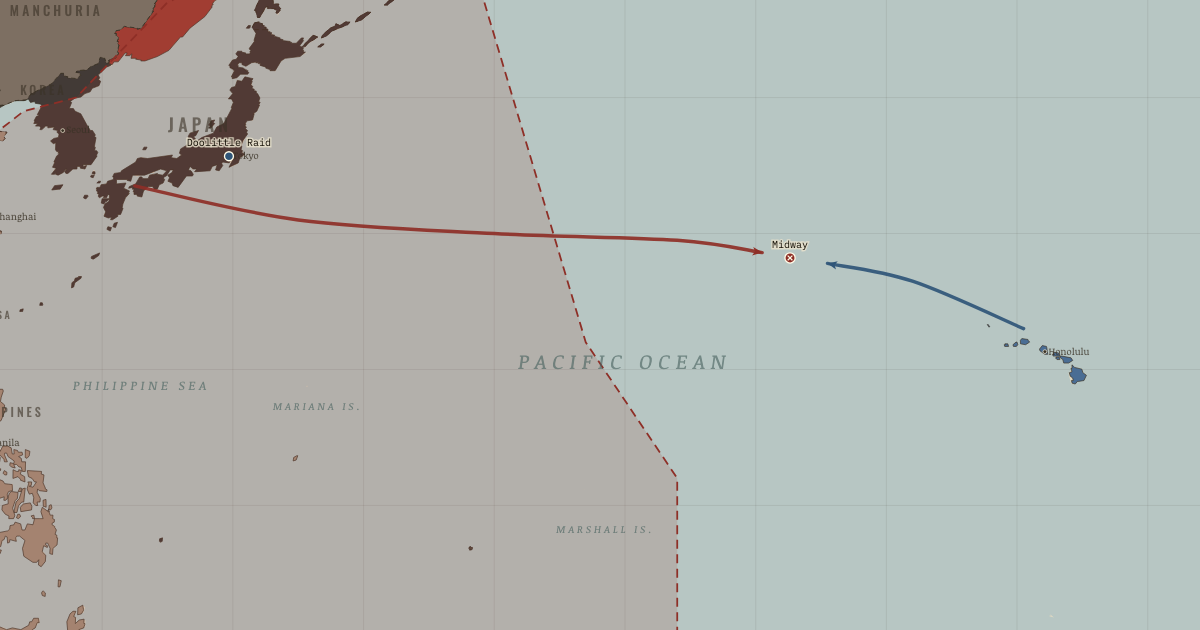
The map above is the world of Asia and the Pacific, May 1942 — The hundred days.
Every state on the map that year: The world in 1942 · Europe in 1942.
Part of IB History: The Second World War →
SHORT EXPLANATION
In April 1942 sixteen American bombers took off from a carrier and struck Japan. The Doolittle Raid did little material damage, but exposed the home islands to attack and embarrassed the navy responsible for their defense. Japanese commanders planned to take Midway and draw the surviving American carriers into a decisive battle. American codebreakers had partly read Japan’s naval code, however, and Admiral Nimitz used their findings about the likely target and timing to position his own carriers.
On 4 June American dive-bombers mortally hit three Japanese fleet carriers within minutes; a fourth was lost later that day. The United States lost one carrier. Japan still had a dangerous navy, but had lost ships and experienced airmen it could not quickly replace. Its perimeter stopped expanding, and American forces landed at Guadalcanal two months later to begin a long counteroffensive.
The full story
Japan had planned an operation against Midway before the Doolittle Raid made it more urgent. In April 1942, sixteen American bombers took off from a carrier and struck Japan. Their material damage was small, but the home islands had been reached, embarrassing the navy sworn to protect them. Taking Midway could extend Japan’s defensive perimeter and draw the American carriers into the decisive battle Japanese commanders wanted.
The operation depended on surprise and on the Americans responding as expected. It also spread Japanese forces across a vast area. These choices mattered once the United States learned where to wait: a plan designed to bring the enemy to battle on Japan’s terms would meet an enemy already prepared for it.
At Station HYPO, analysts had partly broken the Japanese naval code JN-25. Message fragments and traffic patterns pointed to a target called “AF,” but the designation needed interpretation. The Americans sent a false report that Midway was short of fresh water. A Japanese message then reported a water shortage at AF, helping confirm that Midway was the target. Nimitz placed three carriers northeast of the atoll, accepting a real risk while still lacking complete knowledge of Japanese strength.
That intelligence put the carriers in position. The battle still depended on what happened in the air. American torpedo squadrons suffered terrible losses; their attacks disrupted Japanese defenses and drew fighters down toward sea level. Search errors, navigation, cloud cover and the timing of separate air groups all played a part. Dive-bombers found the Japanese carriers while aircraft were being refueled and rearmed. Three carriers were mortally hit within minutes on 4 June, and a fourth later that day. The United States lost one carrier.
The battle brought rough carrier parity, but Japan and the United States could not replace their losses at the same rate. Japan had trained excellent aviators slowly and could not quickly restore its experienced crews. The United States was expanding a much larger system for training pilots and building aircraft and carriers. Codebreaking and command judgment had made the encounter possible; courage and timing helped turn it into victory. American capacity to replace losses helped make the shift in the balance last.
FULL EXPLANATION
Turning information into advantage
Knowing that Japan intended to attack “AF” was useful only if American commanders could establish what AF meant and act on the answer. HYPO analysts combined fragments of JN-25 messages with traffic patterns. They then arranged a false report that Midway was short of fresh water; a Japanese message about AF’s water shortage helped confirm the identification. Nimitz used the finding to place carriers for an ambush, though incomplete knowledge of Japanese strength left him with a serious risk to judge. Japan’s dispersed plan relied on surprise, and its complexity made rapid adaptation harder when American carriers appeared early. The information changed where the Americans waited; from that position their aircraft had a chance to strike. Crews still had to find and attack the enemy.
Luck, preparation, and doctrine
The destruction of three carriers in the famous “five minutes” depended on events no commander could fully arrange. Search patterns, navigation errors, cloud cover and the timing of separate squadrons mattered. Yet the Americans had prepared to meet the attack: codebreaking put their carriers in position, pilots kept searching as fuel ran low, and costly torpedo attacks disrupted Japanese fighter cover. The familiar image of decks simply piled with bombs has since been revised; aircraft handling and disruption of the defenses also help explain what happened. The losses became a lasting shift in power because the two sides replaced their forces differently. Japan’s superb prewar aviators were trained slowly, while the United States built a much larger pipeline of pilots, aircraft and carriers. Japan could not quickly rebuild the elite force it lost.
Key places on the map
On this day
Why it happened
The Doolittle Raid. American aircraft had reached Japan, even though the Doolittle Raid did little material damage. That embarrassment strengthened the case for extending the defensive perimeter and seeking the decisive carrier battle Japanese commanders wanted.
Reading the target. HYPO’s partial reading of JN-25 pointed to a target called “AF.” A false report that Midway lacked fresh water helped establish its identity. Japan planned to trap the Americans; Nimitz could prepare an ambush of his own, though intelligence offered a chance rather than a guarantee.
A dispersed operation. Six months of conquest preceded Japan’s ambitious plan, which dispersed forces across a vast area and depended on surprise. The Aleutians operation formed another part of it. American foreknowledge put Japan’s assumption that it could choose the terms of the encounter in doubt.
THE TURNING POINT
The carrier strikes, 4 June 1942. Around 10:20–10:25 a.m. on 4 June 1942, American dive-bombers attacked Akagi, Kaga and Sōryū, mortally damaging all three within minutes. The aircraft had arrived after separate searches and costly torpedo attacks that disrupted Japanese defenses. A fourth carrier was struck later that day.
What it changed
A counteroffensive begins. Four fleet carriers were gone, weakening Japan’s ability to support further expansion, and its perimeter stopped growing. Two months later, in August, US Marines landed at Guadalcanal. The counteroffensive had begun, although the struggle for the initiative continued.
Replacing the losses. Ships were only part of Japan’s loss. Veteran pilots took years to train, and Japan lacked a mass training pipeline comparable to that of the United States. As Japan struggled to replace its experienced aviators, American supplies of pilots, aircraft and carriers expanded.
Another 1942 turning point. At Midway, intelligence placed the American force where timing and chance could give it an opportunity. The next chapter’s turning point, Stalingrad, shows Soviet commanders striking a different vulnerability in an advancing enemy.
DISCUSSION QUESTION — Was the American victory at Midway a matter of luck or calculated risk?
Both. Codebreaking and Nimitz’s deployment put American carriers in position; navigation, timing and disruption of Japanese defenses helped open the way for the dive-bombers. Preparation made that opportunity usable, without determining every event. Without intelligence there was no ambush, and different timing might have produced a different result.
An interesting fact
The Japanese public learned little of the defeat at the time. Radio announced a victory. Wounded sailors were brought ashore at night and isolated in guarded hospital wards as “secret patients”; many survivors went straight to distant garrisons, where they could not talk about the battle. Even much of the army high command was kept unaware that four carriers had been lost.
Related
THE FREE PRINTABLE STUDY GUIDE
Get the printable study guide for WW2 free. I’ll send you a few short letters, then one when a new atlas opens. That’s all. — Paul
NO TRACKING · YOUR ADDRESS IS USED FOR THE DISPATCH AND NOTHING ELSE · UNSUBSCRIBE ANYTIME