Mongol Empire · CHAPTER 2 ·
Rise of Genghis Khan
Chapter 2 of The Mongol Empire, 1206–1294: “Temüjin Becomes Genghis Khan”
Temüjin united the Mongol steppe by rewarding ability over birth, sharing plunder by fixed rules and punishing betrayal, defeating the Naimans, Merkits and Tatars and his rival Jamukha. In 1206 a kurultai on the Onon proclaimed him Chinggis (Genghis) Khan, and he reorganised his people into decimal army units.
WW2 is free in full, and chapter 1 of every atlas is free. A free account opens 3 more chapters a day. Starter, at $9 a month, opens all 21 with no daily limit — see the plans.
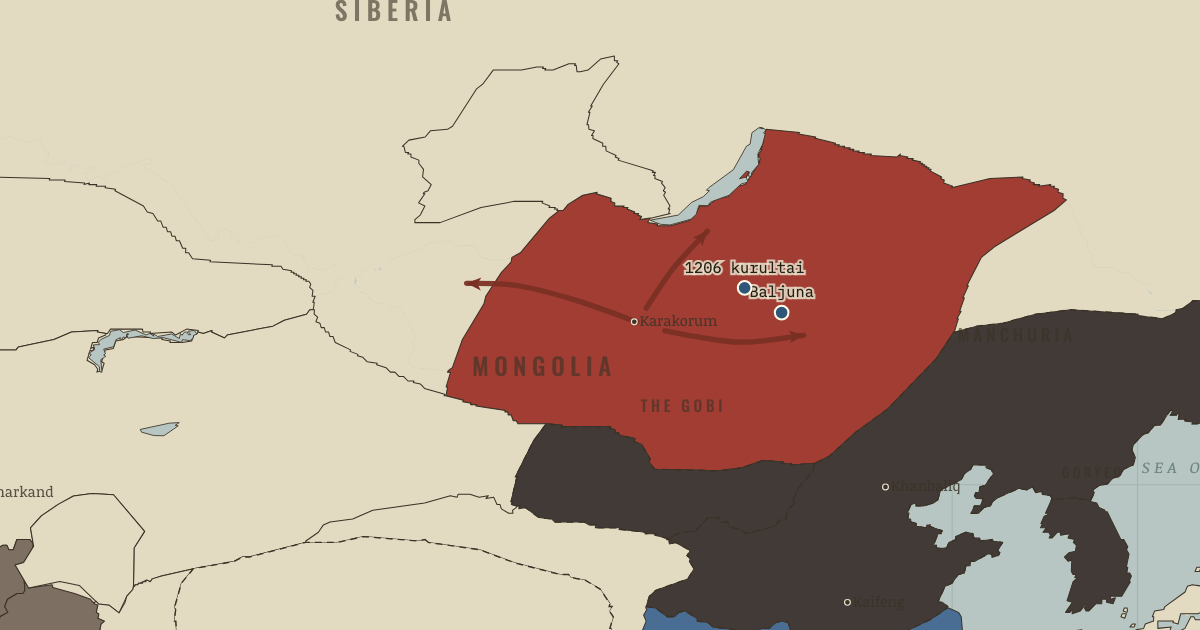
The map above is the world of The Mongol Empire, 1206 — The steppe united.
Every state on the map that year: The world in 1200 · Europe in 1200.
Part of IB History: The Mongol Empire →
SHORT EXPLANATION
Temüjin’s victories depended on attracting and keeping followers. He offered advancement for ability, distributed plunder under rules and punished betrayal even when it benefited him. Men whose prospects were limited by aristocratic lineage could see a reason to join him, while defeated groups could add their strength to his growing coalition.
In 1206 a kurultai, or grand assembly, proclaimed him Chinggis Khan. Numbered army units mixed former rivals, and an expanded imperial guard trained and watched over commanders. These arrangements united the plateau and gave the coalition a structure that could outlive its founder. The search for rewards would now turn increasingly beyond the steppe.
The full story
A leader fighting for the steppe needed more than victories: he needed followers willing to remain with him and a way to use the strength of those he defeated. Temüjin’s campaigns against the Naimans, Merkits and Tatars brought a long civil war toward its end. His former anda, or sworn brother, Jamukha led a rival coalition associated with inherited aristocratic rank. Temüjin gave able men another prospect. Jebe had been an enemy archer who shot Temüjin’s horse; Subötai was a blacksmith’s son. Both rose to high command.
At Baljuna a small band had stayed with Temüjin through a crisis. The assembly on the Onon in 1206 marks a later stage: there he took the title Chinggis Khan and presided over a much larger coalition. To govern it, he organized men from old clans into units of 10, 100, 1,000 and 10,000. The keshig, or imperial guard, brought elite families close to the court and trained future officers. Personal loyalty remained important, but offices and units allowed command to reach people beyond the khan’s immediate companions.
These arrangements did not erase tribal identity, and later accounts may make the reforms look tidier than they were. They did give the coalition a more durable structure. Unity also changed the pursuit of rewards: warriors who could no longer raid one another looked outward, toward wealthy north China. Senior commands for the khan’s family helped the empire survive his death, yet they also gave family branches armies and territories that their descendants would eventually govern separately.
FULL EXPLANATION
Ability within a patronage state
Jebe and Subötai show why Temüjin’s following could attract talent beyond the old aristocratic circles. Calling his order a meritocracy, however, leaves out much of how it worked. Advancement depended on loyalty to the khan, family connections mattered, and descent from Chinggis Khan later became a paramount political qualification. The change was comparative: demonstrated ability had more opportunity to outweigh birth than in older aristocratic coalitions. Followers could also expect courage and obedience to bring rewards and treachery to bring punishment. The Secret History of the Mongols celebrates decisions of this kind. Composed within the ruling tradition, it shapes episodes into lessons about loyalty. Its stories are evidence for the values that tradition honored, as well as imperfect records of particular events and conversations.
Survival after the founder
The steppe had seen large empires before 1206. What needs explaining is why this coalition remained effective after Chinggis Khan died in 1227. Decimal commands and the guard sustained military organization; lands distributed to branches of his family gave them a stake in the empire. Assemblies offered a way to make collective decisions, even when those decisions were contested. Continued conquest also brought wealth that made cooperation profitable. The settlement solved one problem while creating another. Lands and commands helped keep the khan’s sons invested in the first generation’s common enterprise. Their descendants inherited regional power bases as well as a stake in cooperation. The arrangements that supported expansion thus also furnished the foundations of the later khanates.
Key places on the map
Why it happened
Ability and inherited rank. The distinction between “white bone” and “black bone” expressed the importance of aristocratic standing on the steppe. Temüjin still needed loyalty, but ability could open a path to command. Jebe had fought against him; Subötai was a blacksmith’s son. Their rise showed capable men what service could offer. Jamukha retained aristocratic support, while some followers could find opportunities with Temüjin that lineage might otherwise deny them.
Rewards and betrayal. Temüjin’s treatment of loyalty sent a message even when it cost him an immediate advantage. Accounts describe him recruiting enemies who had remained faithful to their own leaders, but killing men who betrayed those leaders to help him. Rewards for service and punishment for treachery gave followers some grounds to anticipate how he would treat them.
A structure for command. The decimal units mixed men from different clans, and the keshig drew commanders’ families toward the center. Later the yam relay would connect distant parts of the empire. Together, such institutions gave succeeding rulers ways to command and communicate beyond the founder’s personal relationships. The empire survived his death, expanded and passed to later rulers.
A mandate from Heaven. Mongol rulers claimed that Eternal Heaven, or Tengri, had granted the khan authority over the earth. From Korea to Hungary, ultimatums could therefore present submission as an existing duty. The claim gave conquest a sacred justification and shaped the peace Mongol rulers offered: submission was the expected answer.
THE TURNING POINT
The Onon assembly, 1206. At the kurultai on the Onon in 1206, Temüjin became Chinggis Khan. Earlier leaders had united steppe peoples too. This coalition acquired numbered commands and a guard tied to the ruler’s court, giving former rivals ways to serve within a common order. Older ties remained, but the institutions helped the empire continue beyond its founder’s lifetime.
What it changed
Rewards beyond the steppe. The khan’s followers could no longer freely raid one another, yet they still expected rewards for service. Conquest offered plunder with which to sustain their allegiance. The rich Jin realm was close at hand and would face a Mongol attack within five years.
Coordinated campaigns. The nerge hunt required riders to time their movements as they closed around their quarry. Later campaigns coordinated converging columns over much greater distances, using messengers and signals. The invasions of Khwarazm and Hungary show this capacity at continental scale.
Religion and rule. Followers associated with the Baljuna oath included Muslims and Christians. Later accounts attribute exemptions from tax and conscription for clergy of different faiths to the yassa, although its precise terms remain uncertain. Working with religious communities could help rulers govern a diverse empire.
DISCUSSION QUESTION — Jamukha had high birth, a large coalition and victories in battle. How did Temüjin ultimately defeat him?
Jamukha’s birth and coalition brought him support, and he won battles. Temüjin, however, offered able outsiders opportunities to rise, rewarded service and incorporated defeated groups into his organization. Each group that joined could strengthen his force and weaken a rival. Birth and personal loyalty still mattered, but his units and commanders gave new followers a more lasting place than a temporary alliance alone.
An interesting fact
Our major source for Genghis Khan’s childhood, the Secret History, reached modern scholars by an unusual route. The Mongolian original was lost. A Ming-era transcription preserved Mongol sounds syllable by syllable in Chinese characters and served as a phonetic aid for interpreters after the Yuan fell. Scholars reconstructed the Mongolian text from this record, made under the dynasty that expelled Genghis Khan’s descendants from China.
Related
THE FREE PRINTABLE STUDY GUIDE
Get the printable study guide for The Mongol Empire free. I’ll send you a few short letters, then one when a new atlas opens. That’s all. — Paul
NO TRACKING · YOUR ADDRESS IS USED FOR THE DISPATCH AND NOTHING ELSE · UNSUBSCRIBE ANYTIME