Mongol Empire · CHAPTER 1 ·
Mongolia before Genghis Khan
Chapter 1 of The Mongol Empire, 1206–1294: “The World of the Steppe”
Before 1206 a grassland corridor from Mongolia toward Hungary supported mobile herding, so steppe peoples could raise skilled mounted archers quickly and cheaply. Their weakness was disunity: Tatars, Kereyids, Naimans, Merkits and Mongols feuded endlessly, while the Jin dynasty of north China backed one group against another.
WW2 is free in full, and chapter 1 of every atlas is free. A free account opens 3 more chapters a day. Starter, at $9 a month, opens all 21 with no daily limit — see the plans.
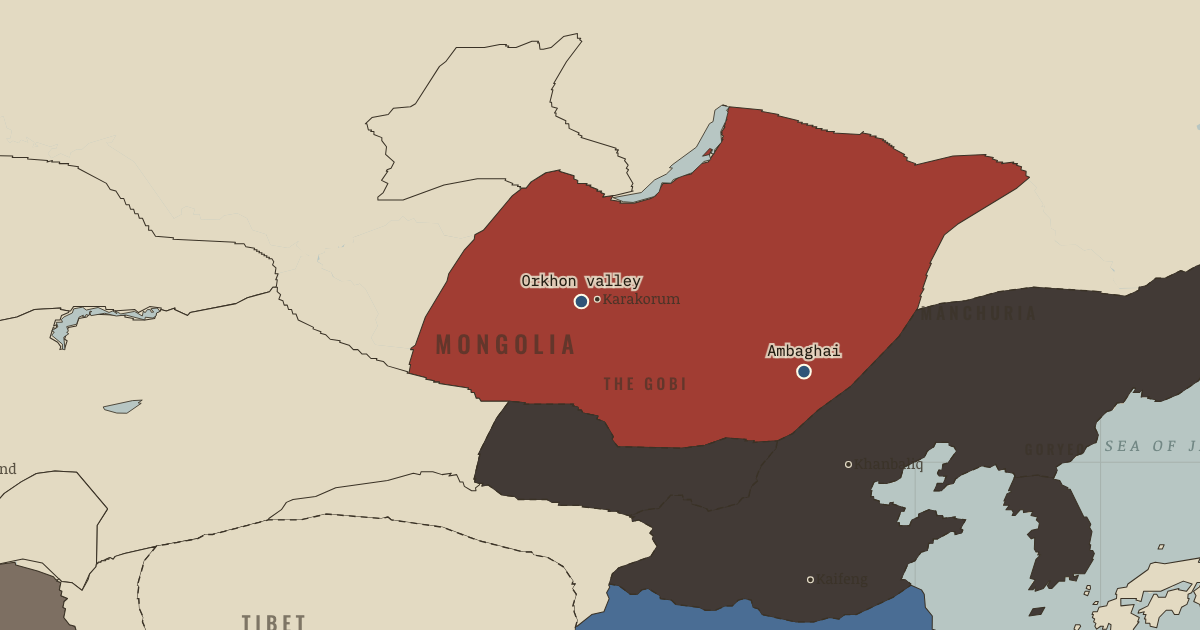
The map above is the world of The Mongol Empire, 1206 — The steppe united.
Every state on the map that year: The world in 1200 · Europe in 1200.
Part of IB History: The Mongol Empire →
SHORT EXPLANATION
Across the grasslands from Mongolia toward Hungary, families made their living by moving with their herds. Riding, archery and managing several horses were ordinary skills, and they gave the steppe a supply of experienced mounted fighters. Yet the same riders belonged to rival clans and confederations, whose feuds absorbed much of their strength.
The Jin dynasty of north China encouraged those divisions, supporting one group against another to protect its frontier. Temüjin grew up in this violent world: his father was murdered and his family abandoned. To turn the grassland’s military resources outward, he would first have to build a coalition that could command them together.
The full story
A farming state could draw on great wealth and a large population, but it had to assemble and supply an army from them. On the steppe, herding households already possessed horses, portable food and the skills of mounted warfare. Children learned to ride and shoot early; communal hunts brought thousands of riders together to encircle prey, obey signals and maintain formation. Their composite bows, made of wood, horn and sinew, combined power at a distance with a size suited to horseback. These habits supplied skilled cavalry at relatively low cost.
The problem lay in directing that strength. Tatars, Kereyids, Naimans, Merkits and Mongols fought over animals and followers, and the obligation to take revenge prolonged their feuds. The Jin court used payments and punitive expeditions to exploit such rivalries. When Tatars handed the Mongol khan Ambaghai over to the Jin for execution, the episode left a grievance that endured for decades. Temüjin’s answer was to mix men from rival groups in numbered units, giving them obligations to a common commander alongside their ties of kinship.
Unification would make different demands at the two edges of the map. Westward, extensive pasture offered routes for mounted armies; southeastward, wealthy farming states offered targets protected by fortified cities. Riders who could cross the grasslands and raid the countryside still needed new skills to take those walls. The later arrows of conquest show the reach of mobility, while walls, rivers and seas help explain its limits. Favorable climate may have improved pasture, but leadership, alliances and institutions decided whether its resources became a united power.
FULL EXPLANATION
Pasture as military supply
Remounts increased the distance a rider could cover: when one horse tired, another could take its place. Herds traveling with an army also reduced its reliance on grain carried in wagons. Yet this arrangement depended on resources along the route. Many horses gathered in one place could quickly exhaust grass and water, particularly beyond the steppe. The same dependence that helps explain Mongol speed also helps explain difficulties in wet, forested and maritime regions. Tree rings add another dimension to the question. They suggest unusually favorable moisture in early thirteenth-century Mongolia, perhaps expanding pasture during unification; the simpler claim that drought drove conquest is less secure. Better pasture could support more animals, but it could not determine whether their owners fought one another or followed a common ruler. That depended on political organization.
The limits of divide-and-rule
Jin subsidies and selective attacks had a practical purpose. While no confederation dominated the plateau, the court could keep frontier groups dependent and encourage rivals to spend their strength against each other. Intervention also left memories of injury, including Ambaghai’s execution. Temüjin changed the problem facing the Jin. He mixed men from different clans in units of ten, one hundred, one thousand and ten thousand, so loyalty and reward could pass through an army serving the khan. Kinship remained, but officials trying to isolate a single group now faced a broader coalition. How far the yassa law code sustained that order is harder to say: no complete contemporary text survives.
Key places on the map
Why it happened
Pasture and mobility. Herding suited land that supported fewer dense farming populations. A rider could bring several horses—often described as five per man—and change mounts as they tired. Mare’s milk, blood and dried curd supplied food, while felt tents could be struck quickly. Such armies depended less on wagoned grain and could travel far or campaign in winter, provided they found grass and water for their animals.
The bow and the hunt. The compact recurved composite bow gave a mounted archer a powerful weapon. In the great ring hunts, called nerge, riders also practiced moving together: an encirclement required signals and timing as well as individual skill. Temüjin later placed men from different groups in units of 10, 100, 1,000 and 10,000, putting those skills at the service of a common command.
The Jin frontier. A divided steppe was easier for the Jin to manage. The court supported some frontier groups against others, including Tatars against Mongol leaders, and could act against a group that grew too powerful. Ambaghai’s delivery to the Jin shows how a rivalry on the grassland could bring a Mongol leader into the hands of the empire. Unification would make the same policy much harder to use.
Feuds and pressure on pasture. Twelfth-century chronicles describe feuds growing more intense, as rivals fought over followers and resources and the duty of revenge renewed old injuries. Some historians, using tree-ring evidence, also argue that cooler, drier conditions strained pasture. That climatic interpretation remains debated; the recorded feuds themselves show the difficulties facing anyone who sought lasting cooperation.
THE TURNING POINT
Ambaghai’s execution, around 1156. Around 1156, Tatars handed Ambaghai Khan to the Jin, who executed him on a wooden mule. Mongols remembered his fate for decades. His death connected two sources of danger: rivalry among steppe peoples and intervention by the empire to their south. Temüjin would try to overcome those divisions and later attack the Jin.
What it changed
An army made by organization. The ingredients of a formidable force already existed: bows, remounts and the discipline practiced in hunts. Temüjin’s command system brought riders together in a larger and more durable army. Its strength lay in the way those existing skills could now be directed under a common plan.
The pasture corridor. Grassland offered routes from Mongolia toward Hungary, allowing mounted forces to find grazing along much of their journey. The westward arrows of 1223, 1237 and 1241 trace movements for which that access mattered. Where suitable pasture became scarce, keeping the horses fed imposed a different constraint on movement.
A united frontier faces the Jin. Jin officials had managed frontier rivals partly by playing them against one another. A coalition under one ruler was harder to divide. Its own test would come in the Jin realm: could steppe cavalry acquire the means to take fortified places?
DISCUSSION QUESTION — Why could steppe societies field formidable mounted armies when settled empires had more people and wealth?
A settled state had to raise and supply cavalry from its population; steppe households already kept horses and had riding skills and portable food. They could therefore furnish capable mounted fighters at relatively low cost. But those fighters had to be united politically, and their horses needed grass and water. Temüjin united the plateau in 1206. Forests, wet farmland, deserts without grazing and the sea remained obstacles.
An interesting fact
Making a composite bow took time. Horn, sinew and birch were laminated with fish glue, then cured for a year or more. Archery was important enough to be commemorated on the “Genghis Stone,” an early monument in Mongolian script carved around 1225 and now in the Hermitage. It credits the khan’s nephew Yisüngge with a shot of 335 alds, roughly half a kilometer. The distance may be exaggerated; the inscription nevertheless shows what its makers chose to honor.
Related
THE FREE PRINTABLE STUDY GUIDE
Get the printable study guide for The Mongol Empire free. I’ll send you a few short letters, then one when a new atlas opens. That’s all. — Paul
NO TRACKING · YOUR ADDRESS IS USED FOR THE DISPATCH AND NOTHING ELSE · UNSUBSCRIBE ANYTIME