WW2 · CHAPTER 13 ·
End of WW2 in Europe
Chapter 13 of The War Room — WW2, 1936–1945: “Closing the Ring”
Germany’s last offensive in the west, through the Ardennes in December 1944, failed within weeks, and in January 1945 the Red Army drove from the Vistula to the Oder. Allied armies liberated camps including Auschwitz, Buchenwald and Bergen-Belsen, exposing the Holocaust. Germany surrendered unconditionally on 8 May.
WW2 is free — every chapter. No sign-up.
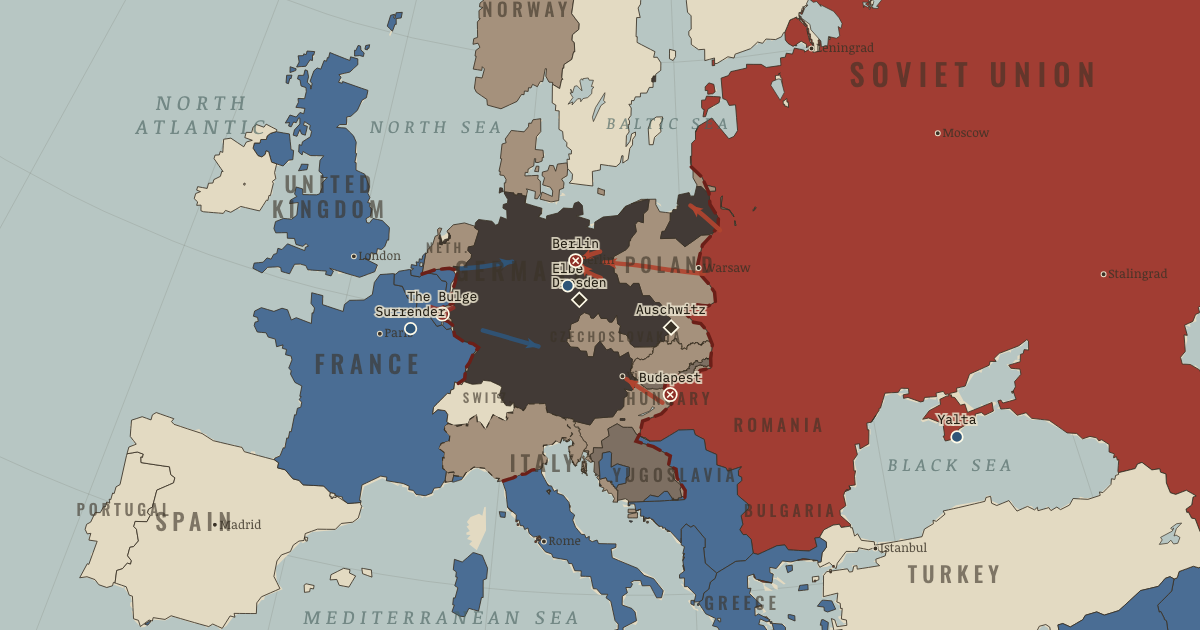
The map above is the world of Europe, January 1945 — The final winter.
Every state on the map that year: The world in 1945 · Europe in 1945.
Part of IB History: The Second World War →
SHORT EXPLANATION
In December 1944 Germany made one last attempt to break the Western alliance. Its attack through the Ardennes failed within weeks, using up reserves needed to defend Germany itself. The Red Army then advanced from the Vistula to the Oder, and Soviet and Western forces entered Germany from opposite sides. They met at the Elbe, while the Nazi regime continued a war it could no longer win.
The advancing armies also reached Auschwitz, Buchenwald, Bergen-Belsen, and other camps. Survivors and material evidence revealed to a wider public the consequences of Nazi persecution and murder: six million Jews had been murdered in the Holocaust, and millions of others had been persecuted and killed under distinct policies. These places on the map are memorial evidence, not measures of military progress. Germany surrendered unconditionally on 8 May 1945, ending the war in Europe.
The full story
The Ardennes offensive was meant to change the political situation as well as the military one. In December 1944 Hitler sent his forces west in the hope of splitting the British and American armies and taking Antwerp. If the blow produced a rupture among the Allies, Germany might escape defeat. Surprise helped the attack at first, but the distance to Antwerp required fuel, transport, and reserves Germany did not have. Within weeks the offensive had failed, and the forces spent on it were unavailable for the defense of Germany.
The pressure now came from both directions. In January the Red Army advanced roughly 500 kilometres in three weeks during the Vistula–Oder offensive, reaching the threshold of the German heartland. In April American and Soviet troops met at the Elbe. Hitler killed himself in Berlin, and Germany surrendered unconditionally on 8 May.
The armies’ advance brought them to places that told another history of Nazi rule. Soviet troops liberated Auschwitz on 27 January; American and British forces reached Buchenwald and Bergen-Belsen in April. They found survivors and corpses, records, and the machinery of systematic persecution and murder. Six million Jews had been murdered in the Holocaust. Roma and Sinti, disabled people, Soviet prisoners of war, Poles and other Slavs, political opponents, gay men, and others were also persecuted and killed. The camps belong on the map as evidence and places of remembrance, not as measures of military progress.
Why did the regime continue to fight when its armies were being defeated? The Allies demanded unconditional surrender, and leaders responsible for immense crimes could expect punishment rather than a safe negotiated peace. Terror punished supposed defeatists, while propaganda encouraged fear of Soviet vengeance. Hitler still hoped the capitalist West and the Soviet Union would fall out; despite their distrust, they cooperated operationally until Germany was defeated.
The victors were already discussing what would follow. At Yalta in February, Roosevelt, Churchill, and Stalin negotiated occupation zones and postwar institutions, but their agreements left contested questions about Europe’s future. Each army would give its government practical power over the territory it occupied. The victory ended Nazi rule, while leaving the victors to contend over the political future of the continent.
FULL EXPLANATION
Evidence, victims, and responsibility
Soldiers and journalists who reached the camps saw evidence that could no longer be kept at a distance from a wider public. Yet the news did not begin with liberation. Governments had received reports during the war, and Jewish communities and resistance networks had documented mass murder while it was taking place. The crimes developed through exclusion and dispossession, ghettoization, mass shootings, deportation, forced labor, starvation, and extermination camps. Carrying them out involved structures across the Nazi state and party, police, military, railways, industry, and collaborators; the choices of individuals within those structures varied. Six million Jews were murdered in a program aimed at their total destruction. Other groups faced distinct Nazi policies, and their experiences should not be folded into an undifferentiated total. The evidence includes records made by the victims themselves. The Oyneg Shabes archive of the Warsaw ghetto preserves their voices alongside the perpetrators’ records. Such evidence calls for precision and remembrance; this history must never be gamified.
Why did the regime fight on?
By late 1944 defeat was evident, but the people directing the German state had both reasons to keep fighting and ways to compel others to fight. The Allied demand for unconditional surrender left the leadership little room to negotiate an exit, and its crimes made punishment likely. Hitler kept personal control and forbade operational retreat. Propaganda portrayed the Soviet advance as annihilation, while the terror apparatus executed soldiers and civilians accused of defeatism. Hitler also counted on a break between his enemies. The Western powers and the Soviet Union distrusted one another, but their coalition held. The Ardennes offensive put his hope to a military test: one shock, he imagined, might undo an alliance whose combined strength Germany could not otherwise overcome. Those made to bear the cost included soldiers and civilians, prisoners still in camps, and people driven on forced marches. More died and cities were reduced to rubble. These mechanisms explain how a regime that could not survive peace imposed further war on those under its control; they do not excuse it.
Key places on the map
On this day
Why it happened
Unconditional surrender and terror. The Allies announced their demand for unconditional surrender at Casablanca in 1943. For Nazi leaders implicated in immense crimes, a negotiated exit offered little prospect of safety. Goebbels’s propaganda presented “Bolshevik vengeance” as the alternative to resistance, while the terror apparatus hanged soldiers and civilians branded as “defeatists” from lampposts into the last week. Together, these pressures helped the regime keep fighting after victory had become implausible.
Hitler’s hope for a split. Hitler hoped that a powerful blow in the Ardennes would break what he called the “unnatural alliance” of capitalists and communists. The distrust was real, but the inference was wrong: the Western powers and the Soviet Union continued to cooperate operationally through Germany’s defeat. The Axis itself had never coordinated its war in the way Hitler imagined his enemies might fail to do.
Yalta and the peace. Roosevelt, Churchill, and Stalin met at Yalta in February 1945 and agreed on occupation zones, a United Nations, and “free elections” in liberated Europe. Those words left room for conflicting understandings. The agreements would matter, but so would the power each army exercised where it stood.
THE TURNING POINT
Berlin, 16 April–2 May. Stalin sent two marshals racing one another toward Berlin between 16 April and 2 May. Some 2.5 million Soviet troops faced a garrison including elderly men, boys, and remnants of German divisions. The Red Army lost about 80,000 dead taking the city. On 30 April, while Soviet troops fought for the Reichstag, Hitler killed himself. The Thousand-Year Reich outlasted him by eight days.
What it changed
Evidence and postwar law. Liberation brought the evidence of Nazi crimes to a wider public. The postwar response drew on new legal and moral language: “genocide” was coined in 1944, the Nuremberg trials addressed “crimes against humanity” in 1945–46, and the Genocide Convention followed in 1948. The Holocaust also formed part of the context of Israel’s founding in 1948. “Never again” became a moral commitment often invoked and imperfectly honored.
A devastated Europe. Around forty million people had died in Europe. Cities lay in ruins, and tens of millions were displaced or expelled, including roughly twelve million ethnic Germans from the East. Borders moved west; Poland’s territory shifted about 200 km, a change reflected in the map’s modern outlines. The determination to build a different future contributed to the United Nations, postwar welfare states, and eventually the European project, even as new divisions emerged.
The armies and the division of Germany. The meeting at the Elbe brought American and Soviet troops together, but it did not itself fix Germany’s eventual division. Occupation zones had been agreed separately. Scrub forward one snapshot and see Chapter 15 for the postwar settlement.
DISCUSSION QUESTION — Could the Western Allies have reached Berlin first, and should they have tried?
A Western advance on Berlin was militarily possible. Eisenhower weighed the heavy casualties he expected against the capture of a city already assigned to the Soviet occupation zone. Churchill attached more value to the postwar leverage it might bring. The choice depends on uncertain casualty estimates, whether arriving first could have changed the agreed zones, and how unavoidable one considers the coming Cold War.
An interesting fact
Historian Emanuel Ringelblum and the secret Oyneg Shabes group in the Warsaw ghetto wanted the victims’ own record to survive. Teachers, rabbis, economists, and writers collected tens of thousands of pages: testimony, diaries, and underground newspapers, as well as candy wrappers and tram tickets from daily life. They buried the archive in milk cans and tin boxes. Ringelblum was executed in 1944. Two caches were recovered from the rubble in 1946 and 1950; a third has never been found. The archive is inscribed in UNESCO’s Memory of the World register.
Related
THE FREE PRINTABLE STUDY GUIDE
Get the printable study guide for WW2 free. I’ll send you a few short letters, then one when a new atlas opens. That’s all. — Paul
NO TRACKING · YOUR ADDRESS IS USED FOR THE DISPATCH AND NOTHING ELSE · UNSUBSCRIBE ANYTIME