Chinese Revolution · CHAPTER 4 ·
Northern Expedition and United Front
Chapter 4 of China in Revolution, 1911–1949: “The United Front Marches North”
With Soviet aid, Sun Yat-sen rebuilt the Nationalist Party, and the Whampoa Academy, founded in 1924, trained officers loyal to party and doctrine, with Communists inside the First United Front. The Northern Expedition of 1926 won the south by early 1927 as warlord units defected.
Chapter 4 is included with every paid plan. WW2 is free in full, and chapter 1 of every atlas is free. A free account opens 3 more chapters a day. Starter, at $9 a month, opens all 21 with no daily limit — see the plans.
Free printable Chinese Revolution study guide, sent by email ↓
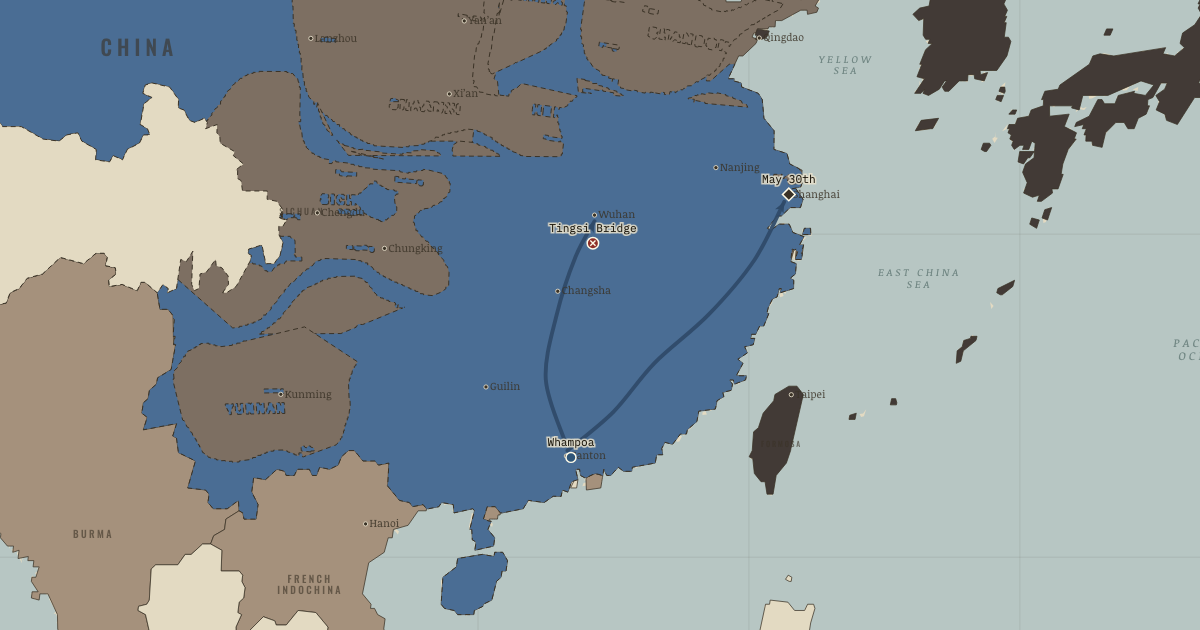
The map above is the world of China, 1927 — The Northern Expedition at the Yangtze.
Every state on the map that year: The world in 1930 · Europe in 1930.
Part of IB History: China in Revolution →
SHORT EXPLANATION
The Nationalists needed an organization capable of doing more than holding a corner of southern China. Sun Yat-sen accepted Soviet help to rebuild the party, while Communists joined it as individuals in the First United Front. Whampoa Academy trained officers to serve a party and its doctrine rather than a personal paymaster. Together, party and army gave the movement a coherence its divided warlord opponents lacked.
In 1926 the Northern Expedition carried that organization north. Its columns benefited from propaganda, strikes and peasant associations as well as defections from warlord armies. By early 1927 the alliance controlled much of the south. Success brought a harder question to the fore: who would command the movement, and what would it do about land and class? The dispute prepared the rupture later that year.
The full story
Sun Yat-sen wanted to build a government strong enough to reunite China. The warlords had armies, but their soldiers served military employers whose alliances could change. Sun’s movement in the blue south was developing a different instrument: a party-army, joining military command to a political organization, a doctrine and discipline.
In 1923 Sun made a bargain with Moscow. Along with money and rifles came organizers led by Michael Borodin, who helped rebuild the Nationalist Party as a pyramid of cells and committees. Members of the small CCP entered as individuals. The allies founded an officer academy on an island below Canton, marked by the ● at Whampoa. Its cadets were to serve a party and a cause rather than a paymaster. Chiang Kai-shek was commandant; the Communist Zhou Enlai led the political department. Officers who later fought on both sides passed through Whampoa.
The movement also found a public beyond its army. In May 1925 British-officered police fired on a crowd in Shanghai, at the ◆ on the Bund. The strike wave that followed gave the Canton movement a mass public to lead. When the National Revolutionary Army marched north in July 1926, it could appeal to grievances already felt far beyond its southern base.
The expedition began with roughly 100,000 troops against warlord forces several times their number. The two blue arrows trace its advance, through Hunan toward Wuhan and up the coast toward Shanghai. Military columns were only part of the campaign. Propaganda teams and Communist organizers went ahead, encouraging peasant associations and strikes behind enemy lines. Railway workers striking against Wu Peifu helped weaken his southern front.
At Tingsi Bridge, the ✕ south of Wuhan, the Fourth Army stormed a fortified rail crossing. The force was known as “the Ironsides” and strengthened by Communists. Other warlord troops defected instead of continuing to fight, bringing their men into the National Revolutionary Army; it more than doubled in size as it advanced. By early 1927 the expedition controlled much of the territory south of the Yangtze, turning the grey-tan south blue in about six months.
The victory left its leaders with a dispute they had not resolved on the march. A left-wing government at Wuhan worked with the Communists, while Chiang’s headquarters moved toward Shanghai. Both had helped defeat the warlords. The next struggle would decide who controlled what they had won.
FULL EXPLANATION
How much of the victory was Soviet?
Moscow’s contribution to the Northern Expedition is visible in its organization. Soviet advisers supplied money, rifles and a model built on party cells and political commissars. Borodin helped rebuild the Nationalists; Vasily Blyukher, known as “Galen,” helped plan the campaign. Soviet policy also required a “national” revolution and kept the Chinese Communists subordinate within the alliance, a position with grave consequences in 1927. But the public force behind the march had Chinese roots. The May Thirtieth strikes, the Hong Kong–Canton boycott and peasant associations drew people together around grievances of their own. Historians differ over whether to emphasize a Soviet export or a Chinese movement borrowing Soviet tools. The imported methods helped organize the movement; they cannot by themselves explain the energy that made the organization effective.
Reading Mao’s Hunan Report against the grain
Mao’s 1927 “Report on an Investigation of the Peasant Movement in Hunan” is often read as a prophecy that peasants would drive the revolution. It also belongs to an argument within the United Front. Party moderates were alarmed by the peasant associations and their violence, and Mao wrote to defend them. His phrase that revolution “is not a dinner party” formed part of that defense, including his case for actions against landlord families, some connected to Nationalist officers. This purpose makes the report valuable evidence of the class conflict inside the alliance. It also means historians must consider Mao’s argument when using it to describe the Hunan countryside. The report’s later elevation as a founding text in the People’s Republic is another part of its history, distinct from what it establishes about 1927.
Key places on the map
On this day
Why it happened
The Soviet package: party, army, mass line. Western powers had declined to support Sun, so he turned to Moscow. Soviet advisers brought money and rifles, but also a way to connect an army with a political movement: party cells, political commissars and organized agitation. Borodin was instructed to keep the revolution “national.” The Chinese parties learned techniques in this alliance that they would later use against each other during 1927–49.
Nationalism with an address. The shootings of May 30th, 1925 gave resentment of foreign privilege a focus in the treaty system and brought the Canton movement a larger public. The Hong Kong–Canton strike and boycott mobilized hundreds of thousands and lasted sixteen months. Keeping such a movement together took organization as well as anger. When the expedition called “down with the unequal treaties” and “down with the warlords,” it spoke to grievances people already knew.
The warlords could not combine. The warlord cliques had experience fighting one another and absorbing defeated soldiers. They had more difficulty joining forces against the expedition. Wu Peifu and Sun Chuanfang fought the National Revolutionary Army separately and fell separately, while Zhang Zuolin protected his position in Manchuria. Each defection weakened a warlord and added men to the advancing force. The habits of competing military employers served them poorly against an organized political movement.
Whampoa as the multiplier. Whampoa’s few thousand cadets could not conquer half a country alone. Their importance lay in what they brought to larger units: junior officers who led from the front and helped troops hold together under fire. Academy troops suffered exceptionally heavy casualties in the Eastern Expeditions and the northern march. Their training cultivated loyalty to the party, but also to Chiang, their commandant. That second attachment would matter when the alliance divided.
THE TURNING POINT
Whampoa, June 1924. At Tingsi Bridge the new army demonstrated its fighting power. Whampoa, founded in June 1924, helps explain how that force was formed: officers learned military discipline in an alliance that also provided political instruction and commissar supervision. The academy was one part of the campaign, and its influence lasted beyond it. Officers associated with Whampoa would serve the rival regimes that followed.
What it changed
Two victors inside one victory. By spring 1927 the alliance had reached the Yangtze, but its victory contained two centers of power. Left Nationalists at Wuhan worked with the Communists. Chiang had his military base and would soon gain support from Shanghai bankers. The partners could agree on defeating warlords without agreeing on command of the movement or the shape of the government to follow.
The peasant association explosion. Peasant associations encouraged by the expedition claimed millions of members in Hunan. Before party leaders had settled land policy, some began settling scores with landlords. Mao’s 1927 “Hunan Report” defended their violence as a revolutionary force. Many Nationalist officers came from landowning families, and what Mao defended alarmed them. The dispute over class and land was pulling the front apart.
The powers pick a Chinese partner. In 1927 foreign gunboats at Nanking and barbed wire around Shanghai’s Settlement showed the treaty powers’ alarm. London and Washington were also beginning to regard a Chiang-led government as a possible source of order. As Chiang’s Nationalists divided from the revolutionary left, negotiation over treaty privileges would proceed gradually alongside that political division.
DISCUSSION QUESTION — Could the First United Front have survived, or did its founding make a rupture inevitable?
The First United Front had serious reasons to split. Comintern instructions treated the KMT as a temporary vehicle the CCP would eventually capture, while Chiang’s faction sought to restrict Communist influence. The partners shared a campaign and an army without settling who would control them. Yet the course of events mattered. Sun’s death in March 1925 removed a leader respected across the movement. Chiang’s Zhongshan gunboat coup in March 1926 reduced Communist influence a year before the purge. Moscow, absorbed in the Stalin–Trotsky struggle, left the move unanswered; Stalin ordered the CCP to remain in an alliance he was unwilling to see fail. A Wuhan-led front might have lasted into 1928, or a purge might have preceded the expedition. A break was highly likely on this reading, but its timing, violence and victor were not settled at the founding.
An interesting fact
Whampoa’s classrooms and staff brought together men who later served rival causes. Alongside Nationalist commanders, they included five of the ten Marshals of the People’s Liberation Army named in 1955: Xu Xiangqian from the first class, Lin Biao from the fourth, and Ye Jianying, Nie Rongzhen and Chen Yi from staff or political roles. They shared an institution under Chiang and Zhou before some helped defeat Chiang’s armies in 1948–49.
Related
THE FREE PRINTABLE STUDY GUIDE
Get the printable study guide for China in Revolution free. I’ll send you a few short letters, then one when a new atlas opens. That’s all. — Paul
NO TRACKING · YOUR ADDRESS IS USED FOR THE DISPATCH AND NOTHING ELSE · UNSUBSCRIBE ANYTIME