Cold War · EPILOGUE ·
End of the Cold War
Chapter 12 of The Cold War, 1945–1991: “The End — and the Arguments”
Germany reunified in October 1990 with Soviet consent. In August 1991 hardliners detained Gorbachev, but their coup collapsed within about sixty hours. After some 90 per cent of Ukrainian voters chose independence on 1 December, the leaders of Russia, Ukraine and Belarus dissolved the USSR, and Gorbachev resigned on 25 December.
Chapter 12 is included with every paid plan. WW2 is free in full, and chapter 1 of every atlas is free. A free account opens 3 more chapters a day. Starter, at $9 a month, opens all 21 with no daily limit — see the plans.
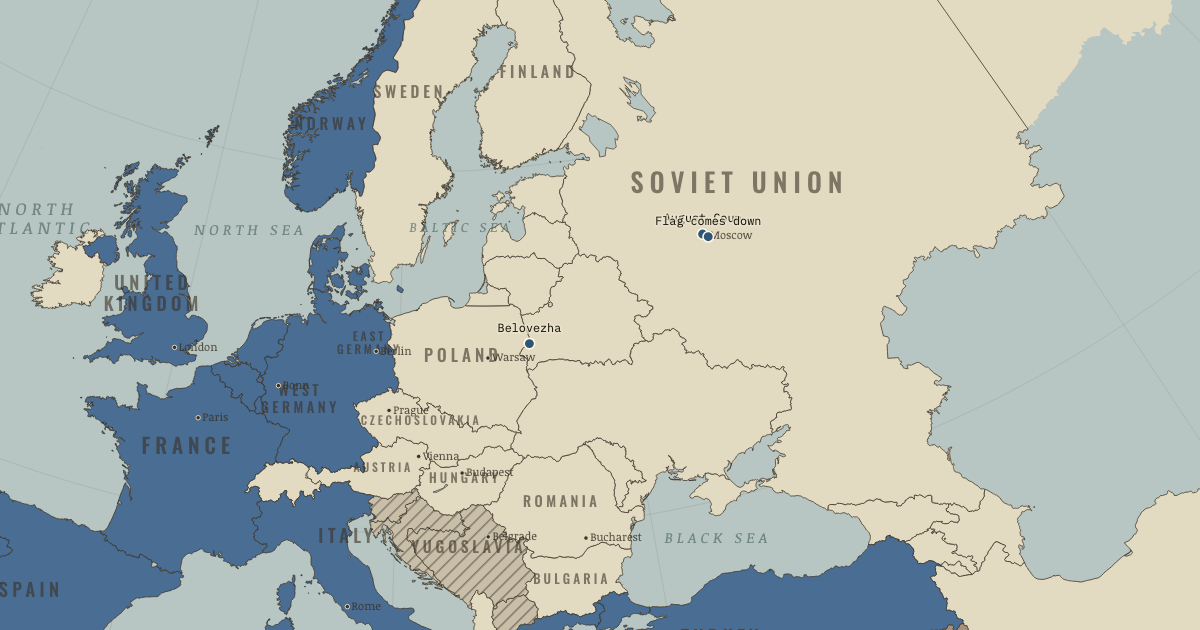
The map above is the world of Europe, December 1991 — After the flags.
Every state on the map that year: The world in 1990 · Europe in 1990.
Part of IB History: The Cold War →
SHORT EXPLANATION
By 1991 reform had opened Soviet political life without resolving the union’s economic troubles. Republics were demanding sovereignty, and hardliners tried to restore central authority in an August coup. They had tanks and senior offices, but crowds resisted and crucial forces would not obey them. The attempt weakened Communist Party authority and hastened the dissolution it was meant to stop.
Ukraine then voted overwhelmingly for independence. At Belovezha, the leaders of Russia, Ukraine and Belarus declared the USSR’s end, and fifteen states replaced one superpower. Washington and Moscow had avoided a direct war. Yet people in Korea, Vietnam, Afghanistan and other countries had lived through wars connected to their rivalry. A verdict on the Cold War must include both experiences.
The full story
The Soviet Union consented to German reunification in October 1990. Gorbachev, attracted by a “common European home” and increasingly dependent on Western credits, accepted a united Germany in NATO—an outcome his predecessors had armed to prevent. At home, however, the settlement he needed was slipping away. Reformers around Boris Yeltsin, elected president of Russia, wanted faster sovereignty; hardliners wanted central authority restored.
In August 1991 leading hardliners detained Gorbachev and sent armor into Moscow. Among them were the KGB chief, the defense minister and the prime minister. They held powerful offices, but they needed people to obey. Six years of glasnost had helped produce free newspapers, elected deputies and independent miners’ unions, while Yeltsin possessed a mandate of his own. Crowds resisted the coup; some crews of the Taman division sided with them, and three young men died trying to stop armored vehicles. Some troops refused to act, and the attempt collapsed in about sixty hours.
The coup had been intended to save the union. Instead it weakened the authority on which a union might have been rebuilt. On 1 December about 90% of Ukrainian voters chose independence, with majorities in every region. A week later the leaders of Russia, Ukraine and Belarus declared that the USSR had ceased to exist. Gorbachev resigned on 25 December. Fifteen independent states emerged where a superpower had stood.
Why did it end? American military competition and the Strategic Defense Initiative increased the strain and encouraged reformers. Stagnation, technological backwardness and a defense burden estimated at 15–20% of output narrowed Soviet choices. Yet Gorbachev chose to renounce force in Eastern Europe, and movements such as Solidarity, the Leipzig demonstrators and the Baltic chain used the opening. These explanations do different work: pressure and weakness help explain the need for change; decisions by leaders and organized people help explain its course.
The outcome also asks us to distinguish two kinds of peace. Washington and Moscow never fought a direct war against each other; deterrence, institutions and luck all contributed to that restraint. Millions nevertheless died in conflicts connected to their rivalry elsewhere. The European settlement and those wars belong in the same account.
FULL EXPLANATION
Four explanations that work together
Four explanations ask us to look at different parts of the Soviet collapse. Structural accounts begin with stagnation, technological backwardness and military spending. Pressure accounts give American competition a role in making the rivalry costlier and strengthening reformers. Accounts of leadership focus on Gorbachev’s political opening and his refusal to intervene in Eastern Europe. Social and national accounts emphasize Solidarity, Baltic movements, striking miners and Russian sovereignty. These explanations need not compete for a single cause. Economic weakness had existed for years before 1985 without dissolving the union. American pressure did not dictate Gorbachev’s response; and his opening mattered because citizens and republican leaders made use of it. Structure narrowed the options, competition added strain, leadership changed policy, and organized people acted on the possibilities. Together they help explain the timing and manner of the end. Much of it was peaceful, but that outcome was never guaranteed.
Where the “long peace” was located
From 1945 to 1991 the United States and the Soviet Union avoided direct large-scale war. Nuclear deterrence made escalation enormously costly, alliances clarified some limits, and crisis-management institutions improved after the Cuban confrontation. Luck mattered too: B-59 and Able Archer show how close danger could come. This record deserves attention. But the phrase “long peace” looks different away from the central European front. Korea, Vietnam, Afghanistan, Angola, Cambodia, Ethiopia and Central America experienced major violence connected in different ways to the rivalry. A worldwide death toll depends on which wars and indirect deaths are included. In Europe, opposing armies and nuclear guarantees made direct escalation dangerous. Elsewhere, decolonization and struggles over state formation gave superpowers opportunities to arm local allies without fighting each other directly. Those struggles also had causes and participants of their own. Peace between the superpowers was real; it did not reach everyone living through their rivalry.
Key places on the map
On this day
Why it happened
The August coup: the ratchet that broke. The August plotters occupied the state’s highest offices: the KGB chief, defense minister and prime minister were among them. They could send out orders and armor, but the coup depended on obedience they could not secure. Glasnost had helped create free newspapers, elected deputies and independent miners’ unions, and Yeltsin could appeal to a mandate of his own. Some Taman division crews joined the crowds they had been sent to confront. Three young men died trying to stop armored vehicles. The coup’s failure exposed the limits of the hardliners’ power and accelerated the contest over the union’s future.
Ukraine votes, and the union is arithmetic. Ukraine’s referendum changed the arithmetic of any proposed union. On 1 December 1991, 90.3% voted for independence; every region, including Crimea, had a majority for it. Ukraine was the second-largest republic, with roughly a quarter of Soviet population and industry. A union without it would be a very different undertaking. Yeltsin’s Russian leadership also preferred sovereignty to the old central arrangements and the subsidizing of the periphery. A week later Russia, Ukraine and Belarus signed the Belovezha agreement. An empire assembled by armies was being undone through votes and signatures.
An economy that could no longer buy time. The economic crisis left little time for a political bargain. Soviet output fell at a double-digit rate in 1991, gold reserves were nearly exhausted, and harvested food rotted without transport. Moscow sought Western food credits while republics withheld taxes from the center. Stagnation had become an immediate breakdown. Earlier leaders had been able to draw on oil income, coercion and belief in the system during crises. Those cushions no longer offered Gorbachev an easy way to sustain a settlement, whatever weight we give outside pressure and his own choices.
THE TURNING POINT
Belovezha, 8 December 1991. On 8 December 1991 the leaders of Russia, Ukraine and Belarus met in a forest lodge at Belovezha. Their agreement announced that the USSR “as a subject of international law and a geopolitical reality is ceasing its existence.” They notified the US president before Gorbachev. Three founding republics had withdrawn; final dissolution followed later that month. The Soviet project had lasted 74 years, the bipolar order 46. A document, rather than a battle, marked this decisive break.
What it changed
Who ended it? The four-way argument. Why did it end? American military competition and the Strategic Defense Initiative increased the strain and encouraged reformers. Stagnation, technological backwardness and a defense burden estimated at 15–20% of output narrowed Soviet choices. Yet Gorbachev chose to renounce force in Eastern Europe, and movements such as Solidarity, the Leipzig demonstrators and the Baltic chain used the opening. These explanations do different work: pressure and weakness help explain the need for change; decisions by leaders and organized people help explain its course.
What the new map inherits. Four successor states inherited Soviet nuclear weapons on their territory: Russia, Ukraine, Belarus and Kazakhstan. In the following years the latter three gave up the weapons on their soil under treaty agreements, a nonproliferation achievement with a long shadow. The final map also shows hatching where Yugoslavia was already breaking apart in war. NATO remained, and its later enlargement became contentious. In Russia, economic depression and the loss of empire accompanied competing stories of defeat and dismantlement. Frozen conflicts and the wars of 2014 and 2022 later brought renewed attention to borders inherited from the Soviet republics.
The ledger of the “long peace”. The superpowers avoided direct war for 46 years. Deterrence, alliance discipline and luck help explain that achievement. The chart below asks a different question: what did conflicts connected to their rivalry cost elsewhere? Korea, Vietnam, Afghanistan, Angola, Cambodia, Ethiopia and Central America all suffered major violence. One broad estimate is about 20 million deaths, though the total depends on which conflicts and indirect deaths are counted. Many victims lived far from Europe, in countries whose people pursued their own aims as well as experiencing outside intervention. Both the absence of direct superpower war and the violence elsewhere belong in the ledger.
DISCUSSION QUESTION — “The Cold War ended without a war.” Defend and challenge this statement using three markers and two snapshots from the atlas.
The claim can be defended if it means that the United States and Soviet Union avoided direct fighting with each other. The m-b59 and m-ablearcher markers show dangerous encounters that did not become such a war. In the e89→e91 snapshots, Soviet power withdraws and the union dissolves without a direct great-power battle to end it. Now consider three of m-pyongyang-bomb, m-tet, m-kabul, m-luanda and m-khmer, alongside the w62→w75 snapshots. Korea, Vietnam, Afghanistan, Angola and Cambodia reveal wars in which millions died. Local actors had aims of their own, while outside powers armed and intervened in their struggles. The statement captures restraint between the superpowers; it leaves out the places where people fought and died in conflicts connected to their rivalry.
An interesting fact
On 25 December 1991 Gorbachev signed his resignation decree live on CNN. According to the account, his Soviet felt-tip would not write, and CNN president Tom Johnson offered a pen. Gorbachev asked whether it was American. “No, sir,” Johnson said, “it’s either French or German”; Gorbachev signed with the Mont Blanc. Minutes later the cheget, the nuclear command briefcase, passed to Yeltsin’s officers. The red flag came down over the Kremlin before a handful of bystanders.
Related
THE FREE PRINTABLE STUDY GUIDE
Get the printable study guide for The Cold War free. I’ll send you a few short letters, then one when a new atlas opens. That’s all. — Paul
NO TRACKING · YOUR ADDRESS IS USED FOR THE DISPATCH AND NOTHING ELSE · UNSUBSCRIBE ANYTIME