Road to WW2 · CHAPTER 6 ·
Second Sino-Japanese War
Chapter 6 of The Road to War, 1931–1941: “China: The War Nobody Declared”
A clash at the Marco Polo Bridge on 7 July 1937 grew into a general war neither government had ordered. After a major battle at Shanghai, Japan drove on to Nanjing, where its forces murdered prisoners and civilians. By late 1938 Japan held China’s great cities, but Chiang’s government had escaped inland to Chongqing.
Chapter 6 is included with every paid plan. WW2 is free in full, and chapter 1 of every atlas is free. A free account opens 3 more chapters a day. Starter, at $9 a month, opens all 21 with no daily limit — see the plans.
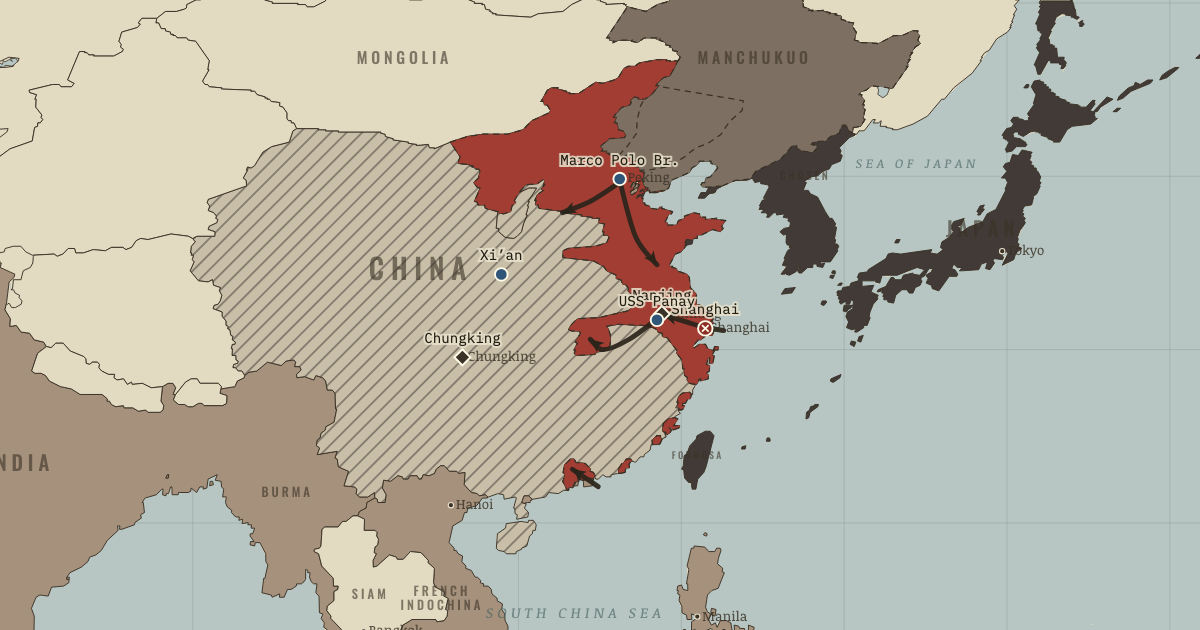
The map above is the world of East Asia and the Pacific, October 1938 — Wuhan and Canton fall.
Every state on the map that year: The world in 1938 · Europe in 1938.
Part of IB History: The Road to War →
SHORT EXPLANATION
On 7 July 1937 Japanese and Chinese troops clashed near the Marco Polo Bridge outside Peking. Neither government had formally ordered a general war, but both faced pressures that made retreat difficult. Japanese commanders had seen Tokyo approve earlier advances; China had already lost Manchuria and Jehol, and another concession threatened Chiang Kai-shek’s authority. Chiang also opened a battle at Shanghai, putting his best troops where foreign interests and observers could see the fighting.
Japan took Shanghai, Nanjing and other major cities. At Nanjing its troops murdered prisoners and civilians and committed mass sexual violence. Yet capturing cities did not compel China to surrender. Chiang moved government, industry and universities inland, preserving the means to fight while Japan held cities and rail corridors. The occupation consumed resources, and resistance continued in the interior.
The full story
On 7 July 1937 Japanese and Chinese troops exchanged fire near the Marco Polo Bridge outside Peking. Local officers negotiated, but the fighting spread. To understand why, we have to look at what each side had learned from earlier encounters. Japanese field commanders had seen Tokyo accept an unauthorized advance at Mukden; Chinese leaders had seen concessions followed by further demands. Sending reinforcements offered each side security, while making the other more fearful.
China’s politics had changed too. In December 1936 Chiang Kai-shek was kidnapped at Xi’an and pressed into an uneasy united front with the Communists against Japan. He now faced a country increasingly unwilling to accept another retreat. Chiang chose to fight at Shanghai as well as in the north, bringing the war to a city full of foreign citizens and interests. The battle drew sympathy abroad, but it cost much of his best trained army.
Shanghai held out for three months. Japanese forces then advanced to Nanjing, where they murdered prisoners and civilians and committed mass sexual violence. Estimates of the dead range from tens of thousands to over 300,000. The marker commemorates the victims.
By late 1938 Japan held major cities and the routes between them, but Chiang’s government had moved inland to Chongqing and continued to fight. Moving officials, industry and universities preserved a base for resistance. Each Japanese advance also lengthened supply lines and added places to garrison; the countryside between cities and railways was harder to control than the routes themselves.
This strategy had a terrible human cost. In 1938 Nationalist forces breached the Yellow River dikes to delay Japan, causing immense death and displacement. Retreat had helped keep China in the war, but survival was purchased in part by decisions imposed on civilians. Japan’s occupation, meanwhile, had not secured the political surrender Tokyo sought.
FULL EXPLANATION
Escalation without declaration
At the Marco Polo Bridge, a local settlement remained possible. Officers negotiated, even as both sides sent reinforcements. Each could see reinforcement as a precaution; the other could see it as preparation for a larger attack. The steps taken to avoid disadvantage made the danger of escalation greater. Past experience shaped those choices. Japanese officers had seen Tokyo accept the results of action in Manchuria. Chinese leaders faced a public increasingly unwilling to concede more territory. Neither had good reason to assume the other would stop merely because talks continued. The earlier choices did not make war inevitable, but they changed what restraint seemed to cost—a process often called path dependence. The fighting became a war without a formal declaration. American neutrality law threatened an arms embargo on belligerents, and both governments wanted their supply channels open. Japan also depended on American oil and scrap. The legal form therefore mattered: trade continued while China and Japan fought under another name.
Trading space for time
A retreat inland gave Chiang’s government room to survive. Officials, industry and universities moved west, preserving institutions needed to govern and fight. Japanese forces could seize cities and railways, but supplying and holding positions across a vast country was harder, especially in the countryside between them. Continued resistance denied Tokyo the quick political victory it had expected and tied down Japanese troops for years. That achievement does not settle what the strategy cost. In 1938 Nationalist forces breached the Yellow River dikes to slow the Japanese advance. Immense numbers of civilians died or were displaced, with little say in the decision. We can ask whether the measure helped preserve resistance and, separately, whether imposing that cost was justified. The answer to one question does not supply the answer to the other.
Key places on the map
On this day
Why it happened
Xi’an and the demand for resistance. Chiang had concentrated on fighting the Communists while Japan took Manchuria and Jehol and extended its influence in north China. In December 1936 the Manchurian marshal Zhang Xueliang, whose homeland Japan had occupied, helped kidnap him at Xi’an. Chiang’s release followed an agreement to cooperate with the Communists against Japan. The United Front was uneasy, but the commitment and Chinese opinion made another concession harder. Japanese planners expecting the earlier pattern misread the changed political ground.
A command system that rewarded advances. Japanese officers at Mukden had acted on their own initiative and then seen Tokyo accept their success. A field commander considering another advance could expect reinforcements and approval afterward. Expansionists on the general staff believed a sharp blow might break Chinese resistance within three months. China’s size and capacity to go on fighting would frustrate that expectation.
Why Chiang fought at Shanghai. Chiang put his modern divisions at risk from Japanese naval power when he chose to fight at Shanghai. He had a political purpose: the battle would take place beside the International Settlement, foreign factories and residents. Witnesses and threatened interests might bring China support. China gained sympathy, a Soviet aid treaty in August 1937 and later American credits, but no intervention sufficient to save the trained divisions from heavy losses. German advisers had spent a decade helping build those forces, and their loss mattered in the long struggle ahead.
A war without a declaration. Japan described the conflict as the “China Incident” and avoided a declaration that might trigger American neutrality legislation. An arms embargo on both belligerents would affect Chinese supplies, while Japan continued to buy American oil and scrap. China also avoided declaring war, hoping to keep its supply channels open. The legal distinction allowed Washington to sympathize with China while American trade still supplied Japan. Chapter 10 follows the movement toward embargo.
THE TURNING POINT
The Marco Polo Bridge, 7 July 1937. A Japanese soldier was briefly missing when troops exchanged fire at the bridge. The encounter became a general war, but its outcome was not settled by that fact alone. Some historians consider the incident containable; others argue that Japanese policy in north China made another confrontation likely even if this one had been resolved. These judgments address different parts of the problem. The particular clash provided the occasion. Earlier advances, independent field commanders and Chinese determination to resist shaped the choices available when it occurred. This encounter could have been contingent while the conditions for further confrontations were already present.
What it changed
The war turns Japanese attention south. The China war absorbed about a million Japanese troops. Holding occupied territory required men and supplies, while the resources consumed exceeded those gained. By 1940 Tokyo’s leaders looked south for resources in Southeast Asia and ways to cut Chiang’s supply routes. Chapter 10 follows the decisions that carried this policy toward Pearl Harbor.
American opinion and policy. Americans learned of Nanjing, the sinking of the Panay and the bombing of Chinese cities. Such news helped turn opinion against Japan, and boycotts of Japanese silk followed. Roosevelt’s October 1937 “quarantine” speech tested support for pressure. Public sympathy moved ahead of government policy; embargo came years later.
Chinese resistance and the Allied war. China’s refusal to surrender kept large Japanese forces committed on the mainland throughout the war. After 1941 Churchill and Roosevelt could count that continuing resistance as an Allied asset. China ended the war among the “Big Four” and received a permanent seat on the Security Council.
DISCUSSION QUESTION — Was Chiang’s retreat into the interior a strategy, or an excuse for defeat?
The charge that retreat was an excuse has force. Nationalist armies lost major battles in 1937–38, and the retreat was often chaotic and callous. In June 1938 they breached the Yellow River dikes to slow Japan. Hundreds of thousands died by drowning or starvation; civilians who were not consulted paid for the delay. Yet the map also shows the logic of retreat. Japan could occupy cities and railways more easily than the countryside between them. Each advance lengthened supply lines and demanded garrisons, while the government that withdrew to Chungking was still fighting in 1945. Retreat helped deny Japan the quick surrender it expected. That military achievement leaves a moral question: who may decide that civilians should bear such suffering to preserve the possibility of resistance? Showing that the retreat helped China fight on does not answer it.
An interesting fact
When China’s coastal ports fell, a road through Burma became a lifeline for the government at Chungking. Around 200,000 laborers—including farmers, women and children using baskets and hoes—built roughly 1,150 kilometers from Lashio in British Burma across the Hengduan ranges to Kunming. The road opened in 1938 after about a year’s work, and trucks carried imports along it. Its importance made control of the route a diplomatic question: in 1940 Churchill closed it for three months under Japanese pressure.
Related
THE FREE PRINTABLE STUDY GUIDE
Get the printable study guide for The Road to War free. I’ll send you a few short letters, then one when a new atlas opens. That’s all. — Paul
NO TRACKING · YOUR ADDRESS IS USED FOR THE DISPATCH AND NOTHING ELSE · UNSUBSCRIBE ANYTIME