Indian independence · CHAPTER 5 ·
India in World War I
Chapter 5 of Indian Independence & Partition, 1857–1964: “The Great War’s Price”
During the First World War India supplied roughly 1.4 million soldiers and labourers, expecting self-government in return. In 1916 Congress and the Muslim League signed the Lucknow Pact, the Montagu Declaration of 1917 promised responsible government without a date, and Gandhi tested satyagraha at Champaran in 1917.
Chapter 5 is included with every paid plan. WW2 is free in full, and chapter 1 of every atlas is free. A free account opens 3 more chapters a day. Starter, at $9 a month, opens all 21 with no daily limit — see the plans.
Free printable Indian independence study guide, sent by email ↓
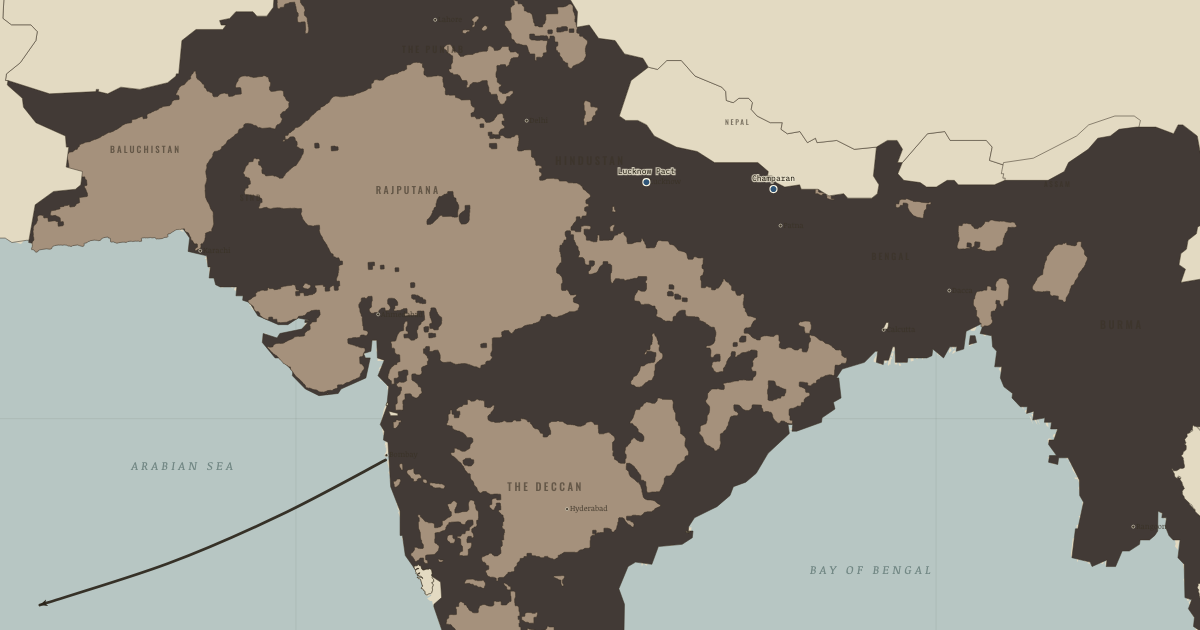
The map above is the world of India, December 1911 — The partition annulled.
Every state on the map that year: The world in 1918 · Europe in 1918.
Part of IB History: Indian Independence and Partition →
SHORT EXPLANATION
During the First World War, Indian leaders supported Britain in the expectation that sacrifice would bring self-government. India supplied roughly 1.4 million soldiers and labourers, as well as money, grain and credit. The prospect of reform helped Congress and the Muslim League agree at Lucknow in 1916 on a common demand for self-rule. Their agreement also accepted separate electorates, preserving a constitutional division between communities.
Gandhi found another way to challenge the Raj at Champaran in 1917. His satyagraha combined disciplined non-violent law-breaking with acceptance of punishment, making the penalty itself part of a public argument. The government backed down. The method offered nationalism more than elite petitions, and would shape the next thirty years of struggle. By the war’s end, tens of thousands of Indians had died, prices had doubled and influenza was raging. A promise of slow, limited reform seemed a poor return for those sacrifices.
The full story
The Great War presented Indian politicians with a chance to make a claim on Britain. Congress and the Muslim League supported the war, and Gandhi recruited for it, expecting that service to the empire would be followed by self-government. India supplied money and wheat from the Punjab as well as men: a hundred million pounds outright and some 1.4 million people sent west to serve in Flanders, Gallipoli and the Mesopotamian disaster at Kut. More than 70,000 men never returned.
Political agreement at Lucknow in December 1916 gave the demand for self-rule greater weight. Congress accepted separate electorates, and the Muslim League joined it in a common constitutional scheme. The broker was Muhammad Ali Jinnah, a Bombay barrister then praised as an ambassador of Hindu–Muslim unity. In August 1917 London appeared to answer the demand. The Montagu Declaration promised “the progressive realisation of responsible government in India.” The promise mattered, but its timing remained open: ‘progressive’ set no date for responsible government.
A different kind of challenge to British authority took shape at Champaran in 1917. Gandhi, an obscure barrister recently returned from twenty years in South Africa, took up the case of indigo tenant-farmers. Ordered by a magistrate to leave the district, he stayed and invited the penalty. His refusal left the Raj to decide whether to punish a man who had neither fought nor fled. It gave way. Gandhi’s satyagraha, or truth-force, had made punishment itself part of a public argument about the farmers’ treatment.
The war’s losses were followed by a disaster at home. Influenza killed perhaps twelve to fourteen million Indians in 1918, emptying villages already drained by the fighting. Historical memory has given the catastrophe remarkably little attention. At peace, India had lost men and resources and received a promise of reform. The following chapters examine the consequences when the Raj declined to meet the expectations attached to that service.
FULL EXPLANATION
The sepoys’ war, and its double erasure
Letters dictated by Indian soldiers and intercepted and translated by military censors let us hear something of the experience of the 1.4 million Indians who served. Historians including David Omissi have only recently mined this record. Its writers could be proud and homesick, horrified by industrial slaughter and struck by the sight of white men killing white men. The letters offer one of the fullest available records of the colonized soldier’s mind. Their service was organized through racial categories. Recruited disproportionately from the Punjab’s so-called martial races, Indians served as labour and shock troops from Flanders to Mesopotamia. Afterwards their place in national memory was awkward on both sides: British accounts preferred an all-white Western Front, while Indian nationalism hesitated to celebrate service to an empire it opposed. Recovering these men complicates both stories. Those who held Ypres came from districts that this atlas will show engulfed in violence in 1947.
Satyagraha: conscience, or leverage?
At Champaran Gandhi brought a method formed over twenty years in South Africa. He drew on Thoreau’s civil disobedience, Tolstoy’s non-resistance, Ruskin’s dignity of labour and the Bhagavad Gita’s teaching on action without attachment to reward. The question is how such resistance could change a government’s conduct. Gandhi emphasized conscience: a resister’s suffering might awaken the oppressor. A realist interpretation, later developed by non-violent action theorists such as Gene Sharp, emphasizes leverage. Colonial rule relied on Indian cooperation; disciplined, public withdrawal of that cooperation could make the state ungovernable. Open acceptance of penalties could also undermine the legitimacy of repression before domestic and world opinion. At Champaran the magistrate’s position became untenable. Whether that result reflected conversion or pressure, rather than a change of heart, remains a question throughout the struggle.
Key places on the map
Why it happened
Loyalty as investment. Support for the war was nearly unanimous among Indian politicians. They could point to Canada and Australia, white dominions being promised autonomy for smaller sacrifices, and ask why India should not expect reciprocity. Tilak, newly released from jail, urged recruitment; Gandhi’s recruiting campaigns in Gujarat puzzled even his followers. Their strategy had a clear purpose and dignity, but it depended on Britain paying a debt it had never explicitly agreed to owe.
Lucknow: unity brokered at a price. Each party had something to gain at Lucknow. Congress wanted Muslim support for a national demand; after 1911 the League had learned that British favour could be fickle. Jinnah brought them together by accepting separate electorates and weighted Muslim representation in provinces where Muslims were few. This was a high point of unity, yet the agreement retained the communal constitutional structure within the shared programme.
Champaran: the method finds its country. Gandhi had learned in South Africa, where Indians were a minority, that disciplined refusal could challenge a state dependent on cooperation. At Champaran he used documentation and accepted suffering to mobilize a district and press the Raj to legislate against its own planters. Ahmedabad and Kheda followed within a year. Nationalists now had a means of mass resistance in which repression could damage the authority using it.
The war hollows the Raj itself. The victorious Raj emerged from the war with a weaker basis for rule. Prices doubled; Punjab recruitment quotas could shade into press-gangs; and influenza came home with troopships. Britain now owed money to India rather than the reverse. Compared with 1914, the government in 1919 had less consent, less cash and fewer reliable men, even as Indians expected a return for their sacrifices.
THE TURNING POINT
Lucknow, December 1916. Congress and the Muslim League spoke together at Lucknow in December 1916 under a scheme drafted by Jinnah, the future founder of Pakistan. The pact shows that Hindu–Muslim political unity could be negotiated on paper. It also made separate electorates part of the nationalist programme. For historians considering whether Partition was inevitable, the same agreement offers evidence of an achieved unity and of the constitutional separation accepted within it.
What it changed
A promise with no date. When Britain promised “responsible government,” it set no date for its arrival. The Government of India Act of 1919 instead introduced “dyarchy”: Indian ministers received education and sanitation, while Britons kept finance, police and the army. Politicians who had seen 70,000 men buried could regard this limited instalment as an insult. The distance between wartime promise and delivery helped Gandhi build mass politics.
The Punjab primed. The Punjab supplied three-fifths of the army, more men than any other province, and felt recruitment’s coercion especially sharply. In 1919 it rose against the Rowlatt Act; martial law and massacre followed. The province that had contributed so much to the war also suffered terribly in the postwar confrontation.
Jinnah’s first exit. Jinnah opposed the Rowlatt Act, but Gandhi’s mass agitation and religious idiom troubled a politician committed to constitutional methods. In 1920 the former ambassador of unity resigned from Congress, warning of “complete disorganization and chaos,” and later drifted to London. Chapter 9 follows his return in the 1930s to a changed political world. His estrangement began in these postwar disputes.
DISCUSSION QUESTION — India backed the war expecting self-government in return. Was the loyalist strategy of 1914–18 a failure?
Judged against its immediate aim, the loyalist strategy failed. Britain gave India dyarchy and the Rowlatt Act rather than dominion status, and disillusionment pushed some advocates of loyalty toward more radical opposition. Yet those years also furnished the next struggle with the Lucknow Pact’s united front, the Home Rule Leagues’ networks and Gandhi’s tested method. Wartime sacrifice gave the nationalist claim moral force: Indians had paid in blood, making the movement harder to dismiss as a seditious clique in India or abroad. Britain’s refusal to meet a debt its own declarations acknowledged helped turn moderates into non-cooperators, more effectively than Extremist pamphlets alone could have done.
An interesting fact
At Hollebeke in Belgium in October 1914, Khudadad Khan kept his machine gun firing after every other man in his detachment had been killed. He survived by feigning death and became the first Indian to win the Victoria Cross. Khan came from a Punjabi village near Chakwal; Indians had been legally barred from the award until 1911, and eleven won it in the Great War. The army holding Ypres that first desperate autumn was in meaningful part an army of the Punjab, including men from districts the map will hatch with violence in 1947. British and Indian memories of empire have both tended to neglect that service.
Related
THE FREE PRINTABLE STUDY GUIDE
Get the printable study guide for Indian Independence & Partition free. I’ll send you a few short letters, then one when a new atlas opens. That’s all. — Paul
NO TRACKING · YOUR ADDRESS IS USED FOR THE DISPATCH AND NOTHING ELSE · UNSUBSCRIBE ANYTIME