Mongol Empire · EPILOGUE ·
Legacy of the Mongol Empire
Chapter 12 of The Mongol Empire, 1206–1294: “The Long Shadow”
After Khubilai’s death in 1294 the khanates stayed connected: protected routes carried merchants, envoys, technologies and travellers such as Marco Polo and Rabban Sauma. The same network helped plague spread toward the Black Sea ports before the Black Death, and its exchange cannot cancel out the mass violence of conquest.
Chapter 12 is included with every paid plan. WW2 is free in full, and chapter 1 of every atlas is free. A free account opens 3 more chapters a day. Starter, at $9 a month, opens all 21 with no daily limit — see the plans.
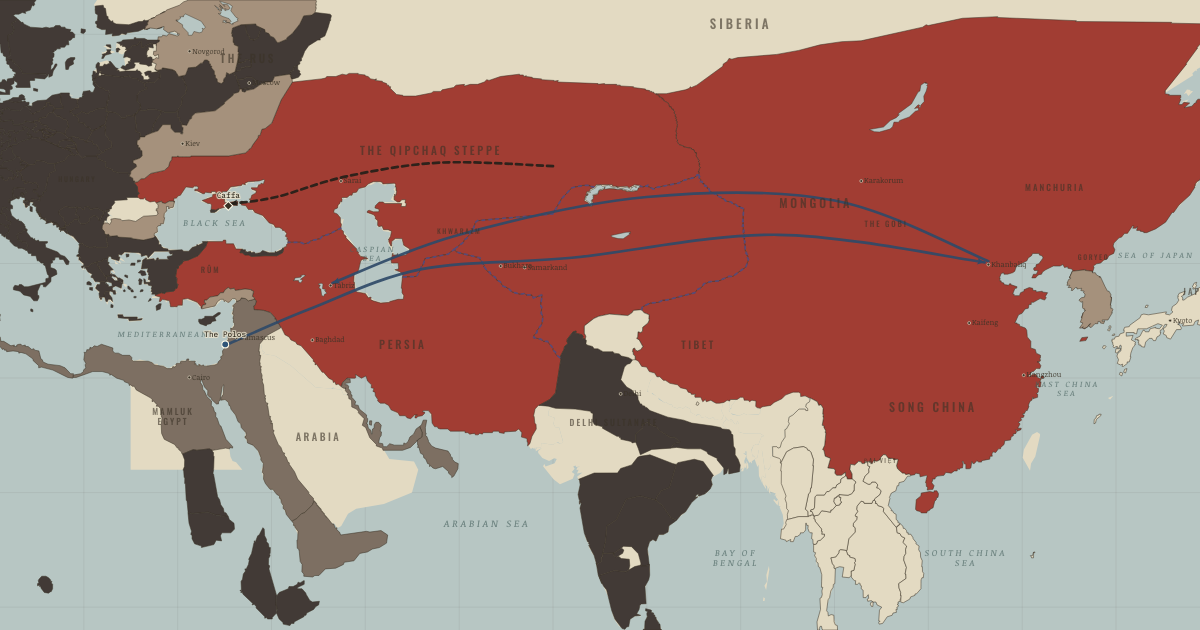
The map above is the world of The Mongol Empire, 1294 — The world Khubilai leaves.
Every state on the map that year: The world in 1300 · Europe in 1300.
Part of IB History: The Mongol Empire →
SHORT EXPLANATION
Khubilai died in 1294, but connections among the khanates endured. Passes, protected routes and diplomatic practices helped merchants, envoys and specialists travel across Eurasia. Marco Polo went east; Rabban Sauma, a Christian monk, went west. Their journeys show traffic in both directions through a world linked by Mongol rule.
Trade and warfare also connected Central Eurasian plague reservoirs with routes toward the Black Sea. The empire left political change, exchange and successor institutions, as well as mass killing and devastated regions. Each belongs in the history; none cancels the others.
The full story
The dashed borders on the final map divide the Mongol world, but they did not sever every connection between its rulers or peoples. Family ties and roads still crossed them. Marco Polo traveled east and later described serving at Khubilai’s court; Rabban Sauma, a Christian monk born near Khanbaliq, traveled west as an Ilkhanate envoy. Their journeys ran in opposite directions through a world whose courts sought allies, trade and knowledge.
Merchants and diplomats shared routes with physicians, astronomers and other specialists. Passes and agreements protected some travelers, helping skills and technologies move between courts. This arrangement is often called the Pax Mongolica, or Mongol peace. It followed conquest, and its protection was uneven, but the connections it maintained made some forms of exchange easier across great distances.
Those connections could carry dangers as well. Plague bacteria lived in animal reservoirs in Central Eurasia, and the routes of trade and war linked inland regions to Black Sea ports. A famous account describes infected corpses thrown into Caffa during a siege. The story is disputed, and a pandemic requires a wider explanation: ships, grain, rodents and repeated human contacts offer other possible links between places.
Look again at the arrows. The eastbound and westbound journeys show more than Europeans discovering an otherwise silent Asia. The route toward Caffa adds a consequence that no ruler had intended when building connections for command and commerce. The Yuan reunified China; the Ilkhanate developed a Persianate culture; the Horde left a deep influence on the Rus lands; and later rulers claimed Chinggisid authority. These legacies do not erase the massacres at Merv, Kiev or Baghdad. Exchange and devastation came from the same imperial history, and describing either gives us no reason to excuse the other.
FULL EXPLANATION
What the Mongol peace explains
The Pax Mongolica helps explain how some travelers crossed long distances. Safe-conducts, relay stations, toll arrangements and diplomatic contacts reduced obstacles for approved travelers moving among territories held by related regimes. A merchant could benefit from those arrangements without finding peace everywhere along the way. Khanates fought one another, borderlands suffered raids, and rulers favored merchants useful to them. Nor did gunpowder, printing and the compass travel along a single route invented by the Mongols. The more precise achievement was to make some exchanges across Eurasia more direct and to help merchants and specialists move. Institutions established for rule could also support trade and learning.
Plague and connected routes
Graves near Issyk-Kul dated 1338–39 have yielded genetic evidence of a strain associated with the fourteenth-century pandemic in Central Eurasia. The subsequent routes toward the Black Sea remain debated. Caffa was one connected port, not a proven single starting point, and the discussion includes rodents, fleas, human movement and repeated introductions. The disputed siege story cannot by itself account for a pandemic across such distances. Connections between inland reservoirs and ports gave infection opportunities to move between regions, even where individual journeys of the pathogen cannot be reconstructed. The same movement of people and goods that carried commerce and knowledge could transmit danger.
Key places on the map
Why it happened
How the routes were protected. A merchant going to China crossed lands governed by several rulers. Related regimes could make the journey more predictable through passes, relay stations and agreements. Around 1340 the merchant Pegolotti called the road “perfectly safe, whether by day or by night.” His judgment describes a particular route and time, not a guarantee for every traveler. As the khanates diverged and fought (Chapter 9), risks and barriers changed; maritime routes offered other ways to reach Asian markets. A road’s usefulness depended in part on the political arrangements that protected those using it.
Specialists and knowledge on the move. Mongol rulers moved expertise across their territories as well as military equipment (Chapter 10). Chinese physicians and engineers worked at Tabriz, and Persian astronomers contributed to Beijing’s observatory. In the Ilkhanate, Rashid al-Din drew on Chinese informants and Frankish envoys for his ambitious world history. Gunpowder, the idea of printing and the compass moved west along networks that included Mongol routes but also predated the empire. Rulers sought skills for their own purposes; once people and knowledge moved, their uses could extend further.
Plague travels through connections. The bacterium Yersinia pestis lived in Central Eurasian animal reservoirs, including marmot and gerbil populations. Caravans, armies and shipments connected inland regions with ports, providing opportunities for infection to travel. The account of bodies thrown into Caffa is memorable, but the routes and carriers of the pandemic remain debated. The Black Death was not deliberately caused by a Mongol ruler. Its spread belongs to the wider history of the commercial and political connections across this region.
THE TURNING POINT
Caffa, 1347. Caffa connected inland routes to ships on the Black Sea. Plague reached the Mediterranean world in 1347, though its precise route remains disputed. The port gives the story of exchange another dimension: links maintained for commerce and command could also carry a catastrophe that no ruler had intended.
What it changed
Successor states and Mongol authority. Mongol rule ended in different places at different times, but its institutions and claims to authority continued to be used. The Yuan fell in 1368, leaving a reunified China with its capital at what is now Beijing. Muscovy grew under the Horde’s tax system and later expanded into the steppe. In India, the Mughals drew on Mongol and Timurid inheritance; on the steppe, Chinggisid descent remained a powerful source of legitimacy into the eighteenth century. Each inheritance served new rulers and ambitions.
Routes toward the sea. Overland commerce continued, although khanate wars, plague and changing costs affected it. European interest in Asian goods and accounts of Asian courts also endured. Columbus carried an annotated copy of Polo’s book as he sought a westward route to Asia, long after Khubilai’s death. Later maritime ventures grew in part from interests and knowledge sustained by those earlier overland connections.
Return to the map. Free Explore lets you follow several different outcomes. Watch Hungary change and recover, then trace Syria after Ain Jalut. Japan, Delhi and Egypt faced Mongol advances with different obstacles available to them: water, climate and capable opposing armies. Finally return to Mongolia, the homeland from which the empire grew. Its territorial color changes less than those of many conquered regions. The map shows that difference; understanding the changes in Mongolian life would require looking beyond its colors.
DISCUSSION QUESTION — With mass death and Eurasian exchange both in view, how should a student assess the Mongol Empire’s achievements?
Describe the consequences separately before trying to judge them. Mass killing, displacement and lasting regional damage deserve attention, including the ranges and limits of the sources. Political reunification, protection of some trade, the movement of specialists and successor institutions also require explanation. Exchange cannot justify atrocities, and condemnation cannot make exchange disappear. Persian, Rus, Arab, Chinese, Mongolian and modern historians work with different archives and inherit different memories. A single moral score would hide distinctions that the history needs us to examine.
An interesting fact
In 2003 geneticists reported a Y-chromosome lineage found in roughly one man in twelve across a large part of the former empire’s lands. They estimated about sixteen million men, close to one in two hundred worldwide, and traced its expansion to Mongolia about a thousand years earlier. The proposed connection to Genghis Khan’s male line is an inference, not a verified identification: his grave has not been established and no verified remains are available for comparison. The lineage spread remarkably widely, even though its founder remains unidentified.
Related
THE FREE PRINTABLE STUDY GUIDE
Get the printable study guide for The Mongol Empire free. I’ll send you a few short letters, then one when a new atlas opens. That’s all. — Paul
NO TRACKING · YOUR ADDRESS IS USED FOR THE DISPATCH AND NOTHING ELSE · UNSUBSCRIBE ANYTIME