Road to WW2 · CHAPTER 4 ·
Italian invasion of Abyssinia
Chapter 4 of The Road to War, 1931–1941: “Abyssinia: The League Dies in Africa”
Italy turned a clash at Wal Wal, inside Abyssinian territory, into a pretext for war, and in October 1935 its armies advanced from Eritrea and Somaliland. The League named Italy the aggressor but left oil out of its sanctions while Britain kept Suez open. Italian forces used mustard gas and entered Addis Ababa in May 1936.
Chapter 4 is included with every paid plan. WW2 is free in full, and chapter 1 of every atlas is free. A free account opens 3 more chapters a day. Starter, at $9 a month, opens all 21 with no daily limit — see the plans.
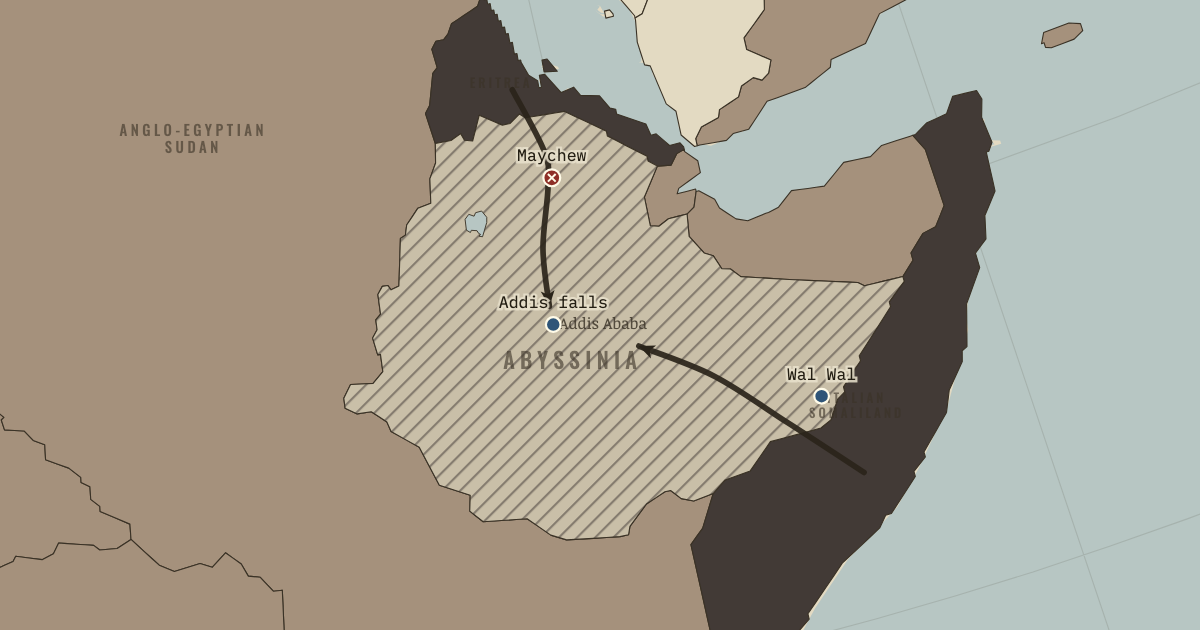
The map above is the world of Europe and Africa, October 1935 — Italy invades Abyssinia.
Every state on the map that year: The world in 1938 · Europe in 1938.
Part of IB History: The Road to War →
SHORT EXPLANATION
Italy’s war against Abyssinia began with a dispute at Wal Wal in December 1934. Mussolini used the clash between Italian and Ethiopian forces as a pretext for an invasion he was already preparing. Emperor Haile Selassie appealed to the League of Nations, of which both countries were members. In October 1935 Italian armies crossed from Eritrea and Somaliland, using modern weapons and aerial mustard gas against Ethiopian forces and civilians. Addis Ababa fell in May 1936.
The League’s response exposed a conflict within its leading powers’ policies. Britain and France supported sanctions, yet left oil outside them and allowed Italian shipping through Suez: they wanted to oppose aggression while keeping Mussolini as a partner against Germany. The leaked Hoare–Laval plan revealed that they had privately offered Italy much of Abyssinia. Ethiopia lost its independence, Italy moved toward Germany, and smaller states had reason to doubt what League membership would protect.
The full story
The clash at Wal Wal in December 1934 gave Mussolini the occasion he wanted. Italian and Ethiopian forces fought at a post well inside territory claimed by Ethiopia. Mussolini used the incident to justify an invasion already being prepared, while Emperor Haile Selassie appealed to the League of Nations. Italian troops and supplies continued to pass through Suez in full view. In October 1935 armies entered Ethiopia from Eritrea and Somaliland, facing forces with far fewer modern weapons.
Both Italy and Abyssinia belonged to the League. Its principle of collective security made an attack on one member a concern for the others; here the invasion was documented and Ethiopia had sought arbitration. The League named Italy the aggressor and imposed sanctions. This was a public judgment that the war should be resisted. The question was how much the members would do to give that judgment effect.
Britain and France had another concern. Mussolini was a potential partner against Hitler, and stronger pressure over Africa might cost them his cooperation in Europe. Their sanctions excluded oil and other essential supplies, and Britain kept Suez open to Italian shipping. The measures answered demands for action while limiting the risk of a break with Italy. They also left the invader with means to continue the war.
In December, the Hoare–Laval proposal leaked. The British and French foreign ministers had privately offered Mussolini much of Ethiopia while their governments were publicly supporting sanctions against him. Italian forces used mustard gas, defeated the remaining Ethiopian armies and entered Addis Ababa in May 1936. Further violence followed under occupation; estimates of the deaths remain contested.
Would a full oil embargo have changed the result? It might have put Italy under much greater pressure, though American oil could have weakened the embargo and stronger action might have brought a wider war. What is clear is the result of the policy chosen: Ethiopia was not saved, and Italy moved toward Germany. At Geneva, Selassie warned an audience of states that now had reason to ask whether their own treaty protection would survive a bargain among great powers.
FULL EXPLANATION
Sanctions and calibration
A sanction has to affect the ability or willingness of a government to continue the policy being challenged. The League’s measures against Italy excluded oil, coal and other strategic materials; Britain also kept Suez open as a route to the war. British and French leaders feared Italian retaliation in the Mediterranean, so restraint reduced an immediate danger. But it also left Italy with supplies and access for the invasion. An oil embargo might have put severe pressure on Mussolini. Its effect would have depended partly on American participation and on his response, so the outcome cannot be assumed. The measures actually adopted angered Italy and helped its government mobilize nationalist feeling, while the campaign continued. The League’s leading members applied pressure but withheld measures that might have made it effective.
The Stresa tradeoff
Mussolini occupied two places in British and French policy. In Africa he was an aggressor; in Europe he was a potential partner against Germany. London and Paris tried to condemn his invasion without losing his cooperation. The Hoare–Laval proposal brought the conflict into view. Sanctions publicly upheld the League’s verdict, while the two governments privately offered Italy much of the victim’s territory. Smaller states had to ask whether their protection could also be traded in a bargain among major powers. Mussolini moved closer to Hitler, who prepared his Rhineland move amid the African crisis. Stronger action would have carried costs and uncertain prospects, but accommodation damaged the rules and relationships on which later resistance depended.
Key places on the map
On this day
Why it happened
A regime that needed a triumph. Fascism had promised greatness after what Italian nationalists called the “mutilated victory” of 1918. By 1934 the corporate economy was stagnant, and conquest offered Mussolini several prizes: revenge for Adwa in 1896, employment for Blackshirts and the “place in the sun” sought by Liberal Italy. The war attracted substantial popular support. Sanctions gave him another opportunity, allowing him to present an imperial attack as a struggle against hostile foreign powers.
Britain and France wanted Italy against Hitler. At Stresa, Britain and France had sought Mussolini’s help against German revisionism. They had reason to think he might provide it: when Austrian Nazis killed Austria’s chancellor in 1934, he moved troops to the Brenner. Strong action over Ethiopia threatened that European partnership. London and Paris tried to punish the invasion while keeping his friendship, but Ethiopia fell and relations with Italy deteriorated.
The victim was inside the system. The League could hardly mistake Abyssinia for a case outside its responsibilities. Both states were members, the aggression was documented, and arbitration had been attempted. Article 16 of the Covenant called for sanctions against a member resorting to war in breach of its obligations. During the Manchurian crisis, opponents of action could point to distance and China’s disorder; those explanations carried much less force here. Many contemporaries and later historians regarded the failure as a decisive blow to collective security.
Air power and gas against spears and rifles. Italy brought nearly half a million men, tanks and around 400 aircraft against Ethiopian forces consisting largely of riflemen and levies. The disparity did not remove the difficulty of advancing through mountains. Badoglio used aerial mustard gas against troops and civilian areas, including Red Cross units, despite Italy’s adherence to the 1925 Geneva Protocol. Estimates of deaths in the war and subsequent occupation range from tens to hundreds of thousands; the Ethiopian government later claimed about 760,000. The range shows the uncertainty in assessments of the human cost.
THE TURNING POINT
Paris, December 1935. The Hoare–Laval leak in December 1935 showed two policies operating at once. Britain and France led sanctions against Italy, while their foreign ministers privately proposed awarding Mussolini most of the territory he was attacking. Hoare resigned and Laval soon left office, but the revelation also affected confidence in the League. Smaller states had reason to wonder whether a great-power bargain would override their protection. Within a year Belgium returned to neutrality, and members of the Little Entente sought their own arrangements; their decisions had causes beyond this episode.
What it changed
The Stresa Front becomes the Axis. The invasion and sanctions strained Mussolini’s relations with his Stresa partners. Germany remained sympathetic and kept buying Italian goods, and Italy moved closer to Hitler. The Rome–Berlin “Axis” was announced in October 1936; Italy joined the Anti-Comintern Pact and left the League in 1937. Mussolini, who had defended Austrian independence in 1934, accepted its loss in 1938.
Hitler moves while the referee is distracted. The African crisis occupied Britain, France and Italy while their relations with one another deteriorated. This was the setting for Hitler’s March 1936 remilitarization of the Rhineland. The next chapter follows that gamble.
Collective security is abandoned in practice. In July 1936, after Italy annexed Ethiopia, the League lifted sanctions. Belgium moved away from its French alliance toward neutrality, complicating French defense plans. Collective security had been weakened in practice. The UN Charter of 1945 established a new system with central enforcement roles for the major powers, alongside powers of veto.
DISCUSSION QUESTION — Britain and France neither closed Suez nor embargoed oil. Were limited sanctions worse than no sanctions?
There is a case against the middle course. Italy depended on imported oil, and Mussolini later claimed that an embargo would have forced him out “within a week.” His retrospective claim served his own purposes, but fuel was a real vulnerability. Stronger pressure might have altered the campaign, while no sanctions might have preserved more of the Stresa partnership. The measures adopted failed to save Ethiopia and helped sour relations with Italy. Neither alternative offers a certain result. British and French publics demanded action, naval leaders feared a Mediterranean war, and American oil from outside the League might have weakened an embargo. The choice must be judged against those risks as well as the limited measures’ failure to stop the invasion.
An interesting fact
Haile Selassie came to the League Assembly on 30 June 1936 to plead his country’s case in Amharic. Italian journalists in the gallery whistled to interrupt him until the Romanian delegate Nicolae Titulescu called for the removal of “the savages.” Time had named Selassie its 1935 Man of the Year. Restored to his throne during the Second World War, he hosted the founding of the Organisation of African Unity in Addis Ababa in 1963, twenty-seven years after the city fell.
Related
THE FREE PRINTABLE STUDY GUIDE
Get the printable study guide for The Road to War free. I’ll send you a few short letters, then one when a new atlas opens. That’s all. — Paul
NO TRACKING · YOUR ADDRESS IS USED FOR THE DISPATCH AND NOTHING ELSE · UNSUBSCRIBE ANYTIME