Cold War · CHAPTER 2 ·
Marshall Plan and Berlin Blockade
Chapter 2 of The Cold War, 1945–1991: “Containment”
In 1947 the United States answered Britain’s inability to support Greece with the Truman Doctrine and offered Europe roughly $13 billion in Marshall aid, which Moscow refused for its sphere. When Stalin closed road and rail routes into West Berlin in June 1948, the Allies flew in some 2.3 million tons of supplies until May 1949.
WW2 is free in full, and chapter 1 of every atlas is free. A free account opens 3 more chapters a day. Starter, at $9 a month, opens all 21 with no daily limit — see the plans.
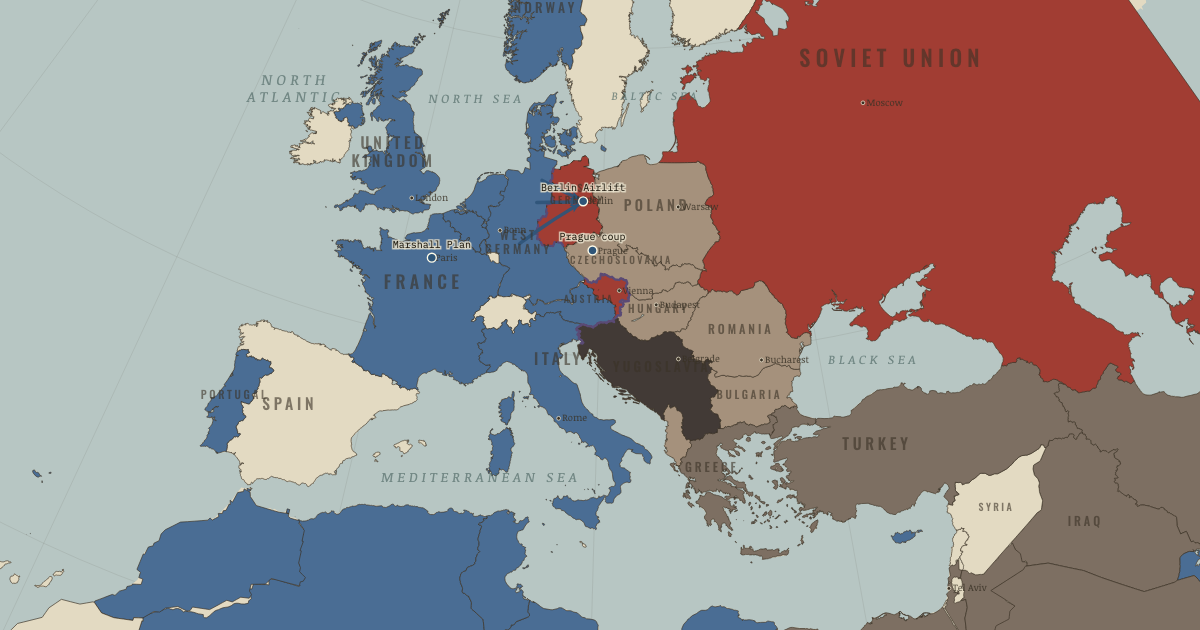
The map above is the world of Europe, May 1949 — Two Germanies, two Europes.
Every state on the map that year: The world in 1950 · Europe in 1950.
Part of IB History: The Cold War →
SHORT EXPLANATION
Britain could no longer afford to sustain the Greek government against communist insurgents in 1947. The United States took up the burden, and President Truman pledged support for “free peoples” resisting subjugation. Washington’s larger response to Europe’s distress was the Marshall Plan: roughly $13 billion to rebuild economies, including those of former enemies. Its reasoning was political as well as economic. Poverty and disorder could bring communist parties electoral support even where Soviet armies had not advanced.
The aid required disclosure of economic information and cooperation across borders. Stalin refused it and required governments in the Soviet sphere to do the same. In Berlin the confrontation then became a test of whether the Western powers could hold their position. After the Soviet Union cut land access in 1948, they supplied their sectors by air for 323 days rather than withdraw or force an armed convoy through. The blockade failed, and the crisis helped consolidate NATO and the division of Germany into rival states.
The full story
Europe’s recovery was far from assured in the winter of 1946–47. Canals froze, fuel ran short and German rations were halved. The hardship also troubled American policymakers for a political reason. Communist parties in France and Italy had already won around a quarter of the vote; if living conditions remained desperate, they might gain power through elections without a Soviet invasion. The Marshall Plan sought to restore production and give people reason to expect a better future. Recovery was to serve containment.
The offer went beyond Western Europe. The Soviet Union and Eastern European governments could take part, but recipients had to disclose economic information and coordinate across borders. Stalin saw these conditions as a threat to his control over a command economy and its buffer. Czechoslovakia agreed to attend the Paris talks, then reversed itself under Soviet pressure. Western European production rose above its prewar level by 1951; Eastern Europe entered a separate economic system under Soviet direction. An offer made to help rebuild the continent had become part of its division.
The next test came in Berlin, where the Western sectors stood inside the Soviet occupation zone. In June 1948 Stalin closed the roads and railways that supplied them. He left three agreed air corridors open. The Western powers could have abandoned their position or tried to force a convoy through. Instead, they used the corridors to deliver roughly 2.3 million tons of coal and food by air. Moscow lifted the blockade in May 1949, without a battle over access.
The siege had consequences beyond the city. It helped persuade the Western powers to make their cooperation more durable: twelve countries signed the North Atlantic Treaty on 4 April 1949, binding American security to Europe in a standing peacetime alliance. Within months the Federal Republic and the German Democratic Republic faced each other across the former occupation line. Pressure intended to loosen Western resolve had helped bring about a closer alliance and a divided Germany.
FULL EXPLANATION
Recovery, influence and division
The Marshall Plan sent about $13.3 billion to assist recovery and encourage trade in Western Europe. It also asked governments receiving aid to open their accounts to scrutiny and coordinate their programs. Those conditions drew them toward an American-led market order. Reconstruction and American influence were both part of what the Plan accomplished. The offer was extended to Moscow, but historians disagree over whether Washington intended it to be accepted or expected a refusal. For Stalin the conditions posed a real problem either way: outside supervision threatened his control over a command economy and a sphere of client states. Czechoslovakia’s government agreed to attend the Paris talks and then reversed its decision under direct Soviet pressure. The Plan supported prosperity and democratic stability where governments were free to join. Its conditions, together with Soviet refusal, also made Europe’s economic division harder to reverse. People east of the line bore costs of a settlement they could not choose.
Coercion without crossing the trigger
Stalin’s blockade exploited a gap in the occupation arrangements. The Western powers had no written guarantee of ground access, so he could close the routes to Western Berlin without launching an attack. The pressure was intended to change their position while avoiding a wider war. This is calibrated coercion: pressure deliberately kept below the point at which it might trigger war. Truman had choices to make in response. Withdrawal would have surrendered the Western position, while an armed convoy risked a direct clash. The airlift sustained the city and left Moscow a way to end the crisis without a visible military defeat. Flight schedules, runway capacity and coal deliveries became instruments of policy: as supplies arrived, they showed that West Berlin could be sustained. The blockade also helped persuade skeptical American legislators and European publics that a permanent alliance was necessary. Pressure meant to prevent NATO and a West German state helped bring both closer.
Key places on the map
On this day
Why it happened
Europe was starving, and hunger votes. Marshall’s planners looked at Europe’s political troubles alongside its material shortages. In the winter of 1946–47 frozen canals interrupted supplies and German rations were halved. French and Italian communist parties already had about a quarter of the vote. If hunger increased their support, they could gain power at the ballot box without Soviet tanks. Aid would meet immediate needs while helping restore production and confidence. Western European output passed its prewar level by 1951, and communist electoral support eventually receded. Recovery had several causes; the Plan contributed substantially.
Why Moscow refused the money. Stalin had to consider what acceptance would require. Marshall aid was offered to the Soviet Union and its sphere, and he sent Molotov to Paris with ninety economists before withdrawing him. Open accounts and integration into a Western-led system threatened Soviet control over both the command economy and its buffer. Historians still debate whether Washington expected acceptance or intended to drive a wedge into the bloc. Czechoslovakia’s government agreed to attend the talks, only to reverse course after Soviet pressure by phone. Moscow kept control, while its neighbors lost access to the aid.
Berlin: geography as leverage. The occupation arrangements of 1945 placed Western Berlin deep inside the Soviet zone. The Western powers had no written guarantee of ground access, but they did have three agreed air corridors, each twenty miles wide; the three arrows show them. Closing the land routes let Stalin exert pressure without an overt attack. Supplying the city by air let the West respond without sending an armed convoy through. Geography gave each side a way to contest the city while trying to avoid direct combat.
The bomb behind the politeness. Behind the Berlin crisis stood the possibility of a much larger war. The United States retained an atomic monopoly until August 1949. Stalin did not shoot down the transports, and Truman sent B-29 bombers to England as a signal. Those aircraft were not configured to carry atomic weapons, so the signal depended partly on what Moscow believed they could do. Both governments applied pressure while trying to avoid turning the confrontation into a shooting war.
THE TURNING POINT
Berlin, 24 June 1948 — the gates close. On 24 June 1948 the blockade cut ordinary land supplies to Berlin’s Western sectors. Stalin hoped to prevent a West German state without war. The airlift gave the Western response a human focus: Berliners who had recently been defeated enemies became symbols of resistance. It also helped convince skeptical senators that Europe would stand up for itself. While aircraft were still flying, the United States Senate approved NATO by 82–13. The blockade was one of several causes of the alliance, but it helped unite the coalition Stalin had hoped to divide.
What it changed
NATO: the entangling alliance at last. The North Atlantic Treaty, signed by twelve nations on 4 April 1949, gave the United States its first peacetime European alliance since 1778. Article 5’s “an attack on one…” made collective defense a standing commitment: an attack on one member would engage the others. Follow the blue column on the timeline to see Greece and Turkey join in 1952 and West Germany in 1955.
Two Germanies, one open wound. Two governments now claimed authority on opposite sides of the old occupation line: the Federal Republic, founded in May 1949, and the German Democratic Republic, founded in October. Neither recognized the other. Find their hatched split on the map. Berlin remained divided but comparatively open, providing a route out of East Germany for around three million people by 1961. That year the East German government closed the route with a wall.
The Cominform and the first heretic. Stalin responded to the Marshall Plan by tightening discipline among communist parties. The Cominform, founded in 1947, brought them under closer direction, while purges enforced obedience. Yugoslavia’s Tito resisted. His forces had liberated much of the country without the Red Army, and he refused Stalin’s orders. Expelled from the Cominform in 1948, he remained in power. Watch Yugoslavia turn charcoal: a communist government had broken with Moscow and survived.
DISCUSSION QUESTION — What did the Marshall Plan achieve, and who bore the costs of the settlement it helped create?
The Plan’s roughly $13 billion helped Western Europe recover and encouraged cooperation that later contributed to the EEC. Recovery also helped create conditions in which French and Italian communists lost electoral ground, while the deutschmark anchored the Western order for decades. The price of that settlement was unevenly borne. Disclosure and cooperation threatened Stalin’s control, and his refusal helped make Europe’s economic division harder to reverse. Czechoslovakia’s leaders initially wished to attend the talks but were forced to change course. Many historians judge the trade knowingly made and worthwhile; Czechs, Poles and Hungarians bore costs of a settlement in which they had little choice. Any judgment of the strategy must take both its achievements and those costs into account.
An interesting fact
At the Tempelhof fence, pilot Gail Halvorsen shared two sticks of gum with children. He began signaling his approach by wiggling his wings, then dropping sweets on handkerchief parachutes. American schoolchildren helped tie the parachutes, and “Operation Little Vittles” grew to deliver roughly 23 tons of candy. The airlift also cost lives: some seventy British and American airmen, along with German ground workers, died in crashes and accidents along the corridors, although no shot was fired.
Related
THE FREE PRINTABLE STUDY GUIDE
Get the printable study guide for The Cold War free. I’ll send you a few short letters, then one when a new atlas opens. That’s all. — Paul
NO TRACKING · YOUR ADDRESS IS USED FOR THE DISPATCH AND NOTHING ELSE · UNSUBSCRIBE ANYTIME