Cold War · CHAPTER 5 ·
Hungary 1956 and the Berlin Wall
Chapter 5 of The Cold War, 1945–1991: “Coexistence and Its Crises”
After Stalin’s death in 1953, Khrushchev promised peaceful coexistence and in 1956 denounced Stalin’s crimes. Soviet tanks crushed Hungary’s rising in November 1956, killing some 2,700 people, while Washington forced Britain and France to abandon their invasion of Egypt at Suez. In August 1961 East Germany built the Berlin Wall.
Chapter 5 is included with every paid plan. WW2 is free in full, and chapter 1 of every atlas is free. A free account opens 3 more chapters a day. Starter, at $9 a month, opens all 21 with no daily limit — see the plans.
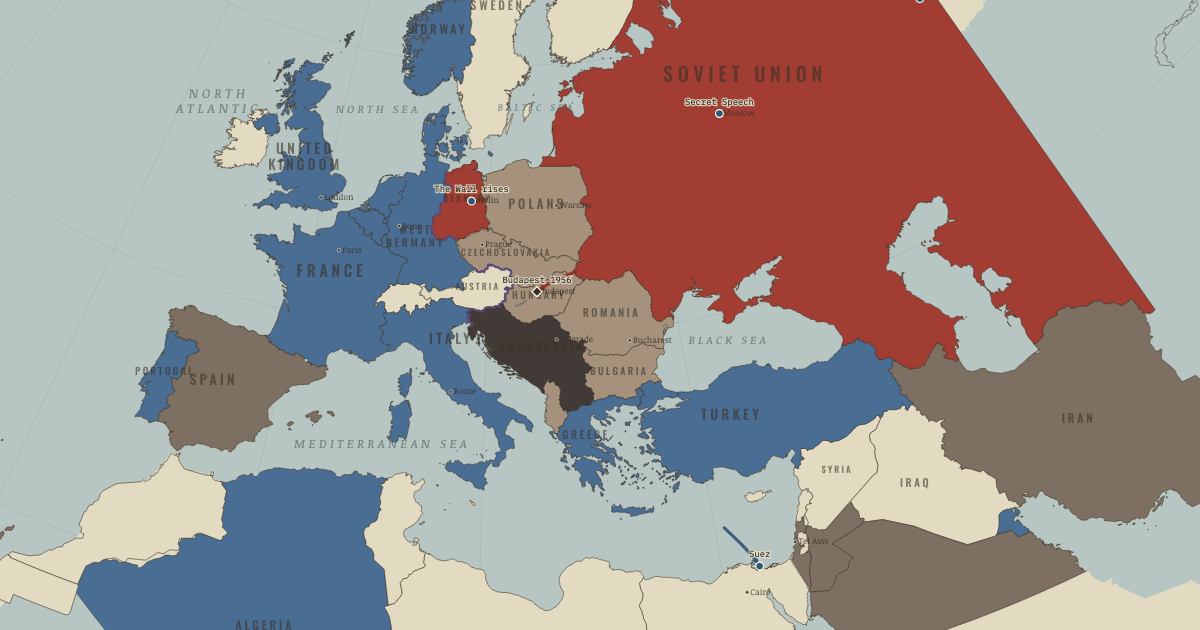
The map above is the world of Europe, August 1961 — The wall goes up.
Every state on the map that year: The world in 1960 · Europe in 1960.
Part of IB History: The Cold War →
SHORT EXPLANATION
Stalin’s death in 1953 left Soviet leaders with a problem: how could they ease a system of terror without losing the control it had secured? Khrushchev promised “peaceful coexistence” with the West and exposed some of Stalin’s crimes in a closed speech to the party in 1956. His admission gave reformers a way to demand change in socialism’s name. Poland won limited reforms; Hungarians went further, seeking multiparty politics, neutrality, and withdrawal from the Warsaw Pact.
The Soviet response established a limit. Tanks crushed the Hungarian rising in November 1956, killing some 2,700 people. In the same week, Washington forced Britain and France to abandon their invasion of Egypt at Suez. Both crises revealed constraints within alliances, enforced by very different means. Berlin remained dangerous because East Germans were leaving through its open sectors, taking skills the GDR needed with them. In August 1961 the government sealed the crossing, reducing an international danger by confining its own people.
The full story
Khrushchev wanted to renew Soviet socialism, not surrender leadership of the bloc. His Secret Speech in 1956 condemned Stalin’s crimes, yet that condemnation gave others an argument for change. If the party itself called the terror criminal, loyal socialists could question the controls left in its place. In Poland, Gomułka secured a less rigid communist government that autumn while remaining in the Soviet alliance. Hungary demanded more: neutrality and departure from the Warsaw Pact. Soviet armor returned to Budapest, killing roughly 2,700 people and driving 200,000 into exile.
During those same weeks, Britain, France, and Israel invaded Egypt over Suez. President Eisenhower brought financial pressure to bear, and the invasion ended. The episode showed that powerful Western allies also faced limits on independent action, although American pressure was very different from the force used in Hungary. The Cold War soon acquired another arena. Sputnik’s flight in 1957 stirred fears of a “missile gap,” although the gap largely favored the United States. The shooting down of a U-2 spy plane over the USSR in 1960 exposed the mistrust that continued beneath coexistence.
Berlin presented the Soviet bloc with a problem that speeches and threats had not solved. East Germans could cross between the city’s sectors and leave for the West; by 1961 thousands were going each day, many of them young and skilled. Khrushchev’s ultimatums sought to change Berlin’s status. In August 1961 East Germany instead closed the crossing. The Wall stopped the loss of people the GDR needed, while showing the world how its government retained them.
Suez also forced Britain and France to reconsider their dependence on Washington. Eden resigned within months and decolonization accelerated. France pursued greater freedom of action: it developed its own bomb in 1960, and de Gaulle withdrew from NATO’s integrated command in 1966. The Western column on the map thus represents an alliance whose members could disagree over the direction of their common enterprise.
FULL EXPLANATION
Reform from above, pressure from below
Khrushchev condemned Stalin’s crimes in the hope of renewing the Soviet system. Reformers could use the same admission to argue that socialism required change. The question then became how far Moscow would allow that change to go. Poland’s settlement preserved communist government and membership of the Warsaw Pact. Hungary sought neutrality and withdrawal, putting the military buffer valued by the Soviet Union at risk. Moscow accepted the Polish settlement and eventually sent force into Hungary. The outcome was not inevitable: the Politburo debated letting Hungary go, and the simultaneous Suez invasion weakened Western claims to moral authority. Intervention kept the bloc together, but it also damaged communist parties abroad: within a year a third of French and Italian members left. Inside the satellites, Soviet force had established the limits of reform. That loss of legitimacy remained as the bloc approached collapse in 1989.
A barrier that reduced one danger
East Germans had a way around the fortified inner-German border: they could cross between Berlin’s open sectors and continue west. Many were young and highly skilled, and the GDR needed their labor. Closing that route stopped the loss, but it also denied freedom of movement and created a fortified border where roughly 140 people are thought to have died trying to cross. Kennedy privately preferred a wall to a war because it stabilized the territorial situation. His preference makes sense in light of the danger of confrontation between states; the people confined by the barrier faced a different consequence. The Wall reduced that danger while deepening repression. Its fall in 1989 ended its practical work as a barrier and its symbolic force as an instrument of division.
Key places on the map
On this day
Why it happened
De-Stalinization and the demand for reform. Khrushchev’s attack on Stalin served his own position and promised to revive a system damaged by terror. It also changed the grounds on which reformers could speak. They could now cite Moscow’s own condemnation of Stalinism while asking for a different kind of socialism. Gomułka’s Poland stayed communist and in the Warsaw Pact; Hungary’s revolution challenged membership of the alliance itself. The tension between admitting crimes and retaining control returned under glasnost, with consequences for the Soviet Union itself.
Hungary and Suez in the same week. Soviet leaders debated whether to let Hungary go; the Politburo minutes record that the decision to intervene was not immediate. The Suez invasion mattered to their choice. As Britain and France attacked Egypt, Khrushchev could condemn their imperialism while Western governments had weaker grounds for condemning his own intervention. Western radio had encouraged Hungarians to hope for help, but no Western government intervened. Other satellites could see how far outside support went, and no comparable challenge succeeded for twelve years.
Sputnik and the politics of alarm. Sputnik flew on a rocket derived from a missile. Its arrival in orbit gave Americans reason to consider whether Soviet rockets could reach the United States, though the USSR had only a handful of unwieldy operational ICBMs. The feared “missile gap” actually favored America enormously. Fear nevertheless shaped decisions: NASA and the National Defense Education Act followed, and Kennedy made the gap a campaign issue. The earlier “bomber gap” and later “window of vulnerability” show the same political power of alarm about an opponent’s weapons.
Berlin and the people leaving. A fortified inner-German border could not stop East Germans who could move between Berlin’s sectors. By 1961 about 2,000 were leaving each day, disproportionately young, educated, and skilled. Their departure threatened the workforce on which the GDR depended. Khrushchev’s ultimatums of 1958 and 1961 tried to end Berlin’s special status; when threats did not settle the issue, East Germany closed the route itself.
THE TURNING POINT
Berlin, 13 August 1961 — the crossing closes. East Germany sealed the crossing overnight on 13 August. Wire came first, then concrete and a fortified death strip where perhaps 140 people died trying to cross. The Wall stabilizes the confrontation over Berlin: Kennedy privately called it “a hell of a lot better than a war,” and the Berlin crises stopped. It achieved that stability by restricting the movement of the people inside East Germany. Reagan’s speech in 1987 and the crowds in 1989 returned to the barrier as a symbol of division.
What it changed
Britain and France after Suez. The Suez failure exposed Britain and France’s dependence on American power. Eden resigned within months, and decolonization accelerated. France responded differently from Britain, seeking greater freedom from Washington: its own nuclear bomb followed in 1960, and de Gaulle withdrew France from NATO’s integrated command in 1966. The alliance endured, but its members did not agree on how dependent they should be on the United States.
Nasser and the choices of non-alignment. Nasser emerged from Suez a hero. Egypt had acquired Soviet weapons through a Czech-brokered deal and later received Soviet engineering help at the Aswan dam, even while Nasser jailed Egyptian communists. On the map Egypt moves from parchment to tan and back. Its leaders could seek support from the rival powers for their own purposes. Suez strengthened Moscow’s anti-imperialist reputation and helped open relationships across three continents.
The contest in space. From Gagarin’s flight in 1961 to Apollo in 1969, the rivals pursued prestige with rockets in a contest watched around the world. Spaceflight had its own casualties: three died in Apollo 1, four in Soyuz 1 and 11, and launch-pad workers died in the 1960 Nedelin disaster, which the USSR denied for thirty years. The competition also contributed to advances in satellites and computing that shaped the post-Cold-War world.
DISCUSSION QUESTION — Was crushing Hungary a Soviet victory or a Soviet defeat?
In the immediate contest Moscow won. The bloc held, the West stayed out, and the demonstration of force discouraged a comparable challenge for twelve years. But keeping control came at a cost. Within a year a third of the members of the French and Italian communist parties left, a loss associated with the birth of Eurocommunism. The invasion weakened Soviet claims to oppose imperial domination and showed people in the satellites that tanks set the limits of reform. In 1989 those tanks stayed home and the bloc unraveled. Soviet control had lasted another thirty-three years, while the means used to preserve it had damaged its legitimacy.
An interesting fact
The Secret Speech reached the CIA by an unexpected route. Polish journalist Viktor Grayevsky saw a red-bound copy on his girlfriend’s desk at the Polish party headquarters, where she was a secretary. It was one of the numbered copies circulated to bloc parties. He borrowed it for an afternoon and brought it to the Israeli embassy, where every page was photographed before he returned it. Israel passed the text to the CIA; by 4 June 1956 the speech delivered behind locked doors had been published for the world to read.
Related
THE FREE PRINTABLE STUDY GUIDE
Get the printable study guide for The Cold War free. I’ll send you a few short letters, then one when a new atlas opens. That’s all. — Paul
NO TRACKING · YOUR ADDRESS IS USED FOR THE DISPATCH AND NOTHING ELSE · UNSUBSCRIBE ANYTIME