WW2 · CHAPTER 2 ·
Invasion of Poland
Chapter 2 of The War Room — WW2, 1936–1945: “The Pact and the Partition of Poland”
On 23 August 1939 Nazi Germany and the Soviet Union signed a non-aggression pact whose secret protocol divided Eastern Europe into spheres of influence. Germany invaded Poland on 1 September, Britain and France declared war on 3 September, and the Red Army crossed Poland’s eastern border on 17 September.
WW2 is free — every chapter. No sign-up.
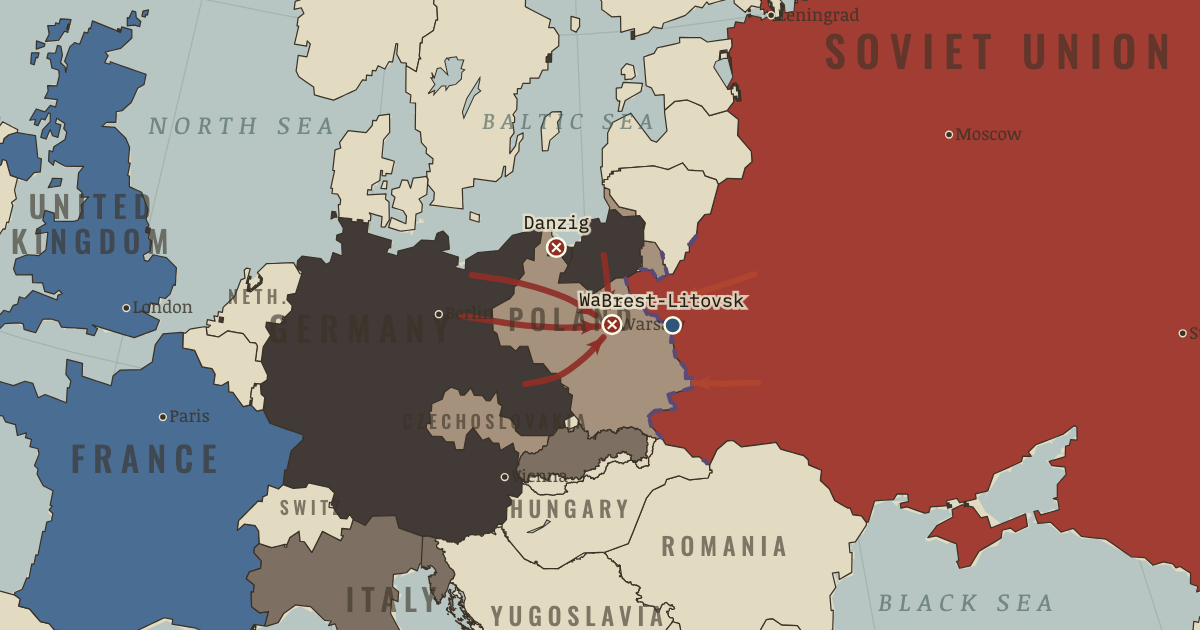
The map above is the world of Europe, October 1939 — Poland partitioned.
Every state on the map that year: The world in 1939 · Europe in 1939.
Part of IB History: The Second World War →
SHORT EXPLANATION
Nazi Germany and the communist Soviet Union had publicly committed themselves to destroying one another. Yet on 23 August 1939 they agreed not to go to war with each other. Each dictator saw an immediate advantage in the bargain. A secret protocol assigned western Poland to Germany and eastern Poland, the Baltic states, and Bessarabia to the Soviet sphere. Neither leader expected the arrangement to last long.
Germany could now attack Poland without an immediate Soviet war. Its invasion from the west on 1 September opened the Second World War in Europe. Britain and France honored their guarantee by declaring war two days later, but could not get help to Poland in time. The Soviet Union invaded from the east on 17 September, and the two powers partitioned the country. Poland’s government escaped into exile; its soldiers, airmen, and codebreakers continued the war abroad even after its state vanished from the map.
The full story
In August 1939 Hitler and Stalin made a bargain that gave each of them room to pursue an immediate goal. Their regimes remained ideological enemies, and both leaders expected a later struggle. For the moment, however, Hitler wanted to attack Poland without facing the Soviet Union at the same time. Soviet grain, oil, and metals would also help Germany withstand a British blockade.
Stalin had his own reasons to postpone a confrontation. His purges had damaged the army, and an agreement gave him time to rebuild it. It also promised territory that would push the Soviet frontier westward. The secret protocol drew a line through Eastern Europe, assigning territory to the two powers’ spheres; Poland’s partition followed from that agreement.
Germany invaded Poland on 1 September. Its forces attacked from several directions, using mobile armored formations to concentrate strength at selected points. Aircraft disrupted movement and communications, while radios helped commanders redirect units as the battle changed. Polish reserves faced attacks that developed faster than they could respond. This combination became known as Blitzkrieg, or lightning war, though it was never a single formal doctrine.
The speed of defeat needs more explanation than a story about German methods alone. Poland had long, exposed borders and was still mobilizing when the attack began. Britain and France declared war on 3 September, but help could not reach Poland in time. Their way to put pressure on Germany was an attack from France, and the limited French advance into the Saar never seriously attempted to do so. On 17 September the Red Army crossed Poland’s eastern border. With enemies advancing from both sides, sustained defense inside the country became impossible.
The partition gave two violent regimes control over Poland. German and Soviet authorities pursued different but overlapping programs of deportation, imprisonment, and murder as they dismantled the state. Defeat did not end Polish resistance: the government escaped into exile, and Polish soldiers, airmen, and intelligence officers continued to fight throughout the war.
Meanwhile Britain and France were formally at war with Germany, but the Allies mounted no land offensive strong enough to seize the initiative in the west. This period became known as the “Phoney War.” Poland had been conquered while the Western powers had yet to bring their strength to bear in a way that could save it.
FULL EXPLANATION
A pact of calculation
The pact did not bring Nazism and communism into agreement. It allowed each government to pursue an immediate interest while setting aside a conflict its leaders expected to return. Hitler wanted to destroy Poland before turning against the West. Soviet deliveries of oil, grain, and metals later helped Germany endure the British naval blockade. Stalin faced danger in both Europe and Asia. Negotiations with Britain and France had collapsed, and his own purges had shattered the Soviet officer corps. Moving the frontier westward seemed to offer more time before an invasion could reach the Soviet Union. That gain had consequences for the people living in the territories concerned: millions came under Soviet rule, and independent buffer states between the two powers disappeared. Historians debate the relative weight of defensive calculation and opportunistic expansion; both were present. Soviet security concerns help explain the bargain, but the secret protocol also enabled aggression and partition. The Soviet Union gained twenty-two months to prepare, while Germany was able to fight its enemies one at a time.
Why Poland fell so quickly
The image of Polish horsemen charging tanks has endured as an explanation of defeat. It obscures the circumstances in which Poland had to fight. Its borders were exposed, mobilization was incomplete, and it had no defensible interior. Germany attacked from the west, north, and south; the Soviet attack from the east added another front. German forces could change the situation quickly. Armored spearheads broke through selected points rather than advancing evenly, aircraft attacked movement and communications, and radios let commanders redirect mobile units. Polish reserves had to find and respond to breaches as they developed. Britain and France had declared war, but geography prevented direct assistance from arriving in time, and the French advance into the Saar was cautious. Polish forces nevertheless resisted at Warsaw and on the coast. Organized units escaped through Romania and Hungary and fought again. The defeat of the state was not the surrender of the nation. The campaign also showed a difficulty for an alliance: a guarantee has little deterrent weight when the promised military help cannot physically arrive when it is needed.
Key places on the map
On this day
Why it happened
Soviet distrust after Munich. Munich had excluded the Soviet Union. Stalin doubted that Britain and France would make an effective anti-German alliance, whereas a deal with Germany offered time, territory, and distance from a future front.
Hitler avoids two fronts. A neutral Soviet Union left Hitler free to attack Poland without an immediate war on two fronts and opened the way to Soviet trade. He expected Britain and France either to yield again or to fight without decisive effect.
Danzig as pretext. Demands over Danzig and the Polish Corridor provided Hitler with a public pretext. His larger purpose was Lebensraum, or living space, and the destruction of independent Poland.
THE TURNING POINT
First shots, 1 September, 04:47. The battleship Schleswig-Holstein opened fire on the Polish depot at Westerplatte at 04:47 on 1 September. The 182 defenders held out for seven days. Their stand could not turn back the invasion, but it makes clear that rapid defeat and determined resistance could occur together.
What it changed
The Phoney War begins. For eight months after Britain and France entered the war, the western land front was largely inactive. During this “Phoney War,” Germany had time to prepare its next campaign.
Two systems of occupation. Partition exposed Poles to two systems of occupation. Nazi authorities targeted Polish elites, clergy, and Jews from the beginning; Soviet authorities deported hundreds of thousands and murdered about 22,000 Polish officers and prisoners at Katyn and related sites. Poland suffered the war’s highest proportional national loss.
The USSR expands its buffer. The Soviet Union absorbed eastern Poland and then attacked Finland. Finnish resistance exposed weaknesses in Soviet forces, encouraging Hitler’s later, mistaken confidence that the USSR would collapse.
DISCUSSION QUESTION — Why would two sworn ideological enemies — fascism and communism — sign a pact?
Each leader expected an immediate benefit from postponing their ideological conflict. Hitler could attack Poland without a Soviet war and obtain raw materials. Stalin gained time, territory, and a wider buffer while Germany fought the Western powers. Both expected a later confrontation, but for now each judged the bargain useful.
An interesting fact
Polish mathematicians had been quietly breaking the German Enigma cipher since 1932. Five weeks before the invasion, Polish military intelligence brought British and French officers to a bunker in the Kabaty woods south of Warsaw and gave each delegation a working replica of the machine. Bletchley Park’s wartime codebreaking built directly on that gift. Poland’s state disappeared from the map within weeks, yet the mathematics carried out that July helped destroy its occupier six years later.
Related
THE FREE PRINTABLE STUDY GUIDE
Get the printable study guide for WW2 free. I’ll send you a few short letters, then one when a new atlas opens. That’s all. — Paul
NO TRACKING · YOUR ADDRESS IS USED FOR THE DISPATCH AND NOTHING ELSE · UNSUBSCRIBE ANYTIME