MAPS OF HISTORY · IB HISTORY · CHINA IN REVOLUTION
IB HISTORY · 1911 – 1949 · 12 CHAPTERS
IB History: China in Revolution — notes, maps and essay questions
Warlords, the long Japanese war, and the final contest between Chiang and Mao: four decades in which the world’s oldest state was broken and remade.
IB notes for this atlas are in preparation. Meanwhile, this page gathers the study notes every one of its 12 chapters already carries: why each episode happened, the moment it turned on, what it changed, and the question historians still argue about. It also shows where the atlas fits the IB course.
WW2 is free in full, and chapter 1 of every atlas is free. A free account opens 3 more chapters a day. Opening a new atlas uses one of them. Membership opens all 21 — Join.
Where it fits the course
The atlas is filed under Paper 2 (Conflict) and Paper 3 for Higher Level (Asia and Oceania, (1910–1949)). Its IB notes, with evidence lists, primary sources and model essay plans, are in preparation. These are the IB History pages for the parts of the course it serves:
- Paper 2 · Conflict
- Paper 3 · Asia and Oceania · HL (1910–1949)
Why it began
The opening chapters offer explanations for how this story began. Their arguments about the causes appear here in a few sentences each, ready to test against your own reading.
Chapter 1: The Fall of the Qing
Defeats that accumulated. Between the Opium War of 1839–42 and the Boxer Protocol of 1901, defeat brought repeated demands for ports, tariff concessions, legal privileges for foreigners, and indemnities. These losses constrained the response to later threats: customs revenue pledged to compensation could not also pay for a navy. The fleet built in the 1880s had itself been sunk by Japan in 1895. After seventy years, the dynasty's claim to protect the civilization it ruled had been challenged in public again and again.
Reform and its consequences. After 1901 the court tried to rebuild its authority through reform. It abolished the examination system in 1905, created New Armies on the German model, and promised a constitution. These measures changed the relationships on which the dynasty had relied. Scholars lost the examinations as a route to office, while students who went to Japan encountered revolutionaries. The provinces gained modern troops, some of whom turned against the throne at Wuchang. The old basis of rule was being taken apart before a new one had secured loyalty.
The railway dispute. Railway policy brought the conflict between court and provinces into the open. In May 1911 the court nationalized provincial railway companies and pledged the lines to foreign lenders, taking over investments held by gentry in Sichuan and Hunan. The Railway Protection movement put provincial elites in the streets before the Wuchang rising. Troops sent from Hubei to suppress protest in Sichuan weakened the garrison left behind. A plan to finance railway construction had estranged people whose support the dynasty needed, while the response to protest altered the military position in Hubei.
A revolutionary idea already in place. Sun Yat-sen's alliance had lost ten planned risings since 1895, but its influence extended beyond those failures. Student journals spread revolutionary ideas, overseas Chinese supplied remittances, and cells recruited within the New Army. These connections help explain why the discovery of a conspiracy could lead soldiers to mutiny. Few Chinese had electoral experience, so republicanism had shallow roots as a practiced form of government. Yet the throne had also lost much of the support on which it depended. As one revolutionary put it, the dynasty was not overthrown. It collapsed.
Chapter 2: Yuan Shikai’s Republic
The Beiyang network. Yuan built the Qing's modern Beiyang Army in the 1890s and 1900s. Its commanders' careers depended on his patronage: he promoted and paid them, and marriages and other connections joined them to his circle. These ties made the army a powerful instrument for the republic, but they did not give the constitution an independent hold over its officers. After Yuan's death, Beiyang commanders and provincial imitators could use their own military networks to pursue power.
A fragile constitutional settlement. The 1912 settlement had been negotiated among elites. About 40 million men were nominally enfranchised for the 1912–13 elections, but the representatives they chose lacked an effective means of enforcing constitutional rules against the army's commander. Song's murder and Yuan's dissolution of parliament showed how little protection those rules afforded. In 1915–16 provincial armies would show that they could resist him by force.
The opportunity for Japan. The European war gave Japan room to act in China. Britain needed the Japanese navy, Russia was absorbed by the war in Europe, and Germany was Japan's enemy. Japan seized the German position in Shandong and presented its demands while the European powers were preoccupied. Although the most intrusive clauses were withdrawn, Japan kept important advantages in Shandong. Another opportunity for Japanese expansion would arise in 1931.
The monarchy miscalculation. Some of Yuan's advisers believed a throne could give his government lasting legitimacy. The American constitutional scholar Frank Goodnow wrote a memorandum on monarchy that supporters quoted beyond its intended scope. But the Qing's fall had ended the old imperial claim to the Mandate of Heaven, and Yuan's own bid failed to secure the backing he needed. Provincial leaders and men in his military network opposed him, combining republican objections with concern for provincial power. Their resistance showed that regional commanders could check the center.
Chapter by chapter
These entries trace the atlas through 12 chapters, identifying the causes and turning point of each. Select a title to open its free chapter page, where the full explanation, a discussion question and the map appear together.
1. The Fall of the Qing
CHAPTER 1 · 1911–1912
Why it happened: Defeats that accumulated · Reform and its consequences · The railway dispute · A revolutionary idea already in place
The turning point: Wuchang, 10 October 1911.
2. Yuan Shikai’s Republic
CHAPTER 2 · 1912–1916
Why it happened: The Beiyang network · A fragile constitutional settlement · The opportunity for Japan · The monarchy miscalculation
The turning point: The National Protection War, 25 December 1915.
3. Warlords and May Fourth
CHAPTER 3 · 1916–1925
Why it happened: Armies as capital, war as business · The Peking government as prize · Versailles radicalizes a generation · A cultural crisis under the political one
The turning point: May Fourth, 1919.
4. The United Front Marches North
CHAPTER 4 · 1923–1927
Why it happened: The Soviet package: party, army, mass line · Nationalism with an address · The warlords could not combine · Whampoa as the multiplier
The turning point: Whampoa, June 1924.
5. The Purge and the Nanjing Decade
CHAPTER 5 · 1927–1931
Why it happened: Class conflict within the alliance · Moscow and the failed risings · Reunification by agreement · The Kwantung Army and impunity
The turning point: Shanghai, 12 April 1927.
6. The Soviet Republic and the Encirclements
CHAPTER 6 · 1931–1934
Why it happened: An army makes foreign policy · Chiang’s calculation · Land reform and rural government · Fixed defenses against blockhouses
The turning point: Guangchang, April 1934.
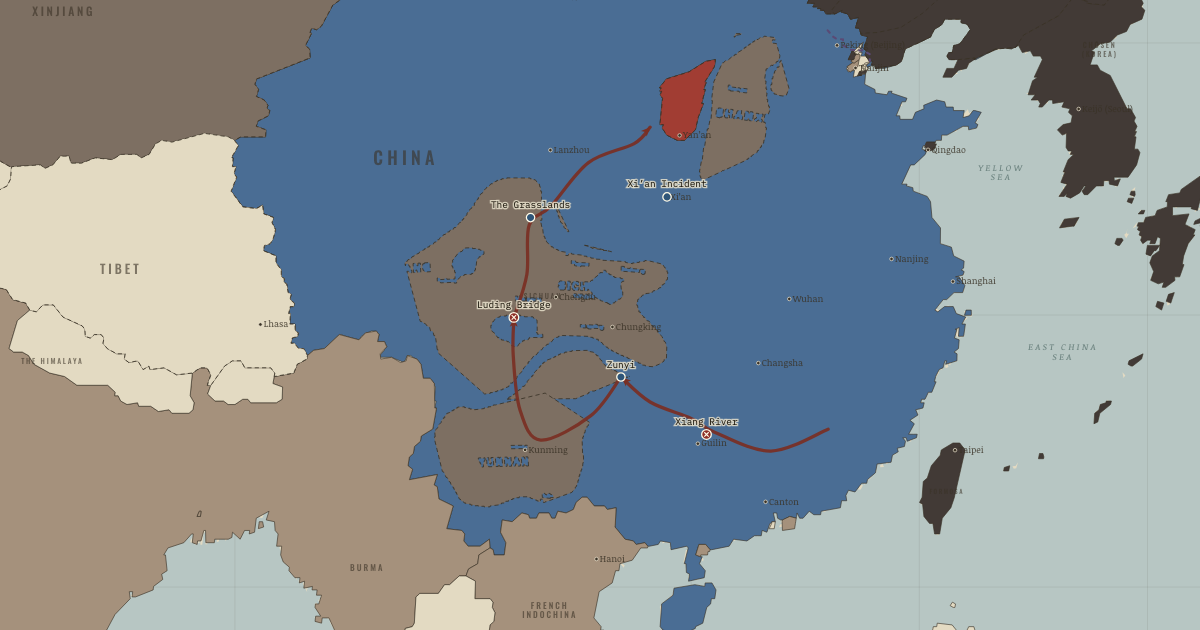
7. The Long March
CHAPTER 7 · 1934–1936
Why it happened: A destination found on the road · Defeat changes the leadership · A corridor through divided provinces · The survivors as a leadership group
The turning point: Zunyi, 15–17 January 1935.
8. The Japanese War Begins
CHAPTER 8 · 1937–1938
Why it happened: Escalation in Tokyo · Why Chiang fought in 1937 · Two strategies, one country · The conditions for atrocity
The turning point: Marco Polo Bridge, 7 July 1937.
9. Stalemate — Two Chinas at War
CHAPTER 9 · 1938–1944
Why it happened: Why the front froze · Two ways to finance a war · Occupation and recruitment · An uneasy alliance
The turning point: Hengyang, June–August 1944.
10. The Failed Peace and Manchuria
CHAPTER 10 · 1945–1947
Why it happened: Why Manchuria mattered · Stalin's two policies · Why mediation was difficult · The return to the coast
The turning point: August Storm, 9–20 August 1945.
11. The Three Campaigns
CHAPTER 11 · 1948–1949
Why it happened: How encirclement worked · Land reform and the supply line · Command and withdrawal · The decision to change sides
The turning point: Jinzhou, October 1948.
12. The People’s Republic
CHAPTER 12 · 1949
Why it happened: The war against Japan · Land and the army · Money and confidence · Rival party-states
The turning point: Tiananmen, 1 October 1949.
Essay questions, argued
Historians still debate the question at the end of each chapter. Before reading our brief answer, try making a plan for how you would answer it.
DISCUSSION QUESTION · CHAPTER 1
Was 1911 a revolution, or primarily the collapse of the Qing dynasty?
Much supports calling it a collapse. Sun's planned risings failed, the crisis at Wuchang began by accident, and provincial elites and Beiyang generals retained much of the power that passed from the throne. The new flag did not immediately produce a new social order. Yet Joseph Esherick and other historians ask us to look at what had disappeared. Monarchy and its appeal to the Mandate of Heaven ended; the examination system and the Confucian elite it sustained had already been dismantled. Yuan's later attempt to restore monarchy met resistance and failed within months. On this account, 1911 was a political revolution with limited immediate social reach. It ended an imperial order and opened the way for the deeper changes associated with May Fourth, the party-states, and land revolution over the following decades.
The chapter behind it: The Fall of the Qing. Every chapter’s question is on the discussion questions page.
DISCUSSION QUESTION · CHAPTER 5
Was the Nanjing decade a real modernization interrupted, or a weak state exposed by Japan?
Lloyd Eastman’s The Abortive Revolution finds the seeds of destruction in the purge of idealists, factional bargains, chronic deficits, tax authority that stopped at the county town and reunification purchased from warlords. Revisionists look instead at the Maritime Customs, the fabi reform, legal codes and universities. They argue that, despite civil war and Japanese pressure, no Chinese government since the 1830s had recovered so much sovereignty or built administrative machinery so quickly. Both accounts capture something essential. Modernization was real, particularly around Shanghai, but reached few of the villages where about four-fifths of Chinese lived. The CCP was building a rival state in those villages. Seen as a contest between two incomplete states, Nanjing was losing the countryside before it lost a city to Japan. Its achievement matters; so does the question of whom it reached.
The chapter behind it: The Purge and the Nanjing Decade. Every chapter’s question is on the discussion questions page.
DISCUSSION QUESTION · CHAPTER 9
How did the Nationalists and Communists fight Japan, and why did their different roles matter afterward?
The Nationalists bore the main burden of conventional battle. They fought at Shanghai and Wuhan, defended Changsha three times and faced Ichigo, suffering the overwhelming share of military casualties. One comparison counts 22 major Nationalist engagements against one large Communist offensive, the Hundred Regiments campaign of 1940. Yan’an then conserved its forces. That comparison leaves out another kind of fighting. Communist forces sabotaged and ambushed the occupiers, defended villages and endured brutal reprisals in the north. Their claim to have been the resistance exaggerates their part; the assertion that “they hid for eight years” erases it. Conventional war broke the Nationalists, while the Communists fought the occupation and built their organization. Both regimes later drew legitimacy from the war, and textbooks in Taipei and Beijing still disagree. Van de Ven, Mitter and Yang Kuisong have spent decades challenging official memories on both sides. The dispute itself has become part of the war’s history.
The chapter behind it: Stalemate — Two Chinas at War. Every chapter’s question is on the discussion questions page.
DISCUSSION QUESTION · CHAPTER 12
Why did Mao win and Chiang lose, and was Communist victory inevitable after Japan surrendered?
Japanese occupation generated nationalism that the CCP could organize, according to Chalmers Johnson. His argument helps explain north China, though it is less complete for areas less directly affected by occupation. Mark Selden and later scholars place greater weight on the “Yenan Way”: land policy, taxation and participatory institutions. Chen Yung-fa’s work adds an important qualification, showing that coercion also operated in the base areas. Lloyd Eastman and other historians emphasize the Nationalists’ inflation, factionalism and command failures. Those failures mattered, but they do not explain how Communist forces conquered Manchuria. Odd Arne Westad’s archival account brings decisions into view, including Soviet policy in Manchuria and Chiang’s 1946 choice to fight there. The Nationalists still had possibilities in 1945; by late 1948 their position had deteriorated dramatically. Victory was made through choices as well as conditions. For an essay on conditions, methods and consolidation, the Japanese invasion belongs among the conditions and years of institutional development among the methods. The Nationalists’ coalition with landed interests constrained their policies. Invasion and government weakness gave the Communists opportunities; their party still had to recruit, govern and win campaigns.
The chapter behind it: The People’s Republic. Every chapter’s question is on the discussion questions page.
What it changed
Consequence questions need the end of the story. The final chapter, The People’s Republic, sets out what the period left behind:
Governing after victory. After victory came the work of governing. In the following years the new state unified currency, suppressed inflation and pursued land reform on a large scale. Violence against landlords accompanied reform, and estimates of the dead remain disputed. China also fought United Nations forces in Korea until the armistice. Administrative capacities developed in base areas now operated across a much larger population, with coercion as well as organization.
Two governments endure. The Taipei government retained China’s United Nations seat until 1971 and its American alliance beyond that date. The strait became an enduring Cold War frontier. Crises in 1954, 1958 and 1996 were among the later consequences of the unresolved dispute.
Revolutionary methods abroad. Other revolutionary movements drew on the Chinese experience of peasant warfare, base areas, united fronts and close ties between party and army. Vietnam was especially important: its war against France was already under way as this chapter closes. These methods traveled across continents, where movements adapted them to their own conditions.
Revision tools
The atlas ends with a map quiz that asks you to find places and moments on the map itself (part of every plan from Starter up). The quick quiz and the discussion questions with our answers are free pages on this site, and the printable study guide gathers every chapter’s notes into one document for revision.
Read next
- Mao’s China after 1949: consolidation, the Great Leap, the Cultural Revolution · THE PEOPLE’S REPUBLIC UNDER MAO
- Japan’s expansion in China, 1931–1941 · THE ROAD TO WAR
Maps of History is independent and is not affiliated with or endorsed by the International Baccalaureate Organization. IB course names describe alignment only; paper, theme and section names follow the new course outline and may change when the final guide is published.
THE DISPATCH
Get the printable study guide for China in Revolution free. I’ll send you a few short letters, then one when a new atlas opens. That’s all. — Paul
NO TRACKING · YOUR ADDRESS IS USED FOR THE DISPATCH AND NOTHING ELSE · UNSUBSCRIBE ANYTIME