Chinese Revolution · CHAPTER 1 ·
Xinhai Revolution of 1911
Chapter 1 of China in Revolution, 1911–1949: “The Fall of the Qing”
By 1911 decades of defeat by foreign powers had drained confidence in the Qing dynasty. On 10 October 1911 soldiers mutinied at Wuchang after a plot was exposed at Hankou, fifteen provinces abandoned the throne within six weeks, and the child emperor Puyi abdicated in February 1912.
WW2 is free in full, and chapter 1 of every atlas is free. A free account opens 3 more chapters a day. Starter, at $9 a month, opens all 21 with no daily limit — see the plans.
Free printable Chinese Revolution study guide, sent by email ↓
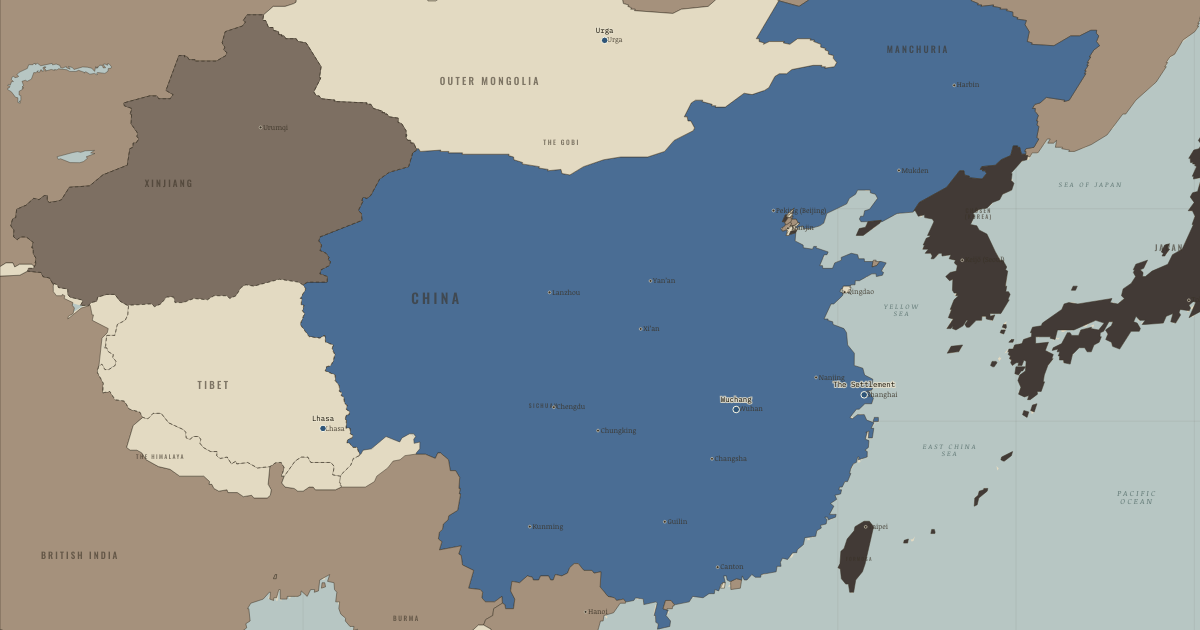
The map above is the world of China, 1912 — The abdication — the edges break away.
Every state on the map that year: The world in 1910 · Europe in 1910.
Part of IB History: China in Revolution →
SHORT EXPLANATION
The Qing dynasty had governed China since 1644, but by 1911 its claim to a vast empire exceeded its power to govern it. Foreign defeats, indemnities paid from customs revenue, and privileges granted to foreign powers had weakened the Manchu rulers. An accidental explosion exposed a revolutionary cell at Hankou. Rather than await execution, New Army soldiers implicated in the plot rose at Wuchang; within six weeks fifteen provinces abandoned the throne.
Puyi's abdication in February 1912 ended the dynasty, leaving its successor with a difficult inheritance. Outer Mongolia declared independence, and Tibet expelled the Qing garrison. Sovereignty, the legal right a government claims, and control, its practical ability to enforce that claim, had come apart. Warlord division, foreign invasion, and civil war would shape the struggle to bring the claimed territories under one government's control over the next thirty-eight years.
The full story
In 1911 the Qing empire appears on the map as a single blue expanse. Yet the legal claim to rule that expanse and the power to enforce it were already far apart. Britain had defeated the dynasty twice, and France and Japan had also defeated it. Foreign powers carved out spheres of influence, while customs revenue collected under foreign administration helped pay the Boxer indemnity. Even within Shanghai, foreign councils governed parts of the city (the ● of the International Settlement), and foreign residents there were exempt from Chinese law.
The pressure also surrounded the empire. The tan rim runs from British India and Burma through French Indochina to the Russian empire along China's northern arc. Japan, shown in charcoal, had annexed Taiwan in 1895 and Korea in 1910; it now watched Manchuria for an opening. The Qing still possessed sovereignty, a claim to the legal right to rule, but foreign governments could exercise power on Chinese territory. Recovering the ability to govern China would become a central concern of the movements in this atlas.
The event that brought the dynasty down began with an accident. On 10 October 1911 a bomb exploded prematurely in a revolutionary cell at Hankou, across the river from Wuchang (the ✕). Police seized membership lists, exposing New Army soldiers who had joined the conspiracy. Those soldiers mutinied that night rather than wait to be arrested and shot.
A local rising became a revolution because of decisions made elsewhere. Within six weeks fifteen provinces declared for a republic. The plotters had no means to conquer the empire themselves; the throne depended on provincial officers and elites choosing to defend it, and few did. On 12 February 1912 the child emperor Puyi abdicated.
The collapse reached beyond the provinces. Outer Mongolia declared independence under its Buddhist theocrat (the ● at Urga), and Tibet expelled the Qing garrison and governed itself. The parchment wedge in the southwest represents that change in practical power. The republic claimed the Qing territories, but a claim could not by itself restore control. The distance between the two would shape the next thirty-eight years.
FULL EXPLANATION
Who brought the dynasty down?
To see why the Wuchang rising spread, consider the men who had asked the dynasty to change rather than disappear. The provincial assemblies elected in 1909 were dominated by reform-minded gentry. For two years they petitioned the throne to move more quickly toward constitutional government. In May 1911 the court formed an imperial family cabinet heavily weighted toward Manchus, while centralizing the railways and pledging the lines to foreign banks. The response persuaded provincial leaders who had sought reform to move toward secession. Joseph Esherick and Ichiko Chūzō give these constitutionalist gentry a decisive role: the throne had lost people who helped administer and finance its rule. The surviving evidence makes another question harder to answer. Literate gentry left abundant records, while sources are much quieter about the peasantry, so the contribution of popular discontent is less certain.
A republic claims an empire
The republic inherited a problem from the very dynasty its revolutionaries had opposed. They had called for the expulsion of the Manchu conquerors, yet the new state claimed the territories of the Manchu empire. Mongolia, Tibet, and Xinjiang had been connected to the Qing emperor through relationships distinct from ordinary administration in China proper, rather as one monarch might hold several crowns. Once the throne disappeared, why should those territories belong to the republic? The formula “Five Races Under One Union” (五族共和) offered an inclusive answer, but the new nation-state still rested its claim on an imperial map. Leaders in Outer Mongolia and Tibet asserted their own authority. Disputes involving the Simla Convention of 1913–14, the McMahon Line, and Mongolia's Soviet-backed autonomy were postponed rather than settled. The parchment areas make the gap in control visible; they do not settle the legal arguments.
Key places on the map
On this day
Why it happened
Defeats that accumulated. Between the Opium War of 1839–42 and the Boxer Protocol of 1901, defeat brought repeated demands for ports, tariff concessions, legal privileges for foreigners, and indemnities. These losses constrained the response to later threats: customs revenue pledged to compensation could not also pay for a navy. The fleet built in the 1880s had itself been sunk by Japan in 1895. After seventy years, the dynasty's claim to protect the civilization it ruled had been challenged in public again and again.
Reform and its consequences. After 1901 the court tried to rebuild its authority through reform. It abolished the examination system in 1905, created New Armies on the German model, and promised a constitution. These measures changed the relationships on which the dynasty had relied. Scholars lost the examinations as a route to office, while students who went to Japan encountered revolutionaries. The provinces gained modern troops, some of whom turned against the throne at Wuchang. The old basis of rule was being taken apart before a new one had secured loyalty.
The railway dispute. Railway policy brought the conflict between court and provinces into the open. In May 1911 the court nationalized provincial railway companies and pledged the lines to foreign lenders, taking over investments held by gentry in Sichuan and Hunan. The Railway Protection movement put provincial elites in the streets before the Wuchang rising. Troops sent from Hubei to suppress protest in Sichuan weakened the garrison left behind. A plan to finance railway construction had estranged people whose support the dynasty needed, while the response to protest altered the military position in Hubei.
A revolutionary idea already in place. Sun Yat-sen's alliance had lost ten planned risings since 1895, but its influence extended beyond those failures. Student journals spread revolutionary ideas, overseas Chinese supplied remittances, and cells recruited within the New Army. These connections help explain why the discovery of a conspiracy could lead soldiers to mutiny. Few Chinese had electoral experience, so republicanism had shallow roots as a practiced form of government. Yet the throne had also lost much of the support on which it depended. As one revolutionary put it, the dynasty was not overthrown. It collapsed.
THE TURNING POINT
Wuchang, 10 October 1911. The bomb exposed the plot at Hankou, but the choices made across the empire turned the Wuchang mutiny into a national crisis. Fifteen provinces left the dynasty within six weeks as officers and local elites declined to defend it. Bringing down the throne did not settle who would govern in its place. The republicans needed an army to secure abdication, and Chapter 2 follows their bargain with the commander who had one: Yuan Shikai.
What it changed
A republic needs an army. At Nanjing, Sun Yat-sen's provisional government could give the republic a president, a flag, and a calendar. It lacked an army capable of compelling the emperor to abdicate. Yuan Shikai commanded the Beiyang Army and could bargain with both sides. Within six weeks Sun surrendered the presidency to Yuan in exchange for abdication, placing the new republic's future in the hands of a general.
The empire's edges detach. Outer Mongolia declared independence in 1911; Tibet expelled Qing forces and governed itself in 1912–13. Chinese governments refused to accept those departures. Warlord, Nationalist, and Communist regimes each inherited the claim to the Qing territories, although the reach of their control remained a consequential question through 1951 and beyond.
Japan sees an opening. China's provincial divisions gave Japan opportunities to increase its influence. Japanese forces seized Germany's position in Shandong in 1914, and Japan presented the Twenty-One Demands in 1915. Over the following decades Japanese military power would continue to shape China's struggle over its territory and government.
DISCUSSION QUESTION — Was 1911 a revolution, or primarily the collapse of the Qing dynasty?
Much supports calling it a collapse. Sun's planned risings failed, the crisis at Wuchang began by accident, and provincial elites and Beiyang generals retained much of the power that passed from the throne. The new flag did not immediately produce a new social order. Yet Joseph Esherick and other historians ask us to look at what had disappeared. Monarchy and its appeal to the Mandate of Heaven ended; the examination system and the Confucian elite it sustained had already been dismantled. Yuan's later attempt to restore monarchy met resistance and failed within months. On this account, 1911 was a political revolution with limited immediate social reach. It ended an imperial order and opened the way for the deeper changes associated with May Fourth, the party-states, and land revolution over the following decades.
An interesting fact
When the Wuchang rising began, Sun Yat-sen was raising money among overseas Chinese in Denver, Colorado. He learned of it from a newspaper. He traveled home by way of London and Paris, seeking diplomatic recognition and an end to foreign loans to the Qing. After reaching Shanghai on 25 December 1911, he was elected provisional president four days later. Six weeks afterward he gave way to Yuan Shikai in the bargain for the emperor's abdication. The republic's best-known founder had been abroad during its decisive rising.
Related
THE FREE PRINTABLE STUDY GUIDE
Get the printable study guide for China in Revolution free. I’ll send you a few short letters, then one when a new atlas opens. That’s all. — Paul
NO TRACKING · YOUR ADDRESS IS USED FOR THE DISPATCH AND NOTHING ELSE · UNSUBSCRIBE ANYTIME