Road to WW2 · CHAPTER 2 ·
Japanese invasion of Manchuria
Chapter 2 of The Road to War, 1931–1941: “Mukden: The First Unpunished Gamble”
On 18 September 1931 Japan’s Kwantung Army damaged its own railway near Mukden, blamed Chinese soldiers and overran Manchuria, ignoring orders from Tokyo. Japan proclaimed Manchukuo with Puyi as figurehead. The League’s Lytton Commission rejected the claim, but no effective sanctions followed and Japan left the League.
WW2 is free in full, and chapter 1 of every atlas is free. A free account opens 3 more chapters a day. Starter, at $9 a month, opens all 21 with no daily limit — see the plans.
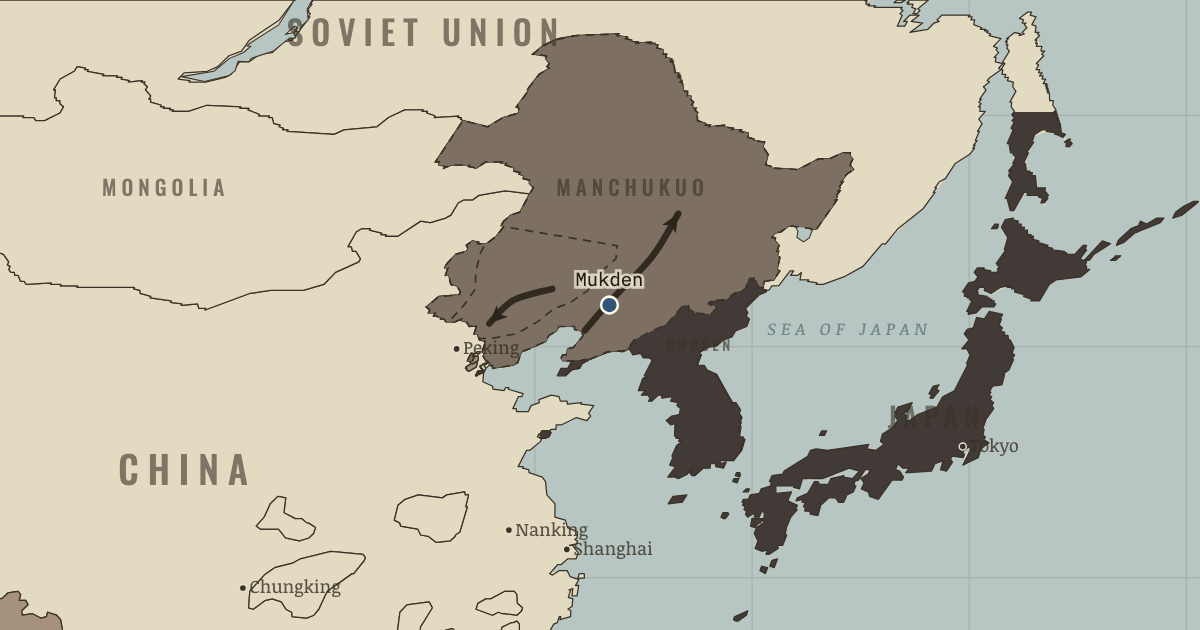
The map above is the world of East Asia and the Pacific, March 1933 — Jehol taken; Japan quits the League.
Every state on the map that year: The world in 1930 · Europe in 1930.
Part of IB History: The Road to War →
SHORT EXPLANATION
A small explosion near Mukden on 18 September 1931 gave Japan’s Kwantung Army the opening its officers had prepared. They damaged their own railway, blamed Chinese troops and began to conquer Manchuria, a territory roughly three times the size of Japan. Tokyo had not ordered the campaign. Its ministers called for restraint, but each advance left them confronting a military success already achieved. China, unable to match Japan in a general war, appealed to the League of Nations.
The League could judge the seizure. Its investigation rejected Japan’s claim of self-defense and its presentation of Manchukuo as independent. Enforcing that judgment was another matter: member governments imposed no effective sanctions, Japan left the League, and its army advanced into Jehol. Later leaders could see that swift conquest had left other powers with a difficult choice about what they were prepared to risk to reverse it.
The full story
The explosion on the South Manchuria Railway near Mukden on 18 September 1931 was a remarkably small beginning for a conquest. A train passed the damaged spot soon afterward. The Kwantung Army officers who planted the charge did not need to destroy the line: they needed an accusation. They blamed Chinese soldiers and set in motion an invasion they had prepared in advance.
Japanese troops drove north, disregarding Tokyo’s instructions to contain the fighting. Chiang Kai-shek expected to lose a general war with Japan and held back from one. Instead, China appealed to the League of Nations, asking the international organization to deal with the seizure. Within months Japanese forces had taken Manchuria.
In March 1932 Japan proclaimed a state called Manchukuo. Puyi, the last Qing emperor, became its figurehead, but Japanese power sustained the government. The League sent the Lytton Commission to examine what had happened. Its report rejected Japan’s claims, and in February 1933 the Assembly adopted it by 42 votes to one. Japan cast the dissenting vote; its delegation walked out, and its army moved into Jehol.
The occupation was a fait accompli: an action completed before opponents had agreed how to respond. To undo it, they would have to dislodge forces already on the ground. The officers had used the same advantage against their own government. Each advance gave ministers in Tokyo a gain to accept or reverse, and the murder of Prime Minister Inukai in 1932 made civilian resistance more dangerous.
At Geneva, the difficulty was not simply finding out who had acted. The United States was outside the League, Britain feared a costly war in Asia, and the Depression constrained governments. Japan depended on imported fuel and foreign credit, so earlier pressure might have helped those in Tokyo who favored restraint. Historians disagree about what pressure could have achieved without war. What did happen is clear: the League delivered its judgment, while Japanese forces kept the territory they had taken.
FULL EXPLANATION
Army autonomy and fait accompli
The officers who planned Mukden did not wait for Tokyo to authorize a conquest. Once their troops had occupied territory, ministers faced a different decision from the one they would have faced beforehand. To reverse a success could be politically costly; to accept it rewarded defiance. Japan’s institutions gave the army further leverage: an army minister’s resignation could bring down a cabinet, and victory brought field commanders prestige. Unpunished insubordination made further resistance harder. This is the force of a fait accompli, a completed action whose opponents must bear the cost of undoing it. The officers’ freedom does not remove responsibility from national leaders who accepted their gains and declined to discipline them. After Prime Minister Inukai was assassinated in 1932, civilian resistance became more dangerous still.
What the League could do
The Lytton Commission rejected the claim that Manchukuo was simply an independent act of self-determination. Its lengthy investigation could establish facts, but it could not itself compel Japan to withdraw. The League had no standing army; the United States had never joined it; Britain worried about its Asian empire; and governments faced the Depression. Sanctions capable of exerting real pressure required cooperation from powers reluctant to risk a Pacific war. There was nevertheless a case for trying: Japan depended on imported fuel and finance, and civilian supporters of restraint remained in its politics. Credible early pressure might have strengthened them. Historians disagree about its prospects and risks. The question for collective security was whether member governments would give their legal judgment material force.
Key places on the map
Why it happened
A railway concession and a larger ambition. Japan’s victory over Russia in 1905 had given it control of the South Manchuria Railway zone, which the Kwantung Army guarded. The region’s coal, soy and iron made it valuable; beyond the concession lay land governed by Zhang Xueliang, whose troops faced competing demands. Ishiwara Kanji, a principal planner, believed a final war with America inevitable. On that assumption, acquiring Manchuria’s resources now would prepare Japan for a future defense.
The army and its civilian government. Wakatsuki Reijirō’s government sent General Tatekawa to restrain the officers. One account says the conspirators entertained him before setting off the charge. Once the invasion began, each new gain confronted ministers as an accomplished fact. The army’s control over its cabinet minister also gave it power to threaten a government by withdrawing him. In May 1932 naval officers assassinated Prime Minister Inukai, the last party politician to head a Japanese government before 1945. As the conquest proceeded, civilian authority weakened.
China’s choice of resistance. Chiang’s policy of ‘first internal pacification, then external resistance’ reflected his judgment that China could not yet defeat Japan. Some of his strongest forces were engaged against the communists. Holding them back from a general war preserved them and helped China present Japan as the aggressor before world opinion. It also allowed Japanese troops to advance at comparatively low cost, while Chiang faced sustained protest at home. His appeal to international law came with a political price.
The limits of the League. An investigation was within the League’s power; military enforcement depended on its members. Britain had an Asian empire and naval commitments to protect, and Depression budgets discouraged new risks. The Lytton inquiry took months, during which Japan conquered Manchuria and established Manchukuo. Its careful report could tell governments what had happened. Reversing the result required a further decision by those governments.
THE TURNING POINT
Mukden, 18 September 1931. Thirty-one metres of railway near Mukden were damaged so lightly that a train soon passed. The Kwantung Army nevertheless used the explosion to accuse China and begin a vast conquest. As Tokyo accepted successive gains, military autonomy grew. Abroad, the League’s 42–1 verdict showed that governments could agree on a judgment without enforcing it. Later aggressors could observe that gap, although their circumstances and calculations differed.
What it changed
A precedent for later aggression. Manchuria offered a visible example of rapid conquest followed by an explanation for it. Other powers then had to decide what they would risk to undo the gain. Later crises had their own causes, but Mussolini could study a case in which condemnation left a conquest intact.
Japan leaves the League. Japan announced its League withdrawal in March 1933. It later renounced the Washington naval treaty limits and joined Germany in the Anti-Comintern Pact in 1936. A power that had risen within the international order was looking to different alignments for security and influence.
Manchukuo as colony and arsenal. Under Japanese control, Manchukuo became both a settler colony and an industrial arsenal. Its institutions included Unit 731’s biological-weapons compound and an opium monopoly associated with financing the occupation. Tōjō Hideki, head of the Kwantung Army’s military police, was among the officials whose careers linked Manchuria to Japan’s wider war.
DISCUSSION QUESTION — Could the League realistically have stopped Japan in 1931–33 — and does “realistically” concede too much?
Stopping Japan would have required governments to accept costs they were reluctant to bear. Britain and the United States had Pacific fleets, but America was outside the League, and neither wanted to risk war during the Depression. Sanctions would have been difficult to enforce without them. Yet Japan depended on imports and credit, and supporters of restraint remained in its civilian government. Credible early pressure might have strengthened them, though it could also have failed or caused escalation. The Lytton Report gave League members a basis for action. The unresolved question is what pressure they could have applied and what risks they would have accepted; they did not agree on pressure capable of changing the result.
An interesting fact
Puyi’s life crossed three political orders. He became China’s emperor at two, lost the throne at six after the 1911 revolution, and was restored for twelve days in 1917. Japan brought him to Manchuria in 1931; as Manchukuo’s “Chief Executive” and later its “Emperor,” he ruled for thirteen years. After the Second World War he spent years in custody, including ten years in a Chinese prison after 1950. He later worked as a gardener and archival clerk in Beijing, where he died in 1967.
Related
THE FREE PRINTABLE STUDY GUIDE
Get the printable study guide for The Road to War free. I’ll send you a few short letters, then one when a new atlas opens. That’s all. — Paul
NO TRACKING · YOUR ADDRESS IS USED FOR THE DISPATCH AND NOTHING ELSE · UNSUBSCRIBE ANYTIME