Mao’s China · CHAPTER 4 ·
China’s First Five-Year Plan
Chapter 4 of The People’s Republic under Mao, 1949–1976: “The Soviet Model”
From 1953 China copied the Soviet model of central planning. The First Five-Year Plan of 1953–57 put heavy industry first around 156 Soviet-aided projects, raising steel output from 1.35 million tonnes in 1952 to 5.35 million in 1957, while the state took control of the harvest and then of the land.
Chapter 4 is included with every paid plan. WW2 is free in full, and chapter 1 of every atlas is free. A free account opens 3 more chapters a day. Starter, at $9 a month, opens all 21 with no daily limit — see the plans.
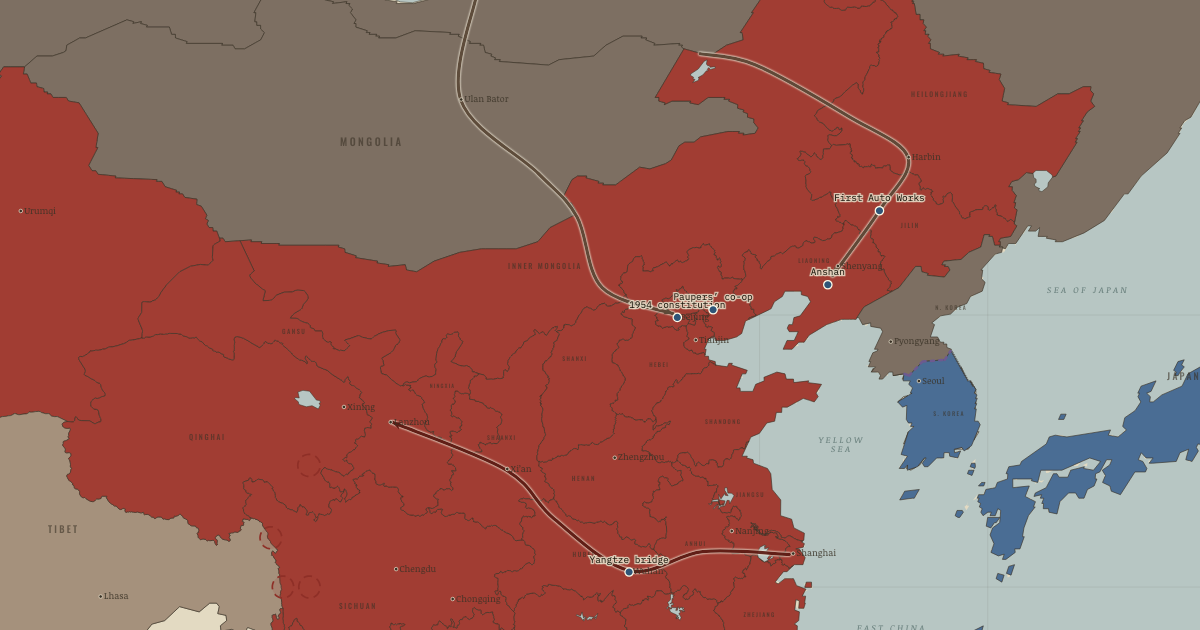
The map above is the world of China, December 1956 — The collectives complete.
Every state on the map that year: The world in 1960 · Europe in 1960.
Part of IB History: The People’s Republic under Mao →
SHORT EXPLANATION
China’s leaders wanted an industrial economy capable of producing steel, coal, machines and power. From 1953 they pursued it through the Soviet model. The Communist Party ruled alone at every level, and under the First Five-Year Plan of 1953–57 officials in Beijing directed factory production and investment, much as managers might direct one enormous company.
Soviet designs and equipment supported 156 major projects. The results impressed foreign observers: steel output increased from 1.35 million tonnes in 1952 to 5.35 million in 1957, and industrial output grew by about 18 percent a year. Grey-tan arrows trace Soviet aid arriving by rail through Manchuria and Mongolia; the red arrow points toward new inland plants. The new industry depended on Soviet credit and goodwill as well as Soviet designs.
Industrial workers needed food, and exported food helped pay for imported machinery. The countryside supplied both. In November 1953 the state made itself the only legal buyer and seller of grain and fixed its price: farmers now had one permitted customer. It then moved to collectivization. Households pooled land, animals and tools in cooperatives worked in common, and members received “work points”, rather like wages paid in shares of the harvest.
Officials had expected this change to take fifteen years. In July 1955 Mao called for a “high tide”, and by the end of 1956 about 96 percent of peasant households had joined cooperatives. Provinces hatched in 1955 become solid red on the map. In four years the Party had gained control of grain, factories and farmland, along with machinery it would use in later campaigns of mass mobilization.
The full story
The Korean War narrowed China’s choices at the very moment its leaders wanted to industrialize. An American-led embargo barred trade with China and closed access to Western technology. The Soviet Union offered designs, machinery and about 10,000 specialists over the decade. China’s leaders trusted the Soviet example; after the war it was also the only model available. They adopted it with little debate.
The First Five-Year Plan of 1953–57 gave ministries responsibility for setting factory output, rather as a head office sets targets for its branches. The northeast had both a Japanese-built industrial base and proximity to the Soviet railway. It received the showpieces: the arrows follow the railway to Harbin and Anshan, where the steelworks was rebuilt. At Changchun the First Automobile Works produced China’s first truck in 1956. Planners also put plants at Wuhan, Baotou, Lanzhou and Xi’an, deep inland and away from the vulnerable coast.
Building the economy went together with building a new state. The revolutionary army gave way to a bureaucracy in which the Communist Party ruled alone and placed its members in charge of every office, like an owner appointing managers. In 1954 the six great regions run by generals were abolished. Gao Gang, the northeastern leader, was purged after trying to displace Liu Shaoqi and Zhou Enlai; he killed himself that year.
The first National People’s Congress adopted a constitution in September 1954. It listed freedoms of speech and religion while placing China under Party leadership; the Congress itself met rarely and approved Party decisions. In the cities, a worker’s employer became a work unit providing housing, health care and pensions as well as political supervision, much like a company town. The resulting lifetime dependence was called the “iron rice bowl”. In January 1956 private firms became “joint state-private” companies with almost no resistance. Urban workers gained security, while the Party gained control over nearly every adult’s livelihood.
The countryside faced a different bargain. The state had been the only legal grain buyer since 1953, but officials found 110 million separate households difficult to tax and still harder to plan. Cooperatives offered a way to organize them: family farms would become units owned and worked in common, rather like farmers’ cooperatives today. Control of the harvest would rest increasingly with institutions the state could direct.
Mao wanted to move faster than his cautious colleagues. In his speech of 31 July 1955 he mocked them as “a woman with bound feet”. Officials competed to report the highest enrollment, while some reluctant peasants slaughtered animals before pooling them and others later tried to leave. By the end of 1956 almost all households had joined. Unlike Stalin’s collectivization of 1929–33, which caused famine in the Soviet Union, China’s caused none; land reform had already destroyed the rich peasants who might have resisted, which partly explains the difference. Mao took the speed of the change as evidence that will and organization could overcome any economic limit. That lesson fed his crash industrial drive of 1958, the Great Leap Forward.
FULL EXPLANATION
Why copy Stalin’s model?
The Soviet model answered a problem of belief as well as a problem of access. Marxist theory held that socialism required modern heavy industry and a working class. The Soviet Union’s rise from the ruins of 1917 to victory over Germany appeared to demonstrate the power of central planning. After the Korean War, the embargo made Moscow the only source of advanced machinery, while the Party’s decades in the countryside had left it with few people experienced in running a modern economy. Barry Naughton explains the economic mechanism: hold down farm prices, use the grain monopoly to extract an agricultural surplus, and invest it in steel and machinery. Industry grew, but agriculture grew by about 4 percent a year, only just ahead of population growth above 2 percent. Historians such as Meisner argue that the imbalance and the bureaucracy created by the model led Mao after 1956 to seek a faster, more Chinese road.
How Mao sped up collectivisation
Collectivization acquired its final form in stages. Families first shared labor in mutual-aid teams; elementary cooperatives pooled land but paid owners a dividend. Advanced cooperatives brought together a hundred or more households, made land collective property and paid income only in work points. The Party’s rural chief, Deng Zihui, slowed the process early in 1955, dissolving about 20,000 weak cooperatives. Mao reversed him in July. In Socialist Upsurge in China’s Countryside, Mao’s enthusiastic notes on model villages such as Wang Guofan’s showed officials the direction he wanted. Political scientist Thomas Bernstein compared the Chinese and Soviet campaigns and argued that China’s involved less violence because cadres already worked in every village and land reform had removed the rural elite. Resistance still appeared in slaughtered livestock, poor work and withdrawals in 1956–57. The apparent ease of victory encouraged Mao to overestimate what mobilization could accomplish.
The machinery of the party-state
Three institutions gave the Party means to govern daily life between campaigns as well as during them. Household registration, or hukou, began in cities in 1951, expanded in 1955 and received national regulations in January 1958. By recording people as urban or rural, it made moving to a city almost impossible without permission. Urban employees depended on their work unit, or danwei, for housing, food rations, medical care and permission to marry or travel; Andrew Walder later called this “organised dependence”. Personnel files, or dang’an, followed people for life with their class labels and political records. Arrest was not the only means of control: withdrawing a ration book or residence permit could also make compliance necessary. These arrangements helped the state retain its grip throughout the rest of Mao’s rule.
Key places on the map
On this day
Why it happened
The war closed every other door. The Korean War left China subject to an American trade embargo and dependent on Soviet weapons, loans and advice. Moscow offered the blueprints, machine tools and engineers unavailable from the West, and agreed to help build 156 major projects. This shaped the economy as well as foreign policy. A factory using a Soviet design also needed compatible parts, training and planning methods.
A Marxist faith in heavy industry. Party leaders associated socialism and national defense with steel, coal, electricity, machinery and a modern working class. The Soviet experience appeared to show that central planning could industrialize a backward country within a generation. Heavy industry consequently received the great majority of industrial investment. Consumer goods and agriculture had to wait, and leaders accepted slow gains in ordinary living standards as the price of national strength.
Grain was the bottleneck. New city workers needed food, and food exports could pay for Soviet machines. Private grain markets failed to supply enough in 1953, so the state monopolized buying and selling and imposed low prices and quotas. Cooperatives made that system easier to administer: officials could deal with a few hundred thousand collective units instead of more than a hundred million separate households.
Mao’s impatience with gradualism. In 1953 Mao replaced New Democracy with a “general line” for the transition to socialism. Planners and rural officials favored a slower course, but his impatience grew. His July 1955 speech made caution a political error. Officials accustomed to campaigns in which overfulfillment was safe then competed to enroll villages. Mao chose the direction, and the system’s incentives drove the rush.
THE TURNING POINT
The “high tide”, July 1955. On 31 July 1955 Mao put the pace of collectivization in the hands of a campaign rather than cautious planners. They had envisaged fifteen years; within eighteen months almost every household had been enrolled. The Party had demonstrated its ability to reorganize half a billion people by command. Mao saw more than administrative capacity in that speed: he took it as proof that political will could overcome economic limits. Wang Guofan’s “paupers’ co-operative” became his image of a poor, determined nation eager to leap ahead. That conviction entered the Great Leap Forward.
What it changed
The Leap forward from the Plan. The Plan built industry faster than agriculture, and Mao came to regard the Soviet model as too slow and bureaucratic for China. From 1958 he sought to mobilize labor in place of capital, combining agriculture and industry in giant communes. The cooperatives created in 1956 provided their building blocks; the officials who had raced to collectivize now raced again.
The state could now take the harvest. Under the grain monopoly, officials could use the collectives to determine how much food a village retained. In ordinary years the system fed cities and paid for imports. In 1959–60 officials based procurements on inflated harvest reports, and the same machinery stripped villages bare. A system constructed to supply industry turned policy failure into famine among the people who grew the food.
Two classes of citizen. Urban work units supplied rations, pensions and health care. Rural people, by contrast, had to feed themselves from collective fields, and the 1958 household registration rules prevented them from moving to cities. This division survived Mao by decades. When food ran short in 1960, it helped determine who lived and who died.
Soviet ties that became a burden. The alliance had put Soviet designs and advisers into factories, schools and planning offices. Its breakdown in 1960 exposed the cost of that dependence: experts left, plants stood unfinished and blueprints were missing. China had to improvise. Self-reliance later became a praised virtue, but it began as necessity; the Lanzhou uranium plant, finished by Chinese engineers in 1964, became its proudest example.
DISCUSSION QUESTION — Was the First Five-Year Plan a success, and for whom?
Measured against its industrial targets, the Plan succeeded. Steel output quadrupled, coal production doubled, and industrial output grew by around 18 percent a year, a pace few poor countries have matched. China acquired industries it had never had, while city workers received steady jobs, housing and welfare through their work units. The gains depended on a different experience in the countryside. Peasants sold grain at state-set prices, surrendered land to cooperatives only a few years after receiving it, and were tied to their villages by household registration. Their contribution financed the cities, while agricultural output grew only a little faster than population and left little margin for error. Naughton credits the achievements but stresses the imbalance; Meisner also identifies a bureaucratic elite that Mao later turned against. The Plan served the state and urban workers while imposing sacrifices on the peasant majority. Growth figures show the achievement, but they cannot by themselves tell us who paid for it.
An interesting fact
The Soviet alliance shaped education as well as factories. In the early 1950s Russian replaced English as the main foreign language in Chinese schools and universities, and thousands of Soviet textbooks were translated, from engineering manuals to novels. Beijing built the Friendship Hotel in 1954 near the new university district to house Soviet experts and their families. Its vast palace-style complex had green-tiled roofs. When Khrushchev recalled the experts in 1960, the rooms emptied within weeks. The hotel still operates today, its name among the few public reminders of the alliance.
Related
THE FREE PRINTABLE STUDY GUIDE
Get the printable study guide for The People’s Republic under Mao free. I’ll send you a few short letters, then one when a new atlas opens. That’s all. — Paul
NO TRACKING · YOUR ADDRESS IS USED FOR THE DISPATCH AND NOTHING ELSE · UNSUBSCRIBE ANYTIME