Meiji Japan and post-Soviet Russia · CHAPTER 1 ·
Tokugawa shogunate and sakoku
Chapter 1 of Remaking the State: Meiji Japan 1600–1912 and Post-Soviet Russia 1964–2000: “The Closed Country”
After Sekigahara in 1600 the Tokugawa shogunate gave Japan some 250 years without civil war, ruling a quarter of the country directly and binding about 260 daimyo through alternate attendance. Peace brought growth and a national market, while the Treaty of Nanking of 1842, imposed on China by Britain, showed the danger outside.
WW2 is free in full, and chapter 1 of every atlas is free. A free account opens 3 more chapters a day. Starter, at $9 a month, opens all 21 with no daily limit — see the plans.
Free printable Meiji Japan and post-Soviet Russia study guide, sent by email ↓
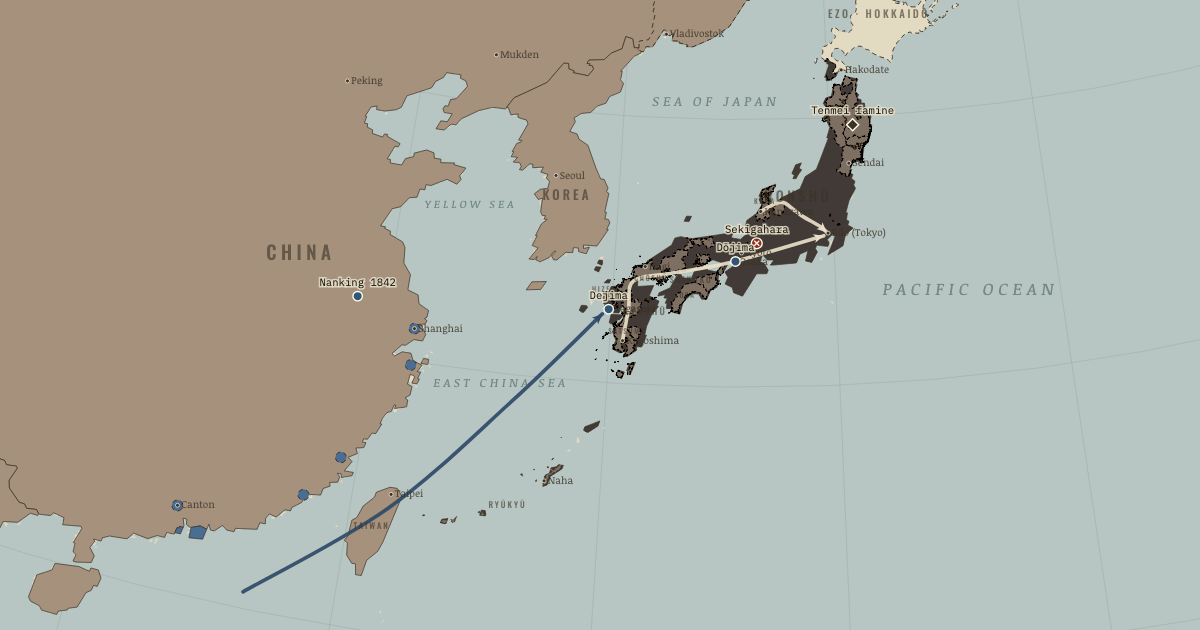
The map above is the world of Japan, August 1842 — Nanking: five Chinese ports opened.
Every state on the map that year: The world in 1850 · Europe in 1850.
Part of IB History: Meiji Japan and post-Soviet Russia →
SHORT EXPLANATION
Why do attempts to remake a state succeed in one place and fail in another, and who bears the cost? This atlas follows Japan after 1868 and the Soviet Union after 1985. Both transformations began under governments that appeared secure. Japan’s Tokugawa shogunate grew out of victory at Sekigahara in 1600. Its hereditary shogun ruled in the name of an emperor without political power in Kyoto, much as a military ruler might govern behind a figurehead king. Yet the shogun directly controlled only about a quarter of the country. Some 260 daimyo governed the rest in domains called han, each with its own taxes, courts and samurai: hereditary warriors who also filled government offices, like a closed caste of soldier-officials. The domains had powers of their own, rather like the governments of a loose federation.
The map of 1840 shows how the shogun managed these powerful lords. His lands and those of loyal houses occupy the centre in charcoal; the old enemy ‘outer’ lords appear in grey-tan on the rim, in Kyushu, western Honshu and the north. Each daimyo had to spend alternate years in Edo, the capital and today’s Tokyo, while leaving his family there. Their presence resembled a permanent exchange of hostages, and the cost of attendance drained the domains. This arrangement helped preserve peace for 250 years. Foreign contact passed through guarded gates, especially the Dutch post on Dejima. But most soldiers and taxes remained with the lords. When Britain defeated China and opened its ports, shown by blue dots on the coast, Japan’s rulers faced a danger their system was poorly equipped to meet: it had no national army or national tax.
The full story
The Tokugawa settlement began with a problem of victory. Tokugawa Ieyasu had won at Sekigahara in 1600 and became shogun in 1603, ruling behind an emperor without power, like a military strongman behind a figurehead king. He still had to keep other lords from fighting him or one another. His own house and the fudai, families who had served him before 1600, received the strategic centre around Edo, Kyoto and Osaka, shown in charcoal. The tozama, or ‘outer’ lords, had fought him or joined late. The Shimazu of Satsuma and the Mōri of Chōshū retained large domains on the grey-tan edges of the map, but were excluded from national office.
These lords continued to govern most of Japan, so peace depended on keeping them under control. From 1635 alternate attendance required each daimyo to live every other year in Edo, the shogun’s capital and today’s Tokyo. Families remained there, tying the lords to the centre, while travel, retinues and permanent mansions consumed much of their domains’ income. The shogunate watched and weakened potential rivals without taking over their governments. The arrangement helped preserve 250 years without civil war.
That peace made economic growth possible, but growth changed the position of the people who maintained the order. Population reached about 30 million, and roads and shipping routes used by the processions carried a national market. Osaka’s Dōjima rice exchange, licensed in 1730, traded promises of rice yet to be harvested, much like a futures market. Samurai, hereditary warriors who also staffed government offices, made up about 6% of the population and ranked first officially; merchants stood last. Yet samurai received fixed rice salaries. When rice prices fell, many had to borrow from merchants, and domains also fell into debt.
The government survived severe disturbances, though survival did not mean that its people were secure. During the Tenmei famine of the 1780s, Japan’s population fell by more than 900,000. In 1837 Ōshio Heihachirō, formerly an Osaka official, led a rising that burned a fifth or more of the city. The divided state remained calm at the top while facing serious strains below.
Foreign contact was controlled, not entirely abolished. Edicts of the 1630s banned Christianity and Japanese travel abroad, while restricting European trade to the Dutch at Dejima, an artificial island in Nagasaki harbour. Three loyal domains handled relations with Korea, the Ryukyu kingdom, today’s Okinawa, and the Ainu, the native people of Hokkaido. Through these guarded routes the shogunate could regulate contact, and scholars of ‘Dutch learning’ could study imported books on subjects such as anatomy and artillery.
Those channels brought alarming evidence from the Opium War of 1839–42. British steamships defeated China, the largest state in Asia; the Treaty of Nanking gave Britain Hong Kong and opened five Chinese ports. In 1842 the shogunate softened its order to fire on foreign ships. Knowing what had happened, however, did not give it the means to build a navy or raise a national tax. The resources needed for a common defence lay largely with the domains that the Tokugawa system had been designed to restrain.
FULL EXPLANATION
A compound state: how historians describe Tokugawa rule
The shogun’s authority over domains could look formidable. Older historians described a centralised ‘feudal absolutism’, pointing to his power to move, reward or abolish them. Conrad Totman drew attention to another side of the arrangement: the shogunate controlled much less land directly. Its holdings amounted to about four million koku of assessed rice yield, and its bannermen held another 2.6 million, together about a quarter of a national total near 30 million. A koku was roughly one person’s yearly consumption. Mark Ravina calls the result a ‘compound state’. Domains issued paper money and ran industries; Satsuma even conducted foreign trade through Ryukyu. These descriptions identify different powers within the same system. The shogunate could keep the lords from making war, but lacked an army and tax for the whole country. Its strength in preserving peace became a limitation when a threat demanded national action.
Growth inside a frozen hierarchy
Did the late Tokugawa economy stagnate, or was it already acquiring resources for modernization? The evidence gives historians reasons to consider both. Thomas C. Smith showed villagers growing commercial crops and adding spinning and other work to farming; much of this rural growth lay beyond samurai tax collectors. Population, meanwhile, barely grew after about 1720. Some scholars attribute that pattern to poverty and infanticide, while Susan Hanley and Kozo Yamamura see smaller families as a way to protect living standards. Education spread through thousands of private terakoya schools. Ronald Dore estimated that by the 1860s about 40% of boys and 10% of girls received some formal education; Richard Rubinger’s later work on signatures and village records revealed wide gaps between town and country. Samurai and domains, meanwhile, struggled to live on fixed rice incomes in a money economy. The Meiji state inherited debts as well as these productive and educational assets; the assets would prove more important.
Was Japan really closed?
‘Closed country’ is a misleadingly simple name for a policy of regulated contact. The term sakoku itself was coined only in 1801, when Shizuki Tadao translated a European book. Ronald Toby’s research describes four gates through which the shogunate conducted foreign policy: Nagasaki for Dutch and Chinese contacts, Tsushima for Korea, Satsuma for Ryukyu and Matsumae for the Ainu. Twelve Korean embassies visited Japan, while Ryukyuan missions paraded through the capital, helping the shogun present himself as the centre of a small international order. Information entered as well. The Dutch supplied written news annually, describing the Chinese war in detail after 1840. Even earlier, in his 1825 New Theses, Mito scholar Aizawa Seishisai argued that resistance to the West required a nation united around the emperor. The rulers had ways to learn of danger; the crisis of 1853 would show the difficulty of acting on what they learned.
Key places on the map
On this day
Why it happened
Sekigahara settled who ruled and left the losers in place. Victory at Sekigahara left Ieyasu with enemies he had not destroyed. The Mōri of Chōshū lost most of their eight provinces but kept two, while the Shimazu retained their whole Satsuma domain in the far southwest. Both remained armed on the rim. Over 250 years their grievances endured, and distance gave them room to build armies and treasuries beyond close shogunal inspection. The peace settlement thus left potential rebels where the centre would find them difficult to control.
Alternate attendance bought loyalty by draining the lords. A lord contemplating rebellion had to reckon with the expense of alternate attendance. From 1635 each daimyo travelled to Edo every other year with a large retinue and kept his wife and heir there permanently. Maintaining the journeys and mansions absorbed a large share of domain revenue. The traffic also supported roads, inns and a national market, helping Edo become one of the world’s largest cities. The political safeguard came at a financial cost: domains borrowed from merchants and had less money available for defence.
A divided state had no national army or tax. Preventing another internal war and resisting a foreign navy called for different powers. The shogun taxed his own lands, while each daimyo retained his samurai and rice tax; no institution could raise money from all Japan or command all its soldiers. Even a limited attempt at centralization met resistance. In 1843 Mizuno Tadakuni tried to bring land around Edo and Osaka under direct shogunal control, but affected lords and bannermen forced him out within months. The government could not readily reorganize even its heartland.
Controlled contact gave knowledge without power. Dejima, Dutch reports and scholars of Dutch learning connected Japanese elites to Western science and news of war. By the 1840s officials knew how Britain had defeated China and what steam warships could do, giving Japan’s rulers an early understanding of the danger compared with much of Asia. Acting on it was another matter. Building a navy required money and soldiers that belonged to the domains, and the shogunate lacked machinery to draw them together.
THE TURNING POINT
The Treaty of Nanking, 29 August 1842. On 29 August 1842 the Treaty of Nanking made the consequences of defeat visible to Japan’s rulers. China, the region’s greatest state, had lost to Britain and agreed to pay 21 million silver dollars, cede Hong Kong and open five ports to British merchants. A year later Britons gained the right to be tried under their own law. Reports of British victories had already alarmed the shogunate, which cancelled its 1825 order to fire on foreign ships in the same weeks. Avoiding a fight it could not win was sensible, but it also exposed Japan’s weakness. The blue dots on China’s coast anticipate changes that would appear on Japan’s own map within twenty years.
What it changed
Caution replaced preparation. The government responded to the Chinese crisis chiefly by avoiding a confrontation. It offered foreign ships fuel and water after 1842, yet rejected a Dutch royal letter in 1844 urging Japan to open on its own terms. Some coastal batteries were built; a navy and national tax did not follow. Thus Perry’s arrival in 1853 found the shogunate with the same divided machinery it had faced the crisis with in 1842.
An emperor-centred nationalism was already taking shape. How could Japan unite against the West? Mito scholars, especially Aizawa Seishisai, looked to spiritual unity around the emperor and coined the slogan of ‘revering the emperor and expelling the barbarians’. They meant to strengthen the shogunate. Yet their argument gave the emperor a prior claim on loyalty, and within twenty years opponents would use it against the Tokugawa house.
The rim domains reformed their finances first. Satsuma and Chōshū found money for change while shogunal reform stalled. In the 1830s and 1840s Zusho Hirosato reduced Satsuma’s enormous debts partly through a sugar monopoly worked by Amami islanders and trade through Ryukyu; Murata Seifū rebuilt Chōshū’s finances and trade. Twenty years later these outer domains could afford Western ships and rifles. Their financial repairs help explain why revolution would come from the map’s edges.
DISCUSSION QUESTION — Was the Tokugawa order already collapsing before 1853, or did the outside world break a system that still worked?
There is a strong case that the system had internal troubles. Samurai and domains accumulated debt, peasant protests became more frequent after 1750, famines killed hundreds of thousands, and Ōshio’s rising revealed discontent within the ruling class. Japanese Marxist historians long saw these as signs of feudalism decaying from within. Yet the order survived famine and protest, the economy grew, and for 250 years no lord challenged the shogun. Those facts also demand explanation. Marius Jansen and Conrad Totman are among the historians who distinguish vulnerability from the event that forced a response: internal strains weakened the system, while the foreign threat determined when it had to confront them. The Soviet half of this atlas raises a related question: was that system dying in 1985, or killed by the attempt to reform it? Internal weakness alone rarely brings down an old order, but it helps determine how severely an outside shock is felt.
An interesting fact
A visit to the shogun’s court could be an unusual assignment for a European doctor. Engelbert Kaempfer, a German employed by the Dutch, accompanied their missions to Edo in 1691 and 1692. Before Shogun Tsunayoshi and his ladies, watching from behind a lattice, Kaempfer and his Dutch colleagues were ordered to walk, dance, jump, sing, play the drunkard and speak broken Japanese. Kaempfer added a German love song to his dance. His posthumous History of Japan (1727) remained Europe’s fullest account for more than a century, showing readers a ruler able to make foreign envoys perform at will.
Related
THE FREE PRINTABLE STUDY GUIDE
Get the printable study guide for Remaking the State free. I’ll send you a few short letters, then one when a new atlas opens. That’s all. — Paul
NO TRACKING · YOUR ADDRESS IS USED FOR THE DISPATCH AND NOTHING ELSE · UNSUBSCRIBE ANYTIME