Chinese Revolution · CHAPTER 8 ·
Second Sino-Japanese War (1937–38)
Chapter 8 of China in Revolution, 1911–1949: “The Japanese War Begins”
A clash at Marco Polo Bridge in July 1937 escalated into full war between China and Japan. Chiang fought a three-month battle at Shanghai that destroyed many of his best divisions, Japanese forces committed mass murder and mass rape after Nanjing fell, and the government moved inland but lost Wuhan in 1938.
Chapter 8 is included with every paid plan. WW2 is free in full, and chapter 1 of every atlas is free. A free account opens 3 more chapters a day. Starter, at $9 a month, opens all 21 with no daily limit — see the plans.
Free printable Chinese Revolution study guide, sent by email ↓
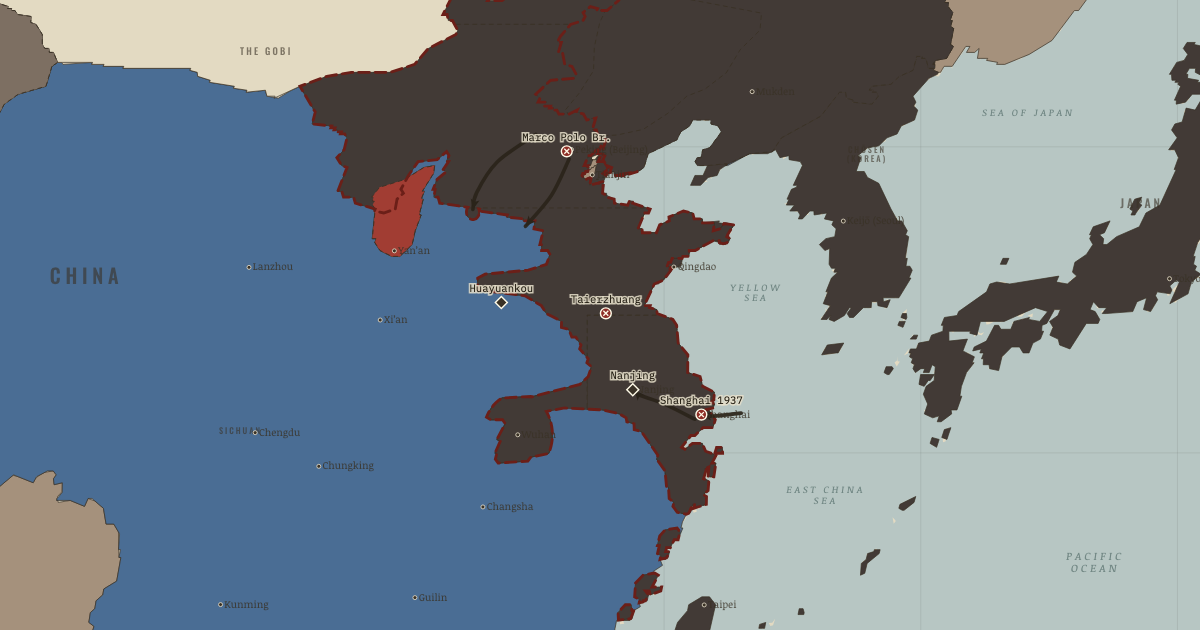
The map above is the world of China, 1938 — Wuhan and Canton — the stalemate line.
Every state on the map that year: The world in 1938 · Europe in 1938.
Part of IB History: China in Revolution →
SHORT EXPLANATION
The July 1937 clash at Marco Polo Bridge became a full war when Tokyo reinforced its troops and Chiang stood firm. Japan advanced along the northern railways. Chiang chose to fight at Shanghai, hoping both to slow the invasion and show the world that China was resisting. Three months of battle consumed many of his best-trained divisions.
Japanese troops murdered prisoners and civilians and committed mass rape after Nanjing fell. Estimates of the dead differ; the atrocity itself is beyond dispute. The Nationalist government withdrew inland and fought on. Victory at Taierzhuang showed that Japanese forces could be beaten locally, but the deliberate Yellow River flood that delayed them inflicted immense civilian suffering and failed to save Wuhan. By late 1938 China faced a prolonged struggle across a divided country.
The full story
The clash that opened full-scale war began during a Japanese night exercise on 7 July 1937. A soldier was missing at roll call, and shots were exchanged near Marco Polo Bridge southwest of Peking (the ✕). Local commanders nearly settled the incident, as they had others since 1931. This time Tokyo reinforced its troops. Chiang stood firm too: currency reform and German-trained divisions had improved his position, while the Xi’an settlement had tied his political standing to resistance. What might have remained a local clash became a test neither government would step back from.
The charcoal arrows from the Peking–Tianjin plain show Japan’s rapid advance along the railways into Hebei and Shanxi. Chiang chose another field of battle. In August he attacked the Japanese garrison at Shanghai (the ✕), drawing the main fighting toward the Yangtze. Rivers, cities and mud offered defenders advantages that the open north did not. At Shanghai, too, observers on the International Settlement’s rooftops could carry news of Chinese resistance to the world. The battle lasted three months, house by house. Casualties approached a quarter-million, and among the losses were junior officers whom Whampoa had spent a decade training. China had made the invasion costly and visible, but had spent much of its best army doing so.
Nanjing fell on 13 December. For weeks Japanese troops murdered prisoners and civilians and raped on a mass scale (the ◆). The postwar tribunal counted more than 200,000 dead; China’s official figure is 300,000. The estimates are contested, while the mass atrocity itself is established. The government continued the war, moving upriver to Wuhan and ultimately Chungking, with universities, arsenals and refugees traveling into the interior.
The strategy was called “space for time”: give up ground while preserving the government and forces needed to fight on. It did not mean that every battle was lost. In spring 1938 Li Zongren’s regional armies encircled and badly damaged two Japanese brigades at the canal town of Taierzhuang (the ✕). China’s first clear victory raised morale and showed that the invader could be beaten locally.
The effort to delay Japan also brought catastrophe to Chinese civilians. In June Nationalist engineers breached the Yellow River dikes at Huayuankou (the ◆), seeking time before the Japanese reached Wuhan. Villages downstream received no warning. The river swung south; hundreds of thousands drowned or starved, and millions fled. The flood bought months, yet Wuhan and Canton fell in October. By late 1938 Japan held much of the eastern urban and transport network, while the government retained the vast interior. Neither had forced a decision, and the war kept that broad shape for six years.
FULL EXPLANATION
Counting the dead at Nanjing
The Tokyo tribunal counted more than 200,000 dead at Nanjing; China’s official figure is 300,000, and a few Japanese historians argue for lower totals. The evidence is difficult to assemble. Japanese records were destroyed, killing lasted roughly six weeks and extended well beyond the walled city, and burial-society and refugee records are incomplete. The dispute has also been affected by a denialist current in Japanese politics that treats a lower count as exoneration. A smaller estimate cannot do that. Historians across nationalities affirm the mass atrocity against prisoners and civilians, and Timothy Brook’s documentary collections are a standard reference. The difficulty of recovering an exact total is no reason to treat the crime as small.
The flood and the cost of survival
At Huayuankou, a government fighting to preserve China deliberately put its own people in danger. In June 1938 Nationalist engineers cut the Yellow River levees to slow Japan’s drive on Wuhan, without warning the villages below. The river swung south across the plain, drowning or starving hundreds of thousands and displacing millions. It delayed the advance for months. That gain is part of the judgment, as is the damage that continued after the immediate campaign. Diana Lary and Micah Muscolino have traced the destruction of Henan’s drainage and farmland and its connection to the 1942–43 famine, which killed perhaps two million more. How should a government weigh survival against the harm it inflicts on its population? The map marks the flood as a memorial.
Key places on the map
On this day
Why it happened
Escalation in Tokyo. Tokyo entered the crisis without a settled plan to conquer all China, but its government struggled to restrain field armies that created facts on the ground. The expectation that “one decisive blow will make Chiang submit” made another attack attractive each time the previous one failed. Domestic politics narrowed the room for restraint: assassinations and attempted coups in 1932–36 had made moderation dangerous. Decisions that promised quick results accumulated into a long war.
Why Chiang fought in 1937. The concessions in Manchuria, Jehol and at the Tanggu line gave Chiang time; the dashed concession line remains visible on the 1933–35 maps. He used those years to reform the currency as the fabi, develop roads and arsenals, and train divisions with German help. But Japanese pressure continued to erode the north, and after Xi’an further delay threatened his nationalist standing. Fighting at Shanghai was a choice to make resistance prolonged, expensive and visible, purchased with much of his best army.
Two strategies, one country. Japan’s army was equipped to defeat enemy armies quickly. Chiang’s announced doctrine of “space for time” sought to prevent that defeat from ending the war: China could yield cities, stretch the invader across the country and retain a government while awaiting the wider conflict he was certain would come. By December 1938 Japan had taken major eastern cities. The government still fought, so those gains had not delivered the decisive result Japan sought.
The conditions for atrocity. Calling Nanjing mere “chaos” leaves out the conditions in which the violence occurred. Japanese soldiers were subjected to systematic brutality within their own ranks and indoctrinated in contempt for Chinese combatants and civilians. Commanders permitted atrocities; the Tokyo tribunal later examined responsibility at command level. Treating a fallen capital as spoils belonged to a pattern of violence tolerated at Nanjing in 1937 and afterward.
THE TURNING POINT
Marco Polo Bridge, 7 July 1937. Since 1931 earlier local incidents had been contained. At Marco Polo Bridge, Tokyo reinforced its troops, while Chiang stood firm under the pressure to resist that followed Xi’an. Tokyo also faced an army it could not readily overrule. The clash was small, but those decisions carried it into eight years of war, in which tens of millions died and the question of who would govern China was among the stakes.
What it changed
Government in the interior. The move to Chungking kept a government in the war, but left much of the Yangtze delta’s industry, customs revenue and tax base behind. Poorer, agrarian Free China had to finance the fighting from what remained. Inflation, conscription and requisition strained both its people and the Nationalist state; Chapter 9 follows the resulting political damage.
Resistance behind Japanese lines. Holding a railway or city was different from controlling all the countryside between them. Japanese occupation displaced older local elites, and within months Eighth Route Army columns found openings to organize villages and resistance behind the lines. Chalmers Johnson later placed this process at the center of his explanation of Communist growth. Japan’s advances could create opportunities for its opponents as well as extend its own reach.
The wider world responds slowly. Americans encountered the war through Shanghai newsreels, reports from Nanjing and the sinking of the Panay. Opinion shifted, but policy took longer: loans came first, followed by the 1940–41 embargoes on scrap and oil that increased pressure on Japan before its choice at Pearl Harbor. China had hoped to endure until a wider war arrived. It did so after years of costs borne by Chinese society.
DISCUSSION QUESTION — Was Chiang right to fight in 1937, six years after Manchuria and before China was fully prepared?
A judgment on Chiang’s choice needs a comparison with the alternatives he faced. War in 1931 would have begun without the reformed currency and German-trained divisions acquired later, and with warlord armies outside his command. China might have been defeated sooner, without the endurance it showed from 1937. Further concession in 1937, however, risked more of the north and Chiang’s nationalist standing after Xi’an, while a postponed war might have come on worse terms. The decision to fight also had terrible costs: China lost the coast, spent its best army at Shanghai and moved the government inland. Yet it remained in the war when the wider world war arrived and eventually stood among the victors. Hans van de Ven and Rana Mitter challenge the older portrait of simple Nationalist incompetence: endurance was a coherent strategy that partly achieved its purpose. Its costs fell on an already strained society. We should compare Chiang’s choice with the possibilities in 1931 and later, including 1941, rather than a peace he could simply command.
An interesting fact
The Palace Museum began packing the Forbidden City’s imperial collections in 1933: porcelain, paintings, bronzes and dynastic archives. From 1937 nearly twenty thousand crates went inland by rail, truck, sampan and porters’ poles. They spent eight years in storage, including caves and temples in Sichuan and Guizhou. Remarkably little was lost or broken over some ten thousand kilometers of wartime evacuation. In 1948–49 a portion, some still unpacked, sailed to Taiwan. Chapter 12 follows their later division, which helps explain the Palace Museums in Beijing and Taipei.
Related
THE FREE PRINTABLE STUDY GUIDE
Get the printable study guide for China in Revolution free. I’ll send you a few short letters, then one when a new atlas opens. That’s all. — Paul
NO TRACKING · YOUR ADDRESS IS USED FOR THE DISPATCH AND NOTHING ELSE · UNSUBSCRIBE ANYTIME