Refugee crises · CHAPTER 9 ·
Vietnamese boat people
Chapter 9 of Uprooted: Refugees in Europe 1945–1960 and Indochina 1975–1990: “The Boat People”
Refugees leaving Vietnam in often unseaworthy boats reached neighbouring shores at about 88,000 in 1978 and over 200,000 in 1979. Officials sold departures to ethnic Chinese for gold, and Vietnam’s invasion of Cambodia and China’s attack on Vietnam added pressure. By mid-1979 some 350,000 people waited in first-asylum camps.
Chapter 9 is included with every paid plan. WW2 is free in full, and chapter 1 of every atlas is free. A free account opens 3 more chapters a day. Starter, at $9 a month, opens all 21 with no daily limit — see the plans.
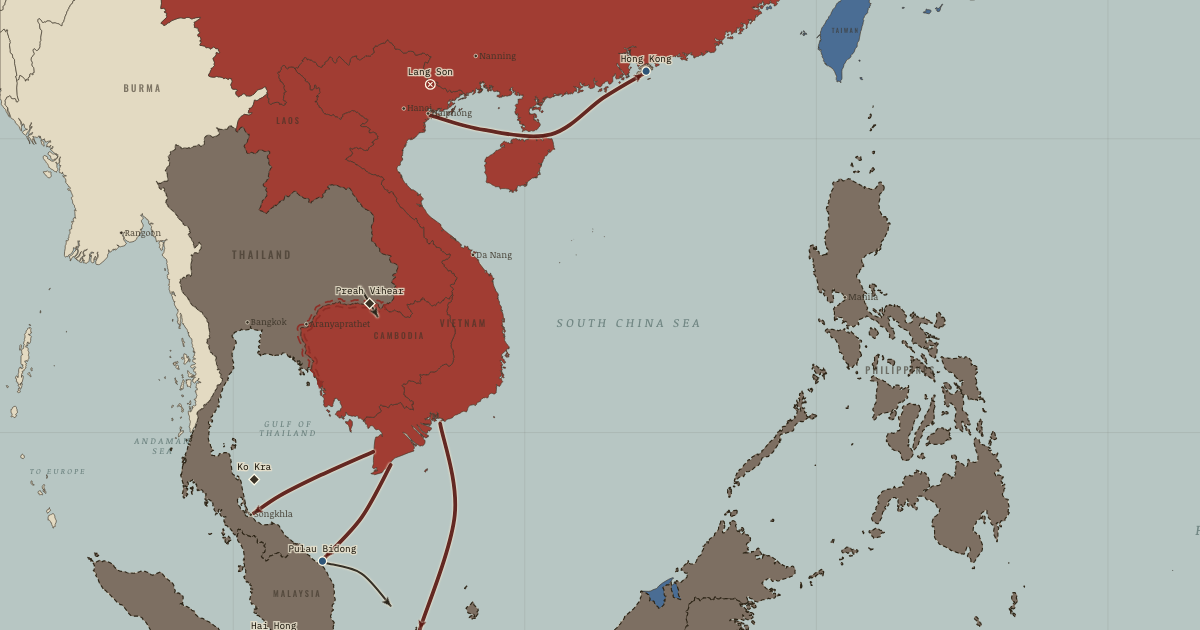
The map above is the world of Refugees in Southeast Asia, June 1979 — Boats pushed back to sea.
Every state on the map that year: The world in 1980 · Europe in 1980.
Part of IB History: Refugees in Europe and Indochina →
SHORT EXPLANATION
In 1978 about 88,000 people fleeing Vietnam reached neighboring shores by boat. The following year the number exceeded 200,000; in a single month at the May–June peak, 54,000 to 59,000 landed. Many traveled in small, unseaworthy fishing boats. The map follows their routes south to Thailand, Malaysia and Indonesia and north to Hong Kong. Officials in Vietnam had begun selling ethnic Chinese permission to leave for gold. War then made departure more urgent: Vietnam invaded Cambodia in December 1978, and China attacked northern Vietnam in February 1979. In a war with China, ethnic Chinese in Vietnam came under suspicion.
A refugee who landed needed somewhere to wait until another country would offer a permanent home. This arrangement, called first asylum, worked rather like an emergency ward receiving a patient before a specialist hospital takes over. Yet none of the regional states had signed the 1951 Convention defining refugee rights, and they feared the wait would become permanent. In June 1979 Malaysia announced that boats would be pushed back; ASEAN ministers said they had “reached the limit of their endurance”; and Thai soldiers forced more than 42,000 Cambodians down an escarpment at Preah Vihear. The states turn grey-tan on the map. Pirates attacked boats in the Gulf of Thailand, and an unknown number of people drowned. Estimates range from about one in ten departures to a widely repeated total of 200,000 to 400,000 deaths. Protection at the shore depended on other countries sharing responsibility.
The full story
For many ethnic Chinese in southern Vietnam, leaving had become a transaction. From 1978 officials accepted gold in return for permission to depart, while syndicates purchased old freighters to carry passengers. The Hai Hong reached waters off Malaysia in November 1978 with about 2,500 people; the Huey Fong arrived in Hong Kong the next month with 3,318. Such ships could carry an exodus that small fishing boats alone could not, and the payments made flight profitable for officials as well as organizers.
War gave people another reason to use these routes. Vietnam invaded Cambodia on 25 December 1978 and captured Phnom Penh on 7 January. Cambodia’s patron, China, invaded northern Vietnam on 17 February, seized Lang Son and withdrew in March. Northern Hoa, the ethnic Chinese of the North, were treated as enemies and sailed along the coast to Hong Kong. In 1979 Hong Kong received 68,748 boat people. By midyear roughly 350,000 refugees were waiting in first-asylum camps throughout the region. Western countries were resettling about 9,000 a month, far fewer than were arriving; each month of waiting enlarged the population that the host countries had to shelter.
On Pulau Bidong the meaning of that wait was visible on a narrow stretch of beach. The hilly Malaysian island, about 260 hectares off Terengganu, received 121 people in August 1978. By mid-1979 it held about 40,000. Refugees made huts, shops and schools, queued for water and waited for interviews with resettlement officers from the United States, Canada, Australia and France. Many had survived robbery, rape or abduction by pirates, often Thai fishermen, in the Gulf of Thailand; some boats reached shore with half their passengers missing. Elsewhere, Indonesia used the Anambas islands, Thailand Songkhla, and the Philippines Palawan; Hong Kong put arrivals in warehouses and old barracks. All had improvised shelter on the expectation that Western countries would soon take people onward.
That expectation was the other half of first asylum. The regional states would let refugees land temporarily; the West would provide permanent homes. By June 1979 the hosts saw the second half failing. Malaysia’s leaders feared that tens of thousands of ethnic Chinese would disturb the political balance between the Malay majority and its large Chinese minority. On 15 June Deputy Prime Minister Mahathir Mohamad was reported as threatening to shoot boat people on sight, a statement withdrawn within days. His government said it would expel more than 70,000 people, while its navy began towing boats back to sea. At the end of June the foreign ministers of ASEAN—Indonesia, Malaysia, the Philippines, Singapore and Thailand—said they would accept no new arrivals. Singapore admitted only those guaranteed resettlement within 90 days. That month Thai soldiers also forced more than 42,000 Cambodians back at Preah Vihear. The disagreement over who should provide a lasting home had reached the point at which people were denied a place of immediate safety.
FULL EXPLANATION
How many died at sea?
The people who reached shore could describe boats that had vanished, but a vessel that sank without witnesses left no complete record of its passengers. No authority counted all those who drowned, starved or were killed after leaving Vietnam. Estimates must therefore be reconstructed from incomplete evidence. In The Refused (1981), journalist Barry Wain suggested a loss rate of around 10 percent and about 30,000 deaths by then; UNHCR’s official history of 2000 cited him. Nghia Vo, in The Vietnamese Boat People (2006), applied a rate of 10 to 15 percent to all departures and estimated 200,000 to 220,000 deaths. Another figure, 200,000 to 400,000, is widely repeated and often attributed to UNHCR, but does not appear in its published reports. It is a commonly cited estimate, rather than a documented agency count. The periods and methods differ, and the risk itself changed: piracy increased in 1979–81, and larger ships could be dangerously overloaded. Diaspora memorials remember “those who did not reach the shore”.
Piracy in the Gulf of Thailand
The figures for boats that reached Thailand in 1981 show how often survival involved more than the crossing itself. UNHCR recorded 452 boats carrying 15,479 people; 349 boats had been attacked, an average of three times each. Among their passengers, 578 women had been raped, 228 abducted, and 881 people were dead or missing. Many attackers were fishermen who knew refugees carried gold. They robbed passengers and raped women, and some kept captives on Ko Kra for weeks. Thailand responded slowly, partly because some officials wanted to deter arrivals. In June 1982 twelve countries funded a $3.6 million program of patrols and police work that ran until 1991. Attacks fell for a time but rose again with departures in 1988–89, when more than 500 and then more than 750 deaths were recorded. Historians treat the attacks as crimes against civilians and the delayed protection as a failure by states able to patrol the Gulf.
Why first asylum broke down
Why would a government that had allowed refugees to land begin turning them away? In Terms of Refuge (1998), W. Courtland Robinson’s standard history of the international response, the answer lies in an unwritten bargain. Neighboring states supplied temporary asylum on the expectation that Western states would quickly resettle those who arrived. By mid-1979 arrivals were six times the rate of resettlement. The hosts feared that Vietnam’s unwanted minority would remain with them permanently; they also believed Hanoi was exporting ethnic Chinese for profit and to destabilize its neighbors. Refugee policy had become a question of foreign policy. None of the states had signed the Convention, so the obligation not to return refugees rested on custom and diplomacy alone. Preah Vihear showed the human consequences: UNHCR later described its own silence there as a low point in its protection history. Austria’s experience in 1956 offers a contrast. It did not push refugees back, and 37 countries took them onward within months. In 1979 onward resettlement lagged far behind arrival.
Key places on the map
On this day
Why it happened
Departures sold for gold. Gold changed the scale of departure. From 1978 Vietnamese officials accepted it from ethnic Chinese seeking permission to leave, while organizers bought fishing boats and freighters. The state earned millions of dollars even as it publicly denied expelling anyone. Boats became larger, fuller and more often ethnically Chinese; neighboring governments saw a deliberate export of Vietnam’s problem.
The wars of 1978–1979. The two invasions made suspicion and economic pressure more acute. Vietnam entered Cambodia in December 1978; China invaded northern Vietnam in February 1979. Northern Hoa were treated as suspected enemies, and most left by sea for Hong Kong. The wars also strained the economy, encouraging ethnic Vietnamese to leave. Military conflict and flight were now bound together.
Resettlement lagging behind arrivals. At the peak in early 1979 more than 50,000 people arrived in a month, while Western countries took about 9,000 for resettlement. Each family needed a sponsor, housing and a visa, and Western budgets and politics slowed the process. Camps in Malaysia, Hong Kong and Thailand grew rapidly. Their hosts concluded that the West was content to leave refugees with them and turned toward deterrence.
Fragile host societies. The hosts had their own political fears. Malaysia’s order depended on a delicate balance between Malays and Chinese; Thailand faced a communist insurgency and a powerful Vietnamese army on its border. Leaders worried that refugees might become permanent populations and unsettle their societies. These fears help explain why governments that had sheltered people since 1975 turned against them in 1979.
THE TURNING POINT
Pulau Bidong and the closing of the shore, June 1979. When Malaysia announced in mid-June 1979 that it would push new boats back to sea, about 40,000 people were crowded onto Pulau Bidong. Landing could no longer be assumed. Within two weeks the other ASEAN states joined Malaysia, and Thailand forced Cambodians back across a minefield. Other governments now faced the prospect of boats sinking unless they helped provide a solution. At Geneva a month later, guaranteed resettlement was exchanged for reopening the shore.
What it changed
The Geneva meeting. The UN Secretary-General called a Geneva conference for 20–21 July 1979 after the pushbacks and ASEAN declaration. Western states doubled their resettlement pledges, and Vietnam agreed to curb illegal departures. The shore reopened, turning tan again on the map in chapter 10. Refugees had no seat at the table, and the agreement came under threat of death at sea.
Rescue at sea. The danger at sea moved people in Western Europe to organize rescues. The West German freighter Cap Anamur and the French hospital ship Île de Lumière patrolled the South China Sea, and merchant ships were urged to pick up boats. A citizens’ committee around Rupert Neudeck chartered the Cap Anamur, which rescued about 10,000 people in 1979–82. Between 1975 and 1990 about 67,000 people were rescued at sea. Chapter 10 continues the story.
Cambodians at the Thai border. The Khmer Rouge fell in January 1979, and hundreds of thousands of starving Cambodians moved toward Thailand. After Preah Vihear, international pressure and famine relief efforts helped bring about the opening of the border in October. The resulting camps appear in the dashed red zone. Chapter 10 follows both the opening and its limit: Thailand admitted Cambodians as “illegal immigrants” awaiting return, never as refugees.
A legacy of deterrence. Regional governments saw that threatening to refuse arrivals could bring concessions from Western states. Deterrence returned in the 1980s, including Thailand’s policy of humane deterrence and Hong Kong’s closed camps. The 1989 Comprehensive Plan of Action combined temporary asylum with screening, resettlement and return. Chapter 11 follows this later bargain.
DISCUSSION QUESTION — Who bears the greatest responsibility for the boat-people crisis of 1979: Vietnam, its neighbours or the countries of resettlement?
The three groups of states held different responsibilities. Vietnam’s re-education policies, attack on private trade and treatment of the Hoa helped drive people out; officials also profited from departures. Neighboring governments then endangered people by towing boats to sea and forcing Cambodians across a minefield at Preah Vihear. The resettlement countries accepted about one person for every six arriving, leaving the region to carry a crisis created partly by their own lost war until it became a spectacle. No burden excuses denying people safety, just as the neighbors’ actions do not erase the policies that caused flight. Protection required a state that did not drive people out, a neighbor willing to admit them, and distant countries prepared to share responsibility.
An interesting fact
On 26 April 1976 the fishing boat Kien Giang entered Darwin harbor. Lam Binh and four companions had sailed all the way from Vietnam: they were the first boat people to reach Australia. Between 1976 and 1981 about 2,060 Vietnamese made the journey in roughly 60 boats. The Tu Do brought more than 30 people in November 1977, its owner using a map torn from a school atlas to navigate. The vessel is now in Sydney’s Australian National Maritime Museum. Those relatively small numbers began a lasting Australian argument about arrival by sea.
Related
THE FREE PRINTABLE STUDY GUIDE
Get the printable study guide for Uprooted free. I’ll send you a few short letters, then one when a new atlas opens. That’s all. — Paul
NO TRACKING · YOUR ADDRESS IS USED FOR THE DISPATCH AND NOTHING ELSE · UNSUBSCRIBE ANYTIME