MAPS OF HISTORY · IB HISTORY · THE ROAD TO WAR
IB HISTORY · 1931 – 1941 · 12 CHAPTERS
IB History: The Road to War — notes, maps and essay questions
Manchuria, Abyssinia, the Rhineland, Munich: a decade of tests that went unanswered, traced step by step as the world order gives way.
IB notes for this atlas are in preparation. Meanwhile, this page gathers the study notes every one of its 12 chapters already carries: why each episode happened, the moment it turned on, what it changed, and the question historians still argue about. It also shows where the atlas fits the IB course.
WW2 is free in full, and chapter 1 of every atlas is free. A free account opens 3 more chapters a day. Opening a new atlas uses one of them. Membership opens all 21 — Join.
Where it fits the course
The atlas is filed under Paper 2 (Conflict) and Paper 3 for Higher Level (Europe and Asia and Oceania). Its IB notes, with evidence lists, primary sources and model essay plans, are in preparation. These are the IB History pages for the parts of the course it serves:
Why it began
The opening chapters offer explanations for how this story began. Their arguments about the causes appear here in a few sentences each, ready to test against your own reading.
Chapter 1: The World the Slump Made
The Depression and a closing world. World trade’s dollar value fell by roughly two-thirds between 1929 and 1933. Governments also raised barriers: the United States passed Smoot–Hawley in 1930, and Britain adopted imperial preference in 1932. Japan already possessed an empire, yet its leaders saw competitors controlling markets and raw materials elsewhere. If trade was being organized into protected blocs, some reasoned, Japan needed a larger bloc of its own. Manchuria became a ‘lifeline’; Hitler would later call the east ‘living space.’
The Washington order and its limits. The Washington treaties of the 1920s offered rules for the Pacific: naval ratios, the Open Door in China and consultation among powers. Their force depended on governments respecting them or acting when they were broken. The League had no army, and Britain and the United States were unwilling or unable to commit force to reverse the seizure of Manchuria. China could appeal to agreements, but the agreements did not automatically bring protection.
The army and the cabinet. Japan’s army claimed a direct relationship with the Emperor rather than ordinary subordination to the prime minister. That left Tokyo with a difficult problem when officers in the field disobeyed. Kwantung Army officers guarding the Manchurian railway concession assassinated the warlord Zhang Zuolin in 1928 and escaped effective punishment. In 1931 the army minister sent a general to check another plot, but word of the visit reached the officers concerned. Civilian weakness would matter when they acted.
China’s divided position. Chiang Kai-shek’s Nationalists had nominally unified China in 1928, but their government faced rival warlords and communist bases in the south. Catastrophic Yangtze floods added to its troubles in 1931. Japanese radicals expected Nanking to seek legal help abroad rather than offer effective immediate military resistance. They were less attentive to what repeated concessions and humiliation could do over time: resentment could strengthen Chinese nationalism.
Chapter 2: Mukden: The First Unpunished Gamble
A railway concession and a larger ambition. Japan’s victory over Russia in 1905 had given it control of the South Manchuria Railway zone, which the Kwantung Army guarded. The region’s coal, soy and iron made it valuable; beyond the concession lay land governed by Zhang Xueliang, whose troops faced competing demands. Ishiwara Kanji, a principal planner, believed a final war with America inevitable. On that assumption, acquiring Manchuria’s resources now would prepare Japan for a future defense.
The army and its civilian government. Wakatsuki Reijirō’s government sent General Tatekawa to restrain the officers. One account says the conspirators entertained him before setting off the charge. Once the invasion began, each new gain confronted ministers as an accomplished fact. The army’s control over its cabinet minister also gave it power to threaten a government by withdrawing him. In May 1932 naval officers assassinated Prime Minister Inukai, the last party politician to head a Japanese government before 1945. As the conquest proceeded, civilian authority weakened.
China’s choice of resistance. Chiang’s policy of ‘first internal pacification, then external resistance’ reflected his judgment that China could not yet defeat Japan. Some of his strongest forces were engaged against the communists. Holding them back from a general war preserved them and helped China present Japan as the aggressor before world opinion. It also allowed Japanese troops to advance at comparatively low cost, while Chiang faced sustained protest at home. His appeal to international law came with a political price.
The limits of the League. An investigation was within the League’s power; military enforcement depended on its members. Britain had an Asian empire and naval commitments to protect, and Depression budgets discouraged new risks. The Lytton inquiry took months, during which Japan conquered Manchuria and established Manchukuo. Its careful report could tell governments what had happened. Reversing the result required a further decision by those governments.
Chapter by chapter
These entries trace the atlas through 12 chapters, identifying the causes and turning point of each. Select a title to open its free chapter page, where the full explanation, a discussion question and the map appear together.
1. The World the Slump Made
CHAPTER 1 · 1931
Why it happened: The Depression and a closing world · The Washington order and its limits · The army and the cabinet · China’s divided position
The turning point: Mukden, the night of 18 September 1931.
2. Mukden: The First Unpunished Gamble
CHAPTER 2 · 1931–1933
Why it happened: A railway concession and a larger ambition · The army and its civilian government · China’s choice of resistance · The limits of the League
The turning point: Mukden, 18 September 1931.
3. Germany Turns Charcoal
CHAPTER 3 · 1933–1935
Why it happened: The men who appointed Hitler · The grievances of Versailles · Disarmament and security · Different powers, different priorities
The turning point: Stresa, April 1935.
4. Abyssinia: The League Dies in Africa
CHAPTER 4 · 1934–1936
Why it happened: A regime that needed a triumph · Britain and France wanted Italy against Hitler · The victim was inside the system · Air power and gas against spears and rifles
The turning point: Paris, December 1935.
5. The Rhineland Bluff and the Spanish Rehearsal
CHAPTER 5 · 1936–1937
Why it happened: Versailles’ last physical restraint was psychological · France would not fight alone; Britain would not fight at all · Spain’s war was internal first, international second · Non-intervention institutionalized the double standard
The turning point: The Rhine bridges, 7 March 1936.
6. China: The War Nobody Declared
CHAPTER 6 · 1937–1938
Why it happened: Xi’an and the demand for resistance · A command system that rewarded advances · Why Chiang fought at Shanghai · A war without a declaration
The turning point: The Marco Polo Bridge, 7 July 1937.
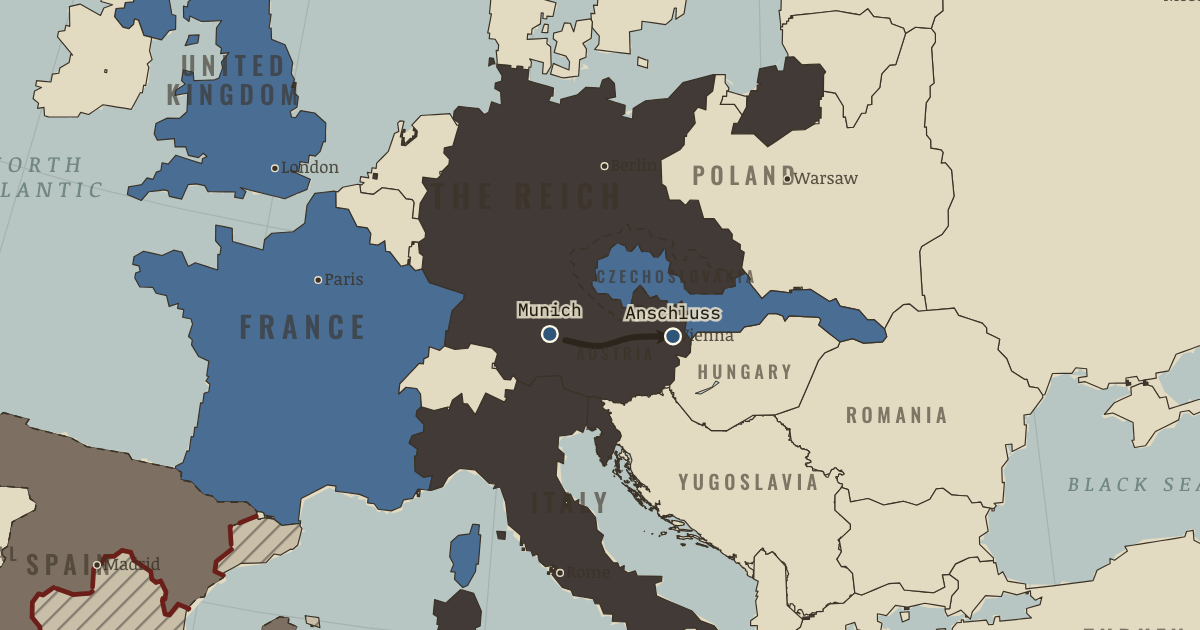
7. Anschluss and Munich: Appeasement at Full Stretch
CHAPTER 7 · 1938
Why it happened: The memory of war and fear of bombing · A real grievance used for conquest · The disputed military balance · France and its British ally
The turning point: Munich, 29–30 September 1938.
8. Prague, the Pact, Poland
CHAPTER 8 · 1939
Why it happened: Prague changes the British calculation · The bargain in Moscow · Danzig and the destruction of Poland · Poland rejects subordination
The turning point: The Kremlin, 23 August 1939.
9. The Fall of the West
CHAPTER 9 · 1939–1940
Why it happened: A risky attack through the Ardennes · The uses of the Phoney War · The limits of neutrality · Vichy: defeat and decisions
The turning point: Compiègne, 22 June 1940.
10. The Turn South
CHAPTER 10 · 1939–1941
Why it happened: The defeat at Khalkhin Gol · The costs of the China war · Opportunity after Europe’s defeats · Pressure understood as a siege
The turning point: The freeze, 26 July – 1 August 1941.
11. Barbarossa: The Gamble That Ends the Gambles
CHAPTER 11 · 1940–1941
Why it happened: Hitler’s eastern program · Britain and the imagined exit · Germany underestimated Soviet strength · Stalin discounted the warnings
The turning point: Berlin, 27 September 1940.
12. Pearl Harbor: The Roads Meet
CHAPTER 12 · DECEMBER 1941
Why it happened: The oil clock ran out · Yamamoto’s wager against his own judgment · Washington expected war — somewhere else · Hitler chose the world war
The turning point: Pearl Harbor, 7:48 a.m., 7 December 1941.
Essay questions, argued
Historians still debate the question at the end of each chapter. Before reading our brief answer, try making a plan for how you would answer it.
DISCUSSION QUESTION · CHAPTER 1
How far was the road to war laid by economics rather than ideology?
The Depression changed politics dramatically: the Nazi vote rose from 2.6% in 1928 to 37% in July 1932, and Japanese military radicals gained support amid rural hardship. But distress did not select the goals of those movements. Other countries suffered without invading their neighbors, and internationalist alternatives remained available in both Germany and Japan. Historians often call the Depression an enabling condition: it weakened confidence in existing arrangements and made expansionist promises more persuasive. Ideology supplied aims and enemies; institutions and choices helped determine who could act, from Japan’s army beyond effective civilian control to German conservatives willing to bring Hitler into government.
The chapter behind it: The World the Slump Made. Every chapter’s question is on the discussion questions page.
DISCUSSION QUESTION · CHAPTER 5
“The dictators intervened and the democracies did not — that is the history of the Spanish war in one sentence.” Is it fair?
As an account of government policy, the sentence identifies a real contrast. Germany and Italy sent aircraft and armor, and Italy sent an army. Britain and France embargoed both sides, restricting the Republic while Franco’s sponsors continued to help him. But several participants disappear from that account. The Soviet Union supplied the Republic with arms and advisers. Soviet security influence and repression of opponents, including Trotskyists and anarchists around the Barcelona May Days of 1937, deepened divisions in the Republican camp. Franco’s propaganda portrayed the war as Christianity against Bolshevism. About 35,000 volunteers from some fifty countries joined the International Brigades even though their governments did not send them. France’s border policy also changed: under Blum, aid crossed the Pyrenees when the border opened. Non-intervention was a state policy with uneven effects, not a complete account of foreign involvement.
The chapter behind it: The Rhineland Bluff and the Spanish Rehearsal. Every chapter’s question is on the discussion questions page.
DISCUSSION QUESTION · CHAPTER 9
Was France’s fall a military defeat or a national collapse, and why does the distinction matter?
Vichy described defeat as a judgment on the divided, “decadent” Third Republic, an account that helped justify ending it. Historians including Ernest May and Julian Jackson have challenged that interpretation. France fielded more tanks than Germany, and its soldiers fought hard: estimates of French military deaths in six weeks range from 50,000 to 90,000, a rate comparable to Verdun. The campaign had a more specific explanation. German concentration and speed exploited Allied decisions at Sedan, with an outcome that was not inevitable. Politics and morale mattered, but an appeal to national character cannot explain where armies were placed or how they were commanded. The distinction matters for justice too, because Vichy used its account of collapse to excuse its own choices after defeat.
The chapter behind it: The Fall of the West. Every chapter’s question is on the discussion questions page.
DISCUSSION QUESTION · CHAPTER 12
“A date which will live in infamy” — was Pearl Harbor a surprise attack, or a foreseen war at a surprising place?
War with Japan was expected in Washington. For two decades American planners had studied it under War Plan Orange; officials read Japanese diplomatic traffic and sent explicit warnings ten days before the attack. But expecting war did not tell commanders where the blow would fall. The intercepts did not name Hawaii, and the decrypt record has not supported claims that Roosevelt knew Pearl Harbor would be attacked. Officials looked chiefly toward Southeast Asia. In Hawaii, concern about sabotage shaped dispositions, and the radar contact was explained as friendly aircraft. The congressional inquiry filled 39 volumes; its evidence points to failures in a system rather than a hidden hand. The distinction matters: a warning that war is likely must be interpreted as an expectation about a particular threat, and people must then act on it. Neither step happens automatically.
The chapter behind it: Pearl Harbor: The Roads Meet. Every chapter’s question is on the discussion questions page.
What it changed
Consequence questions need the end of the story. The final chapter, Pearl Harbor: The Roads Meet, sets out what the period left behind:
The perimeter, then the tide. Japan’s advance continued for roughly the six months Yamamoto had described. Malaya, Singapore in February 1942, the Indies and the Philippines fell; Singapore was a particularly severe imperial capitulation. Then the Battle of the Coral Sea checked an advance in May. At Midway in June, American carriers absent from Pearl Harbor helped sink four of the six Japanese carriers that had attacked it. The WW2 atlas takes up the war that this atlas ends by beginning.
The arsenal opens both doors. Roosevelt could pursue “Europe first” more easily with public support after Germany’s declaration. Lend-Lease was already supplying Britain and the USSR, and became a means of sustaining the global coalition. By war’s end the program had provided about $50 billion in matériel, including Studebaker trucks used by the Soviet Union and food shipped to Britain.
Asia’s empires never come back. The tan across the southern half of the map represents empires whose authority Japan’s victories shook. An Asian power had defeated European colonial forces in weeks. After 1945 European governments attempted to restore their rule, but India became independent in 1947 and Indonesia in 1949; Indochina followed after wars covered in the Cold War atlas. Japan’s conquest was defeated, yet the imperial world it attacked did not survive unchanged.
Revision tools
The atlas ends with a map quiz that asks you to find places and moments on the map itself (part of every plan from Starter up). The quick quiz and the discussion questions with our answers are free pages on this site, and the printable study guide gathers every chapter’s notes into one document for revision.
Read next
Maps of History is independent and is not affiliated with or endorsed by the International Baccalaureate Organization. IB course names describe alignment only; paper, theme and section names follow the new course outline and may change when the final guide is published.
THE DISPATCH
Get the printable study guide for The Road to War free. I’ll send you a few short letters, then one when a new atlas opens. That’s all. — Paul
NO TRACKING · YOUR ADDRESS IS USED FOR THE DISPATCH AND NOTHING ELSE · UNSUBSCRIBE ANYTIME