Refugee crises · CHAPTER 11 ·
Comprehensive Plan of Action
Chapter 11 of Uprooted: Refugees in Europe 1945–1960 and Indochina 1975–1990: “Camps, Screening and the CPA”
In the 1980s responses to the boat people shifted to deterrence: Thailand adopted ‘humane deterrence’ in 1981 and Hong Kong held all arrivals after July 1982 in closed camps. From June 1988 Hong Kong screened arrivals to separate refugees from migrants, and in June 1989 the Comprehensive Plan of Action made screening the norm.
Chapter 11 is included with every paid plan. WW2 is free in full, and chapter 1 of every atlas is free. A free account opens 3 more chapters a day. Starter, at $9 a month, opens all 21 with no daily limit — see the plans.
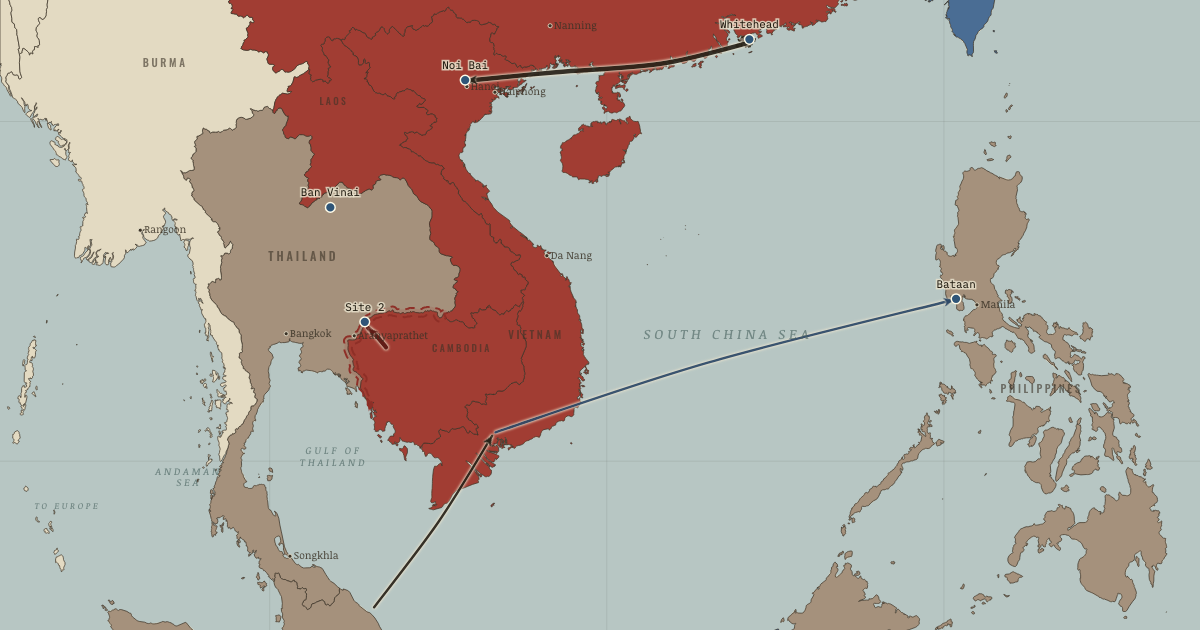
The map above is the world of Refugees in Southeast Asia, December 1989 — Hong Kong’s first forced returns.
Every state on the map that year: The world in 1990 · Europe in 1990.
Part of IB History: Refugees in Europe and Indochina →
SHORT EXPLANATION
By the 1980s the promise made at Geneva in July 1979 was becoming harder to keep. People continued to leave Vietnam, but Western countries offered fewer permanent homes. Thailand responded in 1981 with ‘humane deterrence’: new arrivals were held in bleak camps without access to resettlement. Hong Kong closed its camps to new boat arrivals from July 1982. When departures rose again in 1987–89, Hong Kong began screening people in June 1988, interviewing them to decide whether they met the 1951 Refugee Convention’s definition or were migrants seeking a better life. In June 1989, 70 governments adopted the Comprehensive Plan of Action (CPA) at Geneva and extended screening across the region. A boat reaching shore no longer guaranteed its passengers a home in the West.
The CPA retained first asylum, temporary refuge in the first country reached, and resettlement for those recognized as refugees. It added return to Vietnam or Laos for those not recognized. About 28 percent screened after the cut-off dates were recognized; more than 109,000 Vietnamese went home, most under a voluntary program with a small grant and monitoring by UNHCR, the UN refugee agency. Hong Kong forced 51 people onto a flight to Hanoi on 12 December 1989, and the colony turns grey-tan again on the map. Meanwhile almost 200,000 Cambodians waited at Site 2 and other border camps until peace made return possible in 1992–93. The United States admitted Amerasians, children of American servicemen and Vietnamese mothers, and former inmates of Vietnam’s re-education camps for officials of the old regime. The crisis ended as the category of people recognized as refugees narrowed.
The full story
The 1979 Geneva bargain depended on two movements occurring together. Countries near Vietnam would give arrivals temporary refuge, and Western countries would offer them permanent homes. Departures continued, however, while resettlement places became scarcer. Regional officials also believed that each family accepted abroad encouraged others to leave: generous resettlement, in their view, created a ‘pull factor’. If that was right, making the journey less rewarding might reduce the number waiting on their shores.
Thailand called its policy ‘humane deterrence’. From January 1981, new boat arrivals were held in austere camps such as Na Pho without interviews for resettlement. Hong Kong had allowed refugees in open camps to work in its factories; from 2 July 1982, it confined all new arrivals in closed camps. Some people in processing centers had already been refused by every resettlement country. These ‘long-stayers’ could neither move onward nor go home. Thailand and Hong Kong fade from the tan of 1979 to grey-tan on the map: people could still reach the shore, but waiting behind fences was increasingly what awaited them.
A different war kept Cambodians waiting along Thailand’s border. In the dry season of 1984–85, Vietnam destroyed settlements held by three Cambodian resistance groups, including Pol Pot’s Khmer Rouge. China, Thailand and the West supported the resistance against the Vietnamese-installed government. Survivors moved a few kilometers inside Thailand, as the short arrow on the map shows. Site 2 opened in January 1985 and held about 198,000 people by 1989.
The United Nations Border Relief Operation supplied food and water, but the factions ran the camps. Residents could not leave, and Thailand classified them as displaced persons without a claim to resettlement. Their immediate needs could be met while the question of their future remained tied to the war. The Paris peace agreements of October 1991 opened a way home, and UNHCR returned more than 360,000 Cambodians in 1992–93.
The CPA offered a new way to maintain first asylum while limiting permanent resettlement. Local officials, with UNHCR observers, interviewed arrivals after 14 March 1989—or after 16 June 1988 in Hong Kong—to decide whether they had a well-founded fear of persecution. Those recognized would be resettled; those rejected were to return. Vietnam promised not to punish returnees, UNHCR monitored them and paid small grants, and radio messages and posters in Vietnam warned that a boat journey no longer assured a Western home.
The distinction determined where people would spend the next years of their lives. Hong Kong recognized about 19 percent of the 60,275 people it interviewed. Screened-out families waited in Whitehead and other detention centers, where hunger strikes and riots broke out. On 12 December 1989 Hong Kong forced people onto a flight to Hanoi, provoking protests from Washington and human rights groups. Forced returns paused until another agreement with Hanoi in 1991. The West had rejected forced return for Soviet displaced persons after 1945; now return was again part of refugee policy for people judged not to qualify for protection.
FULL EXPLANATION
Screening and its critics
For roughly a decade Vietnamese boat people had generally been presumed to be refugees. The CPA instead made the Convention definition a question for each applicant. Its supporters, including UNHCR officials who designed the plan, saw a return to legal principle. They argued that Vietnam’s 1986 economic reforms had reduced persecution and that many later departures, especially from the North, arose from poverty. An individual interview could, in principle, distinguish a person with a well-founded fear of persecution from someone leaving to improve a livelihood. Much depended on the interview. The Lawyers Committee for Human Rights and Amnesty International documented short interviews, poor interpretation, lack of legal advice, and officers who disbelieved accounts of re-education and discrimination. Recognition rates differed widely between countries, suggesting that the host state’s attitude could matter as much as the applicant’s story. UNHCR retained power to recognize people rejected by a host state and exercised it in some cases. W. Courtland Robinson described the CPA as both a protection achievement and a containment device. Its difficulty remains familiar in Europe and elsewhere: a procedure must distinguish claims fairly even when governments want fewer people recognized.
A decade at the border
To understand the Cambodian border camps, we have to see both their humanitarian and their political roles. Son Sann’s non-communist Khmer People’s National Liberation Front administered Site 2; Prince Sihanouk’s movement and the Khmer Rouge controlled other camps. The three factions formed a coalition that retained Cambodia’s UN seat until 1991, while China, ASEAN and the United States opposed Vietnam’s occupation. UN agencies and private charities supplied rations and medical care. At the same time faction leaders controlled movement and recruited fighters, and Khmer Rouge camps held civilians as a population base. Thailand did not recognize the inhabitants as refugees, so most had no route to resettlement; Khao-I-Dang was a UNHCR camp from which some were resettled. Historians call such prolonged confinement ‘warehousing’: the people’s future depended on a peace process they could not control. During the UN Transitional Authority in Cambodia, UNHCR returned more than 360,000 people in 1992–93, before the 1993 elections.
Return, voluntary and forced
Return was the CPA’s most contested answer to a rejected claim. Vietnam agreed not to prosecute people for leaving, and UNHCR visited returnees and reported few cases of punishment. Critics questioned whether monitors could see everything. Most returned under a voluntary program that offered a small resettlement grant. Hong Kong, facing public resentment over detention costs, began involuntary return on 12 December 1989 with a flight carrying 51 people. The United States protested; in 1991 Hong Kong and Vietnam agreed on an ‘orderly return’ program for those who had not volunteered. By the plan’s formal end on 30 June 1996, more than 109,000 Vietnamese and about 27,000 Laotians had returned, while about 74,000 refugees had been resettled after screening. Hong Kong’s last Vietnamese detention camp, Pillar Point, closed in 2000. The contrast with Europe is striking: the West stopped forcing Soviet citizens home in 1946–47, but accepted forced return under the CPA once people had been judged not to be refugees.
Key places on the map
On this day
Why it happened
Compassion fatigue. More than a million Indochinese had been resettled by the mid-1980s. The crisis attracted less news coverage, public enthusiasm faded, and resettlement quotas fell even as departures continued. The 1979 bargain had relied on onward movement from first-asylum camps; when places failed to keep pace, the camps stopped emptying. Governments providing first asylum sought other ways to limit the burden.
A changing exodus. The people leaving Vietnam were changing too. Later departures more often came from the North and from people without ties to the old regime. Years of failed planning, a trade embargo and the cost of occupying Cambodia had contributed to poverty. Officials in Hong Kong and elsewhere concluded that many arrivals were economic migrants. Đổi Mới, Vietnam’s 1986 reforms, also made persecution seem less systematic to them, strengthening their case for individual screening.
Fear of a pull factor. If a place in the West encouraged people to leave, host governments reasoned, detention and the prospect of return might discourage them. This belief helped shape policy. Its factual force remains debated: conditions inside Vietnam were changing as well, so departures cannot simply be attributed to the promise of resettlement. Similar arguments appear in asylum debates in Europe and Australia today.
The Cambodian stalemate. Vietnam’s occupation of Cambodia from 1979 to 1989 and the resistance war kept hundreds of thousands near the Thai border. Great-power support for the resistance coalition, including the Khmer Rouge, prolonged the conflict. Each side wanted the population as a base, and no one would resettle it. The camps endured for the duration of the regional Cold War stalemate.
THE TURNING POINT
Geneva, 14 June 1989, and the Whitehead camp. The CPA adopted at Geneva changed the question put to Vietnamese arrivals. Since 1975 they had been presumed to be refugees; after the cut-off dates each had to establish a fear of persecution, and those who could not were to return. At Whitehead, a fenced Hong Kong detention center, screened-out families waited for that decision’s consequences. The exodus ended by 1996, while protection under the international refugee regime had been narrowed to a smaller category of people.
What it changed
Screening becomes the norm. In the 1990s individual screening became a model for asylum systems around the world, as Europe received refugees from Yugoslavia and arrivals from farther afield. The CPA showed both the promise of a hearing and the danger of officials disbelieving applicants. Chapter 12 compares it with group recognition of Hungarians in 1956, when individuals were not asked to prove a personal fear.
Return as a solution. UNHCR came to prefer voluntary repatriation in the 1990s, including in Cambodia, Mozambique and Afghanistan, after it had been rejected for most displaced persons following 1945. The CPA was an early test of return to a state people had fled, accompanied by international monitoring. Some emphasize the lives protected; others emphasize choices denied. Its experience also showed how difficult the boundary between voluntary and forced return could be.
A diaspora formed. The crisis created a worldwide diaspora. By 1995 about 2.5 million Indochinese had found homes abroad, more than a million in the United States, with large communities in Canada, Australia and France. The Amerasian and Humanitarian Operation programs added about 90,000 and 167,000 people respectively. Communities remember 30 April 1975 as ‘Black April’ in California and Journey to Freedom Day in Canada; the epilogue returns to those memories.
Cambodia comes home. The Paris agreements of 1991 and the UN transitional authority made return possible. In 1992–93 more than 360,000 Cambodians went home from the border, and Site 2 and Khao-I-Dang closed. For most returnees this was the outcome they wanted, fourteen years after the crisis began. The epilogue compares their long wait with Europe’s speedier settlement.
DISCUSSION QUESTION — Was the Comprehensive Plan of Action a humanitarian solution to the boat-people crisis or a retreat from the principle of asylum?
The CPA restored an opportunity denied by the push-backs of 1979: every arrival received first asylum and an individual hearing. Departures fell, camps emptied by 1996, recognized refugees were resettled, and UNHCR monitored returnees, documenting few cases of punishment. These achievements matter. But the hearing also became the means of restricting who could leave for a new home. The plan was designed to reduce the number recognized; critics documented defective interviews, years of detention and the forced return of December 1989. Hong Kong recognized about 19 percent of applicants. The CPA protected asylum in form while shrinking it in practice, accepting host states’ view that most later arrivals were migrants. Its record shows how much protection depends on the decision about who does not qualify.
An interesting fact
A photograph helped bring about the Amerasian Homecoming Act. In 1985 Newsday photographer Audrey Tiernan photographed Le Van Minh, a boy with polio fathered by an American serviceman, living on the streets of Ho Chi Minh City. Four students at Huntington High School on Long Island saw it and collected 27,000 signatures asking that he be brought to the United States. Their congressman, Robert Mrazek, flew to Vietnam in 1987 and brought Minh home. He then wrote the law; after it took effect in March 1988, about 23,000 Amerasians and 67,000 relatives emigrated under it.
Related
THE FREE PRINTABLE STUDY GUIDE
Get the printable study guide for Uprooted free. I’ll send you a few short letters, then one when a new atlas opens. That’s all. — Paul
NO TRACKING · YOUR ADDRESS IS USED FOR THE DISPATCH AND NOTHING ELSE · UNSUBSCRIBE ANYTIME