MAPS OF HISTORY · IB HISTORY · REMAKING THE STATE
IB HISTORY · 1600 – 2000 · 12 CHAPTERS
IB History: Meiji Japan and post-Soviet Russia — notes, maps and essay plans
In forty years a samurai elite dismantled its own class and built a modern state and empire. Soviet reformers took another path: they lost the union, the economy and then much of the democracy they had opened. Why?
This page gathers the atlas’s IB notes: where each of its 12 chapters fits the syllabus, the concepts and evidence it supports, practice questions with model essay plans, primary sources, and starting points for the Internal Assessment.
WW2 is free in full, and chapter 1 of every atlas is free. A free account opens 3 more chapters a day. Opening a new atlas uses one of them. Membership opens all 21 — Join.
Where it fits the course
Every chapter’s IB notes name the parts of the course it serves. Across the atlas they add up to this: It is the paired atlas for the Paper 1 Focused Study Political and Economic Transitions, whose page holds a free source-question set.
- Paper 1 · Political and Economic Transitions · 12 CHAPTERS
- Paper 2 · Authoritarian Rule · 5 CHAPTERS
- Paper 2 · Conflict · 3 CHAPTERS
- Paper 2 · Innovation and Transformation · 1 CHAPTER
- Paper 2 · Popular Movements · 2 CHAPTERS
Chapter by chapter
Across its 12 chapters, the atlas holds 72 points of evidence and 42 primary sources. Here you can read all the evidence for chapters 1 and 2. For each later chapter there is one point and the practice question; the rest is in the atlas. Select a chapter title to open its free page and read the full explanation.
1. The Closed Country
CHAPTER 1 · 1600–1853 · CONCEPTS: CONTINUITY, CAUSATION
EVIDENCE TO USE · ALL 6 POINTS (A FREE CHAPTER)
- After Sekigahara in 1600, Tokugawa Ieyasu left outer lords such as the Shimazu of Satsuma and the Mōri of Chōshū armed on Japan’s rim. Their domains appear at the grey-tan edges of the 1840 map, far from the shogunal center and harder to control; they later became bases of opposition.
- The shogun and his direct retainers held lands producing only about a quarter of Japan’s assessed rice harvest. The remaining authority was divided among some 260 lords, or daimyo, who kept their own samurai, taxes and courts. There was no national army or national tax.
- Alternate attendance, compulsory from 1635, required each daimyo to live in Edo every other year and leave his wife and heir there permanently. The journeys, processions and mansions consumed domain revenues, leaving few lords able to finance a rebellion for 250 years.
- The Tenmei famine of the 1780s showed what divided authority could mean for people in need. Japan’s population fell by more than 900,000 as domains hoarded rice for their own people and the shogunate lacked national machinery to move food to the starving.
- European trade was confined from 1641 to the Dutch on Dejima, an artificial island in Nagasaki harbor. Through their books, scholars of “Dutch learning” studied anatomy, astronomy and artillery; Japan’s elite therefore had knowledge of Western power well before 1853.
- On 29 August 1842 the Treaty of Nanking gave Britain Hong Kong, opened five ports and required payment of 21 million silver dollars. In the same weeks the shogunate softened its order to fire on foreign ships, acknowledging that it could not fight.
2. The Black Ships
CHAPTER 2 · 1853–1858 · CONCEPTS: CAUSATION, PERSPECTIVES
EVIDENCE TO USE · ALL 6 POINTS (A FREE CHAPTER)
- On 8 July 1853 Commodore Matthew Perry anchored four American warships, two of them steamers, off Uraga. He refused to go to Nagasaki, showing that steam power had made the shogunate’s rules for receiving foreigners impossible to enforce.
- Abe Masahiro, the senior councillor, sent the American letter to the daimyo and the imperial court for advice in 1853. By consulting them, the shogunate admitted for the first time that it could no longer decide foreign policy alone.
- The Treaty of Kanagawa, signed on 31 March 1854, opened only Shimoda and Hakodate for coal, water and supplies. Hayashi Akira, the Japanese negotiator, kept a trade clause out. Even under threat, Japanese officials had limited the concession.
- The Harris treaty of 29 July 1858 went further: it opened Kanagawa, Nagasaki and Hakodate from 1859 and fixed Japan’s import tariffs. It also granted foreigners extraterritoriality, the right to be tried by their own consuls. Japan had lost control over its customs and courts in these matters.
- An ounce of gold bought about five of silver in Japan, but about fifteen abroad. Gold consequently drained out of Japan, and the shogunate minted lighter gold coins in 1860. By 1867 Osaka rice prices had risen several times over, making inflation a political grievance.
- Ii Naosuke had the Harris treaty signed despite Emperor Kōmei’s refusal to approve it. On 24 March 1860 samurai, most of them from Mito, killed Ii outside Edo Castle. The shogunate’s defiance of the throne had become a crisis of legitimacy.
3. The Fall of the Shogunate
CHAPTER 3 · 1858–1869 · CONCEPTS: CAUSATION, CHANGE
EVIDENCE TO USE · 1 OF 6
- In August 1863 British warships shelled Kagoshima; in September 1864 seventeen allied warships silenced Chōshū’s forts at Shimonoseki. The domains most committed to expelling foreigners had met Western naval power, and both Satsuma and Chōshū came to buy Western rifles and steamships.
Practice question: Assess why Satsuma and Chōshū succeeded in overthrowing the shogunate between 1863 and 1869.
5 more points of evidence, 3 primary sources and the model plan for this question are in the IB notes of chapter 3 in the atlas.
4. Dismantling the Old Order
CHAPTER 4 · 1868–1877 · CONCEPTS: CHANGE, CONSEQUENCE
EVIDENCE TO USE · 1 OF 6
- The Charter Oath of 6 April 1868 promised assemblies and “all matters decided by public discussion”. It also called for the “base customs of the past” to be broken. That broad pledge gave the leaders grounds to invoke the oath for sweeping reform before any assembly met.
Practice question: Discuss the view that the abolition of the domains in 1871 was a more important change than the restoration of 1868.
5 more points of evidence, 3 primary sources and the model plan for this question are in the IB notes of chapter 4 in the atlas.
5. Building the Meiji State
CHAPTER 5 · 1877–1894 · CONCEPTS: CHANGE, PERSPECTIVES
EVIDENCE TO USE · 1 OF 6
- The Iwakura Mission left in December 1871 and spent 21 months in the United States and Europe. It failed to revise the unequal treaties. Its members returned convinced that Japan first needed factories, schools and laws; that judgment helped set the order of the reforms that followed.
Practice question: How far was the Freedom and People’s Rights movement responsible for the introduction of the Meiji constitution in 1889?
5 more points of evidence, 4 primary sources and the model plan for this question are in the IB notes of chapter 5 in the atlas.
6. A Great Power
CHAPTER 6 · 1894–1912 · CONCEPTS: CONSEQUENCE, SIGNIFICANCE
EVIDENCE TO USE · 1 OF 6
- In 1894, a Donghak peasant rebellion prompted Korea to ask China for troops. Japan sent a larger force and seized the royal palace in Seoul. It declared war in August: Japanese leaders considered control of Korea vital to their country’s security.
Practice question: Compare and contrast the causes and consequences of Japan’s wars with China (1894–1895) and Russia (1904–1905).
5 more points of evidence, 4 primary sources and the model plan for this question are in the IB notes of chapter 6 in the atlas.
7. The Stagnant Superpower
CHAPTER 7 · 1964–1985 · CONCEPTS: CONTINUITY, CAUSATION
EVIDENCE TO USE · 1 OF 6
- Brezhnev’s promise of “stability of cadres” gave officials security after the purges and reshuffles of the Khrushchev years. The elite had reason to remain loyal, but its members also remained in office: by 1980 the average age of the Politburo, the party’s ruling committee, was about seventy.
Practice question: Evaluate how the Soviet leadership maintained its rule between 1964 and 1985.
5 more points of evidence, 3 primary sources and the model plan for this question are in the IB notes of chapter 7 in the atlas.
8. Gorbachev’s Gamble
CHAPTER 8 · 1985–1989 · CONCEPTS: CHANGE, CAUSATION
EVIDENCE TO USE · 1 OF 6
- Gorbachev launched a campaign against drinking in May 1985, cutting one of the budget’s largest sources of income. At the same time, world oil prices fell from about $27 a barrel in 1985 to around $14 in 1986. With revenue falling, the state printed money.
Practice question: How far did Gorbachev’s own reforms, as opposed to pressure from below, undermine Communist Party control of the Soviet Union between 1985 and 1989?
5 more points of evidence, 3 primary sources and the model plan for this question are in the IB notes of chapter 8 in the atlas.
9. The Union Unravels
CHAPTER 9 · 1989–1991 · CONCEPTS: CAUSATION, SIGNIFICANCE
EVIDENCE TO USE · 1 OF 6
- On 23 August 1989, the fiftieth anniversary of the Nazi–Soviet Pact, about two million Estonians, Latvians and Lithuanians joined hands across some 675 km. The Baltic Way made a grievance that had long been buried visible as a mass demand for independence.
Practice question: Discuss the importance of national popular movements in bringing about the collapse of the Soviet Union between 1988 and 1991.
5 more points of evidence, 4 primary sources and the model plan for this question are in the IB notes of chapter 9 in the atlas.
10. Shock Therapy
CHAPTER 10 · 1992–1993 · CONCEPTS: CONSEQUENCE, PERSPECTIVES
EVIDENCE TO USE · 1 OF 6
- On 2 January 1992, Yegor Gaidar’s government freed most prices at once. Goods returned to the shops, but prices rose by about 2,500% over the year, wiping out savings Soviet citizens had built up.
Practice question: Examine how shock therapy affected the Russian people and Russian politics in 1992–1993.
5 more points of evidence, 4 primary sources and the model plan for this question are in the IB notes of chapter 10 in the atlas.
11. A State at War with Itself
CHAPTER 11 · 1994–1998 · CONCEPTS: CAUSATION, CONSEQUENCE
EVIDENCE TO USE · 1 OF 6
- On 15 February 1994 Tatarstan signed a treaty with Moscow that kept the republic inside Russia. Russians made up about two-fifths of its population, and the agreement left Tatarstan extensive control over its oil, budget, and much of its law. Bargaining had held this part of the federation together.
Practice question: To what extent did the weakness of the Russian state cause the outbreak of war in Chechnya in December 1994?
5 more points of evidence, 3 primary sources and the model plan for this question are in the IB notes of chapter 11 in the atlas.
12. Two Transitions Compared
EPILOGUE · 1999–2000 · CONCEPTS: CHANGE, CONTINUITY, SIGNIFICANCE
EVIDENCE TO USE · 1 OF 6
- Japan’s leaders abolished the domains in August 1871, three years after the restoration. By the time they granted a constitution in 1889, they had built a national army, a tax system and industry: central authority came before political participation.
Practice question: Compare and contrast the ways in which the sequencing of political and economic reform shaped the outcomes of the Meiji transition (1868–1912) and the post-Soviet transition (1985–2000).
5 more points of evidence, 4 primary sources and the model plan for this question are in the IB notes of chapter 12 in the atlas.
Practice questions and essay plans
Each chapter closes with a practice question and a model plan. The plan gives a thesis, three points with evidence and a link back to the question, a counter-argument and a judgement. Chapter 1’s plan appears here in full. The other plans are outlined here and given in full in the atlas.
PAPER 2 · REMAKING THE STATE · CHAPTER 1
Examine the methods by which the Tokugawa shogunate maintained its rule over Japan between 1635 and 1853.
The shogunate restrained rival lords by placing them carefully and making their obligations expensive, while controlling foreign contacts and leaving local government to the domains. These arrangements kept internal rivals in check for 250 years. They also divided resources and authority, making a national response to foreign pressure difficult.
The placement of lords and the cost of their duties limited their ability to rebel.
EVIDENCEAfter Sekigahara, the fudai, hereditary Tokugawa vassals, held the center around Edo, Kyoto and Osaka, while outer lords including the Shimazu and Mōri remained on the rim. From 1635 every daimyo had to spend alternate years in Edo and leave his wife and heir there.
LINKMaintaining mansions and traveling in processions drained domain treasuries, leaving less money for rebellion.
The shogunate controlled the channels through which foreign support might reach a rival.
EVIDENCEThe edicts of the 1630s banned Christianity and forbade Japanese travel abroad on pain of death. European trade was confined to the Dutch on Dejima, while relations with Korea, Ryukyu and the Ainu passed through three loyal domains.
LINKA discontented lord therefore had difficulty seeking allies abroad: the shogunate regulated the routes through which foreign contact passed.
The domains’ local powers helped make the settlement acceptable to the lords.
EVIDENCEThe shogun directly governed about a quarter of the country, while some 260 daimyo retained their own samurai, taxes and courts. In 1843 Mizuno Tadakuni tried to bring land around Edo and Osaka under direct control; he was forced out within months.
LINKThe lords had a stake in the established balance, but the same autonomy made central reform difficult.
There were signs of strain before 1853. Domains and samurai fell into debt to merchants, and the Tenmei famine of the 1780s reduced the population by more than 900,000. In 1837 Ōshio Heihachirō’s rising burned a fifth or more of Osaka, revealing discontent within the ruling class itself.
Against rival lords, the methods succeeded: none challenged the shogun for 250 years. Internal strains weakened the order, but foreign pressure posed a different test. In 1842 the Opium War showed how difficult it would be for a state built to prevent civil war, without a national army or tax, to resist a foreign navy.
Read the chapter behind this plan: The Closed Country.
PAPER 2 · REMAKING THE STATE · CHAPTER 3
Assess why Satsuma and Chōshū succeeded in overthrowing the shogunate between 1863 and 1869.
By 1868 Satsuma and Chōshū had brought together three advantages: modern rifles and armies recruited beyond the samurai, a claim to the emperor’s authority, and an alliance between former rivals. Military organization helped decide the battles; the imperial banner helped determine how few domains would fight for the shogun. The shogunate’s own decisions also contributed to its defeat.
Military reform allowed the south-western domains to fight above their size.
The emperor’s authority gave the opposition legitimacy and divided the shogun’s camp.
The alliance brought together rivals whose division had protected the shogunate.
The evidence for each point, the counter-argument and the judgement are in the IB notes of chapter 3 in the atlas. Read the chapter first: The Fall of the Shogunate.
PAPER 2 · REMAKING THE STATE · CHAPTER 10
Examine how shock therapy affected the Russian people and Russian politics in 1992–1993.
Shock therapy brought an end to the shortages of the late Soviet years and made private ownership hard to reverse. But savers, pensioners and workers bore heavy costs. As the old parliament turned against the president, the dispute ended in force in October 1993 and a constitution that placed the presidency above parliament.
Freeing prices brought goods back to shops, while destroying much of the value of household savings.
Privatization rapidly created private owners, many of them insiders.
Economic hardship helped turn the dispute over reform into a constitutional crisis.
The evidence for each point, the counter-argument and the judgement are in the IB notes of chapter 10 in the atlas. Read the chapter first: Shock Therapy.
PAPER 2 · REMAKING THE STATE · CHAPTER 4
Discuss the view that the abolition of the domains in 1871 was a more important change than the restoration of 1868.
The abolition of the domains in 1871 was the deeper change. The restoration of 1868 replaced the shogun at the top, but more than 260 lords still controlled their own soldiers and taxes. Abolition changed the government of Japan and made national schools, conscription and the land tax possible. The restoration was nevertheless the necessary first step: it gave the reformers the emperor’s authority.
The restoration changed the rulers while leaving the old distribution of power largely intact.
Abolition made national institutions possible.
The changes that followed abolition ended samurai rule.
The evidence for each point, the counter-argument and the judgement are in the IB notes of chapter 4 in the atlas. Read the chapter first: Dismantling the Old Order.
Primary sources
Before reading a primary source, it helps to know where it came from and its context. Each chapter’s IB notes provide both. Here are the sources from chapter 1 in full.
TEXT · CHAPTER 1
Articles for Nagasaki (the “closed country” edict of 1635), articles 1–5, 8 and 14
- CREATOR
- The Tokugawa shogunate, to its two commissioners at Nagasaki
- DATE
- Fifth month of Kan’ei 12 (summer 1635)
- ORIGIN
- Order of seventeen articles sent to the shogunate’s commissioners at Nagasaki; text as printed in the Tokugawa kinrei kō, the Meiji government’s compilation of shogunal laws
Context. This order instructed the two officials governing Nagasaki for the shogunate. It is one of several edicts issued between 1633 and 1639, later grouped under the name “closed country” (sakoku). The “padres” were Catholic missionary priests; their faith had been banned.
Translation: Maps of History, from the Japanese text (Tokugawa kinrei kō, as transcribed online) · original ↗
TEXT · CHAPTER 1
“An Enquiry, whether it be conducive for the good of the Japanese Empire, to keep it shut up, as it now is, and not to suffer its inhabitants to have any Commerce with foreign nations, either at home or abroad”
- CREATOR
- Engelbert Kaempfer, translated from the German by J. G. Scheuchzer
- DATE
- Written about 1692; published in English in London in 1727
- ORIGIN
- Essay in the appendix to Kaempfer’s posthumous The History of Japan (London, 1727); text from the Glasgow reprint of Scheuchzer’s translation (1906), volume 3, appendix, essay 6
Context. Kaempfer was a German doctor employed by the Dutch on Dejima. He accompanied their mission to Edo in 1691 and 1692. His reference to “his subjects” concerns the shogun Tsunayoshi, whom he calls the ruler on Japan’s “secular Throne”.
Engelbert Kaempfer, The History of Japan, trans. J. G. Scheuchzer (London, 1727); Glasgow: MacLehose, 1906, vol. 3; Internet Archive · original ↗
TEXT · CHAPTER 1
Treaty of Nanking, articles 2, 3 and 7
- CREATOR
- Governments of Great Britain and Qing China (signed by Sir Henry Pottinger and the commissioners Keying and Elepoo)
- DATE
- 29 August 1842
- ORIGIN
- Peace treaty signed aboard the British warship Cornwallis at Nanking at the end of the Opium War; English text
Context. Chinese officials at Canton compelled British merchants to surrender their opium in March 1839; Britain then fought the Opium War of 1839–42. Dutch traders at Dejima submitted annual news reports, allowing the shogunate to follow the war.
Treaty text (1842), Wikisource · original ↗
PICTURE · CHAPTER 1
Japan in 1840: the shogun’s lands and the domains
- CREATOR
- Maps of History
- DATE
- Reconstruction made in 2026 of the situation in 1840
- ORIGIN
- Map drawn from the atlas’s geodata (Natural Earth, with domain borders following the modern prefectures), after Totman, Early Modern Japan, and Jansen, The Making of Modern Japan
Context. This modern reconstruction groups roughly 260 domains into larger blocks. It also combines the shogun’s direct lands with those of his hereditary vassals; it is not a map made in 1840.
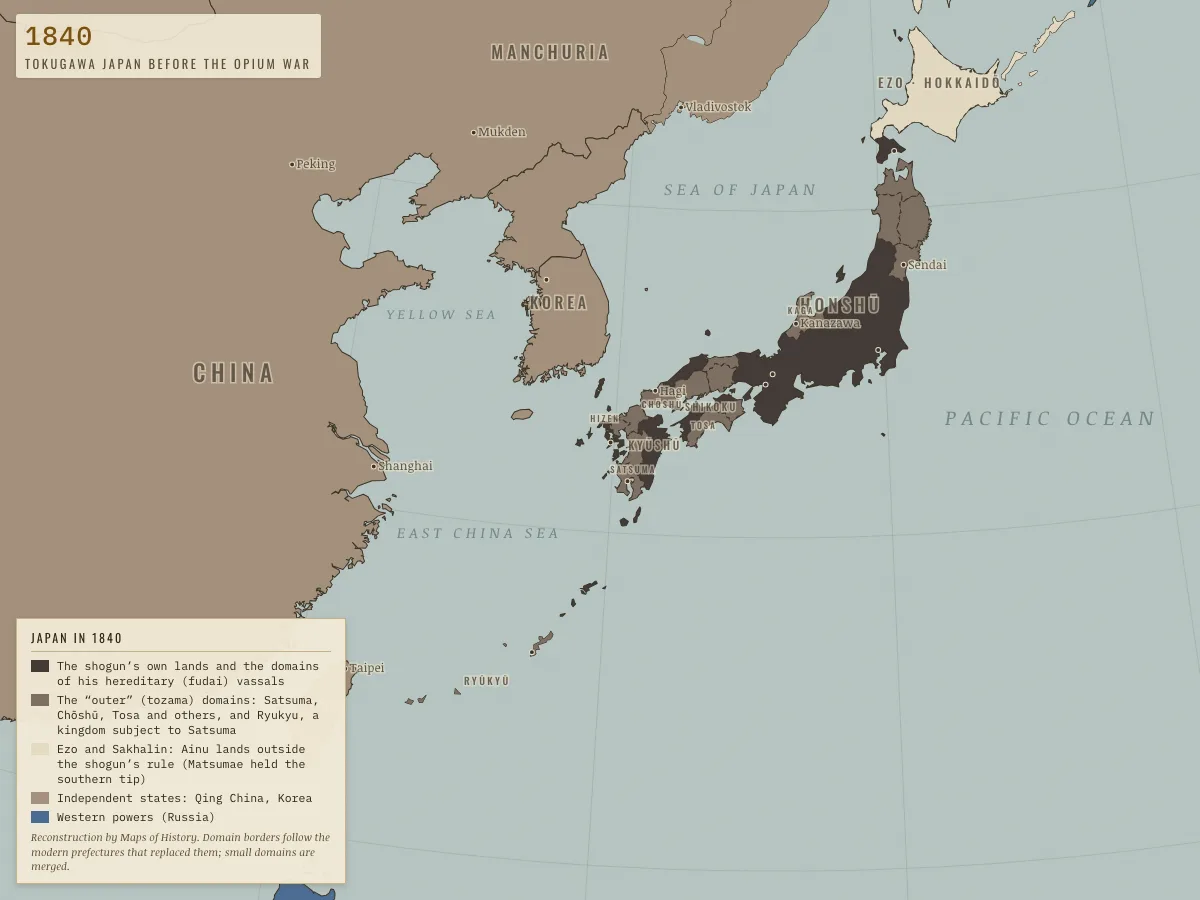
Maps of History (own work); base geography Natural Earth (public domain)
Every other source in the atlas (38)
- Chapter 2: The Black Ships
- Letter from the President of the United States to the Emperor of Japan Millard Fillmore, President of the United States · 13 November 1852 (delivered in July 1853)
- Treaty of Kanagawa (Treaty of Peace and Amity), articles 2, 9 and 11 Commodore Matthew C. Perry for the United States; Hayashi Akira and three other commissioners for the shogunate · 31 March 1854
- Treaty of Amity and Commerce (the Harris treaty), articles 3, 4 and 6 Townsend Harris for the United States; two commissioners of the shogunate · 29 July 1858
- Chapter 3: The Fall of the Shogunate
- The Eight-Point Plan (Senchū hassaku) Attributed to Sakamoto Ryōma · 1867 (traditional date)
- Memorial returning governing power to the emperor (Taisei hōkan) Tokugawa Yoshinobu, the fifteenth shogun · 14th day of the 10th month of Keiō 3 (November 1867)
- A Diplomat in Japan, chapter 24 Ernest Satow, interpreter at the British legation · Events of January 1868; book published in London in 1921
- Chapter 4: Dismantling the Old Order
- The Charter Oath (Gokajō no goseimon) Sworn by Emperor Mutsuhito; drafted by officials of the new government · 6 April 1868 (14th day of the 3rd month of Keiō 4)
- Proclamation on conscription (Chōhei kokuyu) Council of State (Dajōkan), in the emperor’s name · 28 December 1872 (28th day of the 11th month of Meiji 5)
- Before and after the abolition of the domains, August 1869 and August 1871 Maps of History · Reconstruction made in 2026
- Chapter 5: Building the Meiji State
- Memorial on the establishment of an elected assembly (Minsen giin setsuritsu kenpakusho) Itagaki Taisuke, Gotō Shōjirō, Etō Shinpei, Soejima Taneomi and four other former samurai · 17 January 1874
- The Constitution of the Empire of Japan, articles 1, 3, 4, 11, 29, 55 and 71 Promulgated by Emperor Mutsuhito; drafted under Itō Hirobumi; translated by Itō Miyoji · 11 February 1889
- Imperial Rescript on Education Emperor Mutsuhito (the Meiji emperor) · 30 October 1890
- Who could vote for Japan’s lower house, 1890–1928 Maps of History, compiled from official election figures · Chart made in 2026 from figures for 1890–1928
- Chapter 6: A Great Power
- Treaty of Shimonoseki, articles 1, 2 and 4 Itō Hirobumi and Mutsu Munemitsu for Japan; Li Hongzhang (Li Hung-Chang) and Li Jingfang (Li Ching-Fong) for China · 17 April 1895
- The Tragedy of Korea, chapter 18, “With the Rebels” F. A. McKenzie, journalist · Events of autumn 1907; book published in 1908
- Treaty regarding the Annexation of Korea to the Empire of Japan, preamble and articles 1–2 Terauchi Masatake, Japanese resident-general, and Yi Wan-yong, prime minister of Korea · 22 August 1910 (published 29 August 1910)
- The Japanese empire in August 1910 Maps of History · Reconstruction made in 2026
- Chapter 7: The Stagnant Superpower
- Soviet economic growth, 1961–1985 (CIA estimates) Maps of History, from CIA estimates · Chart made in 2026 from estimates published in the 1980s
- Speech to the Fifth Congress of the Polish United Workers’ Party (the “Brezhnev Doctrine”) Leonid Brezhnev, General Secretary of the Communist Party of the Soviet Union · 12 November 1968
- Address to the Nation on the Soviet Invasion of Afghanistan Jimmy Carter, President of the United States · 4 January 1980
- Chapter 8: Gorbachev’s Gamble
- Law of the USSR on the State Enterprise (Association), Articles 2, 6 and 10 Supreme Soviet of the USSR · 30 June 1987 (in force from 1 January 1988)
- Political Report of the CPSU Central Committee to the 27th Party Congress (on Afghanistan) Mikhail Gorbachev, General Secretary of the Communist Party of the Soviet Union · 25 February 1986
- Remarks on East-West Relations at the Brandenburg Gate in West Berlin Ronald Reagan, President of the United States · 12 June 1987
- Chapter 9: The Union Unravels
- Declaration of State Sovereignty of the Russian Soviet Federative Socialist Republic (preamble and points 5 and 7) First Congress of People’s Deputies of the RSFSR · 12 June 1990
- Remarks to the Supreme Soviet of the Republic of the Ukraine in Kiev George H. W. Bush, President of the United States · 1 August 1991
- Agreement on the Establishment of the Commonwealth of Independent States (preamble and Articles 1 and 5) Republic of Belarus, RSFSR and Ukraine; signed for Belarus by S. Shushkevich and V. Kebich, for the RSFSR by B. Yeltsin and G. Burbulis, and for Ukraine by L. Kravchuk and V. Fokin · 8 December 1991
- From one union to fifteen states: February 1988 and December 1991 Maps of History · Reconstruction made in 2026
- Chapter 10: Shock Therapy
- Decree No. 297 “On measures to liberalise prices” (points 1–2 and Appendix No. 2) Boris Yeltsin, President of the RSFSR · 3 December 1991
- Russia’s output and prices, 1990–2000 Maps of History, from World Bank and Rosstat data · Chart made in 2026 from data for 1990–2000
- Decree No. 1400 “On stage-by-stage constitutional reform in the Russian Federation” (preamble and point 1) Boris Yeltsin, President of the Russian Federation · 21 September 1993
- Constitution of the Russian Federation, Articles 80, 83 and 111 (original text of 1993) Approved by nationwide vote · 12 December 1993
- Chapter 11: A State at War with Itself
- Constitution of the Republic of Tatarstan (preamble and Articles 1, 59, 61 and 62) Supreme Soviet of the Republic of Tatarstan · 6 November 1992 (published 30 November 1992)
- Khasavyurt joint statement and “Principles for determining the basis of relations between the Russian Federation and the Chechen Republic” Alexander Lebed and Aslan Maskhadov, with S. Kharlamov and S. Abumuslimov · 31 August 1996
- The 1996 Russian presidential election Maps of History, from official results · Chart made in 2026 from the results of June and July 1996
- Chapter 12: Two Transitions Compared
- Life expectancy at birth in Russia, 1985–2000 Maps of History, from Rosstat data · Chart made in 2026 from data for 1985–2000
- Decree No. 849 “On the plenipotentiary representative of the President of the Russian Federation in a federal district” (preamble, points 1–2 and Regulation point 5) Vladimir Putin, President of the Russian Federation · 13 May 2000
- Russia at the Turn of the Millennium Vladimir Putin, Prime Minister of the Russian Federation · 30 December 1999
- Two transitions side by side: Meiji Japan and the USSR to Russia Maps of History, compiled from the atlas’s cited sources · 1868–1912 and 1985–2000
Internal Assessment starting points
Each starting point is an idea for an investigation: a question, the concept it tests, the kinds of sources you could use and where they are held, and one caution. The investigation must be your own work, and your teacher approves the question.
How did Meiji colonisation of Hokkaido affect Ainu land and livelihoods from 1869 to 1899?
CONCEPTConsequence
SOURCESReports of the Hokkaido Development Commission (Kaitakushi); the Hokkaido Former Aborigines Protection Act of 1899; travellers’ accounts such as Isabella Bird’s Unbeaten Tracks in Japan (1880); later Ainu testimony such as Kayano Shigeru’s memoir Our Land Was a Forest.
WHERE TO FIND THEMHokkaido University Library, Northern Studies Collection (digitised maps and records); National Diet Library Digital Collections (laws and official reports); Internet Archive (Bird’s 1880 edition).
CAUTIONSettlers and officials wrote most surviving documents from the period. Ainu perspectives appear mainly in oral traditions and later memoirs, so identify whose account each source offers.
According to the Iwakura Mission’s official record, what should Japan learn from the West, and for what reasons?
CONCEPTPerspectives
SOURCESKume Kunitake’s official record of the mission (1878; English translation The Iwakura Embassy, 1871–73, 2002); letters of Ōkubo Toshimichi and Kido Takayoshi; Western newspaper reports of the mission’s visits.
WHERE TO FIND THEMNational Diet Library Digital Collections (the 1878 Japanese edition); Japan Center for Asian Historical Records (JACAR) for government papers; British Newspaper Archive and Chronicling America for Western press reports.
CAUTIONKume edited the record for publication five years after the mission and had government purposes in mind. The 2002 translation is still in copyright; keep quotations brief.
Why did the Meiji government not stop pollution from the Ashio copper mine between 1890 and 1907?
CONCEPTCausation
SOURCESTanaka Shōzō’s speeches in the Imperial Diet and his petition to the emperor of December 1901; government inspection reports of 1897 and 1902; newspaper reports; farmers’ petitions.
WHERE TO FIND THEMNational Diet Library, Imperial Diet minutes database (Teikoku Gikai Kaigiroku); National Diet Library Digital Collections; for English context, Kenneth Strong’s biography Ox Against the Storm (1977).
CAUTIONMost primary sources are in Japanese. Identify translations and secondary accounts, and consider how each translator frames the dispute.
How reliable is Ernest Satow’s A Diplomat in Japan (1921) for studying the shogunate’s fall in 1867–68?
CONCEPTPerspectives
SOURCESSatow’s memoir; his diaries; British legation dispatches to the Foreign Office; Japanese accounts of the same meetings.
WHERE TO FIND THEMUK National Archives, Kew (Satow papers, PRO 30/33; Foreign Office Japan correspondence, FO 46); Internet Archive and Project Gutenberg (the 1921 text).
CAUTIONSatow drew on his diaries when writing the memoir half a century later. He was a British official who sympathized with Satsuma and Chōshū, so compare his account with documents written at the time.
What did Kuzbass miners demand during their July 1989 strike, and to what extent were those demands political?
CONCEPTCausation
SOURCESStrike committee demands and agreements with the government; Soviet central and regional newspapers; Western press and radio reports; later interviews with strike leaders.
WHERE TO FIND THEMCurrent Digest of the Soviet Press (English translations, through university libraries); Open Society Archives, Budapest (Radio Free Europe/Radio Liberty Research Institute files); Wilson Center Digital Archive.
CAUTIONGlasnost changed the Soviet press in 1989. Compare local with central reporting and consider when each report appeared.
Why was Tatarstan’s sovereignty claim settled by treaty in 1994 while Chechnya went to war?
CONCEPTCausation
SOURCESThe declarations of sovereignty of 1990–91; the 1992 Tatarstan constitution and the treaty of 15 February 1994; Russian presidential decrees; speeches of Mintimer Shaimiev, Dzhokhar Dudayev and Boris Yeltsin; reports by Human Rights Watch and Memorial.
WHERE TO FIND THEMRussian Wikisource and official legal databases for the texts; Open Society Archives, Budapest (RFE/RL files); the Memorial archive (published reports); Human Rights Watch online report archive.
CAUTIONGeography, economy and population matter alongside the leaders’ choices. When examining decisions in 1991, do not assume that the 1994 war was inevitable.
To what extent do regional results of the 1996 presidential election reveal a divide between reform and communist Russia?
CONCEPTSignificance
SOURCESOfficial regional and district results of both rounds; campaign materials of Yeltsin and Zyuganov; Russian and Western press reports; opinion polls of 1996.
WHERE TO FIND THEMCentral Election Commission of the Russian Federation (published results); Russian Election Watch (Belfer Center, Harvard University); Open Society Archives, Budapest.
CAUTIONObservers questioned sharp changes between rounds in some regions. Before using the returns as a measure of opinion, check claims of irregularity against regional data.
Revision tools
The atlas ends with a map quiz that asks you to find places and moments on the map itself (part of every plan from Starter up). The quick quiz and the discussion questions with our answers are free pages on this site, and the printable study guide gathers every chapter’s notes into one document for revision.
Read next
- Japan’s industrialisation from above · THE INDUSTRIAL REVOLUTION
- The Cold War that ended with the Soviet Union · THE COLD WAR
Maps of History is independent and is not affiliated with or endorsed by the International Baccalaureate Organization. IB course names describe alignment only; paper, theme and section names follow the new course outline and may change when the final guide is published.
THE DISPATCH
Get the printable study guide for Remaking the State free. I’ll send you a few short letters, then one when a new atlas opens. That’s all. — Paul
NO TRACKING · YOUR ADDRESS IS USED FOR THE DISPATCH AND NOTHING ELSE · UNSUBSCRIBE ANYTIME