Cold War · CHAPTER 10 ·
Afghanistan and the Second Cold War
Chapter 10 of The Cold War, 1945–1991: “The Second Cold War”
In December 1979 the Soviet Union invaded Afghanistan to rescue a failing communist government, starting a nine-year war and ending détente. Soviet SS-20s and NATO’s Pershing II and cruise missiles raised tension in Europe, and in November 1983 Soviet intelligence read the Able Archer exercise as possible cover for an attack.
Chapter 10 is included with every paid plan. WW2 is free in full, and chapter 1 of every atlas is free. A free account opens 3 more chapters a day. Starter, at $9 a month, opens all 21 with no daily limit — see the plans.
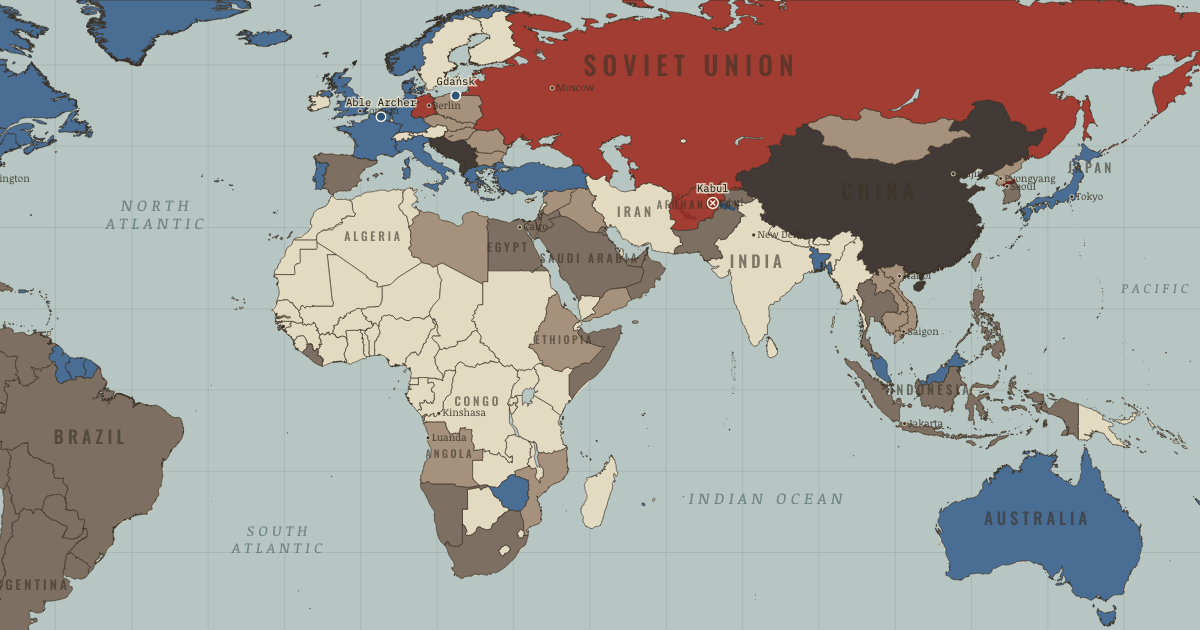
The map above is the world of The world, December 1979 — The year of the shocks.
Every state on the map that year: The world in 1980 · Europe in 1980.
Part of IB History: The Cold War →
SHORT EXPLANATION
The end of the 1970s brought renewed confrontation. Revolutions in Iran and Nicaragua removed governments allied with the United States. Then, in December 1979, Soviet troops entered Afghanistan to rescue a communist government threatened by revolt. What Moscow hoped would stabilize its client became a nine-year war, killing many Afghans and driving millions abroad.
In Europe, Soviet and NATO missiles became the focus of a dangerous competition. Reagan increased defense spending and proposed missile defenses, while Soviet leaders feared a surprise attack. NATO’s Able Archer exercise in November 1983 took place in that atmosphere. It showed how preparations meant to deter an enemy could be read by that enemy as preparations to attack.
The full story
Afghanistan’s communist party took power in 1978 without a Soviet invasion. Its leaders imposed land and literacy programs on a rural, religious society through coercion and executions, helping provoke a revolt that threatened their government. They asked Moscow for troops. Soviet leaders refused repeatedly: Kosygin warned that “we would be fighting the people.” Yet the prospect of losing the client, and concern after Iran’s revolution about Islamist influence reaching Soviet Central Asia, eventually outweighed those objections. In December 1979 Soviet troops entered Afghanistan.
The intervention failed to bring the quick stabilization Moscow wanted. It became a nine-year war in which estimates of Afghan deaths range from roughly half a million to two million, with many studies near one million; about five million people fled abroad. The United States and its allies supplied the resistance through Pakistan. Washington treated the invasion as a wider strategic threat and answered with a grain embargo, an Olympic boycott and the shelving of an arms-control treaty. Détente had given way to confrontation.
A separate contest over missiles made Europe more dangerous. Soviet SS-20s and NATO’s planned Pershing II and cruise missiles were each presented as answers to a threat, yet each gave the other side another reason to fear attack. Reagan’s military buildup and Strategic Defense Initiative also challenged Moscow to compete in costly technology. Soviet intelligence was already searching for signs of a surprise strike when NATO held the Able Archer exercise in November 1983. The alarm passed without war, but the episode helped convince Reagan that Soviet fear was real. His later engagement must be understood alongside the pressure he had applied.
The Afghan war reached Soviet families as well. The official count recorded about 15,000 Soviet deaths; some post-Soviet researchers suggest a figure approaching 26,000. Tens of billions of rubles were spent, and coffins returned to a public given little information about the fighting. The war also helped foster transnational militant networks whose consequences extended beyond Afghanistan. Gorbachev called it “the bleeding wound” in 1986, and Soviet withdrawal was completed in February 1989.
FULL EXPLANATION
Why leaders entered a war they feared
The Afghan communists’ seizure of power in 1978 did not require Soviet troops. Their rival factions then imposed rapid reforms by force, provoking resistance across a rural and religious society. Moscow knew what intervention might entail: Soviet records show that leaders understood they could be fighting much of the population, and Kosygin argued against sending troops. Requests were refused repeatedly. Why, then, did they enter? The regime they supported appeared close to collapse, while revolution in Iran sharpened fears of Islamist unrest spreading into Soviet Central Asia. Abandoning Kabul seemed to threaten Soviet security and credibility; trying to save it meant accepting dangers the leaders already understood. This is the predicament of entrapment. Washington interpreted the invasion as a possible drive toward the Gulf and expanded support for the mujahideen. That assistance did not create Afghan resistance, but it strengthened and prolonged it. The war drained Soviet finances and legitimacy, and its weapons and militant networks helped shape conflicts long after the Cold War.
Pressure, paranoia and the missing exit
Reagan’s buildup and Strategic Defense Initiative can be understood as pressure on a weaker Soviet economy. By confronting Moscow with a contest it could not readily sustain, they may have strengthened the position of reformers. But the same years also show why pressure was dangerous. Soviet warning systems were primed to detect a first strike in 1983, when Korean Air Lines flight 007 was destroyed, false alarms occurred and NATO held Able Archer. Archival evidence establishes that Soviet fear was real; historians still debate how close the exercise came to a Soviet response. Reagan began moving toward engagement before Gorbachev took power, and later used summits and arms reductions to reach agreements with him. That sequence matters. Pressure could change Soviet calculations, but without communication and an acceptable route to concession it could also deepen an adversary’s sense of threat. No single instrument accounts for the outcome.
Key places on the map
On this day
Why it happened
Afghanistan: the trap of the client state. Kabul’s communists seized power in 1978 on their own, then imposed land and literacy reforms by force. Their policies helped ignite resistance in a deeply rural and religious society. The Politburo repeatedly refused requests to intervene, and Kosygin warned that “we would be fighting the people.” Nevertheless, the client regime looked close to collapse. After the Iranian Revolution, Soviet leaders also feared Islamist influence spreading into Soviet Central Asia. The recognized costs of intervention did not remove their fear of abandoning Kabul. Washington saw the invasion in global strategic terms and increased support for Afghan resistance.
The Euromissile spiral, a security dilemma in miniature. The mobile, accurate SS-20s that Moscow began deploying in 1977 could reach Europe. Soviet leaders presented them as modernization, but Europeans had to consider whether America would risk an American city to defend a European one. NATO planned Pershing II and cruise missile deployments while offering negotiations. Large protests followed, yet deployment went ahead in 1983 and Moscow left the missile talks. Each side’s response to its own security problem sharpened the other’s fear. Chapter 11’s INF Treaty would eventually remove an entire class of missiles, showing how the contest could be resolved.
Reagan’s buildup: bankrupting strategy or dangerous bluff?. Reagan’s buildup and Strategic Defense Initiative posed an expensive challenge to a Soviet economy already estimated to devote perhaps 15–20% of GDP to defense, though that share is difficult to measure. The prospect of a technological race may have strengthened the case for reform. But pressure also operated in a climate of fear. Andropov’s government considered a first strike possible; the Soviet shootdown of civilian airliner KAL 007 over Sakhalin in September 1983 and Able Archer followed amid that anxiety. Reagan was shaken by the war scare and by The Day After. In January 1984 he moved publicly toward negotiation, declaring that “a nuclear war cannot be won and must never be fought.” Both the possible effect on reform and the danger require attention.
Solidarity: the crack that martial law painted over. At Gdańsk, workers organized independently against a state that claimed to represent labor. Jaruzelski imposed martial law on 13 December 1981 and imprisoned Solidarity leaders. The union survived underground, assisted by networks including the AFL-CIO and the Vatican. Its survival kept an organized opposition in being despite the suppression, and challenged the government’s claim to speak for workers. When Round Table negotiations began in 1989, Solidarity was there to participate.
THE TURNING POINT
Able Archer 83, 2–11 November 1983. From 2–11 November 1983, NATO practiced escalation in Able Archer 83, using procedures that included new codes and radio silence. Soviet intelligence had been ordered to look for indications of a Western first strike. Seen through that expectation, an exercise could appear to be preparation for an actual attack; some Warsaw Pact aircraft were placed on alert. The exercise ended without war. Historians dispute how close it came to a Soviet military response, but the fear itself was real. Reagan later wrote, “I feel the Soviets are so defense-minded, so paranoid…” His subsequent pursuit of engagement responded in part to that climate.
What it changed
Afghanistan bleeds the metropole. Afghanistan consumed Soviet lives and resources. The official military death toll was about 15,000; some post-Soviet researchers suggest it may approach 26,000. The war cost tens of billions of rubles, and coffins returned to a public told little about the fighting. It helped arm and train militant networks with consequences beyond Afghanistan. For Gorbachev, the conflict demonstrated the burden of commitments the Soviet Union struggled to sustain. He called it “the bleeding wound” in 1986; withdrawal ended in February 1989.
The peace movements change the audience. Nuclear weapons also brought citizens into the argument. Protesters filled streets in Bonn, London, Amsterdam and New York; the June 1982 New York rally was among the largest demonstrations in American history. They did not prevent the 1983 deployments, but they made nuclear danger a mass political issue and built support for arms control. NATO’s “dual-track” decision had already paired deployment plans with an offer to negotiate. Later, Western publics gave Gorbachev’s proposals an audience beyond governments.
The economics arrive on schedule. Military competition added to economic troubles that had begun earlier. Soviet growth was slow, grain had to be imported, and its computers lagged behind Western technology. Oil exports had supplied valuable revenue during Brezhnev’s stagnation, but in 1986 prices fell from around $30 toward $10 a barrel. Gorbachev had come to power in March 1985, aged 54, believing reform was possible. The new pressure made the existing economic problem harder to evade.
DISCUSSION QUESTION — Did Reagan’s pressure end the Cold War, or nearly end the world?
Reagan’s pressure could affect Soviet choices in more than one way. The buildup and SDI presented leaders with a costly technological contest; Politburo records show alarm about competing with American technology, and that contest may have strengthened arguments for reform. But RYaN, KAL 007 and Able Archer also reveal a climate in which pressure could intensify fear. Reagan had written privately to Soviet leaders as early as 1981 and moved publicly toward engagement in January 1984, before Gorbachev took office. Later summits and arms reductions offered a way to turn reassessment into agreement. The outcome depended on communication and on a Soviet leader willing to pursue reform as well as on pressure.
An interesting fact
The autumn of 1983 had a second near-miss before Able Archer. On 26 September, Lieutenant Colonel Stanislav Petrov was on duty in a bunker south of Moscow when the new Oko satellites reported five incoming American ICBMs. He judged the warning a “false alarm”: a real first strike seemed unlikely to begin with five missiles, and ground radar showed nothing. Sunlight reflecting from high-altitude clouds had confused the satellites. His decision remained secret until the 1990s; he died in 2017, almost unknown in his own country.
Related
THE FREE PRINTABLE STUDY GUIDE
Get the printable study guide for The Cold War free. I’ll send you a few short letters, then one when a new atlas opens. That’s all. — Paul
NO TRACKING · YOUR ADDRESS IS USED FOR THE DISPATCH AND NOTHING ELSE · UNSUBSCRIBE ANYTIME