Chinese Revolution · CHAPTER 5 ·
Shanghai purge and Nanjing decade
Chapter 5 of China in Revolution, 1911–1949: “The Purge and the Nanjing Decade”
In April 1927 Chiang Kai-shek’s forces and allied gangsters attacked Communists and unionists in Shanghai, ending the First United Front and driving the Communists into the countryside. Chiang completed the Northern Expedition in 1928, and Nanjing built banks, laws and industry, but its reach stayed narrow.
Chapter 5 is included with every paid plan. WW2 is free in full, and chapter 1 of every atlas is free. A free account opens 3 more chapters a day. Starter, at $9 a month, opens all 21 with no daily limit — see the plans.
Free printable Chinese Revolution study guide, sent by email ↓
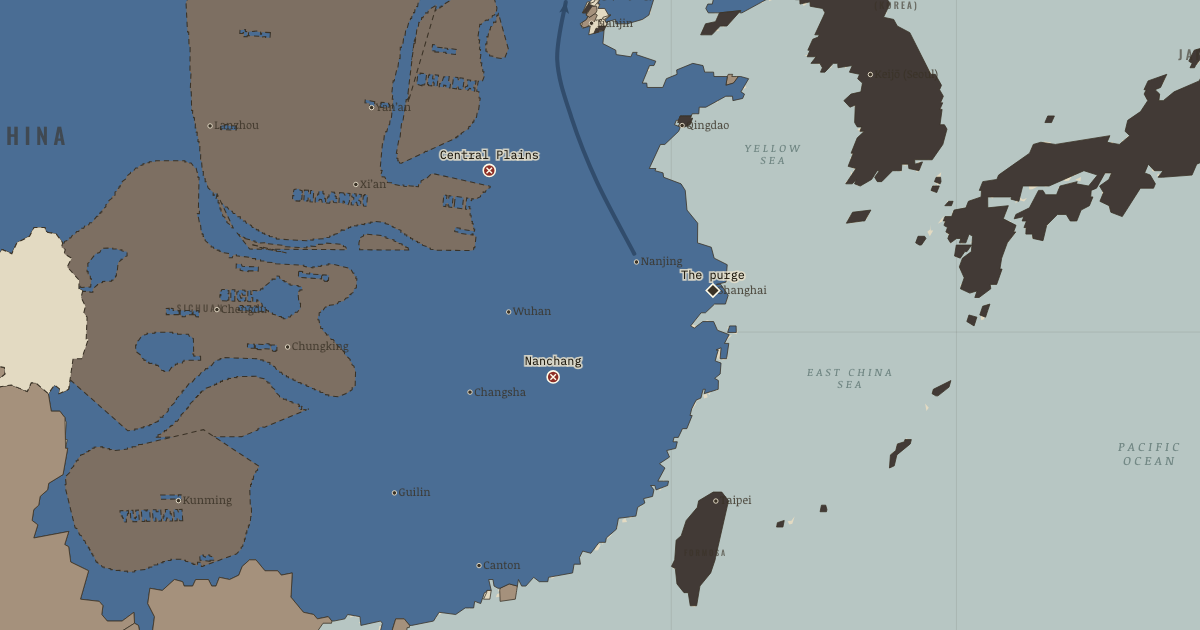
The map above is the world of China, 1928 — Peking taken — nominal reunification.
Every state on the map that year: The world in 1930 · Europe in 1930.
Part of IB History: China in Revolution →
SHORT EXPLANATION
Chiang Kai-shek broke the First United Front in April 1927, when his forces and allied gangsters attacked Shanghai’s Communists and unionists. Failed uprisings, including one at Nanchang, sent survivors toward rural bases. There the movement would acquire a different social and military footing.
The Northern Expedition reached Peking in 1928, and Zhang Xueliang raised the Nationalist flag in Manchuria after Japanese officers murdered his father. Yet regional commanders retained power under the new national government. Nanjing built banks, laws, universities and industry, while its narrow reach and heavy military spending left it vulnerable to Japan.
The full story
The Nanjing Decade, the Nationalists’ main period of state-building from 1927 to 1937, began by destroying the alliance that had helped bring them to power. On 12 April 1927 Chiang Kai-shek’s forces turned on Communists and unionists in Shanghai (the ◆). National Revolutionary Army soldiers and Green Gang enforcers killed hundreds that morning; thousands more were killed across the south in the following weeks. The First United Front broke as the Northern Expedition approached victory.
In August, Communist-led regiments seized Nanchang (the ✕) and held it for three days. The rising failed, although the People’s Liberation Army still dates its founding from it. Survivors under Zhu De moved toward the hills. The party had lost the coastal cities in which it had begun, and the countryside offered a very different setting for the struggle that followed. After years of catastrophe, the Communists would find there a strategy that eventually brought them victory.
The Northern Expedition reached Peking in 1928, carrying the blue of the Nationalist map to its northern edge. Manchuria joined the new order in an unexpected way. Officers of Japan’s Kwantung Army dynamited the train of their own Manchurian client, Zhang Zuolin, outside Mukden at Huanggutun (the ●). They had preferred him dead to defeated, but his son Zhang Xueliang raised the Nationalist flag that December.
The flag did not give Nanjing control over every commander who flew it. Yan Xishan retained Shanxi, Feng Yuxiang the northwest, and the Guangxi generals the far south. In 1930 they fought Chiang in the Central Plains War (the ✕ at Zhengzhou), the era’s largest struggle, involving roughly a million men. Chiang won partly by paying to bring Zhang Xueliang’s army to his side.
Chiang’s strongest governing base lay in the lower Yangtze. There the government built a central bank, legal codes, universities and the beginnings of industry. It also relied on gangster finance, ran chronic deficits, spent heavily on the army and had removed the party’s own mobilizing wing. The state’s achievements were real, but its reach was narrow. Given twenty years, it might have built a durable state; Japan moved in 1931, four years after the decade began, and invaded on a much larger scale in 1937.
FULL EXPLANATION
The White Terror in numbers
The destruction of the urban movement can be seen in its numbers. In Shanghai on 12 April 1927 and across the Nationalist south in the following weeks, Nationalists and Green Gang allies killed thousands of unionists and Communists. CCP membership, perhaps 58,000 early in 1927, fell to around 10,000 within a year. A union network built over a decade was effectively destroyed. The party that reassembled in the hills was consequently younger, more rural and more military. Historians dispute how much responsibility belongs to Stalin: Moscow had ordered the Communists to remain disarmed inside the alliance, then supported failed risings at Nanchang and Canton. Whatever weight those decisions receive, terror destroyed the urban organization and forced the movement to find another setting.
The consequences of impunity
Zhang Zuolin was a client of Japan’s government, yet Kwantung Army officers killed him at Huanggutun in 1928. Tokyo failed to bring the principal perpetrators to effective account. That failure mattered to officers considering future action: they could see that presenting civilian authorities with an accomplished fact might carry little cost. The journalist Hugh Byas called the wider pattern “government by assassination.” Historians trace a chain from Huanggutun through the Mukden Incident of 1931 to officers’ murders and attempted coups in 1932–36. Civilian ministers who resisted were among those shot. Each unpunished act could make further insubordination seem safer. This history helps explain both the difficulty of civilian control and the seizure of Manchuria in Chapter 6, without making later decisions inevitable.
Key places on the map
On this day
Why it happened
Class conflict within the alliance. The United Front joined a revolution to an army whose officers and supporters came in part from landlord and merchant families. Peasant associations and Shanghai unions acted against those same interests: they were doing the work of the alliance’s left wing. By spring 1927 Chiang chose to protect his army’s social allies against the Communist-led revolution. The Green Gang helped enforce that choice; its labor rackets had themselves been challenged by the unions.
Moscow and the failed risings. Stalin had committed himself to the Chinese alliance in his struggle with Trotsky. Moscow consequently told the CCP to remain in the United Front until the last moment. Once the alliance had broken, it called for insurrections at Nanchang, in the Autumn Harvest risings and in the Canton Commune of December 1927. All failed, and the party lost cadres it could scarcely spare. Moscow took defeats as reasons for further risings. Historians disagree about the relative weight of its decisions and Chinese conditions; the cost was borne in China. Mao’s later distrust of imported strategy grew from this experience and his work in the countryside.
Reunification by agreement. The 1928 settlement gave Nanjing national allegiance without requiring Yan, Feng or the Guangxi clique to surrender their provinces and armies. Zhang Xueliang’s decision also defied his father’s Japanese patrons. Such agreements extended Chiang’s authority, but left other commanders able to resist him. When Nanjing tried to demobilize regional armies at the 1929 conference, the dispute helped lead to the Central Plains War. Japan would test the resulting weakness in 1931.
The Kwantung Army and impunity. The officers who killed Zhang Zuolin at Huanggutun had acted against their own government’s client. Tokyo failed to punish the principal perpetrators effectively. An activist in the Kwantung Army could see that a completed action in Manchuria might escape civilian control without costing its authors their positions. In September 1931 the army acted there again, on a much larger scale.
THE TURNING POINT
Shanghai, 12 April 1927. Chiang’s victory in Shanghai settled the immediate struggle inside the alliance, but it also shaped the next twenty-two years of Chinese politics. The purge helped make civil war central, drove Communist survivors toward the countryside where their eventual winning strategy developed, and tied the Nationalist state more closely to banks, gangs and landlords whose interests constrained reform. The terms of victory helped determine the struggle to come.
What it changed
The revolution goes rural. The survivors found refuge where provincial authority was weak: first in the mountains of Jinggangshan, then on the Jiangxi–Fujian border. Mao and Zhu De began to combine land revolution, guerrilla war and government in base areas. The next chapter follows their experiment.
A decade of real, brittle state-building. The government recovered tariff autonomy in 1928–30, built roads and a modern capital, and established a new currency. Its finances still depended on the Yangtze delta and rural tax-farming. Lloyd Eastman stresses faction, debt and repression; revisionists emphasize modernization achieved under severe pressure. Chapter 12 returns to the evidence for both accounts.
Manchuria becomes the fuse. By joining Nanjing, Zhang Xueliang placed Manchuria under a government pledged to recover treaty rights on which Japanese interests depended. The Kwantung Army had both a stake in the region and an example of officers escaping effective punishment. Its seizure of Manchuria follows in the next chapter.
DISCUSSION QUESTION — Was the Nanjing decade a real modernization interrupted, or a weak state exposed by Japan?
Lloyd Eastman’s The Abortive Revolution finds the seeds of destruction in the purge of idealists, factional bargains, chronic deficits, tax authority that stopped at the county town and reunification purchased from warlords. Revisionists look instead at the Maritime Customs, the fabi reform, legal codes and universities. They argue that, despite civil war and Japanese pressure, no Chinese government since the 1830s had recovered so much sovereignty or built administrative machinery so quickly. Both accounts capture something essential. Modernization was real, particularly around Shanghai, but reached few of the villages where about four-fifths of Chinese lived. The CCP was building a rival state in those villages. Seen as a contest between two incomplete states, Nanjing was losing the countryside before it lost a city to Japan. Its achievement matters; so does the question of whom it reached.
An interesting fact
In November 1935 Nanjing nationalized silver and introduced a managed paper currency, the fabi. For centuries Chinese money had been, in effect, weighed metal. The United States Silver Purchase Act of 1934 had driven up silver prices, drawn coin out of China and squeezed credit. With British advice, the government replaced it with notes that gained broad acceptance within months, while prices initially stabilized. A decade later, money printed to finance war contributed to the hyperinflation of 1947–49. The currency that helped solve one crisis became part of another.
Related
THE FREE PRINTABLE STUDY GUIDE
Get the printable study guide for China in Revolution free. I’ll send you a few short letters, then one when a new atlas opens. That’s all. — Paul
NO TRACKING · YOUR ADDRESS IS USED FOR THE DISPATCH AND NOTHING ELSE · UNSUBSCRIBE ANYTIME