Mongol Empire · CHAPTER 7 ·
How the Mongol Empire was governed
Chapter 7 of The Mongol Empire, 1206–1294: “The Machinery of Empire”
By the 1250s a small Mongol ruling class governed tens of millions of people through the yam relay of staffed stations, regular censuses and paiza tablets of authority. Most daily administration was left to local rulers, clerks and religious institutions, while Karakorum gathered specialists and envoys from across Eurasia.
Chapter 7 is included with every paid plan. WW2 is free in full, and chapter 1 of every atlas is free. A free account opens 3 more chapters a day. Starter, at $9 a month, opens all 21 with no daily limit — see the plans.
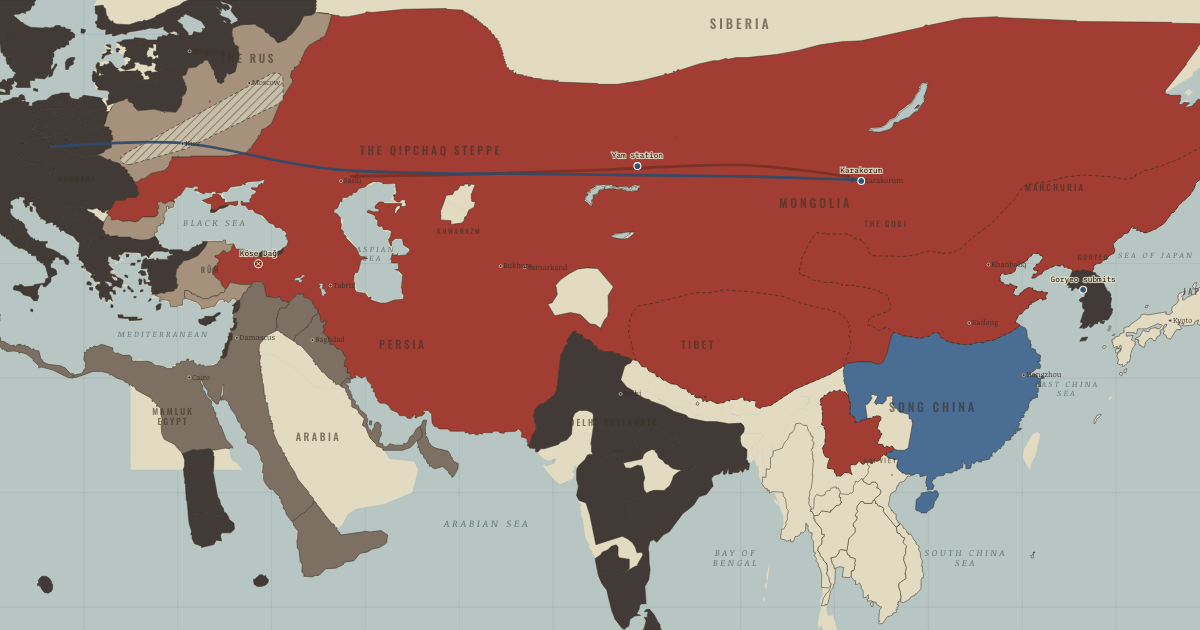
The map above is the world of The Mongol Empire, 1254 — The empire of Möngke.
Part of IB History: The Mongol Empire →
SHORT EXPLANATION
By the 1250s, Mongol rulers faced a problem their armies alone could not solve: how could a small ruling class govern tens of millions of people across Eurasia? Censuses identified households and their obligations, the yam connected relay stations, and a paiza authorized its bearer to demand transport and supplies.
Local rulers, clerks and religious institutions carried out much of the daily work. Cooperation saved the expense of garrisons, while the memory of massacre made refusal dangerous. Karakorum brought envoys and specialists from across Eurasia together; some sought opportunity there, while others had been taken from conquered lands.
The full story
A Mongol army could conquer a city, but it could not station soldiers in every settlement across Eurasia. The empire needed another way to issue orders and collect resources. It kept control of important routes and used institutions already operating among the conquered. Censuses counted households, herds and labor obligations. A paiza, or tablet of authority, identified a bearer as someone acting for the khan.
Those documents mattered on the yam, the network of relay stations along major roads. Each station needed horses, fodder and staff before a protected messenger could change mounts and continue. Local communities had to provide supplies, sometimes willingly and sometimes under pressure. The speed of imperial communication therefore depended on the empire's ability to extract resources along the route.
Karakorum, small beside the lands it directed, displayed the reach of this system. Muslims, Christians, Buddhists and other communities lived at court alongside artisans taken from conquered lands. Clergy who prayed for the khan and steadied their communities received tax exemptions; their cooperation could cost less than maintaining garrisons. Administrators such as Yelü Chucai argued that farming people could yield taxes if their land was not cleared for pasture. Later sources sharpen the famous story of his calculations, but the policy choice was real.
These arrangements followed conquest rather than replacing it. Korea negotiated submission as a client, while censuses imposed on the Rus lands enabled enforced extraction. The center could send orders over great distances, yet regional rulers still had room to interpret them. Indeed, the routes that connected the empire also helped its eastern and western branches build effective governments of their own.
FULL EXPLANATION
Delegation and its costs
A household might deal with a local prince, magistrate, tax farmer or member of the clergy and rarely encounter an ethnic Mongol official. These intermediaries sent revenue and services upward, but they could also use imperial backing against their own rivals. Delegation made government cheaper for the center and gave local elites a reason to participate. It also created a problem of control. Tax farmers had incentives to demand more than the court intended, and people with relay privileges often abused them. Great khans issued repeated reforms because the agents needed to collect resources could themselves impose burdens that threatened the system. Cooperation had to remain more useful to local rulers than rebellion, while the threat behind imperial orders had to remain credible.
Connections under coercion
People came to Karakorum for different reasons. Merchants and envoys could seek opportunity or conduct diplomacy; captives and requisitioned specialists had far less choice. Guillaume Boucher, the Parisian goldsmith associated with the silver fountain, had been seized in Hungary. His work at court was part of the empire's exchange of skills, and his journey there was a result of conquest. Religious variety likewise had political conditions. Faiths could operate while recognizing the khan's authority. Roads, safe-conducts and a broad labor market encouraged exchange, but conquest shaped who moved, who was compelled to work and who paid for the connections. To understand the court, we have to see both the opportunities the network created and the coercion on which it rested.
Key places on the map
On this day
Why it happened
Steppe practices on a larger scale. The Mongols adapted familiar steppe practices to an empire containing agricultural societies. Changing horses along a route became the yam; census rolls extended the decimal army's muster lists; and the paiza enlarged the use of a chief's safe-conduct token. Scale also required skills from conquered peoples. Khitan clerks, Uyghur scribes, Persian tax farmers and Chinese engineers filled different roles, and the Uyghur alphabet supplied a script for Mongol.
Religious communities and the court. The court allowed religious communities room to operate under the khan's authority. Exempting clergy from taxes gave them an interest in Mongol peace, and prayers for the khan acknowledged the power that protected them. Rubruck described a Christian–Muslim–Buddhist debate at court; he admitted that his own side fared poorly once the drinking began. The encounter shows both the variety present at court and the imperial setting in which it met.
The memory of conquest. The census taker did not arrive in a city untouched by the army. Massacres had shown what resistance could bring, and fear had already persuaded other cities to open their gates to Genghis. A demand for cooperation carried that history with it. The Mongols could use fewer garrisons partly because the threat behind their officials was credible.
THE TURNING POINT
The fountain at Karakorum. A silver fountain at Karakorum brought distant parts of the empire into one object. Guillaume Boucher, a Parisian artisan seized during the Hungarian catastrophe, built courtly wonders for the khans at the Orkhon, where they were crowned. Envoys from Lyon, Baghdad, Kiev and Hangzhou entered the same court. Regions once connected through chains of middlemen could meet there directly, although conquest had compelled some of the people who made that meeting possible.
What it changed
Routes and exchange. Imperial authority over routes, backed by the census, yam and paiza, helped bring much of the Silk Road under one jurisdiction. Stations supplied travelers whose authority could be recognized along the way. Chapter 12 follows other movement made possible by connected routes: the Polos' journey, the spread of technologies and the pathogen that followed.
Clients use imperial support. Local rulers could use the empire for their own purposes. Rus princes, Seljuk sultans and Korean kings competed to be useful to khans who could support their succession claims. Moscow later rose as a chief tax collector, while the Goryeo royal family survived through marriage ties with the Mongols. Imperial rule endured partly because such clients could see advantages in it.
A prize for rival branches. Möngke's audits drew authority toward the center even as the family's branches put down regional roots: Jochids on the Volga and Toluids in China and Persia. When he died at Diaoyu, his brothers were campaigning in Syria and China. The centralized system offered no procedure for two centers of authority, and control of its machinery became a prize in the succession struggle.
DISCUSSION QUESTION — A million rulers, a hundred million ruled: how could such a small Mongol ruling group govern so many people?
Mongol rulers did not administer every household themselves. Local officials and rulers collected revenue and managed daily life; imperial authorities controlled routes, censuses, appointments and military punishment. Trade protection and religious exemptions gave some groups reasons to cooperate, while fear made defiance dangerous. The small ruling group governed through many intermediaries.
An interesting fact
In 1846, a silver paiza was found near Minusinsk in Siberia; it is now in the Hermitage. The later Yuan-era tablet has lettering inlaid in gold: “By the strength of Eternal Heaven, may the name of the Khan be holy; whoever does not revere it shall be killed and die.” A bearer presented authority and a threat together, in words intended to command respect across the empire.
Related
THE FREE PRINTABLE STUDY GUIDE
Get the printable study guide for The Mongol Empire free. I’ll send you a few short letters, then one when a new atlas opens. That’s all. — Paul
NO TRACKING · YOUR ADDRESS IS USED FOR THE DISPATCH AND NOTHING ELSE · UNSUBSCRIBE ANYTIME