Cold War · CHAPTER 7 ·
Vietnam War
Chapter 7 of The Cold War, 1945–1991: “Vietnam”
After France’s defeat at Dien Bien Phu in 1954, Vietnam was divided at the 17th parallel, and the US moved from sending advisers to bombing and more than half a million troops. The Tet Offensive of January 1968 failed militarily but undercut official claims that victory was near, and Indochina turned communist in 1975.
Chapter 7 is included with every paid plan. WW2 is free in full, and chapter 1 of every atlas is free. A free account opens 3 more chapters a day. Starter, at $9 a month, opens all 21 with no daily limit — see the plans.
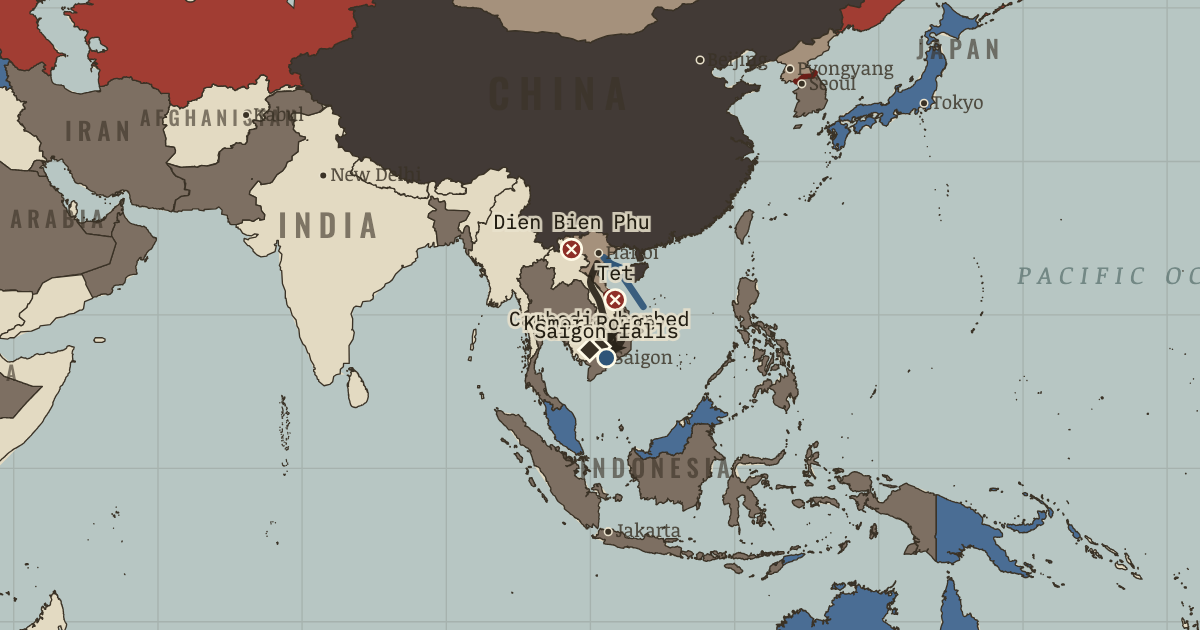
The map above is the world of The world, August 1968 — The communist world splits.
Every state on the map that year: The world in 1970 · Europe in 1970.
Part of IB History: The Cold War →
SHORT EXPLANATION
France lost its colonial war at Dien Bien Phu in 1954. Vietnam was divided at the 17th parallel while reunification awaited elections; those elections never took place. The United States began with advisers and eventually committed more than half a million troops and sustained bombing to the South. Its leaders feared that defeat there would make American promises elsewhere less believable. They faced a movement in which communism and the struggle for Vietnamese independence were joined.
The Tet Offensive in 1968 revealed how far the fighting remained from the victory Washington had described. Communist forces lost heavily, but their attacks reached cities throughout the South. American withdrawal took seven more years, and the war spread into Cambodia with catastrophic consequences. Indochina became communist in 1975; the wider Southeast Asian collapse predicted by the domino theory did not occur.
The full story
France’s defeat at Dien Bien Phu in 1954 ended its colonial war, but it did not settle Vietnam’s future. The country was divided pending elections for reunification, and those elections were never held. As American involvement grew, officials saw the survival of South Vietnam as evidence on which allies elsewhere might judge US promises. A retreat could therefore seem dangerous well beyond Vietnam. This concern made further commitment attractive even when successive governments in Saigon failed to establish broad allegiance among the people they claimed to govern.
The struggle on the ground presented a different problem. The United States could bring immense firepower against forces that regarded the war as a fight for national survival. Hanoi endured devastating losses and kept fighting. In January 1968 communist troops attacked cities across the South in the Tet Offensive. They were badly depleted, yet the scale of their attacks was difficult to reconcile with repeated American assurances that victory was near. Washington began to move toward withdrawal, a process that would take years; bombing and intervention meanwhile spread into Cambodia and helped destabilize it before Khmer Rouge rule.
The way American leaders understood Vietnam helps explain their commitment. The domino theory placed it within a contest against Moscow and Beijing, but communism was part of a Vietnamese nationalist movement. Ho Chi Minh had led resistance first to Japan and then to France for thirty years; his 1945 declaration of independence quoted Jefferson. Kennan and de Gaulle were among those who warned against intervention. De Gaulle told Americans, “you will sink step by step into a bottomless quagmire”. The credibility doctrine associated with NSC-68 pointed the other way: even a marginal commitment seemed hard to abandon if withdrawal anywhere put American resolve everywhere in doubt. Proving that America would fight became a purpose of the war itself.
The human cost was immense. Estimates commonly put Vietnamese military and civilian deaths at 1.5–3.6 million across both zones; hundreds of thousands also died in Laos and Cambodia before the Khmer Rouge’s toll, and 58,220 Americans died. Agent Orange damaged ecosystems, and unexploded ordnance still kills. In the United States, the war helped bring an end to the draft, prompted the War Powers Act, strained the Great Society budget and left a “Vietnam syndrome” that constrained intervention for a generation. On the same battlefield, communism won its costliest victory and containment suffered its costliest defeat.
FULL EXPLANATION
Why credibility could not replace legitimacy
To American leaders, leaving South Vietnam threatened more than the loss of one ally. They feared that other allies would read withdrawal as evidence that no US guarantee could be trusted. Credibility came to look like a single asset that could be spent in any one confrontation. Once Americans had paid heavily in Vietnam, those sacrifices became another reason to continue: leaving would seem to make them futile. But a promise to defend a government could not by itself make that government command lasting allegiance. In South Vietnam, coups, repression, stalled land reform and dependence on foreign support weakened the state. Its opponents combined communist organization with a longer anti-colonial struggle. This does not make the northern regime benign or its victory inevitable. It does help explain why superior American resources failed to produce the political result Washington wanted. Korea supplies a useful contrast. An armistice there left a defensible state behind a bounded line. Vietnam offered no equally stable limit to the commitment needed to sustain an independent non-communist South. Credibility could explain why Washington stayed; it could not supply the legitimacy on which the desired state depended.
A battlefield defeat with political force
The immediate military result of Tet was clear. Communist forces failed to hold the major cities, and the Viet Cong suffered losses from which it never fully recovered. American and South Vietnamese forces won that contest. Why, then, did the offensive matter so much politically? For years officials had overstated progress. Americans had been assured that victory was drawing near, yet communist forces could still strike across the South. Television did not create this gap between the government’s account and the war; the offensive exposed it. A strategy requiring continued public consent became harder to sustain when assessments of its progress could no longer be readily trusted. Tet changed the direction and political purpose of American policy toward withdrawal, but it did not settle every later decision. Nixon prolonged the withdrawal, widened bombing and sought a settlement designed to protect American credibility. Saigon fell in 1975, seven years after Tet. The turning point was a change in the course of the war, not an immediate end to it.
Key places on the map
On this day
Why it happened
The domino logic and its critics. The domino theory made a Vietnamese struggle against foreign rule appear part of a worldwide threat from Moscow and Beijing. Yet the movement led by Ho Chi Minh drew strength from resistance to Japan and then France, a struggle he had led for thirty years. His 1945 declaration of independence quoted Jefferson. Kennan and de Gaulle warned against intervention; de Gaulle told Americans, “you will sink step by step into a bottomless quagmire”. Their warning competed with a concern associated with NSC-68. If allies judged every American promise by the outcome of each individual commitment, even a place considered marginal could become difficult to leave. The need to demonstrate resolve then helped sustain the fighting.
Attrition against patience — why the strongest power lost. Search-and-destroy operations, body counts and graduated bombing were meant to make continued war too costly for Hanoi. The strategy required an adversary willing to stop before the United States did. Le Duan’s regime instead absorbed casualty ratios reported at ten to one and ultimately lost around a million fighters. Washington treated Vietnam as a limited war; its opponents saw national existence and reunification at stake. There was also a political test in the South. Its governments changed nine times between 1963 and 1965, land reform stalled, and raids answered Buddhist crises. Even a battlefield victory could not give Saigon the allegiance it needed in the villages. Tet brought the two problems together: the attackers suffered heavy losses, while their offensive shook confidence in American claims of progress.
The war the neighbors were drafted into. The Ho Chi Minh Trail carried the war through Laos. Bombing aimed at the route made Laos the most-bombed country per capita in history. Cambodia’s neutrality also broke down amid secret B-52 campaigns in 1969–73 and a US-welcomed coup. The destruction and upheaval helped create conditions in which Pol Pot’s Khmer Rouge gained support. Once in power from 1975 to 1979, the Khmer Rouge emptied cities; roughly 1.7 million people died through execution, starvation and forced labor. Communist Vietnam invaded in 1979 and ended that rule, whereupon China invaded Vietnam. These wars among communist states resist a picture of two blocs acting in lockstep.
THE TURNING POINT
Tet, 30 January 1968 — the hinge of perception. The attacks launched on 30 January 1968 brought the war into cities across South Vietnam. Communist forces failed to hold the major cities and paid a severe military price. But Americans had repeatedly heard that victory was approaching. An enemy capable of mounting an offensive on this scale made the government’s account harder to credit. Years of official overstatement had opened the gap; television coverage did not create it. Tet redirected policy toward withdrawal, though Nixon prolonged the fighting, widened bombing and sought terms that would protect American credibility. Saigon fell only in 1975.
What it changed
The costs, counted honestly. The Vietnamese military and civilian dead are commonly estimated at 1.5–3.6 million across both zones. Hundreds of thousands died in Laos and Cambodia before the Khmer Rouge’s toll, and 58,220 Americans died. The damage outlasted the fighting: Agent Orange harmed ecosystems, and unexploded ordnance continues to kill. The war also changed American politics. It helped end the draft, brought the War Powers Act, strained the Great Society budget and left a “Vietnam syndrome” that constrained intervention for a generation.
The dominoes that didn’t fall. In 1975 communist governments held Indochina, but the rest of Southeast Asia had not fallen in succession. Indonesia had already swung violently the other way. In 1965–66 an army-led massacre killed perhaps 500,000 alleged communists, with US approval and lists. ASEAN states later experienced export-led growth and stability. Defenders of the Vietnam War argue that the fighting bought them time; critics credit nationalism rather than American firepower as the barrier. The map shows the outcome, while the competing accounts ask what brought it about.
Détente becomes thinkable. The costs of Vietnam reached American finances and politics. The war strained the dollar’s Bretton Woods parity and divided the Democratic Party; other pressures also contributed to the end of dollar convertibility. For Nixon and Kissinger, an open-ended policy of paying any price had become harder to sustain. As relations between Moscow and Beijing deteriorated, an opening to China offered a way to exploit the division between the communist giants rather than fight their clients everywhere. The experience of Vietnam helped make the 1972 opening attractive.
DISCUSSION QUESTION — Could the United States have won in Vietnam — and what would “winning” have had to mean?
The answer depends on the outcome called victory. Mining Haiphong in 1965 or less restricted bombing might have imposed higher costs on Hanoi. Escalation also risked Chinese intervention, a danger American leaders had reason to fear after Korea: by 1967 Beijing had 170,000 support troops in North Vietnam. Washington’s political goal was a durable, independent non-communist South. More bombing could not itself give that state legitimacy or persuade its citizens to defend it. Most historians consequently judge the war unwinnable at an acceptable cost as defined. The definition deserves scrutiny too, because the military result Washington sought mattered as victory only if it secured that chosen political settlement.
An interesting fact
On 29 April 1975 Hubert van Es photographed evacuees climbing a ladder to a helicopter on a Saigon rooftop. The image is often labeled as the US embassy evacuation. The building was actually the Pittman Apartments at 22 Gia Long Street, a residence used by CIA officers, and the Huey on its elevator housing belonged to Air America. Van Es spent thirty years trying, largely in vain, to correct the caption. The evacuation signal was broadcast as “the temperature in Saigon is 105 degrees and rising,” followed by “White Christmas.”
Related
THE FREE PRINTABLE STUDY GUIDE
Get the printable study guide for The Cold War free. I’ll send you a few short letters, then one when a new atlas opens. That’s all. — Paul
NO TRACKING · YOUR ADDRESS IS USED FOR THE DISPATCH AND NOTHING ELSE · UNSUBSCRIBE ANYTIME