WW2 · CHAPTER 6 ·
Operation Barbarossa
Chapter 6 of The War Room — WW2, 1936–1945: “Barbarossa: The War of Annihilation”
On 22 June 1941 Germany invaded the Soviet Union, driving on Leningrad, Moscow and Ukraine and taking over three million prisoners by winter. It was also a war of racial annihilation: the Einsatzgruppen shot Jews in their hundreds of thousands. The Soviet state did not break, and in December fighting reached Moscow’s gates.
WW2 is free — every chapter. No sign-up.
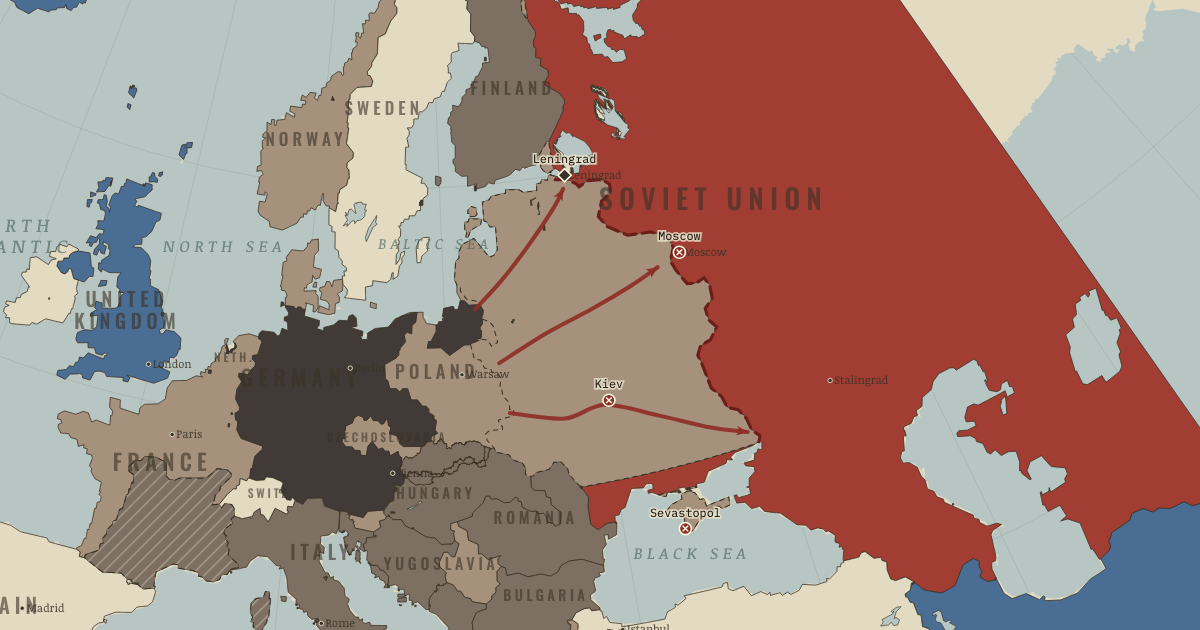
The map above is the world of Europe, December 1941 — Barbarossa checked at Moscow.
Every state on the map that year: The world in 1942 · Europe in 1942.
Part of IB History: The Second World War →
SHORT EXPLANATION
Germany and its allies invaded the Soviet Union on 22 June 1941 along a front of some 2,900 kilometres. Three army groups advanced toward Leningrad, Moscow, and Ukraine’s farmland and the oil of the south. Great encirclements captured or destroyed Soviet armies. Germany counted on those blows bringing down the state before distance, weather and stretched supply lines stopped its advance.
Conquest was joined to racial annihilation. German forces deliberately starved prisoners and civilians, and the Einsatzgruppen, mobile killing squads following the army, murdered whole Jewish communities in mass shootings. The Soviet state used its vast territory to gain time, raised fresh armies and moved more than 1,500 factories eastward. Its counterattack before Moscow in December ended Germany’s hope of the short war its strategy required.
The full story
Germany attacked the Soviet Union on the assumption that a series of victories near the frontier would destroy the state behind the armies. About 3.6 million Axis troops crossed the border in the largest invasion in history. Three army groups drove toward Leningrad, Moscow and Ukraine. At Minsk, Smolensk and Kiev, German mobile formations surrounded enormous Soviet forces; by winter more than three million prisoners had been taken.
These were victories on the scale the German plan required, yet they did not produce the collapse the plan predicted. The Soviet state continued fighting and raised fresh armies. Meanwhile, each German advance carried the front farther from the supplies needed to sustain it. Railway lines had to be converted to a different gauge, trucks broke down on poor roads, and much of the army still moved by horse. Conquering distance made the next advance harder to supply.
The fighting cannot be separated from the purpose of the invasion. Nazi racial ideology treated Soviet territory as colonial Lebensraum, or living space, to be cleared and settled. Occupation policy planned hunger and forced labor; German authorities allowed most Soviet prisoners taken in 1941 to die. Einsatzgruppen and supporting units shot hundreds of thousands of Jews. The armies’ advance opened territory to the killers, while racial goals shaped the occupation itself.
The Soviet Union had room to lose ground, but space alone could not replace what had been lost. The state moved more than 1,500 industrial enterprises eastward and drew on its enormous population to raise new forces, including reserves German intelligence had failed to count. People resisted an invader whose rule openly promised enslavement and death. In December Soviet forces counterattacked near Moscow. Germany had failed to win the quick victory on which its plan depended.
Could an earlier start or a single concentrated drive on Moscow have changed the outcome? Historians debate both possibilities. Either would still have faced German shortages and the Soviet ability to regenerate armies and production. By winter, the struggle had become a war of attrition against an enemy with more manpower, greater industrial potential and growing access to Allied aid. Germany had defeated Soviet armies without destroying the capacity that replaced them.
FULL EXPLANATION
War, occupation, and genocide
The plans for conquest in the East specified what would happen to people as well as territory. Under the Hunger Plan, German forces and cities would feed themselves from Soviet harvests, although this was certain to starve millions. The Commissar Order directed the killing of captured Soviet political officers. These policies belonged to an invasion intended to transform the region along racial lines. Behind the front, Einsatzgruppen, police battalions, Waffen-SS units and local collaborators murdered Jewish men, women and children, including at Babi Yar outside Kiev. By the end of 1941 more than a million Jews had been murdered in mass shootings. Later deportations and extermination camps extended the genocide across occupied Europe. These were crimes carried out through policy, ideology and cooperation among institutions, not a mere breakdown of discipline. Military conquest gave the perpetrators access to their victims; racial objectives in turn shaped the campaign and occupation.
Why the Soviet system survived
German intelligence counted the formations near the Soviet border, but underestimated the state’s capacity to replace them. When those armies were destroyed, the Soviet government still had territory, institutions and people with which to continue the fight. Space gave it time; railways carried factories, workers and machinery beyond the Ural Mountains, where production resumed under brutal conditions. Mobilization raised new armies faster than Germany expected, and scorched-earth measures denied the invader some resources. This effort drew on coercion and patriotic mobilization, as well as the knowledge that Nazi rule meant enslavement and death. Lend-Lease was still small in 1941, but later became vital, providing trucks, food, rails and radios. Geography mattered because Soviet institutions used the distance to rebuild. It worked against Germany at the same time: supplies traveled mainly by rail and horse, incompatible gauges hindered delivery, and less combat power reached the front as it moved farther east.
Key places on the map
On this day
Why it happened
Ideology: Lebensraum and the “Jewish-Bolshevik” enemy. Hitler’s central aim was colonial conquest in the East: the enslavement of Slavs and the annihilation of Jews and communists. Economic and strategic arguments were layered onto that fixed racial-imperial purpose. The aims of the invasion cannot be understood without it.
“Kick in the door and the whole rotten structure comes down”. Berlin expected the Red Army to collapse within weeks. Stalin had shot most of his senior officers in the purges of 1937–38, and Soviet performance against Finland in the Winter War reinforced that expectation. German intelligence counted roughly half the actual number of Soviet divisions, an error described in the original assessment as the greatest intelligence failure of the war.
Britain’s last hope. Britain fought on after invasion had become impossible (Chapter 4). Hitler believed it was counting on Russia and America for help. If he destroyed Russia before America was ready, he reasoned, Britain would have to make peace. In his calculation, the eastern invasion offered a way to end the western war.
THE TURNING POINT
The gates of Moscow, 5 December. Soviet reserve armies helped Zhukov launch a counteroffensive before Moscow on 5 December. Intelligence from Richard Sorge in Tokyo had informed Soviet decisions about reserves, indicating that Japan would strike south rather than attack Siberia. The offensive pushed the frozen, exhausted Wehrmacht back 100–250 km. The short war Germany’s strategy required was over.
What it changed
A war of attrition Germany cannot win. After December 1941, Germany faced a prolonged contest of factories, oil and manpower. The Soviet Union, aided by growing Lend-Lease, dwarfed the Axis in these categories. Later German offensives sought a shortcut out of that arithmetic.
The Holocaust escalates to genocide. More than a million Jews had been murdered in mass shootings in the East by the end of 1941. At Wannsee in January 1942 officials coordinated the continent-wide “Final Solution”: the deportation of Europe’s Jews to extermination camps in occupied Poland. The map’s grey zones conceal the scale of the war’s deepest crime.
The Grand Alliance forms. Churchill, a longstanding opponent of communism, pledged aid to Stalin on the day the invasion began (“If Hitler invaded Hell…”). Days after Pearl Harbor, Hitler also declared war on the United States. His decisions helped complete the coalition of Britain, the Soviet Union and America that would destroy him.
DISCUSSION QUESTION — Why did predictions of a swift Soviet collapse prove wrong?
Observers saw the Soviet armies’ early defeats and expected the same losses to continue until the state collapsed. They underestimated its ability to replace those armies. Strategic depth gave it time to evacuate factories and mobilize, while coercion, patriotism and resistance to Nazi rule sustained the effort. German supplies could not maintain the same tempo across the distances involved. The battlefield losses concealed the capacity the Soviet state still possessed.
An interesting fact
In besieged Leningrad, the Vavilov Institute held the world’s largest seed bank: hundreds of thousands of samples of wheat, rice and potato collected from five continents. During the starvation winter of 1941–42, its scientists guarded the collection and refused to eat it. At least nine died of hunger at their posts. The rice curator was found beside full sacks of grain. The institute’s founder, the geneticist Nikolai Vavilov, was himself starving in an NKVD prison; he died there in 1943. The scientists had kept the seeds for harvests after the war.
Related
THE FREE PRINTABLE STUDY GUIDE
Get the printable study guide for WW2 free. I’ll send you a few short letters, then one when a new atlas opens. That’s all. — Paul
NO TRACKING · YOUR ADDRESS IS USED FOR THE DISPATCH AND NOTHING ELSE · UNSUBSCRIBE ANYTIME