Road to WW2 · CHAPTER 11 ·
Road to Operation Barbarossa
Chapter 11 of The Road to War, 1931–1941: “Barbarossa: The Gamble That Ends the Gambles”
Italy’s failures in Greece and North Africa drew Germany into conquering Yugoslavia and Greece in spring 1941 before it launched Operation Barbarossa on 22 June. It was also a planned war of annihilation: Babi Yar alone recorded 33,771 Jewish victims in two days. By December the advance had been halted short of Moscow.
Chapter 11 is included with every paid plan. WW2 is free in full, and chapter 1 of every atlas is free. A free account opens 3 more chapters a day. Starter, at $9 a month, opens all 21 with no daily limit — see the plans.
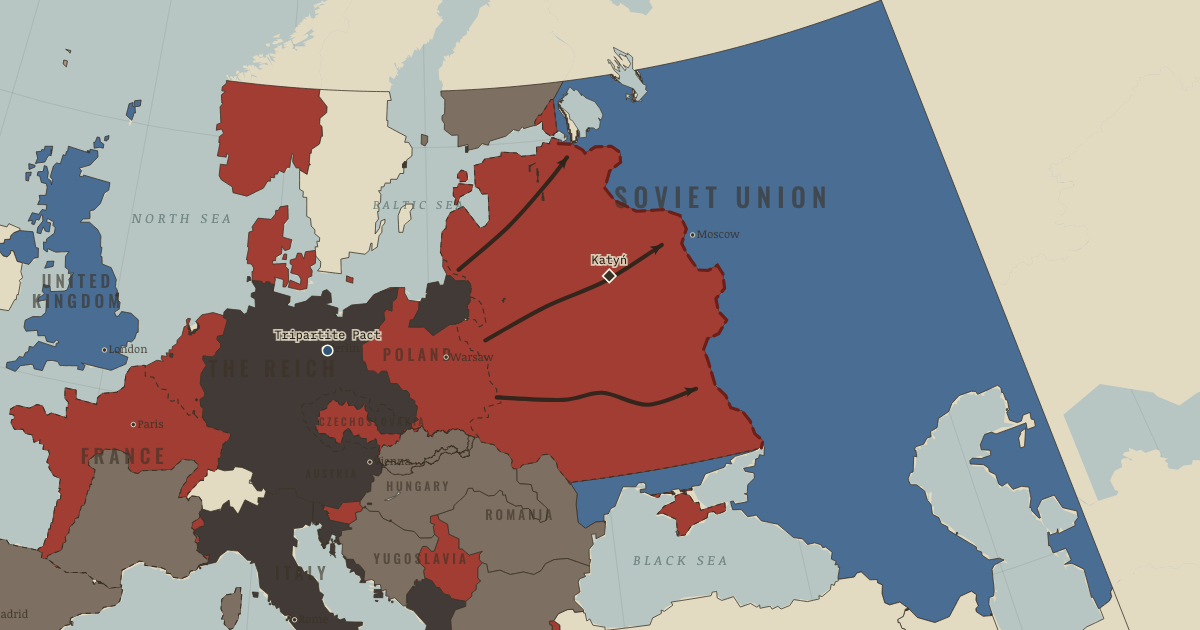
The map above is the world of Europe and Africa, June–December 1941 — Barbarossa — the Pact torn up.
Every state on the map that year: The world in 1942 · Europe in 1942.
Part of IB History: The Road to War →
SHORT EXPLANATION
Mussolini expected Italy to win its own conquests in Greece and North Africa. Instead, defeat drew Germany into both theaters: German troops went to Libya, and in spring 1941 Germany conquered Yugoslavia and Greece. Hitler was preparing a much greater invasion. On 22 June, three German-led army groups entered the Soviet Union, surrounding huge Soviet forces in victories that seemed to promise a short war.
The attack was designed as a war of racial annihilation as well as conquest. German units and local collaborators murdered Jews and other targeted civilians behind the front. Yet the Soviet state survived. Long supply routes exhausted the advancing forces, while Soviet reserves and industry moved east helped sustain resistance. By bringing the Soviet Union into a coalition with Britain, Hitler helped create the alliance that would defeat him.
The full story
Mussolini wanted Italy to fight a “parallel war” and acquire conquests without depending on Germany. The campaigns in Greece and North Africa produced the opposite result. Germany sent troops to Libya and conquered Yugoslavia and Greece in spring 1941. The intervention consumed time, but historians disagree about its effect on the date of Barbarossa: unusually wet weather and the task of assembling forces and supplies also constrained the timetable.
The invasion of the Soviet Union began on 22 June 1941. Three German-led army groups advanced toward Leningrad, Moscow and Ukraine, surrounding and destroying Soviet forces on an immense scale. Their victories seemed to confirm the plan behind the attack: destroy the Red Army near the frontier, and the Soviet state itself would collapse. Stalin’s purges of his officer corps and the army’s poor performance against Finland had given German planners grounds for expecting weakness.
Stalin had misjudged Hitler too. He discounted warnings of an attack, believing Germany would avoid a second front and fearing that Soviet mobilization would provoke it. But German success created a difficulty of its own. Every advance put more distance between the armies and their supplies. Rail gauges differed, roads deteriorated, trucks wore out and horses weakened. Meanwhile Soviet leaders moved factories east and mobilized reserves German intelligence had not counted.
The invasion was also a planned war of annihilation. German units and collaborators murdered Jews and other targeted civilians behind the front; at Babi Yar, 33,771 Jews were killed in two days. Hitler’s racial aims made occupation more violent and resistance more desperate. By December the German advance had stopped short of Moscow, and Soviet forces counterattacked. A different route toward Moscow could neither remove the supply problem nor guarantee Soviet political collapse. The short war had failed, and Hitler had joined the Soviet Union to Britain in a coalition capable of defeating Germany.
FULL EXPLANATION
The short-war model
The German plan required two victories in quick succession. The armies would destroy the Red Army near the frontier; the Soviet state, deprived of its forces, would then collapse. Early encirclements made the first part look possible. They did not bring the second result. German intelligence had underestimated Soviet reserves, the depth of the transport network and the government’s ability to relocate industry. Each advance also made the next one harder to supply. Rail gauges were incompatible, roads were poor, trucks wore out and horses weakened. Replacing them became more difficult as the distances grew. The choices over the Balkans, Kiev and Moscow mattered, and Moscow’s capture might have disrupted communications. But Soviet government and production extended beyond that city, and no choice of route removed the logistical strain. Modern scholarship therefore gives less weight to winter or a single diversion than older German memoirs did. The plan needed Soviet collapse before the costs of invasion accumulated; the state survived long enough for those costs to matter.
Conquest and annihilation
The invasion’s military and genocidal purposes were designed together. Before German troops crossed the frontier, orders excluded Soviet political officers, Jews and broad categories of civilians from normal protections of war. Behind the armies, Einsatzgruppen, police, cooperating army formations and local auxiliaries carried out mass shootings. By the end of 1941 roughly a million Jews had been murdered in this phase of the Holocaust. Hunger planning connected racial policy to the use of occupied land. Germany intended to feed itself from those territories while accepting mass civilian death; racial categories helped determine whose lives were expendable in that calculation. The aim was to remake the occupied east through dispossession, starvation and murder as well as military defeat. This history belongs at the center of the campaign, not after the account of its battles.
Key places on the map
On this day
Why it happened
Hitler’s eastern program. The attack fulfilled an ambition Hitler had long expressed. In Mein Kampf and at the Hossbach conference (Ch. 5), he sought eastern Lebensraum; economic planning also envisaged a continental empire able to withstand blockade. The 1939 Pact gave Germany a temporary arrangement with the Soviet Union while that ambition remained. The intentionalist–functionalist debate (Ch. 3) concerns how Hitler reached war, but even Taylor’s improvising Hitler arrived, within twenty months of maximum power, at the eastern war his book had promised.
Britain and the imagined exit. Britain remained at war after France fell. In July 1940 Hitler told his generals that Britain continued partly because it hoped for help from Russia and America. If the Soviet Union were defeated, he reasoned, Britain would lose that hope. He also saw growing American power as a deadline and believed a self-sufficient continental empire would be needed to meet it. The proposed invasion of the largest country on earth thus became a means of defeating an island. Like the window argument of 1938 (Ch. 7), it depended on a prediction about the cost of waiting.
Germany underestimated Soviet strength. German intelligence estimated Soviet strength at roughly 200 divisions. By August 1941 it had identified 360. The lower estimate had seemed plausible: Stalin’s purges in 1937–38 had killed or imprisoned much of the senior officer corps, including three of five marshals and a majority of army and corps commanders, and the war with Finland (Ch. 9) had exposed the damage. Yet the Wehrmacht encountered a state with space, reserves, mobilization capacity and the T-34, willing to sustain enormous losses. German planners expected an eight-week campaign and issued no winter clothing. In December civilians were asked to provide clothes from their own closets.
Stalin discounted the warnings. Warnings came from Sorge in Tokyo, Churchill, Soviet frontier commands and deserters shortly before the attack. Historians reconstruct Stalin’s reasons for discounting them: Hitler, he believed, would avoid a two-front war; Britain had an interest in drawing the USSR into its own conflict; and mobilization might provoke the very attack it was meant to meet. The experience of 1914 seemed to support the last fear. Soviet forces were caught unprepared, with aircraft lined up on airfields. The Red Army lost more aircraft in the first week than most nations possessed.
THE TURNING POINT
Berlin, 27 September 1940. At the ● in Berlin, Germany, Italy and Japan signed the Tripartite Pact on 27 September 1940. Each pledged mutual assistance against a power not yet involved in their wars. The principal audience was the United States. The pact linked the aggressions shown on this atlas’s two maps: it encouraged Japanese leaders considering a southern advance, while Roosevelt could present aid to Britain and pressure on Japan as connected policies. Its authors raised the stakes for Washington without producing the fear they intended. The signatures did not give the partners a common strategy. Japan remained neutral toward Moscow after Barbarossa, and Germany declared war on the United States after Pearl Harbor without being asked. The pact framed the approach to world war even as its members followed different courses.
What it changed
Mass murder behind the front. The advancing armies made occupied territory available to the Einsatzgruppen, Order Police and local auxiliaries, who carried out systematic mass shootings. By the end of 1941 roughly a million Jews had been murdered. The Wannsee conference in January 1942 coordinated aspects of the wider genocide, which continued beyond this atlas’s December 1941 endpoint. The killings formed part of the racial project of conquest.
The Grand Alliance. Churchill had opposed Bolshevism for thirty years, but offered the Soviet Union support on the evening of the invasion: “If Hitler invaded Hell, I would at least make a favourable reference to the Devil”. American Lend-Lease reached Moscow by November. Hitler’s attack brought Britain and the Soviet Union together, helping assemble the coalition that would eventually include the United States and win the world war.
Japan moves south. Japan’s neutrality pact with the Soviet Union held after Barbarossa, reducing Tokyo’s immediate concern about its northern frontier. A German victory also seemed likely. With European empires occupied elsewhere, both considerations favored a southern strike. Soviet forces counterattacked near Moscow five days before Pearl Harbor, but Japan’s fleet was already at sea.
DISCUSSION QUESTION — Could Barbarossa have succeeded — and what turns on the answer?
German memoirs helped establish a “lost victory” interpretation: the Balkan campaign, the August diversion of armor to Kiev and winter deprived Germany of a chance to take Moscow in October and break Soviet resistance. That account makes particular decisions and delays decisive. Modern operational historians, especially Glantz, put more weight on the conditions under which any advance would have had to continue. By August, distance, incompatible rail gauges and worn-out trucks were already straining supply. Moscow was important, but its capture in 1812 had not ended Russian resistance. The plan also depended on a political judgment. German leaders expected a “rotten structure” to collapse; instead the Soviet state moved some 1,500 factories east and mobilized reserves. Different decisions might have changed the campaign, and the counterfactual cannot be settled with certainty. The evidence favors the structural explanation over a victory lost through a few choices. Even failure in 1941 left four more years of war and immense losses.
An interesting fact
The final Soviet grain train crossed into German-held Poland less than two hours before the invasion began, according to an account of the last deliveries. It was part of a much larger trade associated with the 1939 Pact. From 1939 to June 1941 the USSR supplied Germany with roughly 1.5 million tonnes of grain and nearly a million tonnes of oil, as well as rubber, manganese and phosphates carried along the Trans-Siberian route. Those supplies helped Germany withstand the British blockade and prepare its forces. Some were still being unloaded when the shooting began.
Related
THE FREE PRINTABLE STUDY GUIDE
Get the printable study guide for The Road to War free. I’ll send you a few short letters, then one when a new atlas opens. That’s all. — Paul
NO TRACKING · YOUR ADDRESS IS USED FOR THE DISPATCH AND NOTHING ELSE · UNSUBSCRIBE ANYTIME