Chinese Revolution · CHAPTER 6 ·
Jiangxi Soviet and the encirclements
Chapter 6 of China in Revolution, 1911–1949: “The Soviet Republic and the Encirclements”
In 1931 Japan’s Kwantung Army staged the Mukden Incident and seized Manchuria, while the Communists governed a rural soviet at Ruijin through land reform, courts and currency. The Nationalists’ fifth encirclement campaign used blockhouses and blockade, and after defeat at Guangchang in 1934 the Communists broke out.
Chapter 6 is included with every paid plan. WW2 is free in full, and chapter 1 of every atlas is free. A free account opens 3 more chapters a day. Starter, at $9 a month, opens all 21 with no daily limit — see the plans.
Free printable Chinese Revolution study guide, sent by email ↓
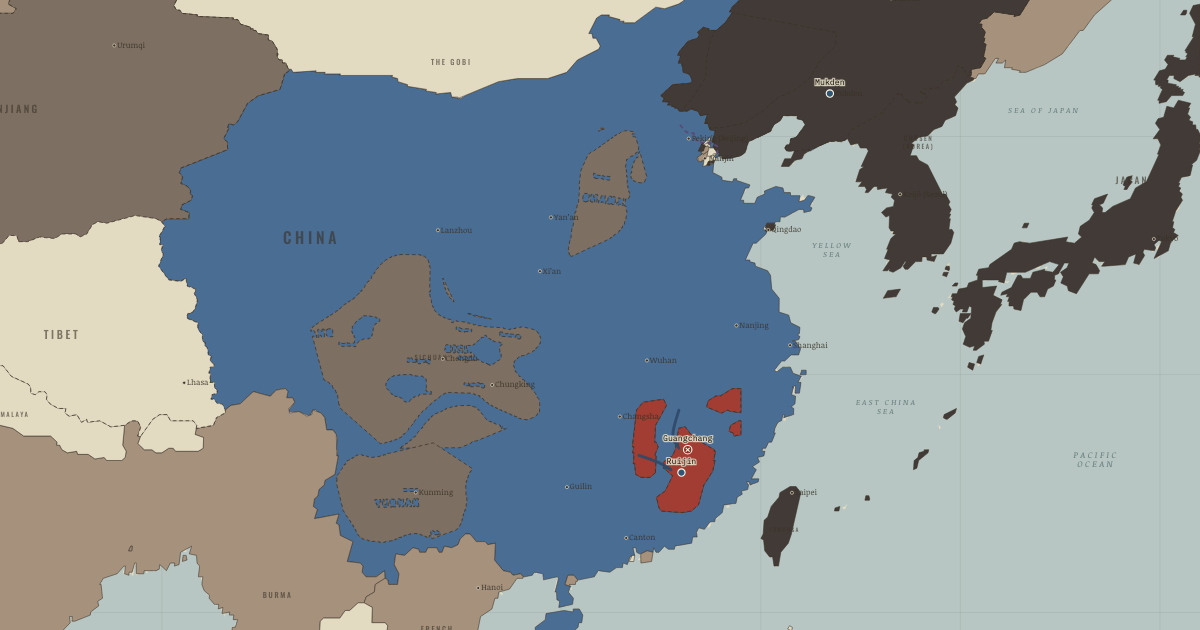
The map above is the world of China, 1933 — Manchukuo and the Tanggu Truce.
Every state on the map that year: The world in 1938 · Europe in 1938.
Part of IB History: China in Revolution →
SHORT EXPLANATION
In 1931 Japan’s Kwantung Army staged the Mukden Incident and seized Manchuria. The League of Nations investigated but did not undo the conquest. Chiang avoided a wider war while strengthening his state; his forces were preserved, but Japanese control spread and his policy cost him support.
The Communists’ rural soviet at Ruijin used land reform, courts and currency to govern, alongside coercion. Its mobile defenses defeated four Nationalist encirclement campaigns. In the fifth, blockhouses and blockade squeezed the base; after costly fighting at Guangchang, the Communists broke out on what became the Long March.
The full story
On 18 September 1931 officers of Japan’s Kwantung Army blew up part of their own railway outside Mukden (the ●), blamed China and used the incident to begin a conquest. They acted against Tokyo’s instructions, but received widespread applause in Japan. Within about five months they had overrun Manchuria. In March 1932 they proclaimed “Manchukuo,” installing Puyi, the last Qing emperor, as its figurehead.
Japan annexed Jehol in 1933. The Tanggu Truce then established a demilitarized zone south of the Great Wall, shown by the dashed line. Chiang, who was fighting the Communists, pursued non-resistance and appealed to the League of Nations. Its commission investigated the seizure, but the League did not reverse it. The charcoal on the map shows territory taken despite the international system meant to protect states against aggression.
A second government opposed to Nanjing appeared in the southeast. The red patch at Ruijin (the ●) marks the Chinese Soviet Republic, proclaimed on 7 November 1931. It governed roughly three million people, issued currency, ran courts and schools, conscripted soldiers and took land from landlords for distribution to the poor. Land reform attracted support. Its record also included terror: the Futian purge of 1930 had killed thousands of its own soldiers as supposed enemies.
Chiang’s encirclement campaigns aimed to isolate this base, cut its supplies and destroy it from the outside inward. In the first four, Nationalist columns advanced into the hills only to meet an enemy willing to give ground. Red forces harassed the columns when they camped and concentrated against them when they were tired or exposed. The fifth campaign, in 1933–34, changed the problem.
On German advice, Nationalist forces built thousands of blockhouses in creeping rings. They advanced a few kilometers at a time, restricting trade and supplies of salt and grain instead of simply pursuing the Red Army into the hills. The two blue arrows show the final campaign’s direction. At Guangchang (the ✕) in April 1934, the Moscow-trained leadership ordered a fixed defense; it failed with about 5,500 casualties. By autumn the blockade was strangling the base. In October about 86,000 people broke out, beginning the Long March, and the tide chart falls to zero.
FULL EXPLANATION
The Lytton Report and collective security
The League of Nations investigated Manchuria rather than simply overlooking it. Its Lytton Commission acknowledged Japan’s economic interests and grievances in its 1932 report, but rejected the claim that Manchukuo was independent of Japanese action. The League adopted the report. Japan walked out in February 1933 and kept the territory. The investigation gave governments a basis for judgment; enforcing that judgment was another matter. Sanctions, ships or soldiers would have imposed costs on powers reluctant to bear them in a distant region where none held a vital stake. Mussolini and Hitler watched the result. The League could identify aggression, but could not make governments accept the price of stopping it, eight years before Europe faced its own great test.
Manchukuo and the planned economy
Puyi’s position as figurehead tells only part of Manchukuo’s history. Japanese reform bureaucrats and the Kwantung Army developed a planned industrial economy there, including the South Manchuria Railway’s research bureau, the Shōwa steel works at Anshan and engineered cities. The colony let them pursue state-led development with fewer of the parliamentary and business constraints they faced in Japan. Historians including Louise Young and Prasenjit Duara have examined its importance for wartime planning and later development. Kishi Nobusuke, a future Japanese prime minister, was among the figures connected with it. The industrial base supported Japan’s 1937 invasion of China proper. Soviet forces occupied Manchuria in 1945, and its resources later mattered to the Communist war effort in 1948–49. Soviet removal of equipment complicates the route from occupation to Communist use; the arsenal did not simply pass intact to a new master.
Key places on the map
On this day
Why it happened
An army makes foreign policy. The conspirators around Ishiwara expected Tokyo to ratify a successful seizure, and it did. They had grounds for confidence: the murder of Zhang Zuolin at Huanggutun had gone effectively unpunished, while the Depression weakened the prestige of civilian government. Army planners called Manchuria, with its coal and iron, a “lifeline.” The army’s direct relationship to the throne also limited civilian ministers’ ability to control it. These conditions made an independent military initiative possible.
Chiang’s calculation. Chiang’s “first internal pacification, then external resistance” set an order for two threats. China had little naval or air strength, and he feared that immediate war with Japan would destroy his forces. Delay might allow time for German-assisted training, currency reform and road building. Yet delay had a price: territory was lost and critics of non-resistance gained support. At Xi’an in the next chapter, even Chiang’s own generals would press him to change course.
Land reform and rural government. Rent, debt and taxes could claim half or more of a poor rural family’s crop. By taking land from landlords and giving it to poorer peasants, the soviet addressed a burden that mattered directly to its subjects. Redistribution was violent, and recruitment drew on both loyalty and coercion. This was a change in the CCP’s work: it was governing rural communities against landlords, rather than organizing urban workers against employers.
Fixed defenses against blockhouses. The Moscow-backed “28 Bolsheviks” and Comintern adviser Otto Braun treated the soviet as a state whose borders regular forces should defend. Mao, associated with the mobile tactics that had defeated four campaigns, was sidelined in 1932–33. Fixed positions gave the advancing blockhouse system a costly contest of attrition, one the smaller Red Army was poorly placed to sustain. The dispute over these choices would reach Zunyi in the next chapter.
THE TURNING POINT
Guangchang, April 1934. Mukden had the wider international consequences. For the war around the soviet, Guangchang was a critical episode: in April 1934 a costly fixed defense failed while the fifth encirclement advanced. The leadership’s chosen way of holding the base was becoming increasingly difficult. The eventual breakout set the movement on the road to the Long March, Zunyi, Mao’s ascent and Yan’an.
What it changed
The breakout becomes the Long March. In October 1934 the Ruijin column took much of its government with it, carrying printing presses, archives and an arsenal on poles. The convoy suffered a devastating defeat at the Xiang River, losing roughly half its strength. Those losses discredited the leadership responsible for its manner of march and helped bring the strategic dispute to Zunyi. Guangchang lay at the beginning of that road.
Manchukuo industrializes for the next war. Japanese investment expanded railways, planned cities and the Shōwa steel works in Manchuria. This industrial base supported Japan’s war effort and its 1937 invasion of China proper. Soviet forces occupied the region in 1945, and its resources and equipment later helped the Communists during the civil war of 1946–48. Soviet removal of equipment makes the path to that later use more complicated than a simple transfer.
The League’s failure is filed for reference. Japan left the League in 1933 and retained Manchukuo; the other powers did not reverse the conquest. Mussolini and Hitler observed the result. The case exposes a difficulty in collective security: a judgment that aggression has occurred still needs states willing to bear the costs of stopping it.
DISCUSSION QUESTION — Did land reform win peasant support for the Jiangxi Soviet, or did coercion hold it together? What evidence would help us decide?
Redistribution gives us reason to expect some peasants to support the soviet. Recruitment rose where land reform went furthest, and Nationalist restoration of landlords behind the advancing blockhouses could show villagers what they stood to lose. But support did not make coercion unnecessary. In the Futian purge, thousands of Red Army men accused of “AB League” membership were killed after confessions extracted by torture. Under blockade, grain levies and conscription became as heavy as a warlord’s, and more people fled as the ring closed. The sources themselves require care. Party memoirs can sanctify the soviet, Nationalist reports can demonize it, and its archives record what cadres chose to report. Chen Yung-fa and others have examined consent and coercion as instruments used together, with their proportions changing under military pressure. A person could welcome land reform and still be pressed to serve. Evidence from particular places and periods helps us see the choices people actually faced.
An interesting fact
The Chinese Soviet Republic issued silver coins and banknotes, sold bonds and legislated. Mao’s economist Lin Boqu ran its “National Bank” from a courtyard with a staff counted on two hands. Its 1931 marriage regulations provided for mutual consent and divorce at either party’s request, and banned bride-prices. Enforcement was sufficient to draw complaints, including from soldiers’ families. In its short life the government gave the CCP experience with currency, taxation and family law before it governed a fifth of humanity.
Related
THE FREE PRINTABLE STUDY GUIDE
Get the printable study guide for China in Revolution free. I’ll send you a few short letters, then one when a new atlas opens. That’s all. — Paul
NO TRACKING · YOUR ADDRESS IS USED FOR THE DISPATCH AND NOTHING ELSE · UNSUBSCRIBE ANYTIME