Refugee crises · CHAPTER 8 ·
Re-education camps and Hoa exodus
Chapter 8 of Uprooted: Refugees in Europe 1945–1960 and Indochina 1975–1990: “Re-education and Flight”
After 1975 Vietnam sent hundreds of thousands of former officers and officials to ‘re-education’ camps without trial and moved city dwellers to New Economic Zones. In March 1978 it abolished private trade, hitting hardest the Hoa, Vietnam’s roughly 1.3 million ethnic Chinese, many of them traders in Saigon’s Cholon district.
Chapter 8 is included with every paid plan. WW2 is free in full, and chapter 1 of every atlas is free. A free account opens 3 more chapters a day. Starter, at $9 a month, opens all 21 with no daily limit — see the plans.
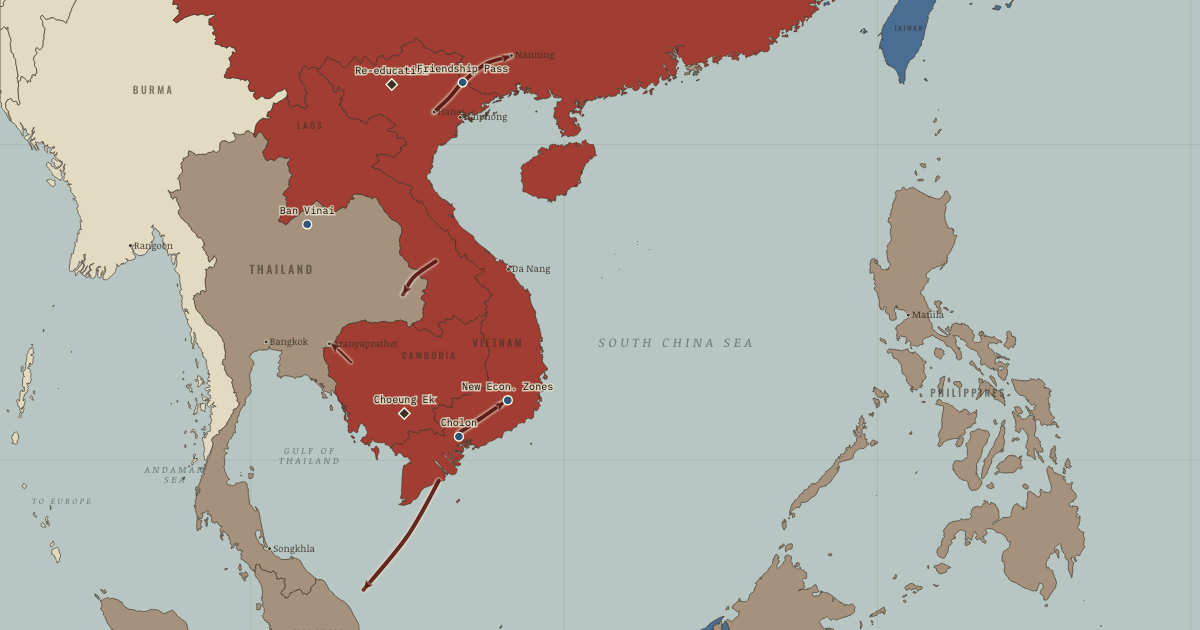
The map above is the world of Refugees in Southeast Asia, mid-1978 — The Hoa expelled; boats multiply.
Every state on the map that year: The world in 1980 · Europe in 1980.
Part of IB History: Refugees in Europe and Indochina →
SHORT EXPLANATION
After 1975 Vietnam's rulers set about transforming the South. Former officers and officials were sent by the hundreds of thousands to “re-education” camps, where forced labor and political study could last years without trial. Between about 750,000 and more than a million urban southerners were sent to farm in New Economic Zones cut from forest and scrub. The abolition of private trade in March 1978 struck another population: the Hoa, Vietnam's roughly 1.3 million ethnic Chinese, many of whom kept shops or traded in Saigon's Cholon district.
Each change gave people reasons to leave, but their routes depended on where they lived and whether they could escape. About 160,000 Hoa crossed into China within a few months in 1978; by the end of 1979 more than 250,000 had gone. Boats headed toward Malaysia, one of the first-asylum places shown in tan with Indonesia, Hong Kong and the Philippines. Lowland Lao and Hmong crossed the Mekong to Thai camps such as Ban Vinai. In Cambodia, execution, starvation and disease under the Khmer Rouge state, Democratic Kampuchea, killed an estimated 1.5 to 2.2 million people, about a fifth of the population. Its sealed borders kept most victims inside.
The full story
For families connected to the defeated South Vietnamese government, the end of the war brought an uncertain wait. Former officers, officials and others were ordered to report for re-education. Many expected a few weeks of political lessons. Instead, they were made to perform forced labor as well as study, and many remained for years; some senior officers were held for as long as seventeen years. UNHCR, the UN refugee agency, later said more than a million people passed through the camps. Gareth Porter and James Roberts estimated 200,000 to 300,000 long-term detainees.
Detention was only one part of the change in southern life. People judged unproductive or politically suspect were sent from cities to New Economic Zones in the south and Central Highlands, shown by the short red arrow. Many had neither tools nor farming experience. Families lost breadwinners to the camps and homes to relocation, while children associated with the old regime faced exclusion from university. A family considering the sea had to weigh its dangers against the prospect of remaining in this new order.
The Hoa faced a different combination of pressures. In late March 1978 security forces sealed Cholon, Saigon's Chinese district, and the government abolished large private businesses and wholesale trade. Many Hoa families depended on that commerce. At the same time Vietnam drew closer to the Soviet Union and fought the Khmer Rouge, Cambodia's communist rulers and an ally of China. As relations between Vietnam and China collapsed, Hanoi treated northern Hoa as a possible fifth column—an enemy within.
About 160,000 Hoa crossed into China between April and July 1978, along the route shown through Friendship Pass, before Beijing closed the border. In the South, officials allowed some ethnic Chinese to leave by boat in return for gold, often about twelve taels, or 450 grams, per adult. About 70 percent of people reaching camps in 1978 were of Chinese origin. Economic transformation had struck their livelihoods; suspicion arising from the dispute with China helped determine who faced pressure and who could buy a departure.
The movements from Cambodia and Laos reveal another condition of flight: people needed a route across a border. Democratic Kampuchea forced its population into rural cooperatives, separated families and banned religion. Former officials, educated people and minorities including Vietnamese and Muslim Cham could be killed as suspected enemies. Ben Kiernan estimates 1.67 to 1.87 million deaths, about a fifth of the population. More than 12,000 people were held at Tuol Sleng prison in Phnom Penh; only a handful survived. Mined and guarded borders meant that few reached Thailand before 1979.
Across the Mekong from Laos, the situation was different. Lowland Lao fearing re-education and Hmong fearing reprisals crossed in their tens of thousands each year. Ban Vinai held about 40,000 people. Thailand, shown in tan, received both groups. The relative size of these refugee flows tells us about the possibility of escape as well as the danger people faced at home.
FULL EXPLANATION
How many were re-educated?
How many people experienced re-education? The estimates differ sharply, partly because they describe different forms of confinement. UNHCR's 2000 history said more than a million people entered the camps and tens of thousands remained into the late 1980s. Writing in Pacific Affairs in 1988, Gareth Porter and James Roberts argued that the million figure misread a statement about short local courses, which most former soldiers attended for days or weeks. They estimated 200,000 to 300,000 long-term detainees. Hanoi's figures were much lower and changed over time. Most remaining prisoners were released in the late 1980s, partly as Vietnam sought Western recognition. Deaths from malnutrition, disease, overwork and execution were never comprehensively counted. Published estimates range from tens of thousands to over 160,000, with the higher figures resting on journalistic syntheses. The experience continued to shape refugee admissions: the United States began the Humanitarian Operation program in 1989 for former detainees and their families, ultimately admitting about 167,000 people, as chapter 11 notes.
The Hoa between two states
The Hoa stood at the intersection of two conflicts: the attempt to reorganize Vietnam's economy and the deterioration of relations with China. An explanation based on class begins with southern commerce, where Hoa were prominent and where nationalization in 1978 struck their livelihoods. An explanation based on security points to China cutting aid in 1978 and Vietnam invading China's ally Cambodia. Hanoi regarded Hoa, particularly those near the northern border, as a potential fifth column. Ramses Amer and other scholars conclude that the two pressures reinforced one another. A 1979 investigation in the New York Review of Books reported that public security officials organized departures for gold. The state may have earned $115 million in 1978 while denying that it was expelling anyone. More than 250,000 refugees entered China, which settled them on state farms with UNHCR help. Accounts centered on boats can obscure the scale of China's role as a receiving country.
Counting Cambodia’s dead
Different methods have produced estimates of Cambodia's death toll that converge on a broad range. Ben Kiernan compared population estimates for 1975 and 1979 and calculated 1.671 to 1.871 million deaths, or 21 to 24 percent of about eight million people. Yale's Cambodian Genocide Program, which mapped thousands of mass graves, cites about 1.7 million. Patrick Heuveline's 2015 statistical reconstruction gives a median of about 1.9 million excess deaths, with a wide uncertainty band. The UN-backed tribunal in Phnom Penh addressed particular crimes: it convicted surviving leaders of crimes against humanity and in 2018 found genocide against Vietnamese and Cham minorities. About 8,985 bodies were exhumed at Choeung Ek in 1980; that site and the Tuol Sleng museum preserve the memory. Most victims had been trapped inside Cambodia by closed borders. The large refugee flow followed the regime's fall in 1979.
Key places on the map
Why it happened
Punishing the old regime. Hanoi regarded people linked to the Saigon government as a danger to the revolution. Re-education removed family members for years without trial; lost property and restrictions on children's education affected those at home. By 1978 some who had been unable to leave in 1975 judged the dangers of the sea worth facing.
Socialist transformation of the South. Collective farming, private business closures and relocation to New Economic Zones were intended to build a planned economy. For many in the urban South, they instead brought loss and alienation. Floods and failed harvests deepened shortages in 1977–78. People from small traders to doctors felt the effects of a program directed at a class.
The break between Vietnam and China. Vietnam aligned with the Soviet Union, joined its economic bloc and fought Cambodia, China's ally. In 1978 China cut aid and protested the treatment of the Hoa, while Hanoi increasingly saw ethnic Chinese as a security risk. A dispute between states now affected a minority within Vietnam and helped produce the largest refugee group. Open war followed in February 1979.
Terror in Democratic Kampuchea. Between 1975 and 1979 forced labor, purges and the killing of class and ethnic enemies cost about a fifth of Cambodia's population their lives. Guarded borders kept most victims inside, although eastern-zone purges in 1978 drove some cadres and civilians into Vietnam. After the regime collapsed, far larger numbers began moving toward Thailand.
THE TURNING POINT
Cholon, late March 1978. The raids on Cholon and abolition of private trade in late March 1978 struck many Hoa livelihoods at once. About 15,000 boat people had reached neighboring countries in 1977; arrivals roughly quadrupled in 1978, most of them Hoa. Economic transformation and ethnic insecurity gave people reason to leave, while officials accepting payment helped organize departures. Neighboring governments increasingly understood the outflow as one Vietnam was directing toward them.
What it changed
The boats multiply. The scale of departure changed quickly: a few thousand a year became tens of thousands a month by early 1979. Many sailed in vessels sold or licensed by officials. Arrivals strained camps in Malaysia, Hong Kong, Indonesia and Thailand. Chapter 9 follows first-asylum governments as they responded to what they saw as an attempt to make them absorb another country's minority.
War with China. Anger over Cambodia and the Hoa formed part of the dispute that led China to invade northern Vietnam in February 1979. War intensified suspicion of northern Hoa, and many later left by sea for Hong Kong. Chapter 9 traces their route past Hainan: a war between communist states had consequences for a British colony receiving refugees.
Cambodia’s hidden displacement surfaces. Vietnamese forces overthrew Democratic Kampuchea in January 1979. Hundreds of thousands of starving Cambodians moved toward Thailand, bringing into view a displacement that terror and closed borders had concealed. Famine and camps from Khao-I-Dang to Site 2 became the region's second great refugee crisis, followed in chapters 10 and 11. Most of these Cambodians remained at the border and were never resettled.
Laos empties slowly. Between 1975 and 1995 about 360,000 people from Laos reached Thailand, roughly one in ten of the population. The Mekong was a border people could cross and authorities found hard to guard. Many Hmong in Ban Vinai and other camps resisted Western resettlement for years, hoping to return home. Chapter 11 follows their situation under the 1989 plan of action. For them, a place in the West was a different answer from the return they sought.
DISCUSSION QUESTION — To what extent was the exodus of the Hoa caused by economic policy rather than ethnic persecution?
Economic policy explains much of the southern exodus. The abolition of private trade in March 1978 struck commerce in which Hoa were prominent, and ethnic Vietnamese traders also lost livelihoods and left. But consider the North: many Hoa there were workers or fishermen, yet about 160,000 crossed into China after being treated as a possible fifth column. In the South, officials allowed ethnic Chinese to buy departures while restricting others. Economic transformation created pressure, and the break with China gave that pressure an ethnic edge. For Paper 1, the case shows how causes overlap and how a government can present a policy with an ethnic outcome as neutral, much as Potsdam spoke of orderly transfer.
An interesting fact
Hmong women at Ban Vinai made a record of their exodus in cloth. They adapted traditional paj ntaub, or “flower cloth”, into story cloths depicting village life, war and flight across the Mekong. Sold to relief workers and visitors, and marketed abroad with help from missionaries and aid agencies, the cloths supported families for years. Examples now in US museum collections remain among the principal records the Hmong made of their own flight.
Related
THE FREE PRINTABLE STUDY GUIDE
Get the printable study guide for Uprooted free. I’ll send you a few short letters, then one when a new atlas opens. That’s all. — Paul
NO TRACKING · YOUR ADDRESS IS USED FOR THE DISPATCH AND NOTHING ELSE · UNSUBSCRIBE ANYTIME