Mongol Empire · CHAPTER 11 ·
Mongol invasions of Japan and Vietnam
Chapter 11 of The Mongol Empire, 1206–1294: “The Limits of the World”
Khubilai then sent forces overseas and into Southeast Asia. Japan defeated the landings of 1274 and 1281 through fortification, resistance, poor Yuan logistics and storms; Đại Việt avoided decisive battle and trapped the Yuan fleet at Bạch Đằng in 1288; Champa and Java held out, and Pagan accepted tributary terms.
Chapter 11 is included with every paid plan. WW2 is free in full, and chapter 1 of every atlas is free. A free account opens 3 more chapters a day. Starter, at $9 a month, opens all 21 with no daily limit — see the plans.
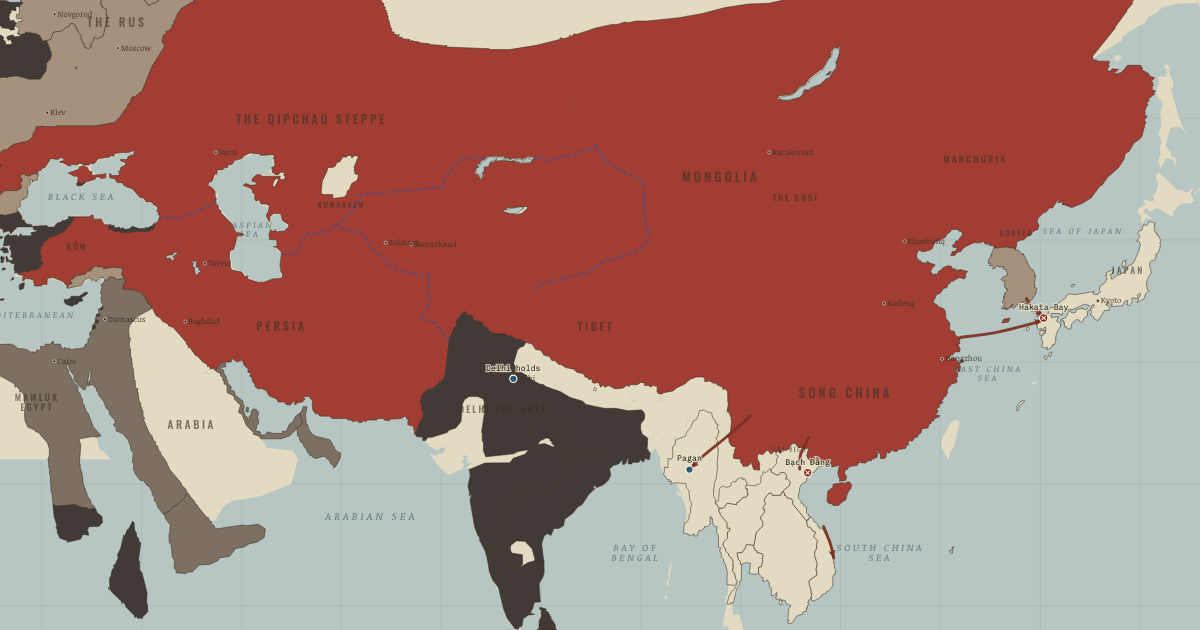
The map above is the world of The Mongol Empire, 1281 — The divine winds.
Part of IB History: The Mongol Empire →
SHORT EXPLANATION
After conquering the Song, Khubilai sent armies across the sea and into Southeast Asia. Japan resisted the invasions of 1274 and 1281; fortifications and fighting kept Yuan forces exposed, and storms then struck their fleets. The kamikaze, or divine winds, were decisive events in campaigns already made vulnerable by human choices.
In Đại Việt, defenders gave up ground, removed supplies and struck the retreating invaders; at Bạch Đằng in 1288, they trapped a fleet on the falling tide. Champa and Java also resisted, while Pagan accepted tributary terms. These campaigns show the difficulties of carrying an army built around horses and movement over connected land into different environments.
The full story
The fleet that attacked Japan in 1274 was assembled mainly in Korea. It struck Tsushima and landed near Hakata, where Japanese defenders faced coordinated volleys and gunpowder bombs. Yuan troops returned to their ships, and a storm damaged the fleet. The Japanese used the interval to build a stone wall around Hakata Bay: an invader would now have to establish itself ashore against a prepared defense.
Khubilai sent a much larger force in 1281, divided between two fleets. They struggled to coordinate and never secured a stable beachhead. As the ships remained exposed through the typhoon season, a powerful storm destroyed most of the force. The weather delivered the final blow, but the fleet was in danger before the storm arrived. The wall, the planning of the expedition, the quality of ships and the demands placed on conquered crews all mattered to its position.
In Đại Việt the defenders made the invaders travel inland without the supplies or decisive battle they sought. Capitals were abandoned and grain removed; distance, heat and disease wore down the Yuan forces. In 1288, stakes planted in the Bạch Đằng River caught the retreating fleet as the tide fell. Champa resisted over a long period. On Java, a local ruler used the expedition against a rival and then turned on the Mongols. Pagan became a tributary while retaining its local rulers.
The map’s arrows carry Yuan expeditions across water, but little permanent Yuan territory appears beyond China. An army could be delivered by ship once; holding territory required repeated supplies and reinforcements, as well as cooperation from sailors and local rulers. Japan made a secure landing difficult, Đại Việt made the journey and retreat costly, and Java’s ruler redirected an expedition into a local struggle. Each case shows a different obstacle between reaching a place and governing it.
FULL EXPLANATION
The storms and the campaigns
The typhoon was real, destructive and beyond anyone’s control. Why, though, was so much of the 1281 force still exposed when it arrived? Japanese defenses had kept much of the army offshore, while separate Yuan fleets sailed from different departure points and struggled to coordinate. Their crews came from recently conquered peoples. Wrecks at Takashima suggest hurried construction in part of the fleet, although they do not establish that every vessel was an unsuitable river craft. Political and logistical schedules placed the expedition in a dangerous season. The storm’s timing was contingent; the position in which it found the fleet was also the result of decisions and resistance. Both are needed to explain the defeat.
Beyond the pasture
The Song conquest warns against treating the environment as a fixed verdict on Mongol armies: they had changed their methods to win before. But change had a price. At sea, ships had to carry troops and supplies, and horses could not graze. In humid regions, fodder, disease and the upkeep of composite bows became harder problems. Defenders in deltas and forests could disperse rather than stake everything on a capital. Shipbuilders and sailors from conquered populations supplied skills the Yuan needed, though their interests were not necessarily those of the court. Adding ships and troops increased the force that could be sent, but it also increased the work of coordinating, supplying and securing cooperation after a landing. A larger expedition could thus bring greater power and greater burdens at the same time.
Key places on the map
Why it happened
Horses beyond the pasture. The mounted army’s mobility depended on remounts that could graze along its route. Ships offered no pasture, while paddy country and humid forests made fodder, disease and the care of composite bows harder problems. Mongol forces had adapted before, as their conquest of the Song shows. Beyond the pasture, however, transport and provisions had to do work that grazing had once done, giving defenders new ways to burden an invading army.
Ships and the people who built them. The Yuan relied on conquered peoples for maritime labor. Goryeo’s king sought relief from shipbuilding levies, and former Song sailors served the dynasty that had defeated them. Wrecks at Takashima include hastily produced hulls, some without keels. They do not establish that the entire fleet consisted of unsuitable river craft. These pressures on construction and crews accompanied a further risk: the expedition sailed during typhoon season.
Defenders learned and adapted. Opponents had learned about Mongol methods and did not all answer them in the same way. Japan fortified Hakata Bay; Đại Việt traded ground for time and opportunities to strike. Delhi maintained cavalry able to meet steppe armies, and the Mamluks used mounted methods familiar to their opponents. Surprise and an enemy willing to fight on favorable terms could no longer be taken for granted.
Conquest and authority. Expansion had long supported Mongol claims to authority. Khubilai was pursuing prestige abroad while Kaidu challenged his position within the ruling family (Chapter 9). Success in a campaign could therefore strengthen his claim at home as well as extend his power abroad. This helps explain the attraction of further campaigns after setbacks, though the succession dispute alone cannot explain every invasion.
THE TURNING POINT
Hakata Bay, August 1281. The storm struck in August 1281 while the force remained exposed off Hakata. Japanese resistance and the wall had made a secure landing difficult, and the expedition depended on ships and crews drawn from the empire. A beachhead offered neither pasture for remounts nor the room for maneuver that steppe forces used on open ground. Before the weather intervened, an overseas conquest already required the Yuan to solve problems far removed from those of a land campaign.
What it changed
The cost of defending Japan. Japan’s victory brought the Kamakura shogunate a difficult obligation. Warriors expected rewards for defending the coast, but there was no conquered land to distribute. Financial strain and grievances contributed to the shogunate’s fall in 1333. The divine winds also entered Japanese memory; their name was used again for suicide attacks in 1944.
States beyond Yuan rule. The invasions and their repulse became important in Vietnamese memory, and the stakes at Bạch Đằng remain a national symbol. Southeast Asian rulers could acknowledge a Chinese-centered tributary order while keeping their own governments. That distinction mattered: tribute did not turn Đại Việt into a province, and abandoning a capital could be a way to continue resistance rather than surrender the country.
The demands of administration. The Yuan still had to pay for their campaigns and govern their possessions. Failed invasions strained their finances, as did paper-money inflation. Elsewhere, the Ilkhans’ paper-currency experiment was disastrous, while the Golden Horde drew revenue from routes carrying furs and enslaved people. The states created by conquest faced the continuing work of administration and finance, the problem taken up in Chapter 12.
DISCUSSION QUESTION — “The kamikaze storms saved Japan.” How would you explain that claim without losing the other causes of the invasions’ failure?
Storms damaged the fleet in 1274 and devastated the invasion force in 1281. Japanese resistance and Hakata’s wall had made landing difficult; the separate Yuan fleets struggled to coordinate, and their ships and crews had been assembled under heavy demands. At sea the Mongols also lost their usual pasture and remount system. The storms were contingent and destructive, striking forces already vulnerable through defense and logistics.
An interesting fact
Takezaki Suenaga fought in both invasions and sought rewards from the shogunate. To help record his deeds, he commissioned the illustrated Mōko Shūrai Ekotoba. The scrolls give us pictures shaped by a participant’s account, although a bomb shown bursting near his horse has raised questions about later additions. At Takashima, divers recovered tetsuhau from the 1281 wrecks: ceramic shell-bombs, some still containing gunpowder and iron fragments. These finds confirm the use of such weapons in the invasion without settling every detail of the painted scene.
Related
THE FREE PRINTABLE STUDY GUIDE
Get the printable study guide for The Mongol Empire free. I’ll send you a few short letters, then one when a new atlas opens. That’s all. — Paul
NO TRACKING · YOUR ADDRESS IS USED FOR THE DISPATCH AND NOTHING ELSE · UNSUBSCRIBE ANYTIME