Meiji Japan and post-Soviet Russia · CHAPTER 2 ·
Black Ships and the opening of Japan
Chapter 2 of Remaking the State: Meiji Japan 1600–1912 and Post-Soviet Russia 1964–2000: “The Black Ships”
On 8 July 1853 Commodore Matthew Perry anchored four US warships at Uraga and asked Japan to open its ports. The shogunate signed the Treaty of Kanagawa in 1854, opening Shimoda and Hakodate, and in 1858 Townsend Harris won a commercial treaty whose terms and politics shook the shogunate.
WW2 is free in full, and chapter 1 of every atlas is free. A free account opens 3 more chapters a day. Starter, at $9 a month, opens all 21 with no daily limit — see the plans.
Free printable Meiji Japan and post-Soviet Russia study guide, sent by email ↓
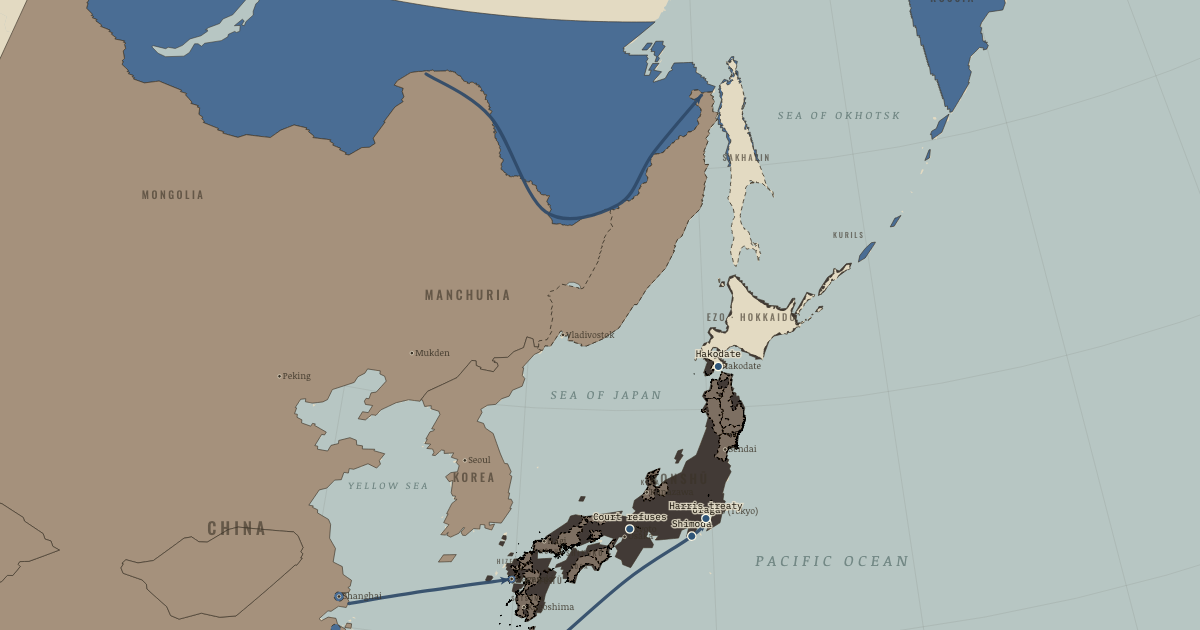
The map above is the world of Japan, July 1859 — Ports open; Russia takes the Amur.
Every state on the map that year: The world in 1850 · Europe in 1850.
Part of IB History: Meiji Japan and post-Soviet Russia →
SHORT EXPLANATION
On 8 July 1853 four American warships anchored at Uraga, below Edo, the shogun’s capital and today’s Tokyo. Commodore Matthew Perry brought a letter asking Japan to open its ports. Two of his ships could steam against the wind, and their guns could reach the waterfront of the capital. The shogunate—the hereditary military government that ruled in the emperor’s name, much as a strongman might govern behind a figurehead king—knew that Britain had recently defeated China. In 1854 it signed the Treaty of Kanagawa, allowing American ships to use the small ports of Shimoda and Hakodate. Four years later the American consul, Townsend Harris, secured a commercial treaty. A consul was a diplomat responsible for his country’s traders; Harris’s agreement was soon followed by demands for the same terms from Britain, France, Russia and the Netherlands. Japan now faced a system of agreements with Western powers.
The treaties opened ports where foreigners could live and trade, shown as blue dots on the map, but constrained Japan’s control over courts and customs. A foreigner accused of a crime would be tried by his own consul under his own country’s law: this was extraterritoriality, rather like giving foreign residents a diplomat’s immunity from local courts. The treaties also fixed tariffs, or taxes on imports, limiting Japan’s ability to protect new industries and raise revenue. The political cost came from the decision to accept these terms. Emperor Kōmei refused to approve the 1858 treaty, yet chief minister Ii Naosuke had it signed. The shogun claimed to govern for the emperor; his opponents could now rally around the emperor’s refusal and question who had the right to decide for Japan.
The full story
The United States wanted Japan to serve ships crossing the Pacific. Steamers bound for China needed coal, American whalers worked in nearby waters, and Washington wanted safety for their crews as well as trade. Perry refused to take his request to Nagasaki, the usual place for receiving foreigners. His guns did not fire in anger, but their presence near Edo forced the shogunate to decide how to respond. A month later Admiral Putyatin’s Russian squadron reached Nagasaki, shown by the arrow from the west. The American request was only one of the demands confronting Japan.
Senior councillor Abe Masahiro sought advice from the emperor’s court in Kyoto and the roughly 260 daimyo, lords who governed domains much like semi-independent states. No previous shogunal government had circulated such a question to them. Most lords wanted refusal or delay, yet none offered a fleet with which to resist. In 1854 the government signed at Kanagawa, opening Shimoda and Hakodate to American ships for supplies. Abe had sought help with an immediate decision, but the consultation also brought others into foreign policy and exposed the shogunate’s inability to settle the question alone.
The next agreement went further. Harris had been American consul at Shimoda since 1856. Pointing to Britain’s renewed war against China, he warned that a fleet might demand harsher terms. The commercial treaty opened Kanagawa, which became the port of Yokohama, as well as Nagasaki and Hakodate, in 1859. It fixed import tariffs at low rates that Japan could change only with foreign approval.
Trade brought gains and losses quickly. In Japan an ounce of gold bought about five ounces of silver; abroad it bought about fifteen. Traders could profit from that difference, and gold flowed out. To halt the drain, the shogunate debased its coins in 1860, putting less gold into them. Meanwhile exports of raw silk and tea boomed. Some merchants and silk farmers grew rich, but prices rose faster than wages and the fixed rice salaries of samurai, the hereditary warrior-officials. For many others, opening the ports became a question of how to afford everyday life.
A quarrel over succession made the treaty harder to settle. The sickly shogun Iesada had no heir. Reforming lords such as Shimazu Nariakira of Satsuma favored the able Hitotsubashi Yoshinobu; conservative officials wanted a boy from the Tokugawa family’s Kii branch. In 1858 minister Hotta Masayoshi returned from Kyoto with Emperor Kōmei’s refusal to approve the Harris treaty. Supporters of agreement saw danger in waiting: Russia had just acquired the north bank of the Amur from China under the Treaty of Aigun, turning the land above the river from tan to blue on the map. Further delay, they argued, might bring harsher demands.
The newly appointed tairō, Ii Naosuke, had emergency powers as chief minister. He signed the treaty despite the emperor’s refusal, installed the boy shogun Iemochi and purged his critics. Perry’s arrival had put the government under pressure from abroad; Ii’s response deepened a struggle over authority at home. Within five years, the shogunate had been unable to keep foreigners out and had lost the consent of lords it claimed to lead.
FULL EXPLANATION
Gunboat diplomacy, and what Perry actually wanted
Perry’s mission shows what naval force could accomplish without a battle. His orders from Washington permitted firing only in self-defense, yet he refused the usual approach through Nagasaki, sent survey boats into Edo Bay and demanded that high officials receive President Fillmore’s letter. The letter asked politely for friendship, coal, help for castaways and trade. The ships gave those requests a force the words did not need to state. That combination of negotiation and visible threat is gunboat diplomacy. The Japanese negotiators still had choices. Michael Auslin’s study of the negotiations shows Hayashi Akira keeping a trade clause out of the 1854 treaty; later officials bargained hard over ports and dates. Kanagawa was a limited concession obtained under threat and narrowed through negotiation. Harris had a more direct warning in 1858: British and French warships were fighting in China, and he could present his commercial terms as the gentler alternative.
Abe Masahiro’s consultation and the shogunate’s own reforms
Abe’s 1853 consultation is often treated as the end of the shogunate’s monopoly on national policy. Hundreds of lords, scholars and bannermen replied. The bannermen were the shogun’s hereditary retainers, something like a household guard turned civil service. Most respondents opposed opening Japan, but did not say how it could be resisted. Their participation mattered as much as their advice: outer lords and the court had entered decisions from which they had been excluded for two centuries. Conrad Totman argues that the shogunate should not be dismissed as merely backward. It lifted the ban on large ships, ordered steam warships from the Netherlands, opened a naval training school at Nagasaki with Dutch instructors in 1855 and founded an institute for Western studies in Edo in 1856. These were efforts to meet the danger, yet each raised the question of who would pay. The government was modernizing while its authority was slipping—a combination that returns in the second half of this atlas.
The economics of the open ports
Economic historians agree that the opening produced a sharp price shock; they disagree about how much of the later political turmoil it explains. One source of pressure was the exchange between gold and silver. Japan’s official ratio was about one to five, while the world-market ratio was about one to fifteen. Foreign traders could buy Japanese gold with silver and profit from the difference. Gold flowed out, and the shogunate stopped the drain by issuing lighter gold coins in 1860. That pushed prices up. Exports added a second pressure. Silkworm disease in France and Italy sent European buyers looking for Japanese raw silk, and tea shipments grew too. Osaka rice prices rose several times over between 1859 and 1867. Export merchants and silk-raising villages in central Japan gained; urban laborers and samurai on fixed stipends faced higher costs, while Kyoto silk weavers lost access to raw material. The political slogans of the 1860s drew on grievances rooted in these changes.
Key places on the map
On this day
Why it happened
Steam and the Pacific brought America to Japan. After gaining California in 1848, the United States sought coaling stations for steamships traveling across the Pacific to China. Its whalers also worked off Japan, and wrecked sailors were sometimes imprisoned there. Japan became a stop on a commercial highway for the first time. Perry’s two steamers could move against winds that had long left sailing ships at the mercy of its coast.
A government without a navy could only delay. Chapter 1’s divided state had neither a fleet nor a national army, and could not quickly pay for them. Abe’s officials built batteries on artificial islands in Edo Bay after 1853, but knew that ships like Perry’s had destroyed Chinese forts. They faced a choice over how much to concede and how to explain it: refusal threatened war against a power they expected to defeat them.
Consultation widened the circle of decision-makers. Abe asked the daimyo and court for advice in 1853 partly to share responsibility for an unpopular choice. In doing so, he invited the outer lords and court to exercise a voice in national policy that they had been denied since 1600. The court’s refusal in 1858 therefore carried weight. An effort to support the government helped establish an alternative authority that would replace it.
A succession quarrel turned diplomacy into a feud. The succession to the heirless Iesada split the elite in 1857–58. Shimazu Nariakira of Satsuma and Tokugawa Nariaki of Mito were among the reforming lords who favored Hitotsubashi Yoshinobu. Conservatives around Ii Naosuke supported a twelve-year-old from the Kii branch. These men also disagreed about the treaty. Ii’s victory in both disputes made rivals over policy and succession enemies of the shogunate itself.
THE TURNING POINT
The Harris treaty signed, 29 July 1858. On 29 July 1858 Ii had the Harris treaty signed despite the emperor’s refusal. The shogunate claimed to govern in the emperor’s name; defying him made the concession a dispute over its right to rule. Ii then used the Ansei Purge against his critics, confining great lords and executing young activists including the Chōshū teacher Yoshida Shōin. On 24 March 1860 samurai, most from Mito, killed Ii outside Edo Castle’s Sakurada Gate. The shogunate never recovered the authority spent in this struggle.
What it changed
Terror entered politics. After Ii’s assassination, political violence continued for a decade. Young samurai calling themselves “men of high purpose” (shishi) killed officials and foreigners in the emperor’s name, trying to force decisions on governments unable to keep order. Many came from Chōshū, Tosa and Satsuma, the domains that would lead the next stage.
Kyoto became a second capital. Lords and activists went to Kyoto after 1858, turning a court that had been powerless for two and a half centuries into a center of decision. The shogunate sought to repair relations by arranging the marriage of the emperor’s sister to the young shogun in 1862. Policy now needed approval in two places, with the emperor’s carrying moral weight.
Open ports remade prices and livelihoods. The new trade changed both places and livelihoods. Yokohama grew from a fishing village into Japan’s main trading port, and raw silk became the country’s largest export. Silk districts prospered, while inflation harmed urban workers and samurai. Merchants and officials also gained a close view of Western commerce; the Meiji state would later use that knowledge to build industry.
Russia’s advance redrew the north. Russia acquired Chinese land north of the Amur under the Treaty of Aigun in 1858 and east of the Ussuri under the Treaty of Peking in 1860. It founded Vladivostok, a name meaning “ruler of the East.” In 1861 a Russian warship occupied part of Tsushima for six months. Fear of Russia shaped Japanese strategy for half a century, through Korea to the war of 1904.
DISCUSSION QUESTION — Did the unequal treaties weaken Japan more through their economic terms or through the political crisis they caused?
The treaties imposed serious economic costs. Fixed tariffs limited customs revenue and protection for new industries until 1911; the gold drain and export boom drove inflation; and extraterritoriality put foreigners beyond Japanese law. Yet Japan’s economic losses were manageable compared with China’s, and merchants and silk districts gained from trade. The political effects were faster and larger. The shogunate signed without imperial approval, making it appear disloyal to the authority in whose name it ruled. The ensuing purge turned some of the most capable lords into enemies, and within ten years the shogunate was gone. Historians such as W. G. Beasley therefore see the treaties above all as a political catalyst, while recognizing their real economic harm. Their terms set Meiji Japan on a long campaign for equality; the crisis helped decide who would lead that campaign. Outside pressure can weaken a government most sharply by damaging belief in its right to rule.
An interesting fact
The delegations used gifts and demonstrations to show one another their capabilities. In 1854 Perry’s party laid a circle of track near Yokohama and presented a working miniature steam railway, complete with engine and carriage. The carriage was made for children, so Japanese officials trying it clung to the roof, robes flying, at about twenty miles an hour, as Perry’s official narrative recorded. The Americans also strung a telegraph line about a mile long. Their hosts offered silks and lacquer and staged a display by sumo wrestlers, who carried heavy rice bales with ease.
Related
THE FREE PRINTABLE STUDY GUIDE
Get the printable study guide for Remaking the State free. I’ll send you a few short letters, then one when a new atlas opens. That’s all. — Paul
NO TRACKING · YOUR ADDRESS IS USED FOR THE DISPATCH AND NOTHING ELSE · UNSUBSCRIBE ANYTIME