Road to WW2 · CHAPTER 8 ·
Outbreak of WW2 in Europe
Chapter 8 of The Road to War, 1931–1941: “Prague, the Pact, Poland”
Germany’s occupation of Prague in March 1939 showed that Hitler’s aims went beyond German-speaking lands, and Britain guaranteed Poland. On 23 August Germany and the Soviet Union signed a non-aggression pact whose secret protocol divided eastern Europe. Germany invaded Poland on 1 September and the Soviet Union on 17 September.
Chapter 8 is included with every paid plan. WW2 is free in full, and chapter 1 of every atlas is free. A free account opens 3 more chapters a day. Starter, at $9 a month, opens all 21 with no daily limit — see the plans.
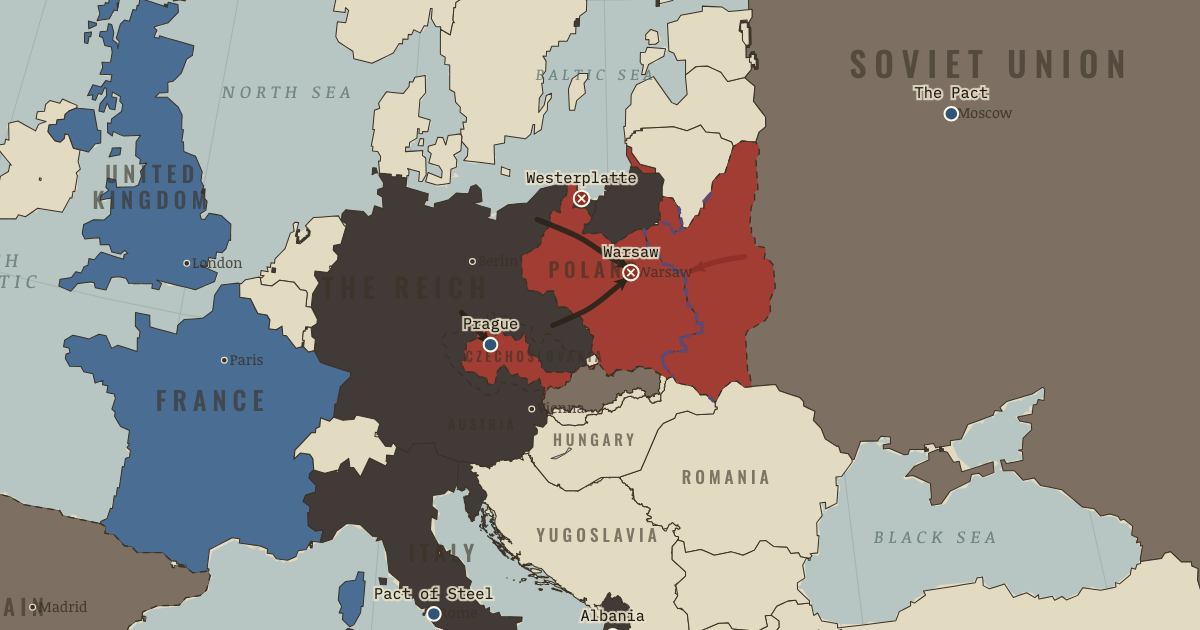
The map above is the world of Europe and Africa, September 1939 — The Pact, and Poland partitioned.
Every state on the map that year: The world in 1939 · Europe in 1939.
Part of IB History: The Road to War →
SHORT EXPLANATION
Germany’s occupation of Prague in March 1939 exposed the limits of Hitler’s claim to be uniting Germans: the Czech lands were predominantly Czech. On 31 March Britain guaranteed Poland’s independence if Poland resisted a threat, although it could not send an army there in time to stop an invasion. Britain and France also talked with the Soviet Union, whose forces could reach Poland, but mutual distrust slowed the negotiations.
Instead, Moscow reached an agreement with Berlin. The two powers pledged non-aggression on 23 August and secretly divided eastern Europe into spheres. German forces invaded Poland on 1 September; Soviet forces entered from the east on 17 September. Britain and France declared war, but their guarantee had failed to deter the attack and they could not prevent Poland’s partition.
The full story
The occupation of Prague in March 1939 changed the argument over Hitler’s intentions. Germany had previously presented its demands as a way to unite Germans; it now took control of a predominantly Czech population. Britain answered on 31 March with a guarantee to Poland. The promise was intended to warn Hitler that an attack would bring a wider war, though Britain could not put an army in Poland in time to stop him.
The crisis was widening elsewhere too. Italy seized Albania in April, and Mussolini signed the Pact of Steel with Germany in May. Britain and France sought an agreement with Moscow, but negotiations moved slowly. Poland refused to admit Soviet troops, whose arrival its leaders had reason to fear. A common danger did not remove distrust among the countries considering how to resist it.
Stalin made a different bargain. On 23 August Germany and the Soviet Union signed a non-aggression pact, with a secret protocol assigning eastern Europe to spheres that included a division of Poland. Stalin gained time and territory; Hitler could attack Poland without facing an immediate Soviet front. Historians debate the relative weight of Stalin’s defensive and expansionist motives. The protocol and later annexations show how a search for security could also bring gains at neighboring states’ expense.
Germany invaded Poland on 1 September, and Soviet troops entered from the east on 17 September. Britain and France declared war but gave Poland little direct relief. The country was partitioned, though its government refused to surrender and Polish forces fought on abroad. The guarantee had committed the Western powers to war; it had not prevented the invasion or saved Poland from partition.
FULL EXPLANATION
Why Stalin signed
Stalin expected an eventual war with Germany, and the agreement offered time to prepare for it. Territory between Soviet and German forces could also provide a buffer. Yet that territory included lands once ruled by the Russian Empire. The two explanations—security and expansion—can therefore overlap: a buffer could be acquired at neighboring states’ expense, as the secret protocol and subsequent annexations showed. An agreement with Britain and France was another possibility. Their mission to Moscow was slow and its envoys low-ranking, while Poland refused to let Soviet troops cross its territory. Later Soviet occupation gave force to Polish fears about admitting them. Hitler received the more immediate advantage of the pact: he could attack Poland without an immediate Soviet front. The regimes’ ideological hostility did not prevent their bargain, just as a shared danger had failed to overcome distrust among the prospective partners in collective security.
The guarantee as tripwire
A guarantee could threaten consequences for an attacker without placing an army in the attacked country. That was Britain’s position in 1939. It could not put troops between Germany and Poland, and France’s limited advance into the Saar made no decisive difference to the Polish campaign. As immediate protection, the promise was weak. Its supporters had another purpose: to warn Hitler that further aggression would bring a wider war and to bind Britain itself after years of concession. That commitment mattered. But Hitler, encouraged by Munich and the Soviet pact to doubt Western resolve and effectiveness, attacked anyway. The guarantee ended open-ended appeasement and brought Britain and France into war; it could not prevent the invasion. A promise to act after an attack may be real and still arrive too late to protect its intended beneficiary.
Key places on the map
On this day
Why it happened
Prague changes the British calculation. Britain’s earlier willingness to negotiate had rested partly on the idea that German demands concerned minorities, plebiscites and treaty grievances. Prague made that account untenable. Public opinion, the press and members of Parliament moved toward resistance, and even advocates of appeasement faced the loss of their premise. The government guaranteed Poland, then Romania and Greece. Since Britain could not deliver an army to each threatened country, the promises had to make Hitler expect a wider war. In September, the warning failed to deter him.
The bargain in Moscow. Each dictator saw a use for the other. Hitler wanted to avoid a two-front war and thought a Soviet agreement might weaken British resolve; he reportedly called his opponents “our enemies are little worms, I saw them at Munich.” Stalin gained a prospective buffer, territory formerly held by the tsars and time before a German attack he expected eventually. A darker interpretation adds that he hoped the capitalist powers would exhaust one another. The alternative was an alliance with Britain and France. Their Moscow mission was real, but slow and low-ranking, and Poland refused passage to the Red Army. Later Soviet conduct at Katyń (Ch. 11) helps explain why Poles feared Soviet troops on their soil. A common danger was not enough to overcome the distrust that obstructed collective security.
Danzig and the destruction of Poland. The public dispute concerned the Free City of Danzig and an extraterritorial road across the Polish Corridor. Hitler’s preparations reached much further. His April 1939 directive ordered the army ready “to destroy Polish military strength and create in the East a situation which satisfies the requirements of national defense”. The demands were made unacceptable and then withdrawn from negotiation as he pursued the war Munich had denied him. The secret protocol envisaged partition, leaving little room for Polish independence. Expulsions and the first ghettos followed under occupation; the later AB-Aktion murdered Polish elites. These measures attacked the Polish state and its people, not simply a disputed frontier.
Poland rejects subordination. Poland’s leaders were not merely waiting for other powers to decide their fate. From 1934 to 1939 Warsaw repeatedly resisted a subordinate role in Hitler’s anti-Soviet plans, and in 1939 it refused demands from both dictators. Józef Beck’s policy had critics: Poland’s seizure of Teschen from Czechoslovakia in 1938 cost it moral standing. Yet the choice in 1939 was to resist subordination. The cost to the population was terrible: roughly twenty percent did not survive the war.
THE TURNING POINT
The Kremlin, 23 August 1939. The pact brought together two regimes whose ideologies proclaimed hostility. Their immediate interests made the bargain possible. Hitler reduced the danger of a Soviet front; Stalin gained time and a prospective territorial buffer. The secret protocol also threatened Poland with partition, and Soviet entry from the east would close another route of resistance. Historians dispute whether the stalled British and French talks offered Stalin a workable alternative, and how to weigh defense against expansion. The protocol, denied by Moscow until 1989, is central evidence for the expansionist reading. Whatever the balance of motives, the pact transformed the diplomatic setting for Hitler’s invasion.
What it changed
The spheres become annexations. The secret protocol allocated spheres on paper; annexations soon gave them a place on the map. Eastern Poland was absorbed after a staged plebiscite, the Baltic states were garrisoned and annexed in June 1940, and Bessarabia was taken from Romania. The next snapshots show the changes. Germany and the Soviet Union expanded in parallel before they fought each other.
A quiet Western front. War was declared on 3 September, but Poland received no major Western offensive to relieve the pressure. The September advance into the Saar went about eight kilometres before withdrawing, and British aircraft dropped leaflets. French doctrine and British unreadiness help explain the limited action. The pause left Hitler with the initiative for the next attack in the west.
Japan reacts to the pact. Japan learned from newspapers that Germany had made a pact with the Soviet Union. This was a shock: Japan was fighting Soviet forces at Khalkhin Gol that month and had an Anti-Comintern Pact with Germany aimed at Moscow. The Japanese cabinet fell, and trust in Berlin suffered. The episode formed part of the background to Japan’s decision not to join the attack on the Soviet Union in 1941 and to move south instead (Ch. 10).
DISCUSSION QUESTION — Should Britain and France have guaranteed Poland — a promise they could not keep — or was the guarantee the necessary end of appeasement?
A. J. P. Taylor’s criticism begins with the guarantee’s practical weakness. It gave Warsaw a part in deciding when Britain would go to war, failed to deter Hitler, and may have stiffened Polish refusal to negotiate while making a Soviet alliance harder to reach. Britain could not send an army to protect Poland directly. The defense gives the promise a different purpose. After Prague, Britain had to decide whether another German attack would be answered. The guarantee publicly committed it to a general war and demonstrated resolve to the Dominions and the United States. It failed as deterrence and direct protection, yet it was a consequential commitment to resist further aggression.
An interesting fact
Throughout the siege of Warsaw in September 1939, the city’s radio station repeatedly played the opening bars of Chopin’s Military Polonaise, every thirty seconds, to show that the capital still stood. The broadcasts ended when Warsaw fell on 28 September. The government crossed into Romania and reconstituted itself in exile, while the navy had already sailed for Britain under the Peking Plan. In 1940 Polish pilots of No. 303 Squadron became Fighter Command’s highest-scoring squadron in the Battle of Britain.
Related
THE FREE PRINTABLE STUDY GUIDE
Get the printable study guide for The Road to War free. I’ll send you a few short letters, then one when a new atlas opens. That’s all. — Paul
NO TRACKING · YOUR ADDRESS IS USED FOR THE DISPATCH AND NOTHING ELSE · UNSUBSCRIBE ANYTIME