WW2 · CHAPTER 4 ·
Battle of Britain
Chapter 4 of The War Room — WW2, 1936–1945: “The Battle of Britain”
After France fell in 1940, the Luftwaffe tried to destroy RAF Fighter Command so that Germany could invade Britain. Britain’s integrated system of radar, observers and control rooms held, and after the Luftwaffe shifted its main effort to London on 7 September, Hitler postponed the invasion on 17 September.
WW2 is free — every chapter. No sign-up.
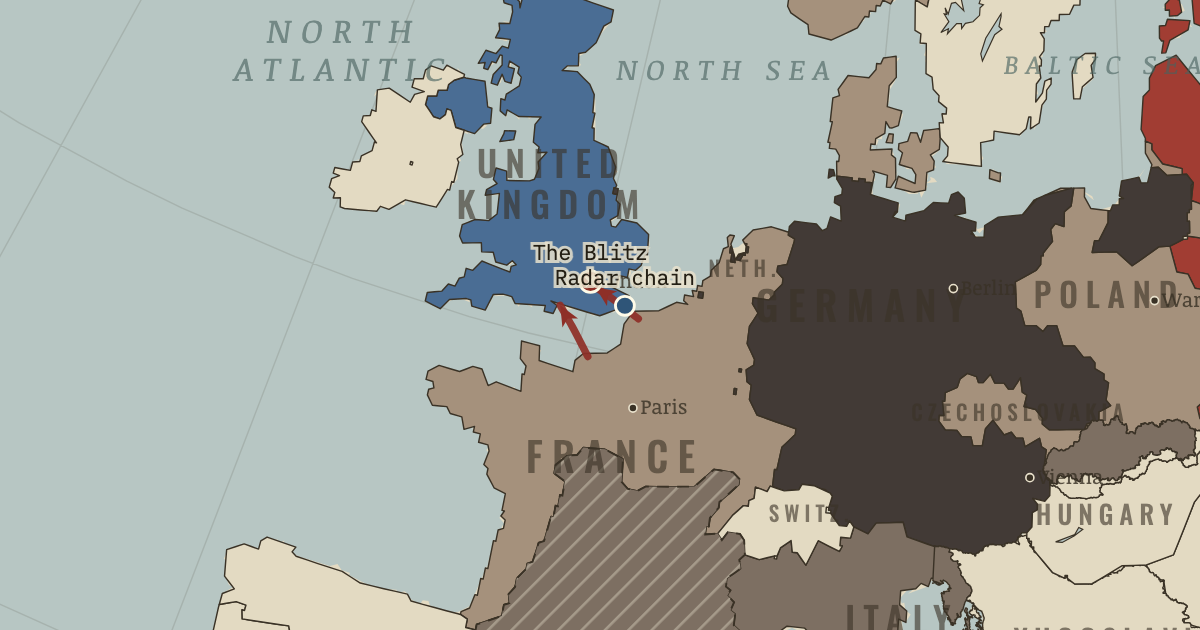
The map above is the world of Europe, June 1940 — France falls.
Every state on the map that year: The world in 1940 · Europe in 1940.
Part of IB History: The Second World War →
SHORT EXPLANATION
France had fallen, but Germany still had to cross the Channel to invade Britain. Its navy had lost warships in Norway, and slow invasion barges would be exposed to the Royal Navy. Germany needed the Luftwaffe to overcome the Royal Air Force first. In the summer of 1940 it attacked Channel shipping, radar stations, and especially Fighter Command’s airfields.
Britain could direct its limited fighters toward raids because radar and ground observers sent reports to control rooms. In early September Germany shifted its main attack to London, partly in reprisal for British raids on Berlin. The airfields gained time to recover, and Hitler postponed the invasion indefinitely on 17 September. London suffered terribly in the bombing that followed, but Britain stayed in the war and preserved a base for the Western Allies’ eventual return to the Continent.
The full story
Operation Sea Lion was Germany’s plan to invade Britain. The Channel made it a formidable undertaking: the German navy had been battered in Norway, and a slow invasion fleet would face the Royal Navy. As long as RAF Fighter Command could operate, German aircraft could not be counted on to protect the crossing. The Luftwaffe therefore set out to destroy the fighters and the facilities that sustained them.
The attacks fell on shipping, radar stations, sector airfields, and aircraft factories. Britain’s answer was an organized system for bringing fighters to the raids. Radar and ground observers supplied reports; control rooms assembled the information and directed squadrons toward the places where they were needed. A small force could be used more effectively when it did not have to patrol everywhere at once.
By early September both sides had suffered heavily, and Britain’s supply of trained pilots was under severe strain. On 7 September the Luftwaffe shifted its main effort to London. Attacks on airfields continued, and historians dispute how close Fighter Command came to defeat. Nevertheless, the change eased sustained pressure on the defensive system when it was vulnerable, allowing damaged airfields time to recover.
London endured heavy bombing in the Blitz. Civilian suffering and destruction did not compel the government to surrender. On 17 September Hitler postponed the invasion; Germany’s first attempt to knock Britain out of the war had failed.
The defenders had advantages beyond the control rooms. A British pilot who survived a crash on home soil could soon return to combat, while a German airman shot down over Britain was usually lost as a prisoner. British factories replaced fighters faster than Germany had expected. The Luftwaffe, meanwhile, lacked a stable target plan and the heavy bombers needed to wear down an entire economy.
Radar did not make interception automatic, and endurance did not make bombing harmless. Britain’s survival depended on information, aircraft, pilots, command, and political resolve holding together, supported by geography and production. It kept a western foothold in the war and a link through which American material aid reached an ally still fighting in Europe.
FULL EXPLANATION
How the defenses worked
A fighter squadron could not be everywhere at once. The Dowding system addressed that problem by joining Chain Home radar, the Observer Corps, telephone networks, filter rooms, sector stations, and the squadrons themselves. Reports were gathered and passed to controllers, who estimated where a raid was heading and sent fighters to meet it. This saved fuel, aircraft, and exhausted pilots who would otherwise have been needed for constant patrols. The connections mattered as much as the individual parts. German intelligence saw components of the defense but did not grasp the network joining them, and attacks rarely concentrated on its critical links. It was not invulnerable: radar reached poorly inland, communications could fail, and sector airfields could be attacked. Yet lost aircraft could be replaced while the surviving information and command network continued to direct the defense. The pilots’ courage mattered within an organization supported by geography and production.
Bombing and the hope of surrender
Strategic bombing aims to change an enemy’s behavior by damaging its capacity to fight, its morale, or both. The Blitz caused serious damage and killed tens of thousands of civilians. British leaders nevertheless chose continued resistance, and indiscriminate attack could strengthen solidarity rather than produce surrender. That outcome did not mean civilians were immune to pressure. Fear, fatigue, evacuation, and unequal access to shelter were real costs. Nor did Germany have the heavy-bomber force needed to sustain an assault on the whole economy while Fighter Command and aircraft production survived. The shift to London also gave damaged airfields time to recover. Later Allied bombing of Germany brought enormous human and industrial costs without the simple collapse prewar theorists had predicted. Air power mattered greatly, but the destruction and suffering it caused did not make terror a reliable means of forcing surrender.
Key places on the map
On this day
Why it happened
The crossing problem. The Royal Navy stood between an invasion fleet and Britain. Germany’s navy had been badly weakened off Norway, so Sea Lion depended on the Luftwaffe gaining control of the air to protect the crossing.
A hoped-for settlement. Hitler had not planned a war with Britain and hoped that a show of force might bring negotiation. As Germany sought a decision, the air campaign developed with shifting target priorities.
A connected defense. Chain Home radar, ground observers, and sector control rooms helped Fighter Command find incoming raids and send fighters to meet them. Attacking aircraft did not by itself disable the network that directed them.
THE TURNING POINT
The defenses hold, 15 September. On “Battle of Britain Day,” 15 September, the Luftwaffe mounted a major effort against London. British fighters met the raids and German losses were heavy; the original account gives a 2:1 loss ratio. Fighter Command remained operational, and two days later Hitler postponed the invasion.
What it changed
A base for return. Britain remained a western base from which the Allies could prepare their return to continental Europe in 1944.
Germany looks east. Hitler saw destroying the Soviet Union as a way to remove a source of British hope, as well as a means of pursuing his ideological aims. Barbarossa planning advanced in autumn 1940 while Britain still refused to yield.
American support grows. Accounts of British resistance and the Blitz reached American audiences and helped shift opinion. Destroyers-for-bases and then Lend-Lease in March 1941 supplied Britain before the United States entered the war. The “arsenal of democracy” was beginning to arm a fight it had not yet joined.
DISCUSSION QUESTION — Why did the shift from airfields to London help Britain continue the war?
Fighter Command stood in the way of invasion. Attacks on its airfields and pilots put the defense under pressure, so directing the main effort toward London gave parts of the system time to recover, even though attacks on airfields continued. The bombing inflicted immense civilian harm without compelling surrender. Historians still dispute how close Fighter Command had come to defeat.
An interesting fact
Fighter Command’s “Few” came from many countries: nearly one in five was not British. Its summer roll included 145 Poles and 88 Czechoslovaks, alongside pilots from a dozen other nations. A handful of Americans had enlisted through Canada while the United States was neutral. No. 303 (Polish) Squadron entered battle on 31 August and became one of its highest-scoring units. Airmen from partitioned Poland helped defend the island from which the Allies would later return to Europe.
Related
THE FREE PRINTABLE STUDY GUIDE
Get the printable study guide for WW2 free. I’ll send you a few short letters, then one when a new atlas opens. That’s all. — Paul
NO TRACKING · YOUR ADDRESS IS USED FOR THE DISPATCH AND NOTHING ELSE · UNSUBSCRIBE ANYTIME