Chinese Revolution · CHAPTER 3 ·
Warlord Era and May Fourth Movement
Chapter 3 of China in Revolution, 1911–1949: “Warlords and May Fourth”
After Yuan’s death in 1916, military cliques ruled China’s regions and fought for Peking, the prize that carried foreign recognition and customs income. In 1919 anger at the Versailles decision on Shandong sparked the May Fourth movement, and in 1921 a tiny Chinese Communist Party formed in Shanghai.
Chapter 3 is included with every paid plan. WW2 is free in full, and chapter 1 of every atlas is free. A free account opens 3 more chapters a day. Starter, at $9 a month, opens all 21 with no daily limit — see the plans.
Free printable Chinese Revolution study guide, sent by email ↓
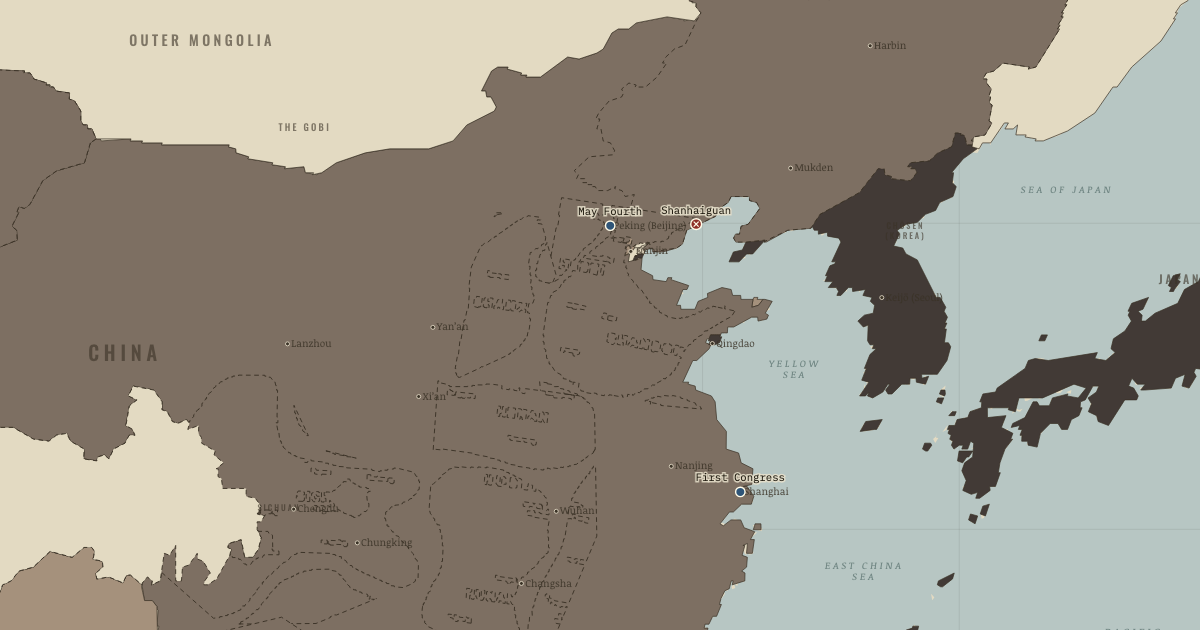
The map above is the world of China, 1923 — The warlord wars — Canton organizes.
Every state on the map that year: The world in 1920 · Europe in 1920.
Part of IB History: China in Revolution →
SHORT EXPLANATION
After Yuan’s death, no government could command China as a whole. Regional military rulers raised revenue through their armies and fought for territory. Peking remained especially valuable: foreign powers recognized its government, and the customs surplus went to whoever controlled it. The provinces paid for a struggle in which control of the republic’s name could be as useful as control of land.
In 1919 the Versailles decision on Shandong brought students into the streets. Their protest grew into a wider challenge to foreign privilege, ineffective government and inherited cultural authority. Vernacular writing, translated ideas and student networks gave the movement a reach beyond the capital. The Chinese Communist Party founded in Shanghai in 1921 was tiny, but its members and many future Nationalist rivals belonged to a generation shaped by May Fourth.
The full story
The grey-tan plates on the map show what happened when Yuan’s central power dissolved. A warlord governed through an army, and that army supplied his income as well as his authority. Zhang Zuolin, a former bandit backed by Japanese patrons, held Manchuria and its arsenals. The Zhili clique controlled the Peking–Tianjin plain. Peking was a prize in itself: foreign governments recognized its rulers, and the customs surplus was paid to them. Holding the capital gave a regional commander the resources and standing of the government of China.
The ✕ at Shanhaiguan marks one of the largest struggles for that prize. Perhaps 450,000 men fought with artillery, aircraft and armored trains; betrayal finally decided the contest. Elsewhere Wu Peifu held the central Yangtze, Yan Xishan ruled Shanxi behind its mountains as a private model kingdom, and Sichuan had wars of its own. Sun Yat-sen’s blue patch at Canton stood apart: he was trying to build a state around a doctrine. Xinjiang and Tibet continued beyond the reach of the Peking government.
The challenge that outlasted the battles began at the ● in Peking. On 4 May 1919 about three thousand students marched against the Versailles settlement’s transfer of rights in Shandong to Japan. Strikes and boycotts spread to some two hundred cities, and merchants discovered that refusing to buy could be a political weapon. For many young people, the settlement raised a larger question: why had China’s government and inherited institutions left the country so vulnerable?
New Culture writers sought answers in a change of language and ideas. They promoted vernacular Chinese in place of classical writing; journals such as New Youth championed “Mr. Science and Mr. Democracy,” and Ibsen and Marx appeared in translation. In 1921 thirteen delegates met in a girls’ school in Shanghai’s French Concession and founded the Chinese Communist Party. One was Mao Zedong, a library assistant from Hunan. The party had about fifty members and no territory visible on the map. The tide chart begins at zero so we can follow how much would change.
FULL EXPLANATION
Was the warlord decade chaos, or an order?
Was China simply without order between 1916 and 1928? Older accounts, and the propaganda of the parties that ended the era, often presented it as pure anarchy. Arthur Waldron and Edward McCord instead describe hierarchies of cliques, conventions governing fighting and defection, and a market in military units. These arrangements did not make the system benign. They help explain how it worked. The Peking republic, for example, retained recognition and customs income that made it worth capturing. Commanders had reasons to preserve that fiction even as they fought over it. A predatory system could therefore persist for twelve years while the provinces paid its costs. A stronger party-army might inherit some of its methods rather than simply abolish military politics.
May Fourth: whose founding is it?
Both rival party-states later claimed May Fourth as an origin. The movement they claimed was wider than either party. Liberal pragmatists around Hu Shi sought gradual cultural reform under “Mr Science and Mr Democracy”; anarchists proposed other paths; a small group looked to the Bolshevik example. These participants shared an urgency about China’s future without agreeing on the answer. Later Communist histories often presented a direct line from the 1919 protests to the party’s founding in 1921, leaving liberals less visible. Did the movement produce the parties, or did powerful parties later adopt it as a respectable ancestor? Vera Schwarcz and others distinguish the genuine enthusiasm of the time from its later appropriation. Both rivals drew on a generation asking what a Chinese person should be, though that generation had argued over the answer.
Key places on the map
On this day
Why it happened
Armies as capital, war as business. An army had to be paid, but it could also make its commander rich. Warlords taxed opium and salt, printed money, and mortgaged railways and mines to foreign lenders. They could enlarge their forces by taking defeated units into service. A rival’s soldiers were therefore assets worth acquiring. This helps explain the defections and indecisive wars: destroying an army could mean destroying something the victor wanted. Commanders could profit from an arrangement that impoverished the provinces supporting it.
The Peking government as prize. The Peking government could no longer command the whole country, yet the office remained valuable. Foreign powers recognized whoever held the capital, and the foreign-run Maritime Customs paid its surplus to that government. A commander who took Peking gained both a treasury and a claim to represent the republic. The Zhili–Fengtian wars of 1922 and 1924 were contests for these rewards. The appearance of one government survived partly because rival commanders wanted to capture it intact.
Versailles radicalizes a generation. China had joined the Allies and sent 140,000 laborers to the Western Front, hoping that Wilson’s promises would help it recover its rights. At Paris its representatives found that Britain and France had secretly conceded Japan’s claim to Shandong in 1917. The Peking government had itself signed loans acknowledging the arrangement. The outcome discredited the West as a model, the treaty system as a remedy, and the government claiming to represent China. Against that disappointment, the Bolshevik offer in 1919–20 to renounce Tsarist privileges in China addressed a powerful grievance.
A cultural crisis under the political one. For many May Fourth thinkers, the treaty exposed a failure deeper than diplomacy. They judged the Confucian family, classical language and examination-trained elite to have failed China in a Darwinian struggle for survival. That judgment was contestable, but it explains the scale of their ambitions. If the inherited culture had left China weak, replacing one ruling clique would not be enough. A party-state, national renewal and class revolution offered different answers to what Chinese society should become; better administration alone could seem too small.
THE TURNING POINT
May Fourth, 1919. The battles changed control of territory, often temporarily. May Fourth changed the political generation that would inherit the struggle. Its student networks and nationalism supplied recruits and legitimacy to both the reorganized Nationalists and the young Communists. Soviet money and organizational models later helped both parties build on that energy. The movement had several possible answers to China’s troubles, even though the two eventual rivals both claimed its legacy.
What it changed
Moscow finds its opening. The Comintern saw Chinese nationalism as a force the small CCP could join. In 1923 Moscow agreed to supply Sun’s Nationalists with arms, money and organizers, while Communists entered the KMT as individuals. Soviet support and Leninist methods shaped both parties. For the moment, the arrangement put future rivals to work in the same alliance.
The warlord system peaks and rots. During the 1924 Zhili–Fengtian war, Feng Yuxiang seized Peking before the campaign was over. His move showed how much depended on loyalties that could change in mid-war. Exhaustion with competing military governments later helped the Northern Expedition; the cliques’ inability to unite against it also made the advance easier.
A party of fifty waits. The CCP remained a junior partner for much of the decade, drawing largely on urban intellectuals while organizing railway and mill workers. Its members suffered a massacre during the 1923 Peking–Hankou railway strike and learned United Front work inside the KMT. None of this gave the party territory on the map. Its later importance would take much longer to become visible there.
DISCUSSION QUESTION — How far was the warlord era a laboratory for China’s state-building as well as an interruption of it?
The case for calling the era an interruption is strong. Armies drained provinces, famine spread, railways were mortgaged and central authority broke apart. Yet regional rulers built as well as consumed: Yan Xishan’s Shanxi and Zhang Zuolin’s Manchuria maintained schools, arsenals and railways. The wars trained officers who would fight later conflicts. The experience also made a disciplined party-army attractive to KMT and CCP leaders who associated political fragmentation with national weakness. Diana Lary and others draw attention to banditry, refugee flows and the militarization of rural life, conditions in which later revolutionaries organized. The constitutional experiment of the republic was weakened while the ground was prepared for authoritarian party-states. The era was a laboratory, but its institutions emerged from destruction and suffering.
An interesting fact
Hu Shi’s 1917 essay in New Youth proposed writing in the vernacular. The change reached schools quickly: within three years the Ministry of Education under the warlord government ordered primary schools to teach it. By the mid-1920s newspapers, fiction and political debate had moved to vernacular writing. Classical Chinese had served as the empire’s written language for roughly two thousand years; it differed greatly from speech and required a difficult literary education. The rapid, peaceful reform transformed the written culture of later party manifestos and village literacy classes.
Related
THE FREE PRINTABLE STUDY GUIDE
Get the printable study guide for China in Revolution free. I’ll send you a few short letters, then one when a new atlas opens. That’s all. — Paul
NO TRACKING · YOUR ADDRESS IS USED FOR THE DISPATCH AND NOTHING ELSE · UNSUBSCRIBE ANYTIME