MAPS OF HISTORY · IB HISTORY · WW2
IB HISTORY · 1936 – 1945 · 15 CHAPTERS
IB History: The Second World War — notes, maps and essay questions
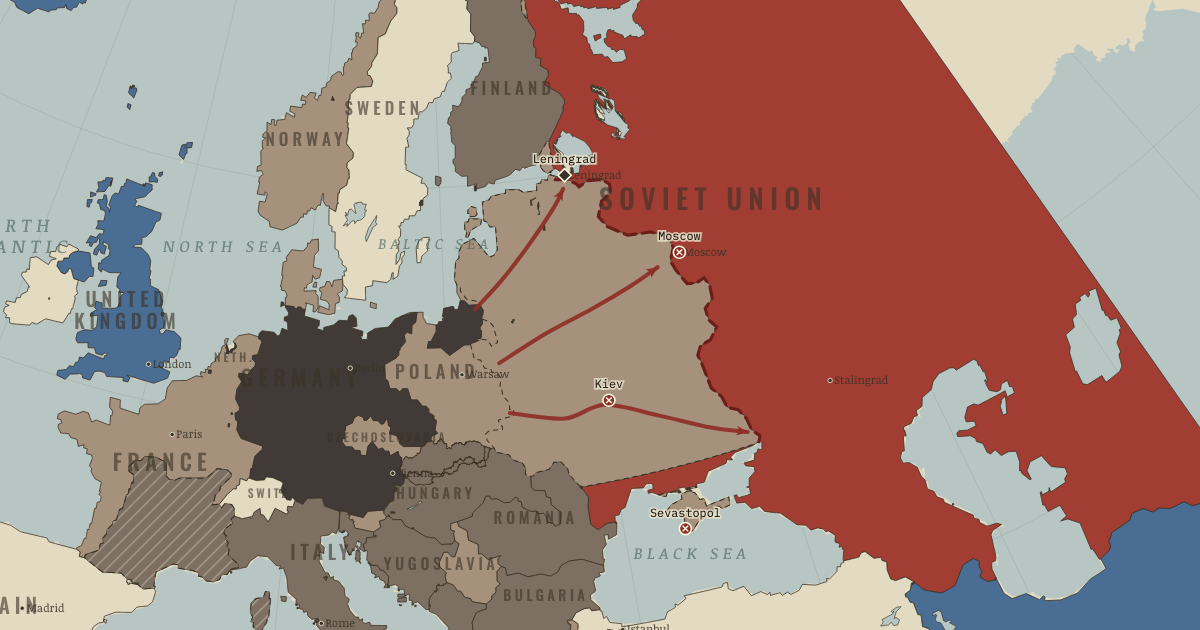
Ten years of war on one living map: fifteen guided chapters across two theaters, twenty-two territorial states, sixty-five battles and memory sites, and a map quiz at the end of it.
IB notes for this atlas are in preparation. Meanwhile, this page gathers the study notes every one of its 15 chapters already carries: why each episode happened, the moment it turned on, what it changed, and the question historians still argue about. It also shows where the atlas fits the IB course.
WW2 is free in full, and chapter 1 of every atlas is free. A free account opens 3 more chapters a day. No sign-up.
Where it fits the course
The atlas is filed under Paper 2 (Conflict) and Paper 3 for Higher Level (Europe and Asia and Oceania). Its IB notes, with evidence lists, primary sources and model essay plans, are in preparation. These are the IB History pages for the parts of the course it serves:
Why it began
The opening chapters offer explanations for how this story began. Their arguments about the causes appear here in a few sentences each, ready to test against your own reading.
Chapter 1: The Gathering Storm
Versailles and Nazi revisionism. Germany lost territory and military strength under the 1919 settlement. The Nazis used resentment of those terms to build support for expansion, falsely describing each breach as a limited correction.
Depression and political weakness. Economic crisis damaged moderate parties and helped the Nazis come to power. It also put pressure on British and French military spending, while making support for another major war harder to secure.
Memory of 1914–18. Voters and leaders remembered the mass slaughter of 1914–18. Postponing another war seemed worth taking risks, especially when more time could help their countries rearm.
Failed collective security. The League of Nations failed to enforce its responses to Japan in Manchuria and Italy in Abyssinia. Those failures showed how an aggressor could act while other states struggled to agree on enforcement.
Chapter 2: The Pact and the Partition of Poland
Soviet distrust after Munich. Munich had excluded the Soviet Union. Stalin doubted that Britain and France would make an effective anti-German alliance, whereas a deal with Germany offered time, territory, and distance from a future front.
Hitler avoids two fronts. A neutral Soviet Union left Hitler free to attack Poland without an immediate war on two fronts and opened the way to Soviet trade. He expected Britain and France either to yield again or to fight without decisive effect.
Danzig as pretext. Demands over Danzig and the Polish Corridor provided Hitler with a public pretext. His larger purpose was Lebensraum, or living space, and the destruction of independent Poland.
Chapter 3: Blitzkrieg in the West
Concentrating the armor. France had many capable tanks and assigned much of its armor to infantry support. Germany brought tanks and other arms together in formations coordinated by radio, allowing force to be concentrated at a breakthrough.
Risk through the Ardennes. The revised German plan sent its main weight along a route the Allies thought unsuitable for a large, rapid armored advance. That choice offered surprise, but crowded columns on narrow roads were exposed.
Norway’s gain and cost. Norway protected Swedish ore shipments and offered Atlantic bases. The warships Germany lost there were unavailable to cover a later invasion of Britain.
Chapter by chapter
These entries trace the atlas through 15 chapters, identifying the causes and turning point of each. Select a title to open its free chapter page, where the full explanation, a discussion question and the map appear together.
1. The Gathering Storm
CHAPTER 1 · 1936–1938
Why it happened: Versailles and Nazi revisionism · Depression and political weakness · Memory of 1914–18 · Failed collective security
The turning point: Munich, 30 September 1938.
2. The Pact and the Partition of Poland
CHAPTER 2 · AUG–OCT 1939
Why it happened: Soviet distrust after Munich · Hitler avoids two fronts · Danzig as pretext
The turning point: First shots, 1 September, 04:47.
3. Blitzkrieg in the West
CHAPTER 3 · APR–JUN 1940
Why it happened: Concentrating the armor · Risk through the Ardennes · Norway’s gain and cost
The turning point: The crossing at Sedan, 13–15 May.
4. The Battle of Britain
CHAPTER 4 · JUL–OCT 1940
Why it happened: The crossing problem · A hoped-for settlement · A connected defense
The turning point: The defenses hold, 15 September.
5. Mussolini’s Parallel War
CHAPTER 5 · OCT 1940–JUN 1941
Why it happened: Prestige and war · Britain’s route through Suez · The Belgrade coup
The turning point: Crete: victory at a price.
6. Barbarossa: The War of Annihilation
CHAPTER 6 · JUN–DEC 1941
Why it happened: Ideology: Lebensraum and the “Jewish-Bolshevik” enemy · “Kick in the door and the whole rotten structure comes down” · Britain’s last hope
The turning point: The gates of Moscow, 5 December.
7. Rising Sun: From China to Pearl Harbor
CHAPTER 7 · 1937–MAY 1942
Why it happened: An empire built on imported oil · The China quagmire · Khalkhin Gol turns Japan south · The knockout-blow theory
The turning point: Pearl Harbor, 7 December 1941.
8. Midway: Intelligence, Risk, and a Turning Point
CHAPTER 8 · APR–JUN 1942
Why it happened: The Doolittle Raid · Reading the target · A dispersed operation
The turning point: The carrier strikes, 4 June 1942.
9. The Hinge: Stalingrad and El Alamein
CHAPTER 9 · JUL 1942–FEB 1943
Why it happened: Oil and the Volga · The city and its name · Supplies across the sea
The turning point: Operation Uranus, 19–23 November.
10. Kursk, and the Fall of Fascist Italy
CHAPTER 10 · JUL–DEC 1943
Why it happened: A victory after defeat · Warning and preparation · The Mediterranean compromise
The turning point: Prokhorovka and the halt order, 12–13 July.
11. The Island Road
CHAPTER 11 · AUG 1942–OCT 1944
Why it happened: Distance and supply · Two routes across the Pacific · The submarine campaign
The turning point: Guadalcanal, August 1942–February 1943.
12. Overlord and Bagration: Germany pressed from both sides
CHAPTER 12 · JUN–AUG 1944
Why it happened: Preparing the crossing · Fortitude and Calais · An allied timetable
The turning point: Omaha Beach, 6 June.
13. Closing the Ring
CHAPTER 13 · DEC 1944–MAY 1945
Why it happened: Unconditional surrender and terror · Hitler’s hope for a split · Yalta and the peace
The turning point: Berlin, 16 April–2 May.
14. The Downfall of Imperial Japan
CHAPTER 14 · FEB–SEP 1945
Why it happened: A government of two minds · Unconditional surrender and the Emperor · The bomb’s momentum
The turning point: Hiroshima, 08:15, 6 August.
15. The World the War Made
EPILOGUE · 1945 AND AFTER
Why it happened: Armies and the peace · Security through buffer · The productivity superpower
The turning point: The handshake that became a border.
Essay questions, argued
Historians still debate the question at the end of each chapter. Before reading our brief answer, try making a plan for how you would answer it.
DISCUSSION QUESTION · CHAPTER 1
Britain and France could probably have stopped Hitler cheaply in 1936–38. Why didn’t they?
Stopping Hitler meant accepting the possibility of another mass war. Leaders faced economic pressure, divided opinion, and forces that needed more preparation; delay did give them useful time to rearm. They also treated his demands as disputes over particular borders. Hitler saw concessions as steps toward a larger racial empire, so the bargain they hoped would settle the dispute encouraged further demands.
The chapter behind it: The Gathering Storm. Every chapter’s question is on the discussion questions page.
DISCUSSION QUESTION · CHAPTER 6
Why did predictions of a swift Soviet collapse prove wrong?
Observers saw the Soviet armies’ early defeats and expected the same losses to continue until the state collapsed. They underestimated its ability to replace those armies. Strategic depth gave it time to evacuate factories and mobilize, while coercion, patriotism and resistance to Nazi rule sustained the effort. German supplies could not maintain the same tempo across the distances involved. The battlefield losses concealed the capacity the Soviet state still possessed.
The chapter behind it: Barbarossa: The War of Annihilation. Every chapter’s question is on the discussion questions page.
DISCUSSION QUESTION · CHAPTER 11
Why isolate a fortress such as Rabaul, with its roughly 100,000-man garrison, instead of assaulting it?
The roughly 100,000 men at Rabaul could not make their strength count against the advance once Allied air and sea power suppressed their aircraft and cut supply, movement and communications. Assaulting them would risk heavy casualties for a position the Allies could leave behind. The comparison with Stalingrad is structural: a strongpoint depends on the system supporting it.
The chapter behind it: The Island Road. Every chapter’s question is on the discussion questions page.
DISCUSSION QUESTION · CHAPTER 15
Was the Second World War “one war”? Argue both sides using what you’ve seen on this map.
The case for separate wars begins with their different origins: the conflicts in China and Poland, Barbarossa and the Pacific war started at different times, involved different actors and had different aims. By December 1941, however, alliances, production, shipping and strategy connected the theaters. Lend-Lease and coordinated offensives made outcomes in one theater matter to others. Several conflicts had merged into one global system.
The chapter behind it: The World the War Made. Every chapter’s question is on the discussion questions page.
What it changed
Consequence questions need the end of the story. The final chapter, The World the War Made, sets out what the period left behind:
The long peace — under a mushroom cloud. Since 1945 there has been no direct great-power war. Historians debate how much deterrence, exhaustion, institutions and luck contributed to that peace. Its limits become clear when we look beyond the great powers’ direct relations. Wars continued in the decolonizing world, including Korea, Vietnam and Angola, where outside powers supported opposing sides. A peace between powerful states could coexist with devastating fighting elsewhere.
Never again — the unfinished project. The catastrophe of 1939–45 helped produce human-rights law, refugee conventions and efforts to prevent genocide. Those commitments established reasons to act, but they did not ensure action when people were threatened. Atrocities in Cambodia, Rwanda and Bosnia tested them, and prevention often failed. The record leaves a question about what governments and others will do when warnings come.
Revision tools
The atlas ends with a map quiz that asks you to find places and moments on the map itself (free in WW2). The quick quiz and the discussion questions with our answers are free pages on this site, and the printable study guide gathers every chapter’s notes into one document for revision.
Read next
- The road to war, 1931–1941 · THE ROAD TO WAR
- The Cold War that followed · THE COLD WAR
Maps of History is independent and is not affiliated with or endorsed by the International Baccalaureate Organization. IB course names describe alignment only; paper, theme and section names follow the new course outline and may change when the final guide is published.
THE DISPATCH
Get the printable study guide for WW2 free. I’ll send you a few short letters, then one when a new atlas opens. That’s all. — Paul
NO TRACKING · YOUR ADDRESS IS USED FOR THE DISPATCH AND NOTHING ELSE · UNSUBSCRIBE ANYTIME